Keith Robinson, back where he belongs

TwelfthNight2

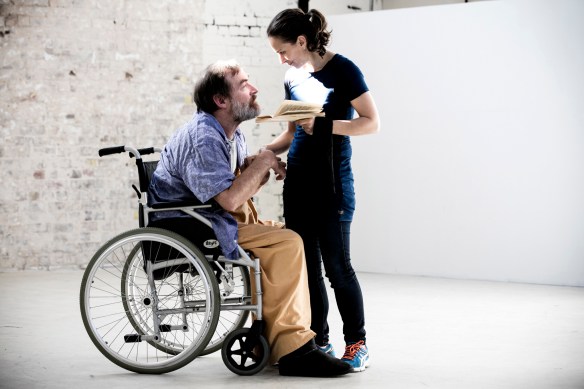
Keith Robinson and Lucia Mastrantone rehearse Twelfth Night for Belvoir. Photo: Brett Boardman

In 2006, Keith Robinson went from being a fit, active young man to suddenly being unable to walk.

The highly regarded, busy actor, known for his comedy skills, was diagnosed with a variant of Guillain-Barre Syndrome, a rapid-onset condition causing extreme muscular weakness, and was in hospital and rehabilitation for five-and-a-half months.

“I went from running around the block to not be able to walk in a three-week period. There was no sense of being unwell or sick, it was just like it was happening to somebody else. My whole body muscularly just powered down to nothing virtually. But then I regained some strength to where I’m wheelchair bound but I can take care of myself, sort of,” says Robinson.

A decade on, he is back on stage for the first time since his diagnosis, playing the clown Feste in a Belvoir production of Shakespeare’s Twelfth Night, directed by the company’s artistic director Eamon Flack.

Robinson has performed in many Belvoir productions over the years. In the early 1990s he was part of the Company B ensemble and appeared in landmark productions including Hamlet with Richard Roxburgh, Geoffrey Rush and Cate Blanchett in 1994 and The Tempest with Blanchett and John Bell in 1995.

His other credits include the original Australian production of Les Miserables and Nicholas Nickleby for Sydney Theatre Company. He also co-wrote The Popular Mechanicals with Tony Taylor, a wonderfully mad comedy inspired by Bottom and co in Shakespeare’s A Midsummer Night’s Dream, which premiered at Belvoir directed by Rush.

Returning to the stage is “wonderful”, says Robinson during a break in rehearsals.

“For better or worse I actually identified myself almost entirely through my work so when that was taken away it’s like my whole life was just ripped away from me.

“This was the first (acting) offer I’ve had and it came out of the blue. At the end of last year my agent Sue Barnett was calling me. I thought she was ringing to say ‘let’s have a coffee’ but she said, ‘no, I am actually ringing as your agent.’ All those synapses and nerves just sparked back into life: a job!” says Robinson with a laugh, admitting he now hopes others will follow.

Robinson says he doesn’t know why Flack decided to offer him the role. “That may be a question for the final night at the bar: ‘so, how did it happen?’” he says grinning.

“There seems to be a society-wide sea-change in terms of diversity in all sorts of areas and certainly in the theatre in terms of gender blind casting, ethnicity blind casting and now mobility/ability blind casting. To my knowledge this is the first time that one of the main (Australian) theatre companies has cast like this where the character isn’t in a wheelchair but the actor is. So I take my hat off to Belvoir,” says Robinson.

Chatting in the rehearsal room, where a special ramp has been built leading up onto the stage area and where there are several wheelchairs behind a wall on the set, Robinson admits that having excitedly accepted the offer to perform in Twelfth Night, he then had second thoughts.

Feste has several melancholic songs in the play – with Alan John composing the score for Flack’s production – and Robinson was worried that he wouldn’t be able to handle them.

“To be honest with you, I actually said ‘yes’ and then got cold feet and pulled out and said, ‘no, this is beyond my technical and physical capability’ because one of the things that happened to me is that I lost all my abdominal muscles, all my intercostals, all my breath support, diaphragm muscles. I just felt that the songs that Feste has were an essential part of the character and I felt, ‘I can’t do them,’” he says.

“I met with Eamon one more time and he literally batted away all the negative feelings that I brought to the table and he said, ‘we’ll deal with it, we’ll deal with it.’ And I felt, ‘well if you are willing, who am I to say no?’ So we are finding theatrical ways to render the songs that might not be expected.”

Working with Flack has been “fantastic”, says Robinson. “I wanted to be in a rehearsal room with Eamon (because) his ethos and aesthetics seemed to be like-minded to mine and a lot of the fun you have (on a show) is in that initial rehearsal period where you are delving into the piece and exploring it, and I liked his mind.

“I was so thrilled when he got the artistic directorship of Belvoir. Having seen his productions of The Glass Menagerie and Angels in America, I felt there was nobody better suited to the Belvoir company. I think he is in so many ways the natural successor to the company that it had been in the past. He will take it into new territory but not in a divorced way from what has gone before.”

Twelfth Night plays Belvoir St Theatre until September 4. Book: www.belvoir.com.au or 02 9699 3444

 A version of this story ran in the Sunday Telegraph on Sunday July 24
You’re a Good Man, Charlie Brown

Hayes Theatre Co, July 6

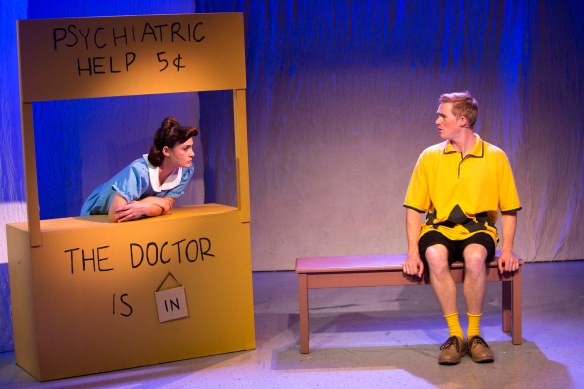
9 You're a good man Charlie Brown_5-7-16_Noni Carroll

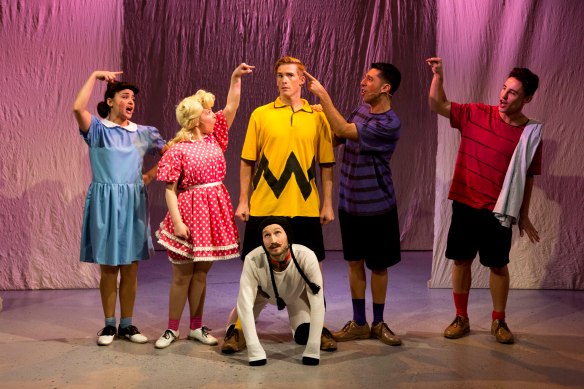
Sheridan Harbridge, Laura Murphy, Mike Whalley, Andy Dexterity, Nat Jobe and Ben Gerrard. Photo: Noni Carroll

First staged off-Broadway in 1967, You’re a Good Man, Charlie Brown is based on Charles M. Schulz’s legendary, long-running comic strip Peanuts with its group of anxious children and their beagle Snoopy, whose imaginary life includes being a World War I flying ace.

The musical comedy charts a day in the life of Charlie Brown told through a series of vignettes with catchy songs by Clark Gesner and Andrew Lippa (brought to perky life by musical director Michael Tyack and his four-piece band).

In keeping with the simplicity of Schulz’s drawings, Georgia Hopkins has designed a minimal set consisting of several drapes and a few set pieces including Schroeder’s piano, Snoopy’s kennel and a bench, while her costumes are instantly recognisable. Hugh Hamilton’s lighting brings plenty of colour to the simple staging.

Deftly directed by Shaun Rennie, the production boasts a cast of gifted comic actors who capture the wry, bittersweet humour of the piece so that it is charming but not too cutesy.

Interestingly, the York Theater Company experimented with a production, that ran off-Broadway in June, featuring relatively young children who had professional stage experience, some of them on Broadway. It led the New York Times to conclude that “this is a more demanding musical than you might remember” and that “there is a fair amount of complexity in these seemingly simple characters, which is why Charlie Brown is best when performed by adults, or at least by high school students.”

The adults in this Hayes Theatre Co production certainly find the emotional nuances in the characters.

116 You're a good man Charlie Brown_5-7-16_Noni Carroll

Sheridan Harbridge and Mike Whalley. Photo: Noni Carroll

At the heart of the show, Mike Whalley may not have the strongest singing voice but he is endearing as the lovable loser Charlie Brown. At times you want to hug him but his Charlie is no sad sack. Along with his loneliness and awkwardness, Whalley conveys Charlie’s resilient hope and droll self-awareness.

Sheridan Harbridge is hilarious as the forceful, super-crabby Lucy. Laura Murphy brings just the right heightened energy to Charlie’s indignant, stroppy younger sister Sally and her song My New Philosophy is a musical highlight.

Ben Gerrard as the smart, lisping, blanket-carrying Linus and Nat Jobe as the Beethoven-loving Schroeder are also spot on. Andy Dexterity (who does a terrific job as choreographer) stepped in late as Snoopy and does a commendable job though he still has more to find in his two big numbers.

Unfolding in a similar vein throughout, there are no great dramatic surprises but the musical is funny and gently touching. Children will find it accessible but the stronger appeal is the sense of nostalgia for adults looking back on childhood.

You’re a Good Man, Charlie Brown runs at the Hayes Theatre Co until July 30. Bookings: www.hayestheatre.com.au or 02 8065 7337

 A version of this review ran in the Sunday Telegraph on July 9

Singin’ in the Rain

Lyric Theatre, July 9

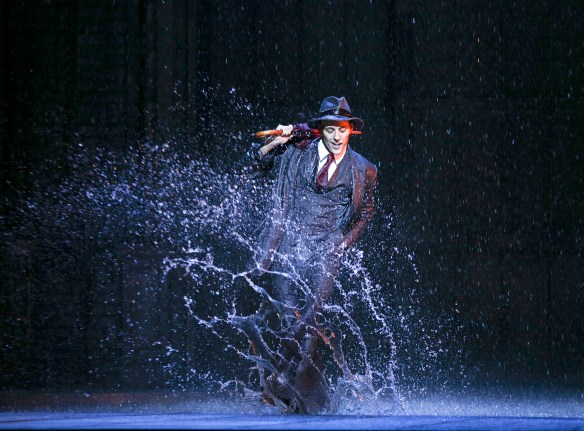
Rain1

Grant Almirall as Don Lockwood singin’ and dancin’ in the rain. Photo: Hagen Hopkins.

Based on the beloved 1952 MGM movie, this production of the musical Singin’ in the Rain is largely faithful to the film. You get what you expect but without the excitement of a truly inventive, reimagined staging.

However, there’s no denying the thrill of the joyous, splashy Singin’ in the Rain sequences at the end of Act I and the finale, which take place in heavy showers (12,000 litres of water apparently), dousing people in the front few rows of the stalls (ponchos provided) and sending the audience out on a high.

Directed by Jonathan Church, who left Sydney Theatre Company in May just months after being appointed artistic director, the production originated at the UK’s Chichester Festival in 2011 then transferred to the West End.

Act I is slow to fire. Apparently Church was given little freedom to rework the original screenplay. Simon Higlett’s set is also partly to blame. Set in Hollywood in the late 1920s as the talkies were about to revolutionise the industry, it’s a clever idea to set the show on a Hollywood soundstage. However, the grey walls make for a drab setting that frequently leeches energy despite coloured back lighting (Tim Mitchell) and attractive costuming. It’s not such an issue in Act II where rainbow hues and illuminated signs brighten the stage for the Broadway Ballet.

The black and white footage of the talkie that they are making, shown on a giant screen, is brilliantly done and extremely funny (video design by Ian William Galloway).

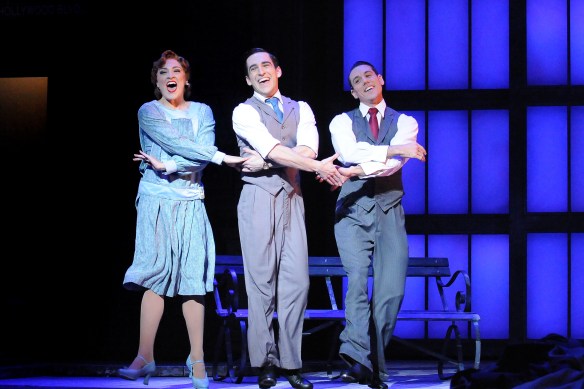
Andrew Wright had more leeway to change the choreography, which is always lively and sometimes thrilling as in the tap routines for Moses Supposes and Good Morning, though we miss some of the famous tricks (like the backflip off the wall) in Make ‘Em Laugh.

Rain6Trio

Gretel Scarlett, Jack Chambers and Grant Almirall in Good Morning. Photo: Lindsay Kearney

The iconic pas de deux between Cyd Charisse and Gene Kelly in the film has been replaced by the girl (a wonderful Nadia Coote with gorgeous leg extensions) partnered by the male ensemble and is beautifully danced (the ensemble dancing is sharp throughout) though it doesn’t have quite the same impact as that gorgeous, sexy duet.

Replacing the injured Adam Garcia as Hollywood heartthrob Don Lockwood, South African performer Grant Almirall is a strong dancer, sings well and understands the period style but he doesn’t exude huge charisma.

As aspiring actor and Don’s love interest, Kathy Selden, Gretel Scarlett dances up a storm, sings sweetly and conveys a warm sincerity in a winning performance. Erika Heynatz is a hoot as Don’s shrill, manipulative co-star Lina Lamont. She does a great job of sustaining Lina’s screechy voice and strangled accent, while the scene in which she tries to act in her first talkie is a comic highlight.

As Don’s sidekick Cosmo Brown, the elastic-limbed Jack Chambers dances superbly and lands the cheesy, vaudevillian shtick, while Rodney Dobson has just the right comic energy as film director Roscoe Dexter.

The 14-piece band, perched high above the stage, is impressive under musical director Adrian Kirk.

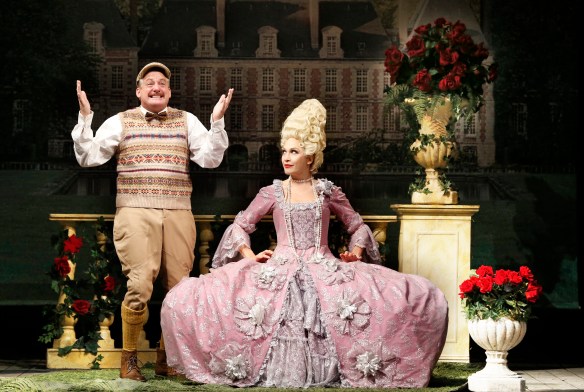
Rain5ErikaDobbo

Rodney Dobson and Erika Heynatz. Photo: Jeff Busby

Overall, it’s a polished production with plenty to enjoy. But apart from the stunning rain routines, it just lacks that special something that makes a good production great.

Singin’ in the Rain plays at the Lyric Theatre until September 4. Bookings: www.ticketmaster.com.au

 A version of this review ran in the Sunday Telegraph on July 10