
Spring Awakening

ATYP Studio 1, The Wharf, April 29
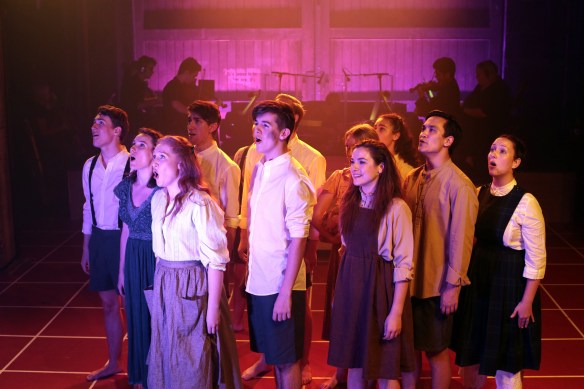
SpringA3

The cast of Spring Awakening. Photo: Tracey Schramm

When you cast convincingly young performers in a musical about teenagers, the trade-off is the relative inexperience of the cast – one of the reasons Squabbalogic’s recent production of The Original Grease struggled to really take off.

But under the guiding hand of director Mitchell Butel, the raw, youthful energy that his young cast brings to this ATYP production of the musical Spring Awakening outweighs any lack of experience, making for an altogether more satisfying production than the one staged by Sydney Theatre Company in 2010.

With book and lyrics by Steven Sater and music by Duncan Sheik, Spring Awakening is based on the controversial 1891 play of the same name by German playwright Frank Wedekind. After premiering off-Broadway in 2006, it transferred to Broadway where it won eight Tony Awards including Best Musical.

The musical retains the 19th century setting but uses a contemporary indie rock score that moves from wistful, melodic ballads to punky anthems like The Bitch of Living and Totally F**ked. Set in a repressive world where parents, teachers and other authority figures consider any talk of sex disgusting, the curious, hormonal, angst-ridden teenagers are wilfully kept in ignorance of the facts of life – with tragic results. In such a society, parents are so concerned with what others think that they are prepared to sacrifice their children’s welfare for the sake of appearances.

Spring Awakening goes to dark places including sexual and domestic abuse, abortion, self-harm and suicide.

Though things have certainly progressed since Wedekind’s day, the recent debate surrounding the “Safe Schools” initiative to broaden sexual education shows how much conservatism still persists today. At the very top of the show, Butel brings the cast onto stage accessing social media mobile phones as a nod in this direction, but from there the production sticks to the period.

The musical focusses primarily on three teenagers: the intelligent, confident, rebellious Melchior (James Raggatt), the naïve, inquisitive Wendla (Jessica Rookeward), and the troubled misfit Moritz (Josh McElroy) who is tortured by wet dreams and a fear of failure at school, particularly given his cold, bullying father. Around them, cameo stories of other school friends amplify the world of the play.
SpringA2

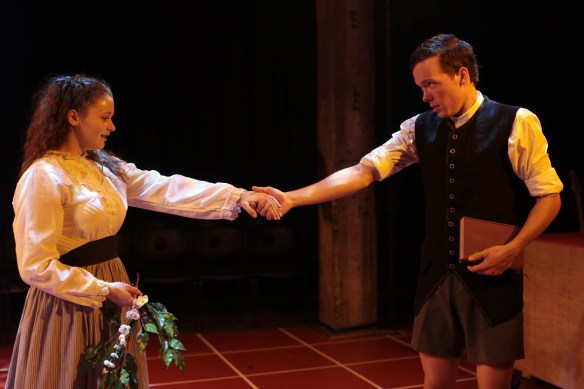
Jessica Rookeward as Wendla and James Raggatt as Melchior. Photo: Tracey Schramm

This is only the second musical Butel has directed, following his award-winning production of Violet for the Hayes Theatre Co and Blue Saint Productions last year, and once again he proves to have a sure and sensitive touch, drawing heartfelt, affecting performances from his young cast. The singing is a bit uneven but despite this the production is very powerful. It rocks when it needs to and also lands the quieter, emotional moments.

Staged on a simple set designed by Simon Greer, with a grid floor, a few square stools, and the band on a platform at the back, Butel uses the space brilliantly, keeping the focus sharp and true in scenes featuring just a few characters. For the ensemble numbers, he has the cast surge onto stage and perform with a furious energy that explodes in the intimate space.

The way the production moves between the two is handled with a keen sense of rhythm, supported by Amy Campbell’s inventive, punchy choreography. Greer’s costuming is excellent, as is the moody lighting by Damien Cooper and Ross Graham and Lucy Bermingham’s tight musical direction.

Raggatt’s Melchior (the charismatic boy all the girls fancy and to whom Moritz turns) is less an obviously dashing figure and more a smart, mature character who initially appears far more able to survive than his classmates. It’s a strong performance, and Raggatt (a recent NIDA graduate) plumbs the tragedy of Melchior’s downfall and heartbreak.

As Wendla, Rookeward convincingly portrays a girl on the cusp of womanhood, aware of her changing body but still genuinely naïve, and she sings with a lovely, clear voice.

McElroy gives a compelling, intuitive performance as Moritz, which seems to pour untrammelled straight from his gut and heart; one that keeps you transfixed whenever he is on stage. Alex Malone’s Ilse combines youthfulness with a quiet maturity beyond her years, while Patrick Diggins is unsettlingly funny as the cocky, gay Hanschen, played here like a forerunner to the Hitler Youth. Richard Sydenham and Thomasin Litchfield take on all the adult figures, most of them grim.

All in all, though there are times when you are aware that this is youth theatre, Butel has worked wonders with his young cast, helming a production that really rocks and at the same time moves you with the authenticity of its raw emotion.

Spring Awakening plays at the ATYP Studio, The Wharf until May 14. Evenings are sold out but there are tickets available for mid-week matinees. Bookings: http://www.atyp.com.au
The Detective’s Handbook

Hayes Theatre Co, April 27

Detectives_ProductionPhotos-87

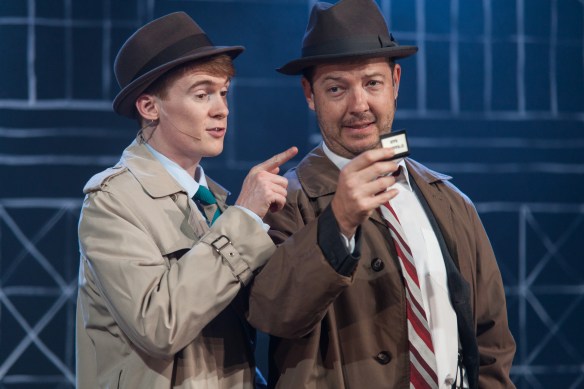
Rob Johnson and Justin Smith. Photo: Clare Hawley

Writing a new musical is a massive undertaking, generally requiring a huge investment of time and money. Australian musicals with an original score are pretty thin on the ground and so in 2010 the New Musicals Australia (NMA) program was established to address this.

During a two-year period, 13 new works went through various stages of development under NMA. In 2015, the Hayes Theatre Co – hub for some of the most exciting musical theatre in Sydney at the moment – took over the initiative, with funding from the Australia Council.

From 60 submissions, eight musicals were selected for “snapshot presentations”. From these, one was chosen for further development via workshops with industry mentors, leading to a full production.

The Detective’s Handbook is the first musical from the scheme to be produced at the Hayes. It’s a fun show and though it may not be the next great Australian musical – in its current form, anyway – it does herald the arrival of an exciting young writing team with plenty of talent.

With book and lyrics by 26-year old Ian Ferrington and music by 22-year Olga Solar, who recently graduated from the Sydney Conservatorium, The Detective’s Handbook pays loving homage to the detective novel and film noir.

Set in 1950s Chicago, Frank Thompson (Justin Smith), a hard-boiled, hard-drinking detective, is called into the station one Sunday morning to investigate the murder of two cops in a factory on the seedy side of town. To his irritation, he is paired with Jimmy Hartman, a church-going rookie who likes to do things by the book – The Detective’s Handbook that is, in two volumes. With only a matchbox for a clue, they begin their investigation encountering the inevitable femme fatales along the way.

What differentiates The Detective’s Handbook is that some of the lyrics are rapped over a jazz score. Ferrington certainly has a punchy way with words and his book and lyrics are full of puns, one-liners and some brilliantly clever internal rhyming structures. Even if it’s not always laugh-out-loud funny, it’s inventive and immensely enjoyable. The rapping style is primarily given to the cynical Frank, while the bright-eyed Jimmy gets to sing in a more melodic musical theatre style.

Solar’s jazzy score is also very clever, with a sound that nods to the period but also feel modern, with references ranging from Scott Joplin to Sondheim. The intricate underscoring and the lively melodies are attractive even if none of the songs are wildly memorable – on one listening anyway. A number about femme fatales sung by Sheridan Harbridge is the most obvious crowd-pleaser.

So, musically and lyrically, there is much to enjoy about the show. But, given that the tropes of the genre are so well known, the plot could do with some thickening and a more surprising twist, while the characters could be developed more. Though it only runs 80 minutes without interval, two-thirds of the way through, it feels as if the show is losing steam, despite some terrific performances.

Produced by Neil Gooding, the Hayes has done the show proud.  After a slightly slow start, Jonathan Biggins keeps things rollicking along. James Browne’s flexible black and white set works well both in practical terms and as a nod to film noir and the chalk outlining of dead bodies, while his costuming adds colour and underpins character types. Sian James-Holland’s lighting plays with noirish shadows most effectively.

Smith and Johnson complement each other well as the ‘odd couple’ cops. Smith exudes just the right amount of crumpled, jaded cynicism and handles the rap rhythms with a natural, easy confidence, while Johnson’s naïve, puppy dog eagerness is pitched to perfection.

Detectives_ProductionPhotos-60

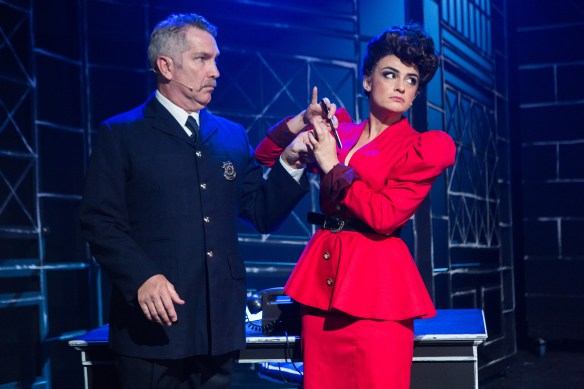
Tony Cogin and Sheridan Harbridge. Photo: Clare Hawley

Harbridge is sensational as three women all called Maria: the sexy, efficient secretary to the Chief of Police, a helpful café owner, and a rather formidable mortician. Her quick changes between the three characters are skilfully handled – hilariously so at the end when two of them are in the same scene.

Lara Mulcahy is very funny as yet another Maria, who owns a Polish delicatessen and runs a matchmaking service on the side, and paired with Christopher Horsey as a couple of cheery, dim-witted cops.

Horsey, who is also the choreographer, has overseen an amusing number in which he and Mulcahy move from typewriting to tap dancing, though a later tap routine feels like filler. Tony Cogin completes the well-chosen cast as the ineffectual Irish Chief of Police.

Musical director Michael Tyack leads a fine jazz quartet and sound designer Jeremy Silver balances the amplification well.

Currently The Detective’s Handbook feels slight but is still lots of fun. Most importantly, it shines a light on two very talented writers in Ferrington and Solar, giving them an opportunity to develop the show and their skill base with the likes of Biggins, Tyack, musical consultant Phil Scott and dramaturg Christie Evangelisto.

The chance for them to see The Detective’s Handbook up and running in front of an audience is invaluable experience and will hopefully encourage them to write another musical.

The Detective’s Handbook plays at the Hayes Theatre Co until May 7. Bookings: www.hayestheatre.com.au or 02 8065 7337