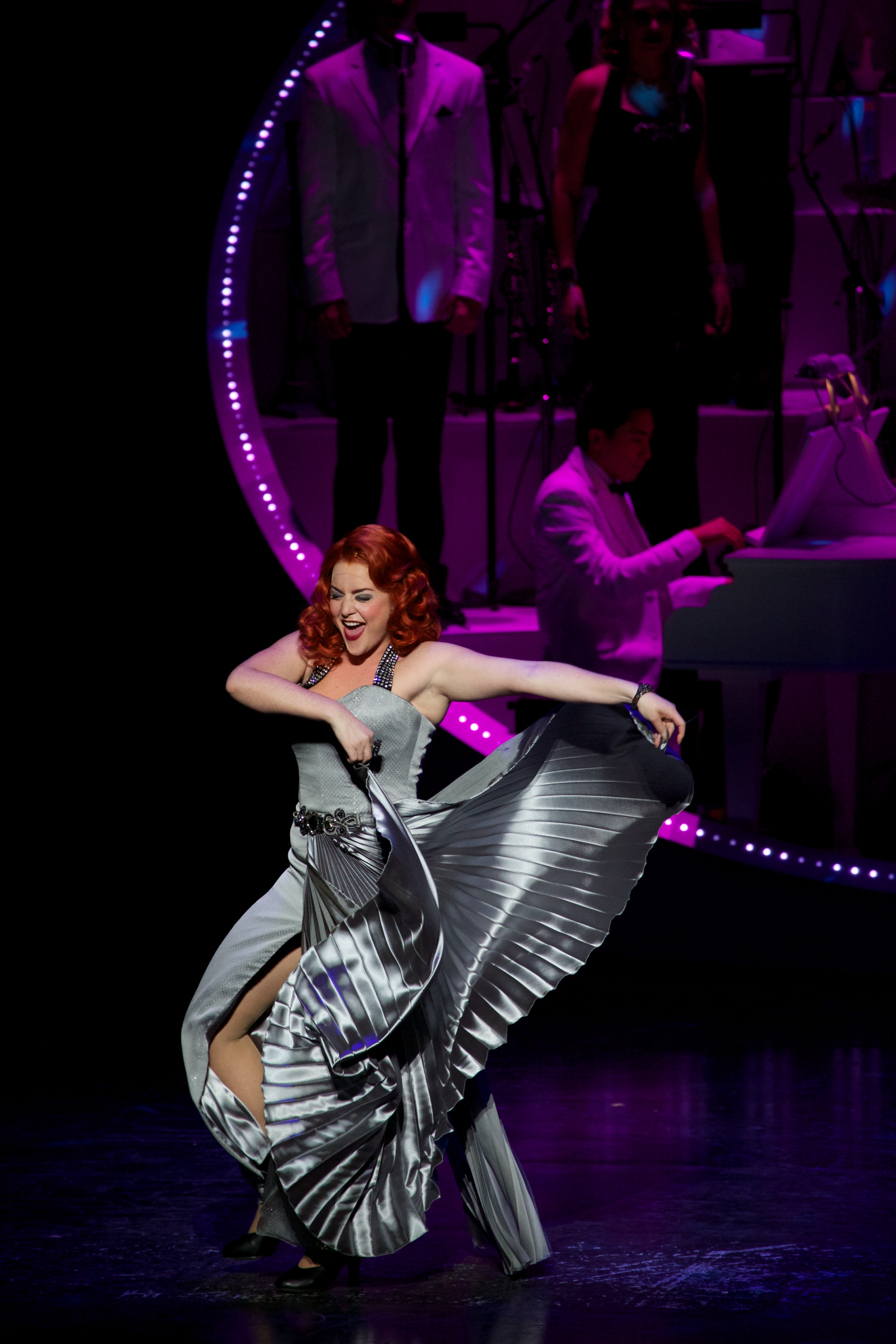
Todd McKenney’s Centre Stage Tours: interview

Todd McKenney

Todd McKenney

Todd McKenney is used to being centre stage. Now the musical theatre performer who has starred in shows including The Boy From Oz, Priscilla, Queen of the Desert – the Musical, Crazy for You and Annie among many others, is organising a series of personally guided theatre tours, which will give others the chance to join him there – if only after the curtain has fallen.

Todd McKenney’s Centre Stage Tours will kick off during the Sydney leg of the forthcoming tour of Grease – in which he plays Teen Angel – when he will take people backstage after the show, ending up on stage for photographs with himself and other cast members.

He is also opening up his beautiful, spacious home on Sydney’s Upper North Shore for high tea soirées at which guests will wander his lovely garden then gather around his piano for a relaxed private performance.

The first soirée on August 4, at which he will perform with Nancye Hayes and Chloe Dallimore, sold out within a matter of hours after he chatted about it on radio with Alan Jones. However, there are still some tickets available for his first theatre tours. Some of the proceeds from the tours will go to the Children’s Cancer Institute Australia.

The idea began during a conversation with his friends Julie and Chris Walker, co-owners of several Sydney restaurants including Berta in Surry Hills.

“They said, ‘have you ever thought of taking groups to Broadway and the West End?’” recalls McKenney. “I thought about it more and more and said to Julie, ‘why don’t you run it with me?’ So we looked at putting it together and decided to start closer to home where we have the contacts.”

John Frost, the producer of Grease, and the Lyric Theatre, where the show is playing in Sydney, both loved the idea. “The Lyric are giving us private champagne rooms as the guests arrive, all sorts of stuff. We have had two travel agents contact us now so we are meeting them. It’s just taken off,” says McKenney.

The first tours on offer are dinner-theatre tours on October 25 and November 1 when a group of 30 will dine at Berta, which offers modern Italian cuisine, then go by private coach back to the theatre for pre-show champagne. After seeing they show, McKenney will take them on a backstage tour. There are also sip-a-soda tours on December 1 and 8 after the matinee with an optional meal.

The reason McKenney is able to dine with guests before the show is that as Teen Angel he only sings one song in the second act – however, he plans to dazzle, literally.

“They asked what I wanted to wear and I said, ‘I want to blind them,’ says McKenney with a laugh.

“If I’ve only got one number I want to hit that stage like a human mirror ball so I’ve got a costume covered in Swarovski crystals with silver aviators, a big white quiff and silver crocodile skin boots, which I’ve just had made. So it’s going to be a good look. I’m going to make an impact.”

Into the future, McKenney is performing in another musical for Frost next year, which is yet to be announced. He has also put in a couple of requests.

“There are a couple of shows I really, really want to do before I can’t do them. One of them is Barnum,” he says. “I’m desperate to do Barnum so I rang Frosty one day and he and I have been talking about that for the future. I don’t know if he’s got it.

“It’s a role I’ve always wanted to play. I love the music, I love the character, I love the story. He’s a showman but he’s got a dark side and I get to do acrobatic tricks. It’s an itch which I haven’t been able to scratch – and it’s my Mum’s favourite musical.”

Meanwhile, Dancing with the Stars – where McKenney has made his mark as the “nasty” judge – is set to return to Channel Seven for its 13th season. The line-up has not yet been announced but McKenney is keen to return.

Dancing with the Stars and The Boy From Oz changed my life,” he says. “As long as they keep running it and asking me back, I’ll be there.”

Tour information and bookings: toddmckenneyscentrestagetours.com.au or Julie 0411 424 010.

An edited version of this story appeared in the Sunday Telegraph on July 14. 

Tim Minchin and Toby Schmitz: interview

Tim Minchin and Toby Schmitz discuss Rosencrantz and Guildenstern are Dead and other future projects including the Australian tour of Matilda the Musical and the new musical Minchin is writing.
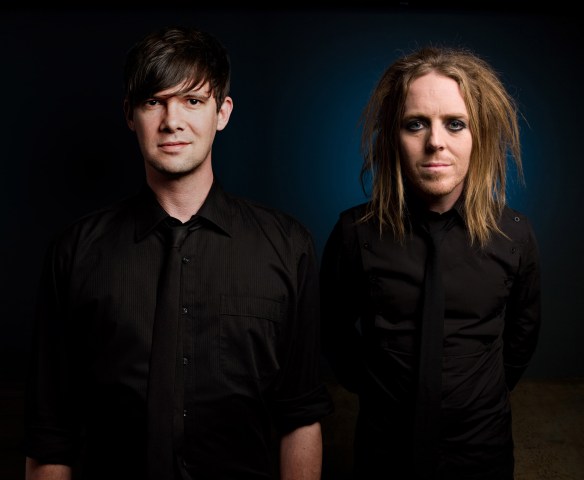
Toby Schmitz and Tim Minchin. Photo: James Penlidis/EllisParrinder

Toby Schmitz and Tim Minchin. Photo: James Penlidis/EllisParrinder

In 1996, Tim Minchin and Toby Schmitz performed together in a University of Western Australia (UWA) student production of Rosencrantz and Guildenstern are Dead – the 1966 play that made Tom Stoppard’s name.

Schmitz was initially cast in one of the lead roles but during rehearsals broke up with the director, who he’d been dating, and promptly found himself demoted to the much smaller part of Hamlet. Minchin played the meatier role of The Player and helped his brother write the music.

Seventeen years on, they about to co-star in the play for Sydney Theatre Company, this time with Minchin as Rosencrantz and Schmitz as Guildenstern: a casting coup that has triggered such demand for tickets, the production has extended before opening.

The excitement at such a double act is hardly surprising. Minchin is now a superstar comedy-musician whose hilarious satirical songs have won him an international cult following and who is regularly hailed “a genius”.

Based in London with his wife and two young children, he recently received rave reviews for his rock star turn as Judas in the UK arena production of Jesus Christ Superstar alongside Mel C and Ben Forster. He has also been winning serious plaudits as the composer/lyricist of the Royal Shakespeare Company’s Matilda the Musical, currently doing a roaring business in the West End and on Broadway, and headed for Australia in 2015 – more of which later.

Schmitz, meanwhile, is one of Australia’s most in-demand actors. In October, he plays Hamlet for Belvoir then jets off to Cape Town to film a second season of US television series Black Sails: a pirate drama prequel to Treasure Island, which premieres early next year.

He is also a successful playwright whose comedy I Want to Sleep with Tom Stoppard was a hit for Tamarama Rock Surfers (TRS) last year and whose latest play Empire: Terror on the High Seas opens at Bondi Pavilion for TRS next month.

Friends since they met as teenagers at a youth theatre company in Perth, an interview with the two of them is a lively affair with thoughtful, intelligent conversation punctuated by sharp wit and much easy banter.

“We arm-wrestled and I lost,” deadpans Minchin when asked how they decided who should play who in Rosencrantz and Guildenstern.

Stoppard’s play was just one of many productions they collaborated on at the UWA drama society, during which time they also performed as a cabaret duo.

In 2004, after Schmitz had graduated from NIDA and Minchin had moved to Melbourne to kick-start a career in music and cabaret, they co-wrote a show with Travis Cotton called This Blasted Earth, which had a short season at Sydney’s Old Fitzroy Theatre.

“It was a musical about putting on a terrible musical,” says Minchin. “The first half was the terrible musical and the second half was the cast saying: ‘I can’t believe we are in this terrible show.’ I think I came away with $50 for my songs and three months of work.”

To date, it hasn’t been revived. “Travis and Tim and I talk about it. It wouldn’t take too much work to re-mould it for 2013,” says Schmitz.

“If we didn’t have anything else to do we would probably do it,” says Minchin. “If we had spare time on an island together it would be fun.”

Spare time, however, is the last thing on their hands right now.

It was Luke Cowling, a co-director of the UWA production of Rosencrantz and Guildenstern, who suggested around four years ago that they revisit the play with the two of them co-starring.

“But then he had a baby, blah, blah, blah and it kind of ground to a half. But my manager Michael knew it was a good idea and wasn’t going to let it go so he set up a meeting with these guys (STC),” says Minchin.

The play is an absurdist tragicomedy in which the two hapless courtiers of the title – minor characters in Shakespeare’s play – find themselves in the spotlight, trapped in a confusing, existential world where most of the drama is happening elsewhere as the plot of Hamlet unfolds predominantly offstage.

On the page, Rosencrantz and Guildenstern seem somewhat interchangeable. They finish each other’s sentences, are mistaken for each other by other people, and even muddle their own names up.

In the stage directions at the start of Act One in which Rosencrantz is tossing a coin that improbably keeps coming up Heads, Stoppard writes that Rosencrantz “betrays no surprise at all – he feel none. However, he is nice enough to felt a little embarrassed at taking so much money off his friend. Let that be his character note.

“Guildenstern is well alive to the oddity of it. He is not worried about the money, but it is worried by the implications; aware but not going to panic abut it – let that be his character note.”

Schmitz and Minchin chuckle at the casual brilliance of Stoppard’s succinct character notes.

“At the beginning you think, ‘I wish you’d given us just a tiny bit more here Tom!” says Schmitz. “But the genius is that you realise he has given you just enough. It’s your job to take one word and riff on it for four pages or hark back to a moment an act ago.”

“We bang on about his incredible genius to be able to write this play at the age he wrote it – you know, almost in a Shakespearean way, how could he have the knowledge?” agrees Minchin.

“But there’s an incredible maturity in how he used that knowledge and I reckon that’s very apparent in the stage directions: ‘Let that be your character note.’ What 29 -year old writes that? The effortless authority at age 29 – I would have wanted to punch him!”

“It becomes quite quickly apparent in performance or on reading out loud even that Stoppard has delineated two quite different personalities,” says Schmitz. “And then in the third act when things start to fall apart for them, lines are crossed and the characters are blurred a little more but I think it’s very clever in its delineation.”

“For the first half of the first act Rosencrantz does a lot of listening,” adds Minchin. “Guildenstern has a lot more text throughout the play. Rosencrantz does a lot more reacting and responding so that when his rants come they are really exceptions to the rule.”

The STC production is directed by Simon Phillips and designed by Gabriela Tylesova who produced the extraordinary sets and costumes for Phillips’ production of Andrew Lloyd Webber’s musical Love Never Dies.

Schmitz was at NIDA with Tylesova and says that even then the students were excited by her special talent – “and it’s not that common among the acting fraternity to go and be interested in any other department at acting school.”

He describes her design as “a vision of Elizabethan England” though Minchin qualifies that as being “not so much Elizabethan England as a traditional, Elizabethan-style Hamlet.

“The set is a minimalist, post-modern set, so it’s a Beckettian, Stoppardian non-specific set with entrances and exits designed to have their own weight because of our (Rosencrantz’s and Guildenstern’s) inability to enter and exit. So the entrances are foreboding and the stage disappears in a converging line into infinity.

“There’s a nod to Godot because the play was a nod to Godot so the set design is very minimal but the costumes make it very clear that it’s a traditional Hamlet. You need that to anchor the play. If you reinterpret what are meant to be the foundations then your house crumbles a bit.”

Not surprisingly, Schmitz and Minchin are relishing Stoppard’s famously dazzling word play.

At one point, Rosencrantz and Guildenstern play a game akin to verbal tennis where they have to keep lobbing questions at each other.

“In that questions game, everything they say is utterly related to the characters and the text as well as relating to a rhythm and a toying and a playfulness,” says Minchin. “It’s scary, man. He’s the monster as they say in jazz. The monster.”

Phillips has gathered an exceptionally fine company of actors for the supporting roles, among them Ewen Leslie as The Player, John Gaden, Christopher Stollery and Heather Mitchell: “an embarrassingly fabulous cast” says Schmitz.

“It’s thrilling when the court (characters) come on. It’s seismic. You can do nothing but be slightly rattled and a rabbit in the headlights – which is exactly the effect you want.”

“I think it’s very difficult to do a brilliant production of a Stoppard play,” adds Schmitz. “You need a sparkling cast, great direction and great resources.

“And you need time too,” says Minchin.

“That’s right, like a Shakespeare you need time to plumb and realise that a lot of it is bottomless but you just have to pull up somewhere and say, ‘OK we’re going to have to make a decision.’ Like all brilliant plays, it just continues to reveal itself,” says Schmitz who first read Rosencrantz and Guildenstern at age 12.

Schmitz played Dadaist Tristram Tzara in STC’s 2009 production of Travesties – his only other experience of performing Stoppard – while for Minchin it’s his first on-stage encounter with the playwright.

However, he has met the playwright a couple of times at awards nights. “The first time I met him it was just me going, ‘oh my god?’” he says. “And the second time he’d become aware of who I was – which is the most profoundly satisfying thing from someone. You want to meet your idols but actually you don’t want to meet them. What you want is for them to meet you.

“He’s so youthful in his curiosity that he had gone ‘OK, that guy wrote Matilda’ so he’d gone away and discovered I do other things.”

Schmitz has also met Stoppard – though it was only the briefest of encounters. “It was during a writers’ festival and a bunch of young playwrights were being herded into a back room at the Opera House to meet him,” says Schmitz. “Someone had told him I’d written a play called I Want to Sleep with Tom Stoppard. He said, ‘I’m just glad it’s not called I just want to sleep during Tom Stoppard.’ I didn’t even name the play, it was my Dad’s title.”

The chance to see Minchin on stage in Jesus Christ Superstar and now Rosencrantz and Guildenstern is something for Sydneysiders to cherish because we’re not likely to see him in another musical or play any time soon given his hectic schedule.

However, we will be seeing Matilda the Musical. Ever since the show premiered in Stratford-upon-Avon in 2010, Australian producers have been vying for the rights.

Adapted from Roald Dahl’s classic children’s novel and featuring songs by Minchin, the RSC production transferred to the West End in November 2011 where it won rave reviews and a record seven Olivier Awards including Best Musical. In April this year it opened on Broadway, again to ecstatic reviews and 12 Tony nominations (though it was pipped to the post for Best Musical by Cyndi Lauper’s Kinky Boots).

At last, a deal has been done for the RSC to present it in Australia in 2015 in association with a local producer, reveals Minchin.

“We actually know who the local producer is going to be (but) it’s still embargoed. I only found out (on Tuesday),” he says. “The plan is for it to open in Melbourne in September 2015.”

Meanwhile, Minchin is busy writing a new musical. “It’s still embargoed even though I’ve been working on it for six months,” he says. “But it’s a very interesting, arty but much-loved early ‘90s film we are adapting for the stage: very conceptual, somewhat Stoppardian. It will be more complex and dark (than Matilda). Even though I am working on it with Matthew Warchus, who was the architect and director of Matilda, we are going to try and start it quietly.”

Minchin is also working on an animated musical film for DreamWorks about animals in the Australian outback and when that is done will put a new solo show together.

Schmitz also has a lot happening. Rehearsals for Belvoir’s Hamlet (his second stab at playing the Prince of Denmark after taking on the role for Brisbane’s La Boite Theatre in 2010) begin while he is still performing in Rosencrantz and Guildenstern, which will make for “an interesting double play”, as he puts it.

At the end of August, TRS will premiere his new play Empire: Terror on the High Seas about a serial killer aboard a luxury cruise liner in the 1920s featuring a cast of 20.

“The first half is my take on an Agatha Christie and the second half descends into something far more gothic and horror,” says Schmitz. “It’s a spectacle. It’s huge and it’s really ambitious. Leland Kean (artistic director of TRS, who is directing) has always done my stuff well and the cast is really talented and stupidly good-looking, I realise.”

Schmitz wrote his first play at NIDA. He won the 2002 Patrick White Playwrights’ Award for Lucky and was shortlisted for the Philip Parsons Young Playwrights Award for Chicks Will Dig You in 2003. His 2007 play Capture the Flag about the Hitler Youth has toured widely and I Want to Sleep with Tom Stoppard was a hit for TRS last year.

“I’ve never had any interest from any (mainstage) theatre company in putting on any of my plays, ever – and this is play number 12. And I’ve had some really popular ones and critically acclaimed and even relatively economically successful ones,” says Schmitz. “But it got to the point a few years ago where I said to Leland Kean, ‘I’m just trying to get a mainstage company to put one on’ – hence I Want to Sleep with Tom Stoppard (with) four middle class people and a couch.

“And he said, ‘for your own soul, write one as if it was going on independently as a commercial thing like The 39 Steps or The Mousetrap or something. Don’t worry about the budget.’ I don’t think he was expecting 20 characters or an ocean liner.”

Given the number of projects they both have on the go, is there no end to their talents?

“I hope not,” fires back Schmitz.

“Is there no end to your ego is really the question,” quips Minchin.

But in the end, they agree, it all comes back to a love of words – and music, in Minchin’s case.

“It’s not multi-skilling,” says Minchin. “It’s a love of language and expressing ideas, wanting to perform other people’s great work and wanting to perform your own. That explains everything I do pretty much.”

“Yes it’s just another way of generating your own material,” says Schmitz. “We’ve both been doing that since before we can really remember.”

Rosencrantz and Guildenstern are Dead plays at the Sydney Theatre from August 6 to September 14. Bookings: 9250 1777 or http://www.sydneytheatre.com.au

Random Musical & Horrible Histories: Awful Egyptians – review

Sydney Opera House, July 4

Scott Brennan, Gillian Cosgriff and Rik Brown in Random Musical

Scott Brennan, Gillian Cosgriff and Rik Brown in Random Musical

As part of its July school holidays program the Sydney Opera House is presenting three shows – two of which I caught up with in the one day: Random Musical for ages 5+ and Horrible Histories: Awful Egyptians for ages 6+.

It’s always so much more fun going to children’s theatre with a child, but with no littlie to take, a friend/colleague and I rocked our inner infant for the day.

We started with Random Musical, which was utterly charming: a lo-fi delight that had us both laughing our way through the hour-long show.

Once seated, the children are asked to write their name and a word beginning with the same letter on a piece of paper which is then collected by the performers.

The cast of four “randomaniacs” – Scott Brennan, Rik Brown, Gillian Cosgriff and Rebecca De Unamuno, with John Thorn on piano – then create a musical on the spot inspired by some of those words.

The first song That’s Pretty Random, which provides a framework in order to mention as many of the suggestions as possible (a lovely way to involve many of the children), was presumably written in advance. But from there on it’s all free-wheeling.

Our musical was called The Zany Ostrich (thanks, Zach and Olivia), about a rare, pink-feathered bird who really wants to be a penguin. Meanwhile, an evil explorer – “the strangely named Georgia” – wants to capture the ostrich and turn her into a feather boa.

The quick-witted cast did a superb job, not only conjuring plot and lyrics on the spot but singing spontaneously in various musical styles initiated by Thorn from English Musical Hall to rap.

Brown, in particular, as the explorer, came up with some incredibly funny lyrics that included an exploding snake (which later became an integral part of the plot) and had them rhyming effortlessly into the bargain. He also fired off some brilliant one-liners.

But all were excellent. Brennan did a lovely job as MC to get things going, De Unamuno was the sweetest penguin imaginable and Cosgriff made a great ostrich.

The children embraced any opportunity for audience involvement. Getting them to supply a few more sound effects might be a good idea to keep the youngest really engaged. But props to all involved. A great little show.

A scene from Horrible Histories.

A scene from Horrible Histories.

Horrible Histories: Awful Egyptians is a wildly different experience. It belongs to a phenomenon (which has passed me by as my children are too old) spear-headed by Terry Deary’s hugely popular books, which have spawned live shows and a BBC TV series.

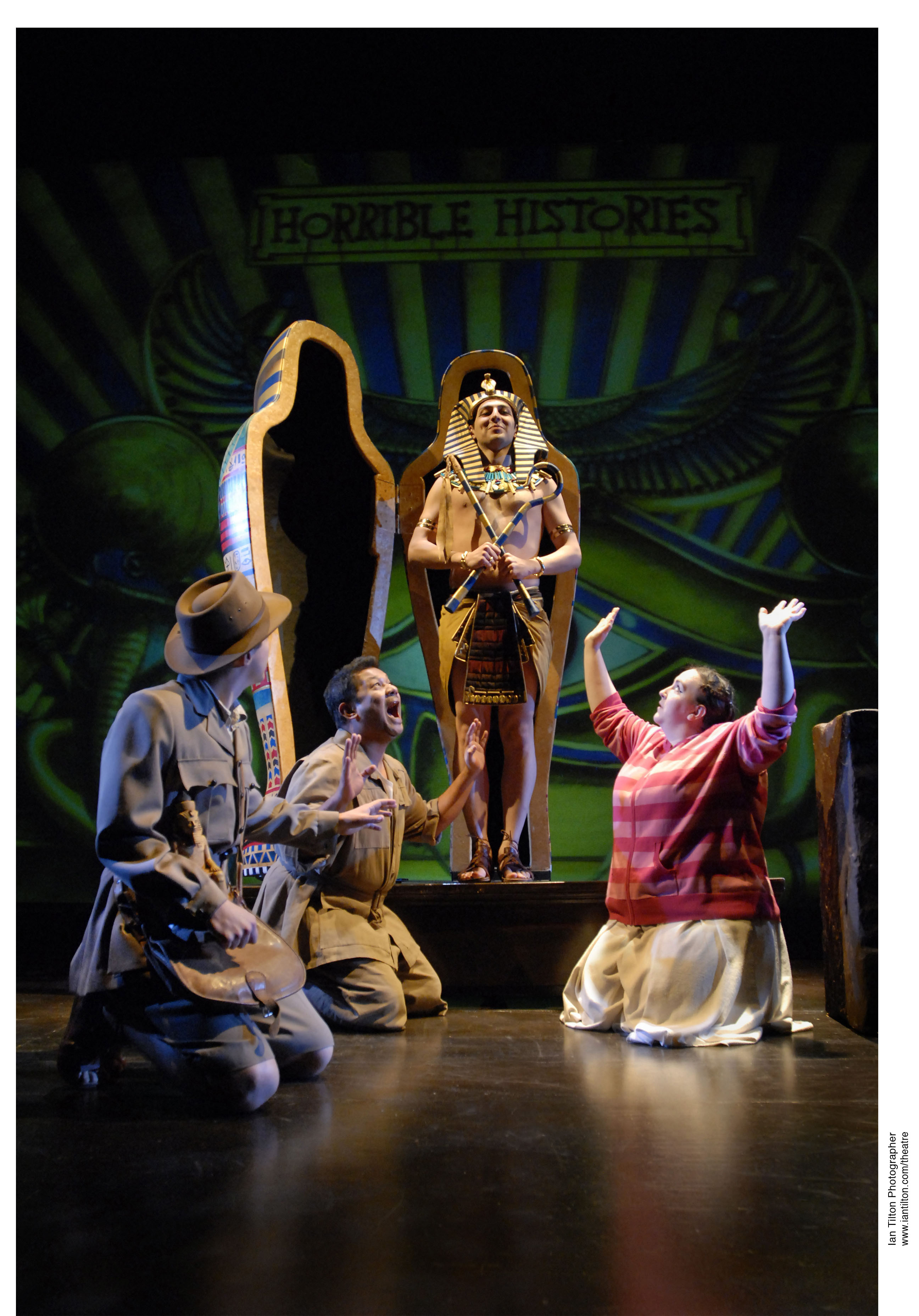
This production is performed by the British-based Birmingham Stage Company. To the uninitiated it’s a weird mix of historical fact, broad British humour in a pantomime vein, with slapstick, lots of terribly corny jokes, hammy acting and lashings of gore (think rubber intestines and other body parts being flung freely). But the buzzy audience couldn’t have been more excited.

The plot involves an archaeologist and his dorky assistant who try to steal a statue of Ramesses II from a museum. Together with a schoolgirl on a guided tour, they conjure up the spirit of Ramesses himself who explains all about Egyptian history including the pyramids, mummies, Tutankhamun and the afterlife.

Running two hours it feels far too long for the material, though the second act features some pretty speccy 3D effects.

However, the audience seemed to be having an absolute ball. What’s more, demand is so great that the Sydney season quickly sold out so an extra show has been added on Saturday July 13.

Random Musical runs until July 14. Horrible Histories also closes in Sydney on July 14 then plays at Melbourne’s Her Majesty’s Theatre, July 19 – 21.

King Kong review

Regent Theatre, Melbourne, June 19


Esther Hannaford and King Kong. Photo: Jeff Busby

Esther Hannaford and King Kong. Photo: Jeff Busby

Set in New York in 1933 during the Great Depression, the story of King Kong has all the romance, tragedy and grand themes to make a wonderful musical. The biggest challenge, you would think, would be to portray the giant gorilla of the title on stage in a convincing way.

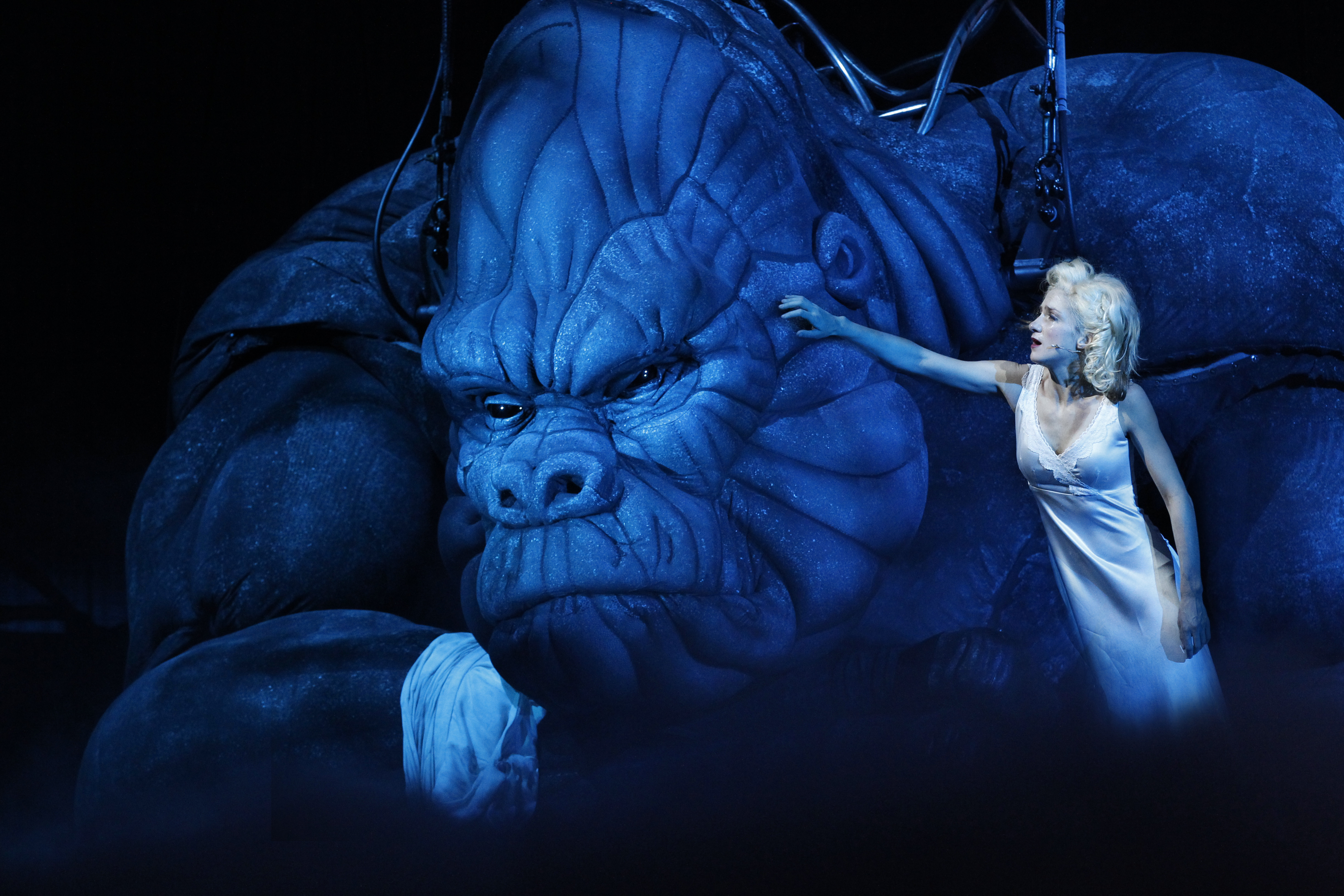
In fact, the truly extraordinary animatronic puppetry employed to create the beast is far and away the most successful element in Global Creatures’ new musical theatre show.

We hear him first – a thundering noise as he crashes through the jungle on Skull Island. Lights then pick out his enormous teeth and eyes, and suddenly there he is on stage – all six-metres of him. It’s an astonishing sight. And it only becomes more remarkable as we realise how much more he can do than roar in a terrifying fashion.

Operated by 10 on-stage puppeteers known as the King’s Men and three off-stage operators he looks incredibly realistic, while 15 motors in his face create a range of different expressions. Thus we see him not just snarling and angry but thoughtful, anguished and vulnerable. We relate to him and care about him. He is the most “human” character on stage.

It’s a genuinely remarkable achievement by creature designer Sonny Tilders and his team who prior to this created the dinosaurs and dragons for Global Creatures’ previous arena shows Walking with Dinosaurs and How To Train Your Dragon for Global.

What a shame then that the show surrounding him doesn’t match his magnificence.

The main problem is a weak book. Characters are sketchily presented and not developed, much of the dialogue is banal and clichéd, and there are umpteen gaps in the storytelling.

For example, Act I finishes as sleazy film producer/entrepreneur Carl Denham (Adam Lyon) prepares to leave Skull Island with the captured King Kong in tow, who has protected rather than eaten Denham’s newly discovered starlet Ann Darrow (Esther Hannaford). In Act II we are back in New York and Denham is about to present Kong as “the Eighth Wonder of the World”. As Ann and Jack arrive at the theatre, Ann says that Denham “will kill us” if he finds them there.

None of this has been set up. We haven’t seen anything of Ann sympathising with or comforting Kong on the ship back, and very little of her blossoming romance with Jack Driscoll (Chris Ryan) – here the son of a steel magnate who is working as a sailor because he needed to get away from his father.

We can fill in the gaps in our heads and make sense of most of it but the emotional arc of the show suffers.

Craig Lucas who wrote the book is highly experienced with credits including the Broadway musical The Light in the Piazza. Apparently a fair amount of dialogue was cut during rehearsals, which, if true, would go some way to explaining the problem  – but what we end up with is a structure that feels somewhat out of kilter.

At the heart of the show should be the relationships of Ann and Kong, and Ann and Jack – but we don’t see enough of either for the story to affect us as emotionally as it should.

Yes, it’s touching when Ann rushes to Kong as he stands atop the Empire State Building with planes attacking him but surely, if the show had done its job properly, we should be in tears at this point, in the way that Warhorse had people sobbing. Instead everyone around me seemed dry-eyed.

And what to make of dialogue such as Ann’s “It’s me or the whole city” when we know that she is the one person Kong won’t harm?

Meanwhile, the character given the biggest focus is the unlikable Denham – and unfortunately Lyon, a relative newcomer, doesn’t have the snake-oil charisma to bring him to life.

Meanwhile a prophetess figure – pointedly called Cassandra (Queenie van de Zandt) – could easily be dropped. We don’t need anyone to tell us that heading to Skull Island in order to find and exploit a ferocious beast is likely to end badly.

Stylistically and musically the show is ambitious but a bit of a mish-mash. Clearly the producers and the creative team led by American director Daniel Kramer, want to deliver a musical for the 21st century in a very different mould to a traditional Broadway show and they deserve kudos for that.

There’s certainly no shortage of spectacle what with Peter England’s striking production design, Roger Kirk’s lovely costumes, Peter Mumford’s dramatic lighting, and Frieder Weiss’s busy projections and lasers. What emerges is a show that is sometimes expressionistic, sometimes more conventional; a show that is part cabaret, part musical and part music video.

At times that works brilliantly, notably when Kong is destroying New York and a line of showgirls struggle on with a performance of Get Happy but at other times the different styles sit uncomfortably together.

A dream sequence on board ship in which Ann discovers her inner showgirl, backed by a line-up of scantily clad chorus girls with enhanced bosoms feels out of character for Ann and somewhat gratuitous, while the inhabitants of Skull Island are a strange combination of primitive and space age in a scene with a dance party vibe.

The music is an eclectic mix of original compositions by Marius de Vries, period songs from the 1920s and 1930s like Brother Can You Spare Me A Dime and I Wanna Be Loved by You, and contemporary songs by Massive Attack, Guy Garvey, Sarah McLachlan, Justice and The Avalanches.

Not much of the new music is very memorable. The most powerful song is Rise by De Vries. Van de Zandt, who gives a powerful performance, sings the hell out of it but it does feel strange to have a little-seen, secondary character singing the big 11 o’clock number. Ann’s Full Moon Lullaby (also by De Vries), a reprise of which follows Rise, is a pretty song but no showstopper.

Hannaford and Ryan are lovely as Ann and Jack. Both sing beautifully, have a great presence, and do as much as they can with the material they are given. The ensemble also give it their all.

King Kong has been five years in development and had a rare 19-week rehearsal period but it still needs more work.

As the centerpiece of the production, King Kong himself is truly wondrous. I can’t imagine anyone not marveling at him. His portrayal is a staggering piece of stagecraft and he deserves to be seen on Broadway – but the show could usefully do with further development before braving the Great White Way.

King Kong will only play in Melbourne and will not tour Australia. The show is currently booking through to August 18 and to October 13 for groups.

Hot Shoe Shuffle review

David Atkins Enterprises, Lyric Theatre, Queensland Performing Arts Centre, May 4

Before The Boy From Oz and Priscilla, Queen of the Desert – The Musical, there was Hot Shoe Shuffle: the little musical that could.

It was the first Australian musical to play in London’s West End, where it won an Olivier Award for best choreography, and subsequently toured the UK, Japan, Canada and the US, as well as returning for two Australian tours.

Now, 21 years since it premiered and 11 years since it was last seen here, Hot Shoe Shuffle is back ­– and feeling fresh as a daisy in an exuberant production that had the Brisbane opening night audience on its feet cheering.

The paper-thin story is pretty silly. The seven Tap Brothers discover that they stand to inherit over $2 million from their father – but only if they can recreate his famous tap-dancing act, the Hot Shoe Shuffle. What’s more they must include April, the sister they didn’t know they had, who has two left feet.

Tap Brothers

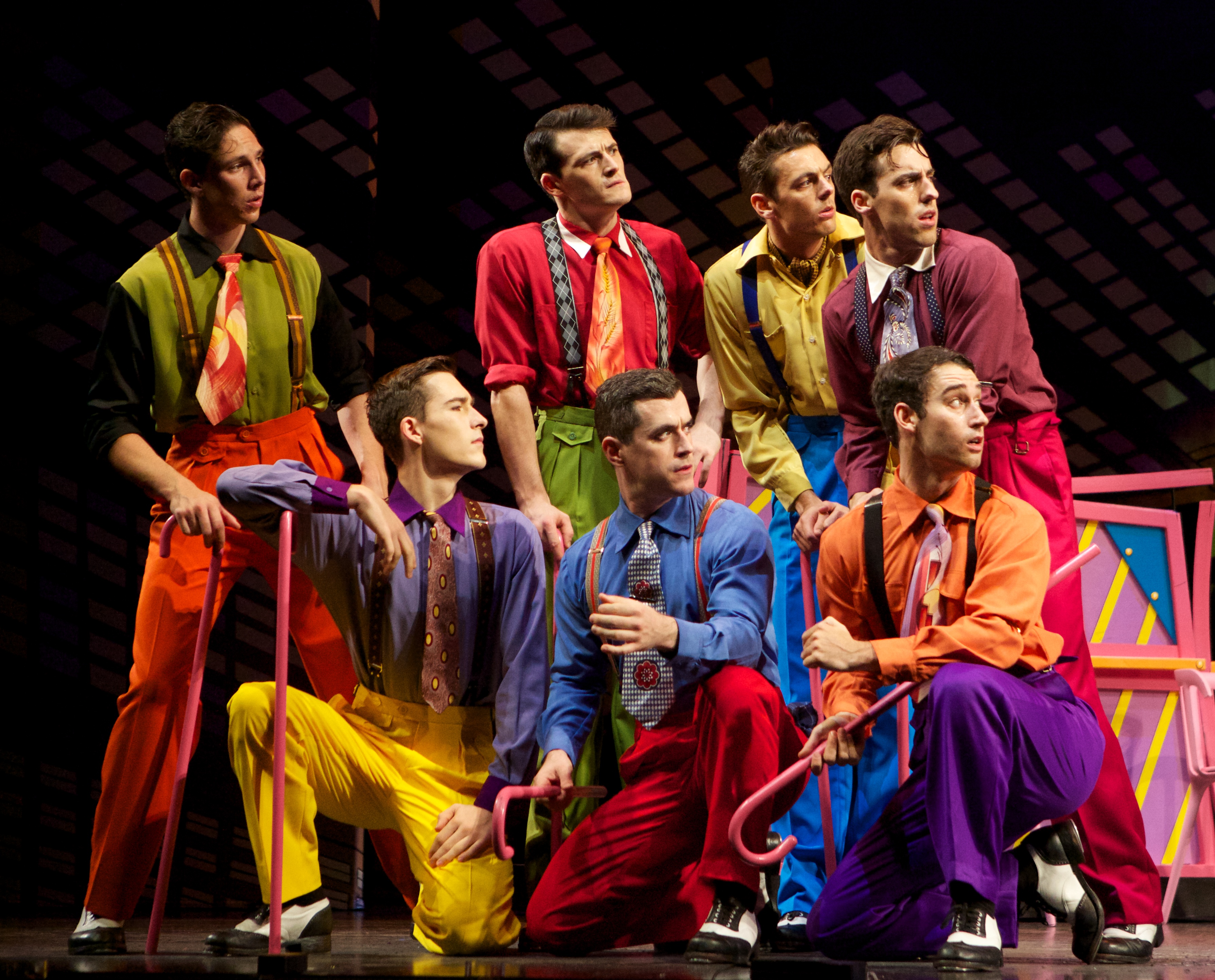
The Tap Brothers: Morgan Junor-Larwood, Mason Schaube, Rob Mallett, Bobby Fox, Mitchell Hicks, Max Patterson, Alexander Kermond.

Though the plot has been rewritten slightly, with April telling the boys right near the top of the show that she isn’t actually their sister but the daughter of their father’s leading lady, it’s still just an excuse on which to hang some standards from the 1940s big band era (I Get Along Without You Very Well, Puttin’ on the Ritz, Shall We Dance and Ac-cent-tchu-ate The Positive among others) and some spectacular tap dancing.

However, the song and dance numbers are good enough, and the show warm-hearted enough, for the flimsiness of the plot not to really matter.

Hot Shoe Shuffle was co-choreographed by David Atkins and Dein Perry (who went on to create Tap Dogs). Atkins also directed and played Spring, the eldest of the Tap brothers and leader of the pack.

Playing opposite him as April was Rhonda Burchmore (Jackie Love and Debra Byrne took on the role in later seasons). In the original incarnation Spring and April were twins and the huge height difference between Atkins and Burchmore was a running gag in the show.

Atkins now plays the senior role of Dexter Tap and his various alter-egos, while Bobby Fox steps into the role of Spring and Jaz Flowers plays April.

Bobby_Jaz park

Jaz Flowers and Bobby Fox.

Fox and Flowers both bring their own personalities to the roles and make them their own. The height difference is no longer there but the chemistry between them sparkles.

Sporting a red wig, Flowers looks fabulous in the 1940s-style cotton frock and gorgeous gowns. Her April is a little less goofy and klutzy, and more of a feisty girl who longs to perform but lacks confidence. Flowers is in fine voice, singing the numbers with power but subtlety, and she holds her own as a dancer.

Fox brings his twinkling charisma to the role of Spring. Less hard-boiled than Atkins’ Spring, he is more of an eye-rolling cynic and perfectionist, who keeps his distance while his brothers flock to April like moths to a flame. His dancing has a lovely ease (with a cheeky nod to his Irish dancing background) and he sings well, proving himself a genuine leading man.

Atkins is a great anchor as the older Dexter, while the six other Tap Brothers – played by Morgan Junor-Larwood, Rob Mallett, Mitchell Hicks, Alexander Kermond, Max Patterson and Mason Schaube – all emerge as distinctive personalities.

The choreography, which was created as a tribute to the tap dancing legends who inspired Atkins, combines the elegant style of the 1930s and 40s with an exciting, contemporary energy and sense of fun. Overall, the dancing does it justice, while Patterson makes the most of a solo, which he nails.

How Lucky - Jaz

Jaz Flowers.

The cartoony-looking production, with set by Eamon D’Arcy and costumes by Janet Hine, feels brighter than ever. Hine’s costumes, though similar to the originals, have been redesigned with even more vibrant colours for the boys and some stunning new outfits for April, while LED lights add extra razzle-dazzle to the final tap routine.

The 11-piece band, meanwhile, under musical director David Stratton performs with panache.

Hot Shoe Shuffle is an unashamedly old-fashioned, feel-good show. This 21st anniversary production is as impressive as any that have gone before and a fun, uplifting night of theatre.

QPAC until May 25; Lyric Theatre, Sydney, July 5 – 21; Her Majesty’s Theatre, Melbourne, August 9 – 25.