Buckingham Palace drama is no fringe show

CharlesIII_040915_photoRichardHubertSmith-4627

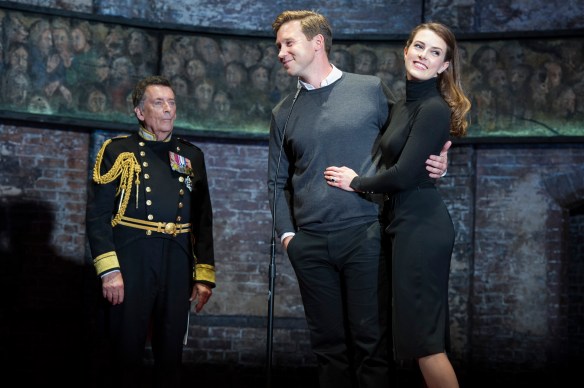
Robert Powell as Charles with Ben Righton and Jennifer Bryden as the Duke and Duchess of Cambridge in King Charles III. Photo: Richard Hubert Smith

To cut or not to cut a fringe? Without being too superficial about it, you can’t play the Duchess of Cambridge – Kate Middleton as was –without taking her lustrous locks into account, even if you aren’t attempting an impersonation.

“It’s amazing really to make the front cover of most newspapers just for the very fact that you’ve had a hair cut. When her fringe was cut (in September) suddenly that was massive news,” says Jennifer Bryden who plays Kate in King Charles III, the phenomenally popular, award-winning play by British playwright Mike Bartlett.

In fact, Bryden won’t be sporting bangs when the British production arrives at Sydney Theatre Company later this month.

“I wanted to. I angled for it but because we weren’t doing impersonations they felt that actually having long dark hair was enough. So I’ve kept mine long and we put it in hot rollers,” she says.

Ben Righton who plays William has a much healthier head of hair than the Duke of Cambridge with his receding thatch.

“He was slightly dreading the fact that they were going to suggest shaving a bald patch,” says Bryden with a laugh.

King Charles III premiered at London’s 325-seat Almeida Theatre in 2014. Directed by Rupert Goold, it quickly became the hottest ticket in town and transferred to the West End. When a Broadway season was confirmed, a second company was formed to take the play on a UK tour. Led by Robert Powell as Charles, that company is en route to Sydney.

Described as “a future history play”, Queen Elizabeth II is dead and Charles finally ascends the throne, Camilla at his side. But when he refuses to sign a bill restricting the freedom of the press, he triggers a constitutional storm. With civil war brewing, there are suddenly tanks outside Buckingham Palace.

Praised by New York critics as “flat-out brilliant” and “breathtakingly audacious”, Bartlett’s Buckingham Palace drama about a monarchy in crisis is written in iambic pentameter, giving the play a Shakespearean feel infused with a dash of Fleet Street.

Righton says he was “blown away” when he read the script. “That kind of writing does a lot of the work for you because it tells you which words to stress. It forces you into a style of talking. What is brilliant about Mike’s script is it refers to all kinds of modern things but in verse. I love it. It pushes the play along at a wonderful pace,” he says.

Will and Kate are among the most photographed people on earth but both Righton and Bryden decided to focus on the script itself rather than taking a forensic look at the young Royals when preparing for their audition.

“That turned out to be the right decision. Something we were told early on in rehearsals is that this wasn’t about impersonating. We were to approach the text as we would any text and approach the character as we would any other character. And only then, at the end, were we allowed to add suggestions of mannerisms that we had observed in real life,” says Bryden.

“They were never after imitations,” agrees Righton. “It’s like an alternative reality this play, a ‘what if’ Charles were to take the throne.”
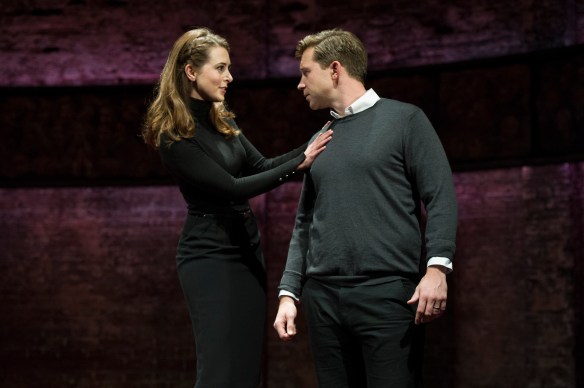
Jennifer Bryden and Ben Righton in KCIII Tour. Credit Richard Hubert Smith

Jennifer Bryden and Ben Righton as Kate and Will in King Charles III. Photo: Richard Hubert Smith

When it came to observing mannerisms, Righton noted that the Duke of Cambridge speaks in a “breathy” way, fiddles with his hands a lot and often has them in his pockets. “He’s left-handed. I’m right-handed so I’ve had to teach myself to be left-handed,” says the actor.

“If you look at Will for any length of time he’s – I’m trying to find a nice way of putting this – but he’s quite bland. He’s very straightforward and polite and he smiles a lot so there’s not a lot to go on. He’s a blank canvas.

“Because he’s been photographed since he was born you feel you know so much about him but you realise that we don’t. They’ve done a very good job of keeping his life private and what makes the bloke tick is very hard to find out anywhere. I know two people who went to school with him and I tried to get them to tell me a bit about him but they were very loyal and haven’t said a word. I can’t get anything out of them,” says Righton.

Bryden believes that the way Kate dresses has a strong influence over the way we perceive her. “I am lucky with the silhouettes of the costumes she wears and the heels. Once I was in costume that really helped.

“It’s amazing what the power of the imagination does,” adds Bryden. “In real life I don’t think any of us look particularly like the members of the Royal Family. There are similar shapes, colourings and heights but that’s about it. But actually once we’ve got the costumes on and the characters are introduced in the first scene, the power of the imagination lies with the audience to see the person they are used to seeing in the public eye.”

Beneath the fashionable outfits and flowing hair, there’s a backbone to Bartlett’s Kate that comes as a surprise. Portrayed as a shrewd political operator, who supports and motivates William, she has been compared to Lady Macbeth.

“She definitely wears the royal trousers…. In our play she’s a very commanding figure,” says Righton with a chuckle.

Careful not to give too much away, Bryden says: “She is the key operator, the person who makes the changes in the action of the play. She’s the one person within the Royal Family who can look at what’s going on objectively because everyone else is too tied up with their own family drama. Because Kate is new to all this, she is the one with the outside eye.”

Before she had any idea that she would be auditioning for the play, Bryden saw King Charles III in the West End from a seat in the gods with a friend of hers.

“It was so fascinating in the interval hearing all the discussions. So often everyone just makes and a beeline for the bar and it’s about what they’ve been doing that day. Here, everyone was talking (about the play), whether it was politics or family or actors playing real people or the monarchy. It was amazing. My friend said, ‘you should play that part one day,'” says Bryden.

None of the Royal Family has been to see the play. However, Tim Piggott-Smith who played Charles in the original production, received a letter from a member of the staff at Clarence House, Charles’s official London residence, pointing out that Charles doesn’t wear a wedding ring.

“I think everyone has taken that as a bit of a nod that they’re watching and hopefully approve,” says Bryden.“I’m sure they know all about it but I don’t think they would ever come and see it.”

King Charles III, Roslyn Packer Theatre, March 31 – April 30. Bookings: www.sydneytheatre.com.au or 02 9250 1777

A version of this story ran in the Sunday Telegraph on March 13

Lisa McCune and Darren Gilshenan in Machu Picchu

2016 STC MACHU PICCHU Lisa McCune by James Green 2106

Lisa McCune. Photo: James Green

Australian sweetheart Lisa McCune, who shot to fame at age 22 as Constable Maggie Doyle in Blue Heelers, is about to take on her first middle-age roles. And it feels like “the right fit”, she says.

Best known for her television work and, more recently, her roles in musicals such as South Pacific and The King And I, McCune returns to straight theatre in a new Australian play called Machu Picchu opening tonight in Sydney in which she plays Gabby, a middle-aged civil engineer, whose life and marriage is upended when her husband is involved in a serious car crash.

In May, she plays Sally, a former showgirl who is now 49 but “still remarkably like the girl she was thirty years ago” in a concert version of the Stephen Sondheim musical Follies in Melbourne.

McCune, who recently turned 45, still looks extremely youthful herself but is very happy to embrace the more mature roles coming her way.

She describes Machu Picchu as: “a grown-up play about relationships and mid-life” and “a fascinating subject matter.

“It’s my first role playing (a middle-aged woman). Well, I suppose Anna in The King and I was too. But it’s a more mature part of my life as well so that is interesting to me. It’s not the ingénue any more. And it’s really nice to explore that,” says McCune.

“I don’t consciously go ‘oh these characters are older’. I think it’s just that feeling of the right thing. I certainly not going to be botoxing to try and play ingénues who are in their late 20s. It’s just where you start to fit I think.”

Though she denies giving too much thought to getting older, McCune admits that she felt different the second time she played the vivacious nurse Nellie Forbush in South Pacific.

“It’s funny, I did the first season of South Pacific (in 2012). By the time I came back to it a year later, I thought ‘I can’t play this any more’. I’m actually getting too old to play her and that’s when I did Anna and that felt right.

“It’s nice with this play (Machu Picchu) that it hasn’t been done before and there are no comparisons. We’re starting from scratch.”

Machu Picchu is a co-production between Sydney Theatre Company (who commissioned it) and the State Theatre Company of South Australia. It is written by Sue Smith, whose TV credits include Brides of Christ and Mabo and whose last play Kryptonite was premiered by STC in 2014.

It centres on a middle-aged couple who seem to have it all, but who must reassess their lives, priorities and relationship when the husband Paul is left a paraplegic after a car crash. The play moves back and forth in time, so that we see them before and after the life-changing accident.

Machu Picchu is worlds removed from the lavish musicals McCune has performed in of late, throwing up many questions about how you live your life after such an event. McCune’s character also wrestles with a lot of guilt.

McCune agrees it’s “tricky subject matter” but says the play has “many humorous moments” and “great heart. I think Sue’s language is really beautiful and her observations are fantastic,” she says.

In rehearsals, McCune found that performing in a straight play has required her to flex different acting muscles.

“It sharpens different things and that’s great. It’s the different language. A musical heightens things in different spots whereas when its just text, not backed up by songs, it doesn’t happen that way. So for me, it’s a new experience again. I’m finding it challenging – which is what you want out of your work really.”

Darren Gilshenan, who plays Paul, believes the role is very different to the parts McCune is usually cast in.

“I think she’s really excited that people will see her in a different guise and see what she’s capable of. This allows her to dig deep and find a lot of ugliness as well that you wouldn’t normally associate with Lisa,” he says.

Gilshenan is a fine comedy actor whose numerous credits include the seemingly hapless but kindly, occasionally wily neighbour Jack in Channel Nine’s Here Come the Habibs!, Uncle Terry in ABC-TV’s The Moodys and Bell Shakespeare’s hilarious production of The Servant of Two Masters.

McCune and Gilshenan have worked together once before: in the musical Urinetown for STC in 2006.

“I’ve admired his work for a long time. He was one of the reasons I wanted to do (Machu Picchu),” says McCune.

On the face of it, it seems almost perverse to cast an actor renowned for his physicality as a character in a wheelchair. But Gilshenan’s physical skills will be tested in Machu Picchu. “The level of detail that happens in the nine months (Paul is) in hospital, his development physically through rehab and the various stages needs to be very clear,” he says.

“I was saying to my wife after the first couple of day’s rehearsal that the scope of this piece emotionally, physically and intellectually, and what I can do with it, is fantastic. It’s a dream role.

“A lot of the comedy I’ve done recently is based on humour through the pain and truth of flawed individuals. But there’s always an awareness you’re in a comedy, whereas in this it’s really surprising where the real tragedy is at times. In the awfulness of the situation, there also a lightness and a comedy in there too.”

Smith has described the play as “both a grand love story, and a deeply ordinary one”, as well as a celebration of courage.

“That’s the part I love about it,” says McCune. “I’m such a romantic. I think the romantic side of it is really beautiful. It’s about a couple who are somehow meant to be together and how they are going to travel the next part of their life that’s really hard. It’s a tricky subject matter. I think Darren has had a lot to contemplate for his role.”

Asked if anything has happened in her own life to make her stop and take stock, McCune says: “I think for me the biggest turning point in my life was having children.”

McCune, who has never commented on her reputed relationship with opera singer Teddy Tahu Rhodes, has three children aged 15, 13 and 11 with her husband Tim Disney.

Machu Picchu rehearsed in Adelaide and has a season there after its Sydney run – which means a fair amount of time away from her Melbourne-based family.

“It’s one of the lines in the play: ‘work is work and it must be attended to,’” says McCune.

“It’s a different part of my life. Isn’t it funny: that’s what the play is about. It’s about living your life. And I guess for me I’m a better mum when I am doing some work. I think I feel more content. I’m happier and I’m happy to go and really throw myself back my life at home. I kind of need it.

“The kids are fantastic. They are a little bit older now and they understand that that’s the life that we’ve chosen (and) that they’re a part of. So they are OK and we just make sure we talk about it with them. And they’ll come away for holidays. Once you start throwing in holidays, you’re not actually away for that much.”

Machu Picchu plays at Wharf 1, Sydney until April 9. Bookings: 9250 1777. Dunstan Playhouse, Adelaide Festival Centre, April 13 – May 1. Bookings: BASS 131 246

 A version of this story ran in the Sunday Telegraph on March 6


CounterMove

Roslyn Packer Theatre, Sydney, February 29

Cacti

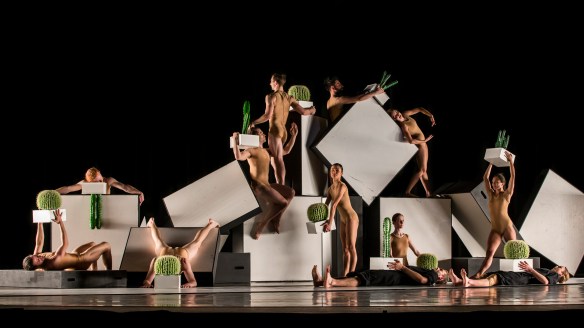
Sydney Dance Company in Cacti. Photo: Peter Greig

“This is a bit weird isn’t it,” mutters one of the dancers in Cacti to a huge laugh from the audience.

Created by Swedish choreographer Alexander Eckman in 2010, Cacti is a rare thing: a genuinely funny contemporary dance work. Sydney Dance Company first performed it in 2013 and is now reviving it alongside a new work by Rafael Bonachela as part of a double bill called CounterMove.

Poking fun at alienating, self-absorbed contemporary dance and at critics who indulge in a pretentious search for meaning, Cacti features 16 dancers, each with their own square, wooden platform (and later a cactus), a string quartet, an orchestral soundtrack and a wanky, jargon-laden voice-over analysing the work.

Cacti begins with the dancers in flesh coloured tops, black baggy pants and skullcaps kneeling on their separate wooden tiles. Seemingly trapped, they beat out rhythms, sprint on the spot in perfect unison, writhe, leap, fall and strike poses in a joyous display of exuberant physicality before larking around with their upended rostra and creating a large sculpture.

In a very funny duet performed by Charmene Yap and Bernhard Knauer, their humdrum thoughts are revealed via a voice-over as they dance. (“Look out for my head” and such like).

It’s lovely to actually laugh out-loud at contemporary dance and to see the dancers matching their glorious physicality with such animated facial expressions. Using wit to make a spiky point, Cacti is a breath of fresh air. Oh, and there’s a dead cat.

LuxTenebris

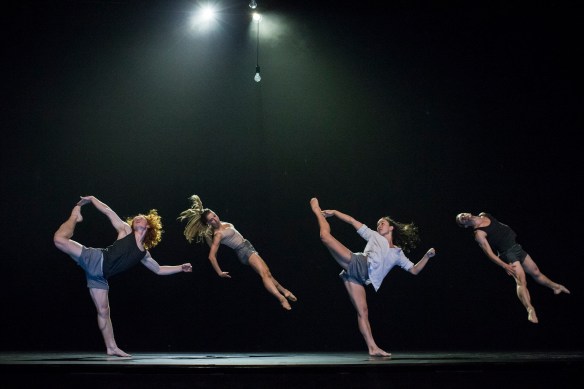
Nelson Earl, Holly Doyle, Fiona Jopp and David Mack in Lux Tenebris. Photo: Peter Greig

Bonachela’s Lux Tenebris, meaning light and darkness, was choreographed to a visceral electronic score commissioned from Nick Wales that buzzes, throbs, pulses and thumps, sending vibrations through the body.

Performed in shadows, we glimpse the dancers through the glowering half-light of copper-coloured light bulbs and shards of wan illumination (design by Benjamin Cisterne). Often, the effect is similar to a roving spotlight picking out people in the middle of already unfolding situations.

Clad in casual streetwear, the dancers hurl themselves into a frenzy of highly physical movement, kicking, whirling and whipping their way through solos, duets and various groupings.

Two beautiful, sexy duets between Charmene Yap and Todd Sutherland to more gentle music are like lulls in a storm. Acrobatic yet poetic, they resonate with the human yearning for connection before the work powers back into top gear.

Lux Tenebris has a slightly uneasy, disquieting air of mystery. Eventually the pounding score and ferocious physicality starts to feel relentless but the kick-ass choreography is incredibly exciting and the dancing is extraordinary.

CounterMove plays at the Roslyn Packer Theatre Walsh Bay, Sydney until March 12, Canberra Theatre Centre, May 19 – 21, and Southbank Theatre, Melbourne, May 25 – June 4

 It then goes on a regional tour:

 NSW: Wollongong, June 17 – 18, Orange, June 22, Newcastle, June 25, Port Macquarie, June 29

QLD: Rockhampton, July 2, Gladstone, July 6, Cairns, July 9 – 10, Gold Coast, July 15 – 16

NT: Darwin, July 29

WA: Geraldton, August 3, Mandurah, August 6, Albany, August 9, Bunbury, August 13

NSW: Bathurst, August 20, Griffith, August 24, Dubbo, August 27

A version of this review ran in the Sunday Telegraph on March 6

Six Dance Lessons in Six Weeks

The Concourse, Chatswood, February 27

Todd McKenney and Nancye Hayes SIX DANCE LESSONS IN SIX WEEKS -18 Photo by Clare Hawley

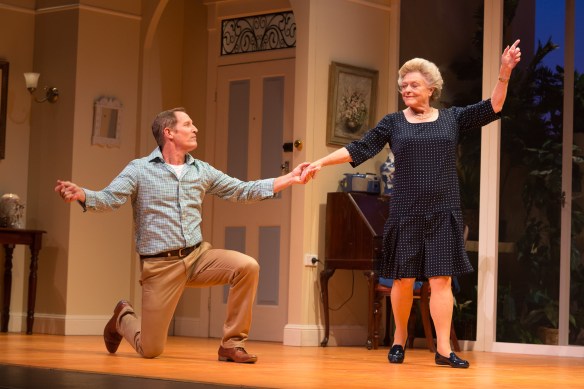
Todd McKenney and Nancye Hayes. Photo: Clare Hawley

Six Dance Lessons in Six Weeks was a big hit for the Ensemble Theatre in 2006, winning a 2007 Helpmann Award for Best Regional Touring Production when they took it on the road.

The production was blessed to have Nancye Hayes and Todd McKenney co-starring in the bittersweet two-hander. A decade on, the Ensemble is doubly blessed that Hayes and McKenney have reunited with director Sandra Bates for the current revival. It’s perfect casting and even more touching than last time around.

The 2001 comedy by American playwright Richard Alfieri has a classic odd-couple premise. Set in a light, bright, well-appointed Florida condominium, wealthy retiree Lily Harrison, the lonely, prim widow of a Baptist minister, has hired a dance instructor to polish her ballroom dancing.

Enter Michael Minetti, an acerbic, middle-aged, gay, former Broadway chorus boy with plenty of attitude and a bad case of foot-in-mouth.

Things don’t get off to a good start. Both initially have their guard up and are less than honest with each other. Early antagonisms threaten to detonate their lessons before they begin. But gradually they foxtrot, cha-cha, tango and waltz their way to a blossoming friendship, realising that they have far more in common than they could ever have imagined.

Six Dance Lessons is well-written with lots of zingy one-liners but it’s also fairly predictable and sentimental and could easily become schmaltzy if allowed to.

However, under Bates’ direction, Hayes and McKenney play against the sentimentality and create tough, flawed, warmly believable characters. They have a lovely rapport and both are able to play the cut-and-thrust of the comedy superbly while convincingly suggesting the emotional scars both characters carry within.

Todd McKenney and Nancye Hayes SIX DANCE LESSONS IN SIX WEEKS -41 Photo by Clare Hawley

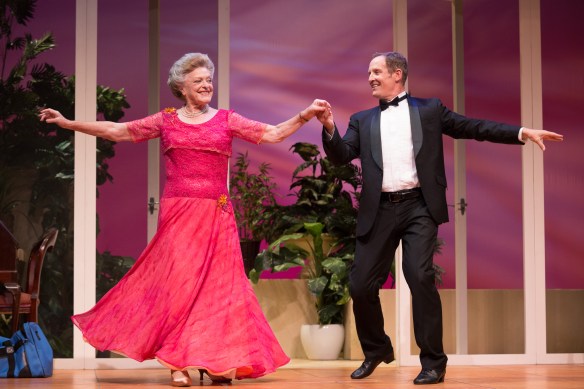
Nancye Hayes and Todd McKenney. Photo: Clare Hawley

Both Hayes and McKenney are very experienced dancers, of course, so the dancing (choreographed by John O’Connell) is effortless and full of charm. The fact that they are ten years older this time actually suits the roles and lends the play an added poignancy.

Designer Graham Maclean’s gleaming set and attractive costuming makes for a vibrant looking production that complements the feisty comedy.

Gently touching on homophobia, loneliness and ageism, Six Dance Lessons wears its heart on its sleeve but Hayes and McKenney do the play proud, bringing enough nuance to their roles to make the lightweight comedy a moving plea for understanding and acceptance.

Six Dance Lessons in Six Weeks is at The Concourse, Chatswood until March 13. Bookings: www.ensemble.com.au

 This review ran in the Daily Telegraph Arts online on February 29

Little Shop of Horrors

Hayes Theatre Co, February 23

LittleShop1

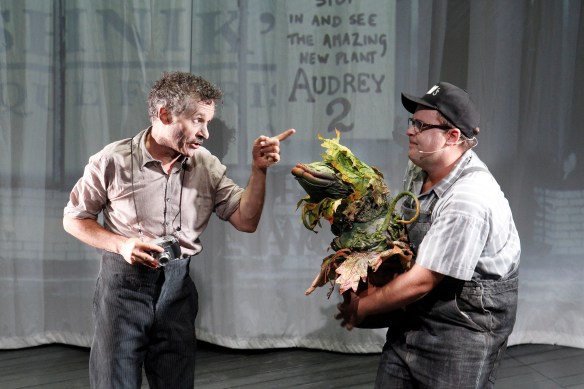
Tyler Coppin as Mr Mushnik and Brent Hill as Seymour (with Audrey II). Photo: Jeff Busby

The Hayes Theatre Co burst onto the scene in February 2014 with a brilliantly re-imagined production of Sweet Charity. Two years later, the same creative team, led by director Dean Bryant, has reunited to stage Alan Menken and Howard Ashman’s 1982 cult musical Little Shop of Horrors.

Naturally, expectations were high but this pitch-perfect production (from Luckiest Productions and Tinderbox Productions) exceeds them.

Based on Roger Corman’s 1960 black-and-white schlock-horror film, Menken has described Little Shop of Horrors as “a merry little musical romp about how greed will end the world”.

Set in the early 1960s, a downtrodden, dorky florist’s assistant on Skid Row called Seymour Krelborn dreams of a better life and winning the love of his equally put-upon co-worker Audrey, who is dating a sadistic dentist.

When Seymour discovers a strange plant, which he calls Audrey II, fame and fortune follow. But the plant needs human blood to survive and its appetite just keeps growing. Seymour must decide how and whether to keep feeding it.

LittleShop2

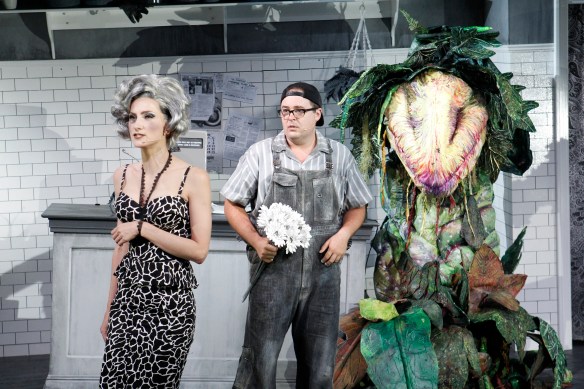
Esther Hannaford as Audrey, Brent Hill as  Seymour and Audrey II. Photo: Jeff Busby

With a wonderfully catchy score drawing on 1960s rock and doo-wop, a tight plot and razor-sharp lyrics, Little Shop has long been a crowd-pleaser. But Bryant’s superb production gives the show a fresh heart and dark edge that could hardly be bettered, balancing the show’s spoofy comedy and gritty themes perfectly.

Much of it is laugh-out-loud funny but we never lose sight of the fact that the plant feeds on greed and self-interest (even if it comes from a heartfelt, innocent place) as well as human flesh. It is also a metaphor for every fear about being invaded and consumed whether by aliens or migrants, communism or capitalism, anything we might consider threatening.

Owen Phillips’ superb, off-kilter set with its drab florist shop and clever projections on a front curtain embodies an inspired surprise in the way it plays with colour, while the plant itself is a series of remarkable, ever-bigger puppets by Sydney-based company Erth Visual & Physical Inc., eventually taking over most of the stage. When the plant gets its teeth into a full, meaty meal, it’s so well choreographed it’s stomach-turningly convincing.

Tim Chappel’s costuming is gorgeously kitsch, and Andrew Hallsworth’s witty choreography is sensational, ranging from a modern take on 1960s girl group moves to a hilarious Russian/Jewish folk dance with squatting kicks and turns for “Mushnik and Son”. Brought to vibrant, heightened life by Ross Graham’s lighting, the production is an eye-popping visual delight.

Musically the production is terrific too, performed by a five-piece offstage band led by musical director Andrew Worboys. At times, in a minor quibble, the sound is a bit loud for the tiny Hayes but that won’t be an issue when the production goes into larger venues on its national tour.

Bryant has cast the show beautifully. As Seymour and Audrey, two lost souls who briefly glimpse happiness, Brent Hill and Esther Hannaford give the production an aching heart.

LittleShop4

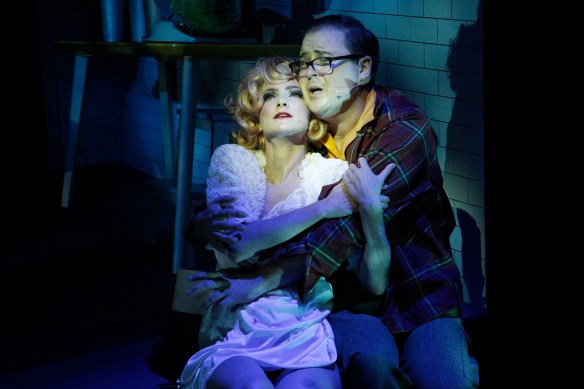
Esther Hannaford and Brent Hill. Photo: Jeff Busby

Hill is totally endearing as Seymour. In an intriguing move, Bryant has Hill voice the plant too, which opens up Seymour’s relationship with Audrey II to various interpretations. It means that Hill sings an extraordinary duet with himself in “Feed Me (Git It)”. It’s hugely demanding technically but Hill does it so superbly (a vocal tour de force) you don’t even realise he’s doing it initially.

Hannaford is exquisite as the ditsy Audrey, conveying her vulnerability and painful lack of self-esteem. Her comic timing is impeccable and her ravishing voice shimmers with emotion whether it’s gently caressing a ballad or soaring into the stratosphere. “Suddenly Seymour”, which she sings with Hill is a spine-tingling musical highlight.

Ellen Greene, who played Audrey in the original production and Frank Oz’s 1986 film, famously gave the character a girlish, breathy voice complete with lisp. Hannaford’s accent is less pronounced than that (mercifully) but mixes an Eastern European tinge into the New York drawl, which works well.

Scott Johnson is hilarious as the psychopathic dentist who gets high on nitrous oxide while inflicting pain, giving him a knowing swagger. Tyler Coppin is also very funny as the mercenary, unmensch Mr Mushnik.

LittleShopTrio

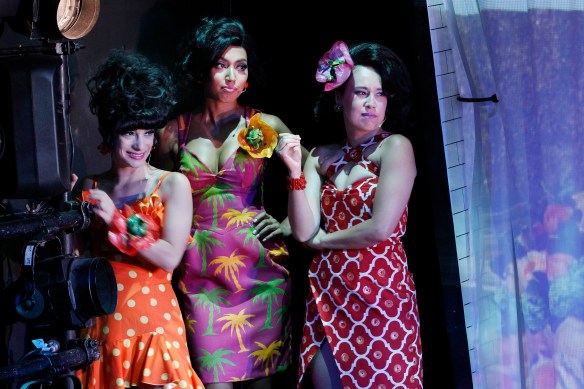
Angelique Cassimatis, Chloe Zuel and Josie Lane. Photo: Jeff Busby

As the sassy girl-group Greek chorus, Angelique Cassimatis, Josie Lane and Chloe Zuel each have a fierce individual presence and voice while harmonising tightly, raising the roof.

Bryant brings it all together in a production that is dazzlingly entertaining, creepy in a comical kind of way and yet tough enough to get under your skin and keep you pondering it long after the lights have gone down. Utterly brilliant.

Little Shop of Horrors plays at the Hayes Theatre Co until March 19. It then tours to Adelaide Festival Centre from April 20 – 29; Comedy Theatre, Melbourne from May 4– 12; Canberra Theatre Centre from May 25 – 29; QPAC, Brisbane from June 1 – 9; Roslyn Packer Theatre, Sydney from July 20 – 24; His Majesty’s Theatre, Perth from August 4 – 7.

 A version of this review ran in the Sunday Telegraph on February 28

Hey, there Georgy girl!

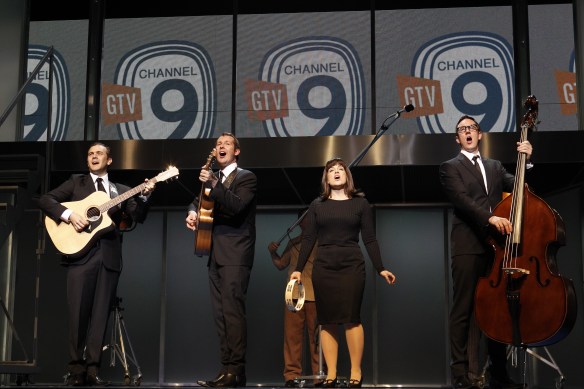
Pippa Grandison wasn’t interested in imitating Judith Durham, but in trying to find her spirit for Georgy Girl – The Seekers Musical 

GeorgyGirl

Pippa Grandison with Phillip Lowe, Mike McLeish and Glaston Toft as The Seekers in the musical Georgy Girl. Photo: Jeff Busby


When Pippa Grandison’s agent asked her if she was interested in auditioning for the role of Judith Durham in Georgy Girl, the new musical about The Seekers, she did some quick research, not knowing a great deal about them.

“I’d been hiding up in Terrigul being a mum for a while and not coming out for anything that didn’t really interest me or that took me away for too long from my family,” says Grandison who has a seven-year old daughter.

“I had a (listen) and I thought ‘I really do like that style of music’. And I looked on YouTube and saw Judith and I talked to my husband (actor Steve Le Marquand) and we both thought ‘gosh, there was something there’ (a similar quality). So I thought, ‘I’ll give it a go, throw my hat into the ring,’” says Grandison.

Several auditions later, Grandison was one of four girls in final contention for the role and desperately wanted it.

“The third audition was in Melbourne. They flew me down and the other girls were so fantastic. We could all hear each other, which was disconcerting. I came home and thought I did well but that I wasn’t going to get it, maybe because I wanted it so much and I started grieving,” says Grandison.

When the call finally came to say that the part was hers, she couldn’t believe it.

“It was so exciting. For two days I was jumping around the house with my husband and child,” recalls Grandison. “On the third day I got up and went ‘oh my gosh! What have I done? I’ve got to do it now. This is huuuuuge!’”

Grandison’s many musical theatre credits include Elphaba in Wicked, Mrs Banks in Mary Poppins, The Witches of Eastwick and We Will Rock You. She is currently on screen in the Channel Nine comedy series Here Come the Habibs! playing the well-heeled best friend of Olivia, the Habib’s appalling, antagonistic neighbour.

Georgy Girl premiered in Melbourne in December, and Grandison has received warm praise for her portrayal of the golden-voiced Durham.

Written by Durham’s brother-in-law Patrick Edgeworth, the show tells the story of The Seeker’s incredible rise to fame in the 1960s and Durham’s decision to leave the group just four years later as the US beckoned. It also covers her 25-marriage to pianist Ron Edgeworth and The Seeker’s sold-out 25th anniversary and 50th anniversary reunion tours.

Featuring their hit songs The Carnival is Over, I’ll Never Find Another You, A World of Our Own, Morningtown Ride, I am Australia and the Oscar-nominated Georgy Girl, the show arrives in Sydney in April.

pippa-grandison-298436-wfrpowwsrjlc

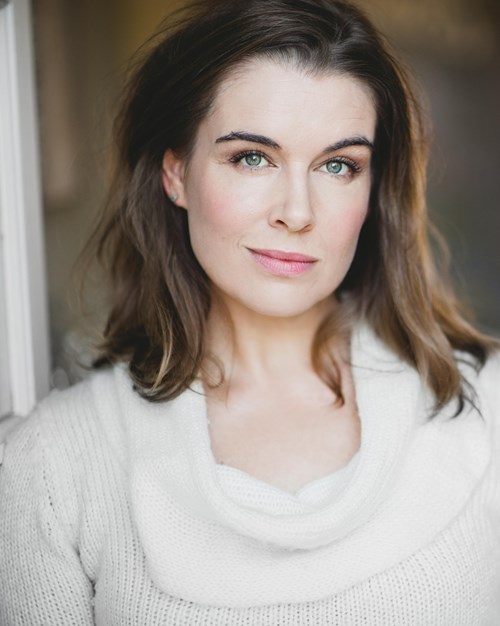
Pippa Grandison. Photo: supplied

Grandison got a chance to spent time with Durham on the publicity trail when the musical was first announced and soaked it all in.

“The first time I really started to get to know her was when we were being interviewed together and I just sat and watched and listened and learned so much about it. We do have some kind of a connection,” says Grandison.

“I can’t imagine the feeling of having someone play you. I wasn’t quite sure how she would respond to me but she’s very open, warm and encouraging. I hope I’m not speaking out of turn but I think she’s happy with my portrayal of her, and our portrayal of her story. She sent me a beautiful card and some flowers on opening night. It’s such an honour to be able to play her.”

Grandison says she wasn’t interested in doing an imitation of Durham – “and thankfully neither were the creative team. I think an imitation would be disrespectful to her and the fans really. Their memories are so precious and her voice has something so unique.

“I’ve obviously worked the voice so that I can get similar sounds but there will never be another Judith Durham so I just want to get the spirit of her.”

Grandison says that she and Phillip Lowe, Mike McLeish and Glaston Toft who play the other members of The Seekers worked really hard in rehearsals on getting their voices to blend and create a similar sound to the original band.

“We all really wanted to get that right: listening to each other and no-one singing over the top of each other. Once you get into the theatre it changed because you don’t hear each other like you do when you are just sitting around a room singing because you don’t get the fold back and in different spots it’s really hard to hear each other so you just have to hold on to that memory and listen to each other as much as you can.”

Watching her during the media interviews they did together, Grandison says she was struck by how calm Durham is.

“I noticed particularly how present she is. She has a stillness about her. It’s quite intense but it’s a soft, gentle energy. She’s very present and she listens intently and focuses you. She meets your gaze and she stays there.”

This is only the second time Grandison has originated a role in a brand new musical – in 1988 she took on the title role in David King and Nick Enright’s musical Mary Bryant at the Ensemble – and she says it is “a tremendous experience”.

“I think we are all really proud that it’s an Australian production, it’s an Australian story and it’s an Australian cast. It’s a dream come true. I’m not sure if I’ll ever get the opportunity again. It is really special. Sometimes I have to pinch myself,” she says.

“I’ve never been in a show where the response has been so wonderful. You look out during the show and there are people singing along or laughing or crying or sharing memories together and at the end they are on their feet cheering. I think all of us at the end of the show come off going ‘wow!’ every time.”

Georgy Girl plays at Her Majesty’s Theatre, Melbourne until March 20. Bookings: www.ticketek.com.au or 132 849. State Theatre, Sydney, April 2 – June 5. Bookings: Ticketmaster 136 100

A version of this story ran in the Sunday Telegraph on February 21

The Whale

Old Fitz Theatre, February 18

KeithMeredithThe Whale

Keith Agius and Meredith Penman. Photo: Rupert Reid

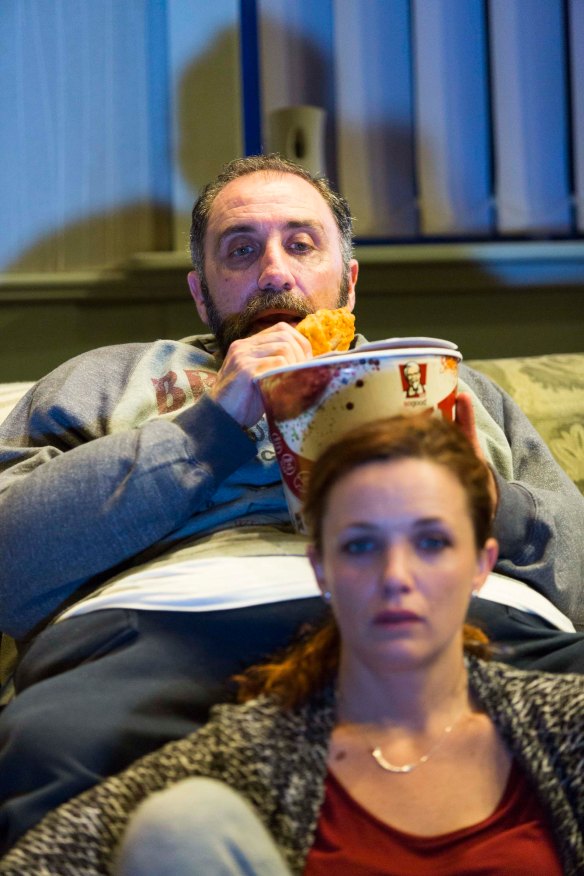
The lights go up on a morbidly obese man. Charlie is 600-pounds and counting – not just his weight but the number of days he has left.

“Do you find me disgusting?” he asks visitors several times during the course of Samuel D Hunter’s moving play The Whale, set in Idaho on the outskirts of Mormon country.

It’s certainly confronting initially to see someone so overweight, beached on a sofa gorging on fried chicken or masturbating to gay porn. But beneath the bulk, Charlie (Keith Agius) has an agile mind and a huge heart.

He teaches essay writing to English Literature students online (with the camera turned off). He has a close, loving friendship with Liz (Meredith Penman), a nurse who visits regularly and cajoles him into leading a healthier lifestyle while bringing him the junk food he now craves.

He is also desperate to re-connect with his estranged daughter Ellie (Chloe Bayliss), a troubled teenager whose need for love has turned into spitefulness and who he basically bribes to be there. Constantly prickly and sometimes downright vicious, Ellie lashes out at Charlie, who with the patience of a saint is prepared to take whatever she has to give in order to get to know her.

Into the mix comes a young Mormon, Elder Thomas (Alex Beauman) who wants to interest Charlie in the Church of Latter Day Saints. Charlie’s former lover Alan, it transpires, was also a Mormon. Latter in the play, Charlie’s ex-wife Mary (Hannah Waterman), a single mother doing it pretty tough, also appears.

Gradually, we discover why Charlie is eating himself to death, and what has brought all the other characters to this point.

Lacing The Whale with references to Moby Dick and the Biblical tale of Jonah and the whale, Hunter has written a humane, tender and compassionate play, which takes in themes including homophobia, religion, small-mindedness, self-loathing, grief and family.

Designer Charlie Davis has used the Old Fitz space cleverly, suggesting a hallway and other room beyond the rather squalid sitting room where the play takes place. There are also rows of seating on one side of the stage to create a more intimate performance space. Davis’s costuming is also spot-on as is Alexander Berlage’s lighting.

AlexKeithThe Whale

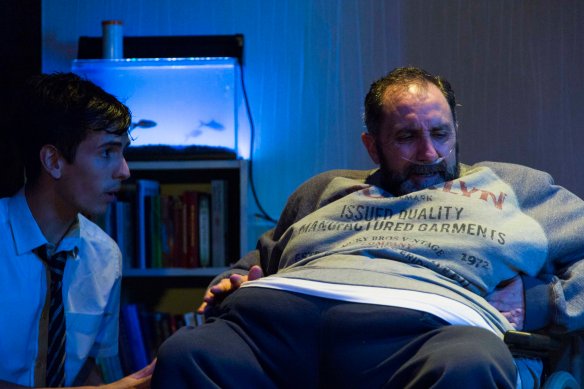
Alex Beauman and Keith Agius. Photo: Rupert Reid

Shane Anthony directs a tight, beautifully performed production. Agius, who wears a fat suit, conveys Charlie’s physical decay brilliantly: the laboured wheezing breath, the heart palpitations and the struggle to move. But he also warms the cockles of your heart with his endearing portrayal of a man who is patient, kind, loving, understanding and desperate to atone for previous wrongs: a true gentle giant.

The other actors all offer utterly believable, touching portrayals of people struggling with their own problems and hurts. The relationships that develop between them take you by surprise and the ending of the play is deeply affecting. Recommended.

The Whale plays at the Old Fitz until March 4. Bookings: www.oldfitztheatre.com

Ladies in Black

Southbank Theatre, The Sumner, Melbourne, February 4

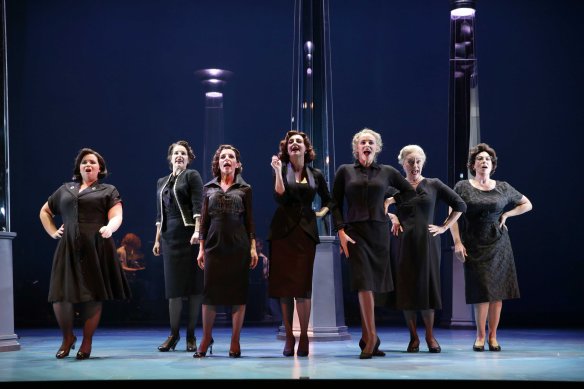
Kathryn McIntyre, Kate Cole, Christen O’Leary, Naomi Price, Lucy Maunder, Deidre Rubenstein, Carita Farrer Spencer

Kathryn McIntyre, Kate Cole, Christen O’Leary, Naomi Price, Lucy Maunder, Deidre Rubenstein, Carita Farrer Spencer. Photo: Rob Maccoll

Enchanting. That’s the word you keep hearing when people discuss the new Australian musical Ladies in Black – and enchanting it is.

It’s wonderful to see an Australian musical that succeeds so well as a show, feels distinctively Australian and strikes such a chord with audiences. What’s more, unlike hit musicals Priscilla Queen of the Desert and The Boy From Oz, which use existing songs, Ladies in Black has an original score written by Tim Finn.

It was Finn who initiated the project, having had his interest piqued in writing a musical after a dozen of his pop songs were used in Poor Boy, a 2009 play with music by Matt Cameron. Finn approached Simon Phillips, the director of Poor Boy, who quickly became interested in the idea of Ladies in Black and agreed to direct it, bringing his wife Carolyn Burns on board to write the book, which is adapted from Madeleine St John’s 1993 novel The Women in Black.

Regular Phillips collaborator Gabriela Tylesova was enlisted to design set and costumes, Guy Simpson joined the team as orchestrator and musical supervisor, with Andrew Hallsworth as choreographer and David Walters as lighting designer. Together, they proved to be a match made in heaven and the results are a true delight.

Produced by Queensland Theatre Company, Ladies in Black premiered in Brisbane in November and was then presented by Melbourne Theatre Company in Melbourne, where it opened in January and runs until February 27.

Set in Sydney in the 1950s, it tells the coming-of-age story of high school leaver Lisa Miles; a story which embodies the changing role and status of women in Australia at that time. It’s also about a city and a country on the cusp of becoming cosmopolitan thanks to the influx of European immigrants or “continentals” as the Australian characters call them.

LadiesChristen

Christen O’Leary as Magda and Sarah Morrison as Lisa. Photo: Rob Maccoll

Lisa, who is super-bright, wants to go to university if she gets the high grades anticipated. Her mother is supportive but her working class father won’t have a bar of it. As he sees it, a secretarial course is more than enough education for a woman; he’s already been generous in letting her stay on at school.

Over the Christmas holidays, Lisa gets a job at Goodes, Sydney’s most prestigious department store (a thinly disguised David Jones). Naïve and mousey when she starts, her horizons are rapidly expanded by the two women she assists in Ladies Cocktail Frocks, Patty and Fay, and particularly by the enigmatic Magda, a Hungarian refugee, who oversees the more exclusive attire in Model Gowns.

Magda takes a shine to Lisa and invites her home to meet her husband Stefan, where Lisa is excited by the chance to taste different food, discuss literature, dance and glimpse a far more bohemian, cultured, passionate lifestyle.

Woven through this narrative are the stories of Patty, who desperately wants a child but whose husband walks out on her when the infertility problem seems to be his, and Fay, a lively young woman with a past who would dearly love to settle down but who can’t find a man who wants more than a brief fling.

Burns’ book skilfully juggles the various stories and while it doesn’t go into great depth, the characters are well enough drawn and so beautifully performed that we believe in them, warm to them and care about them all.

In a succinct piece of storytelling, we also meet the lonely, kindly Miss Jacobs, whose fiancée was killed during the First World War. In a few brief moments we learn enough about her to be very moved by a short scene showing her at Christmas.

Finn’s music, which ranges in style from country ballads to soaring romantic odes to comedy numbers, is charmingly melodic. There isn’t a big 11 o’clock number, which wouldn’t go astray. Instead, the show ends with a reprisal of a song called “Tomorrow Becomes Today”.

The lyrics, also written by Finn, are sharp and witty, drawing on the Australian vernacular to great comic effect in numbers including the show-stopper “He’s a Bastard”, which gets a huge response. Fay’s song “I Just Kissed a Continental” is also joyously uplifting.

Performed by a six-piece band led by musical director David Young, the thoroughly engaging score has been given some lovely arrangements by Simpson.

Phillips, whose musical theatre credits include Priscilla, Love Never Dies and The Drowsy Chaperone among others, directs with consummate flair, keeping the action moving swiftly and seamlessly, aided by the three stage revolves incorporated into Tylesova’s design. Together with Hallsworth’s choreography, all the moments land from poignant moments of quiet drama to the exuberant showpieces.The only scene that feels under-staged (because of cast size and logistics) is Magda’s New Year’s Eve party where Magda essentially narrates what happens (including Lisa meeting a young man) and we just see silhouettes of people dancing.

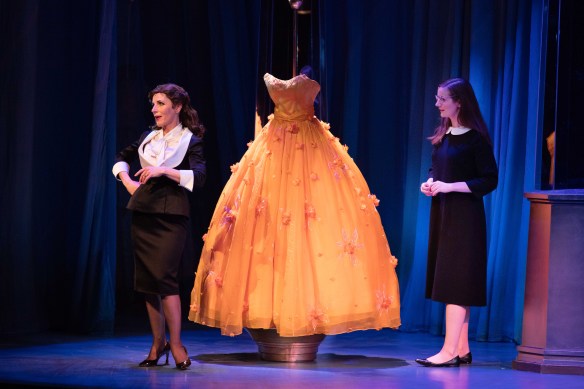
Tylesova’s set features several Perspex pillars to suggest the elegance of Goodes, along with various props from clothing racks to tables and chairs, which appear quickly for the different settings. Her costumes are just gorgeous from glamorous gowns to colourful cotton frocks to 1950s beachwear.

LadiesinBlack4

Kate Cole and Lucy Maunder (front); Naomi Price, Deidre Rubenstein and Christen O’Leary (behind). Photo: Rob Maccoll

The cast is uniformly terrific – and given that the musical is primarily about women, it’s wonderful to see such a large, strong female cast. Sarah Morrison convincingly portrays Lisa’s gradual blossoming from shy, gauche youngster to confident young woman ready to face a brave new world. And, yes, she wears glasses initially which are later removed – a well-worn trick but one that works.

Lucy Maunder brings a luminosity and vulnerability to Patty, subtly conveying her confusion and heartache when her husband leaves. Naomi Price is wonderfully vivacious as Fay, and has us all rooting for her to find love. Christen O’Leary brings just the right level of exoticism to Magda, while the warm, loving, playful relationship she has with her Hungarian husband is delightfully evoked by her and Greg Stone.

Deidre Rubenstein gives a touching performance as the lonely Miss Jacobs, Carita Farrer Spencer conveys a quiet strength as Lisa’s mother, while Kate Cole and the very funny Kathryn McIntyre, both impress in double roles.

As the men in the women’s lives, Stone is excellent, giving two very different performances as Lisa’s disciplinarian, working class father and Magda’s loving, supportive husband. Bobby Fox is heartwarmingly charming as Rudi, another young Hungarian refugee and friend of Magda’s, and gets to dazzle with some fancy footwork, while Andrew Broadbent captures the emotional repression of Patty’s “bastard” Aussie husband Frank, later revealing the shame and hidden pain he is struggling with.

While tackling themes including the cultural cringe, sexism and xenophobic attitudes to refugees, Ladies in Black doesn’t dig that deep in its exploration of the era and has a light, almost fairytale feel to it. Nonetheless, the issues are still strongly felt and we care about all the characters. It’s a beguiling, joyous show and sent me home floating on air. Hopefully someone will bring it to Sydney – it certainly deserves to be more widely seen.

Ladies in Black plays at The Sumner, Southbank Theatre until February 27. Bookings: www.mtc.com.au or 03 8688 0800

The Blind Giant is Dancing

Belvoir St Theatre,  February 17

BlindGiant1

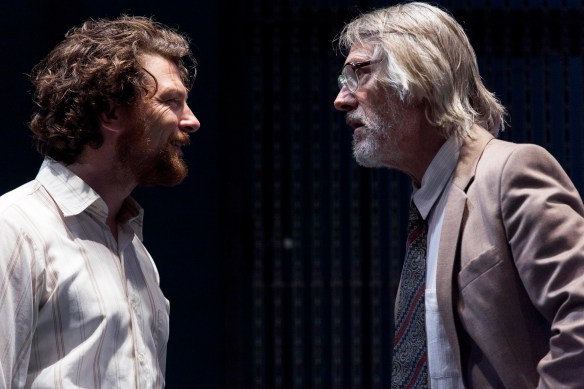
Dan Spielman and Geoff Morrell. Photo: Brett Boardman

Stephen Sewell’s blistering 1983 play The Blind Giant is Dancing is very much of its time but it still feels timely in this ferociously good Belvoir production.

The epic drama is set in the world of NSW State Labor party politics in the early 1980s at a time when Australia’s strong manufacturing base was being dismantled in favour of a free market, with devastating consequences for the working class. Seething with political intrigue, Sewell looks at how power corrupts and at how individuals both shape and are shaped by the world around them.

At the centre of the play is Allen Fitzgerald (Dan Spielman), a social economist and Marxist from a working class Catholic family who begins as an idealist. Unhappily married to Louise (Yael Stone), a Jewish feminist socialist, he is seduced by financial journalist Rose Draper (Zahra Newman) and becomes so caught up in a political power struggle that he sells his soul and his family down the river.

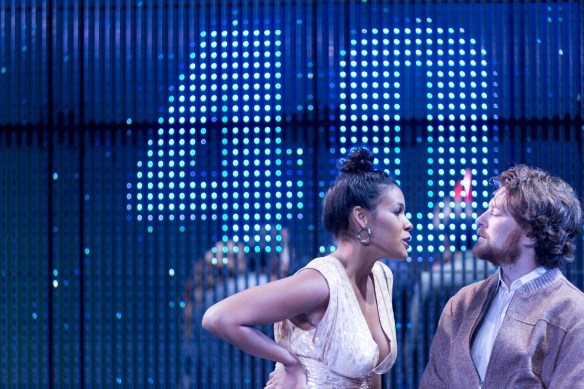
Director Eamon Flack and designer Dale Ferguson bring the play to furious life on a stark set at the centre of which is a large screen, which can either resemble the metal bars of a cage allowing us to see scenes behind it or light up with dazzling brightness, flashing up place names and images to locate the numerous different scenes. It’s a clever solution for a play with umpteen short scenes, while Ferguson’s keenly observed 80s costuming evokes the period.

Steve Toulmin’s sound, which includes bursts of 80s pop songs, and Verity Hampson’s lighting enhance and punctuate the fast-paced staging.

BlindGiantZahra

Zahra Newman and Dan Spielman. Photo: Brett Boardman

Unfolding over three acts with two short intervals, Act I requires great concentration as Sewell establishes the main players including: Allen’s arch foe Michael Wells (Geoff Morrell), a corrupt Social Democratic Party secretary; Mr Carew (Michael Denkha) an American advisor to Wells; Bob Lang (Ben Wood) an obnoxious, misogynistic banker; and Ramon Gris (Ivan Donato) a Chilean socialist exile working with Allen, among others.

Flack directs at a cracking pace and it is hard initially to get your head around it all with so much coming at you. But as soon as Act II begins, everything becomes clear and from there the play hurtles along like a runaway train as scenes become shorter and snappier, keeping you riveted.

A family barbecue in Port Kembla where we meet Allen’s father (Russell Kiefel) and brother (Andrew Henry), who are both steelworkers, and his housewife mother (Genevieve Lemon), brings a human face to the politicking. It also gives us an insight into Allen’s tortured personality.

Spielman gives a performance of extraordinary intensity, his body language reflecting the passion that drives him and is tearing him apart. As he slides deeper into the morass, his physicality and vocals become ever more aggressive, his humour ever more sardonic. It’s a huge, demanding role and Spielman is utterly convincing every step of the way.

Stone gives an equally passionate performance as Allen’s activist wife who refuses to play the role of housebound homemaker. Kiefel is superb as both wily capitalist Sir Leslie Harris, who is prepared to take Wells on in the battle over the steel industry, and as Allen’s father Doug who rules the family with a rod of iron. In another compelling performance, Morrell’s Wells has a recognisable touch of the mongrel about him.

BlindGiantYael

Genevieve Lemon and Yael Stone. Photo: Brett Boardman

Lemon brings a gentle humour to Allen’s mother and her efforts to keep the peace within her family are quietly touching, while Newman imbues the seductive Rose with a fascinating sense of enigma. However, the acting is incredibly strong across the board.

Blind Giant is driven by a visceral rage, which Flack’s production captures superbly. At times it feels as if Sewell is delivering an impassioned lecture but overall it’s compelling stuff with an astonishingly good performance by Spielman at the heart of a wonderfully fierce production.

The Blind Giant is Dancing plays at Belvoir St Theatre until March 20. Bookings: www.belvoir.com.au or 02 9699 3444

Arcadia

Drama Theatre, Sydney Opera House, February 12

ARCADIA1

Glenn Hazeldine and Ryan Corr. Photo: Heidrun Lohr

Ryan Corr gives a standout, charismatic performance in Tom Stoppard’s brilliantly clever 1993 play Arcadia but the production itself wasn’t quite firing on all cylinders on opening night.

Set in a stately English country estate called Sidley Park, Arcadia unfolds across two time frames, with alternating scenes set in the early 1800s and the 1990s (which eventually begin to overlap and share the stage).

Beginning in 1809, teenage genius Thomasina Coverly (Georgia Flood) is discovering chaos theory and the Second Law of Thermodynamics a century before anyone else under the admiring eye of her dashing, witty tutor Septimus Hodge (Corr). Meanwhile, the garden is being transformed from a classical idyll to a Gothic wilderness.

In the same room 200 years later, Bernard Nightingale, a smug, ambitious Byron scholar (Josh McConville) desperate to prove that Byron fled England after killing a minor poet in a duel at Sidley Park, and Hannah Jarvis (Andrea Demetriades) a historian and author researching the mysterious hermit who lived in the garden’s faux hermitage, try to piece together the past from notes, drawings and other bits and pieces, which we have seen being created.

With illicit affairs, love, iterated algorithms, discussions about determinism and free will as well as Romanticism and Classicism in the mix, it’s heady stuff.

Richard Cottrell directs a sound, lucid, well-staged production on a handsome classical set by Michael Scott-Mitchell with stylish costumes by Julie Lynch.However, in striving to make Stoppard’s dazzling wordplay and complex ideas understandable to an audience, some characters feel underdeveloped and a little of the play’s sparkle and magic was lost on opening night.

At the moment, the historical scenes have a better rhythm than the contemporary ones where not all the humour lands, and there are times when the play feels pretty dense without enough of a leavening human dimension.

Corr has a wonderful, natural ease and charm as Septimus. He handles the zippy dialogue beautifully and his scenes with Flood have depth, heart and a lovely energy, though a stronger chemistry between them as the play progresses would make the ending more moving.

ARCADIA #2-749

Andrea Demetriades and Josh McConville. Photo: Heidrun Lohr

Demetriades gives a strong performance as the wryly sceptical, somewhat stand-offish Hannah though one senses that there is more to find her character (a loneliness is hinted at in the play) and in her relationship with McConville’s Bernard, which we gather is underpinned by a sexual attraction, though there is little chemistry here.

McConville looks a little ill at ease as Bernard, though his zinging barbs are often very funny. Michael Sheasby gives a lively portrayal of Valentine, a gifted mathematician like his ancestor Thomasina before him, and Glenn Hazeldine is a hoot as Ezra Chater, a poet with precious little poetry in his soul whose wife has been discovered in “a carnal embrace” with Septimus. But not all the other performances feel entirely believable.

Given the brilliance of Stoppard’s writing and the top-notch production values, there is already much to enjoy but once the production settles, the cast will hopefully convey more of the play’s humanity and passion, and then it will really soar.

Arcadia plays at the Drama Theatre, Sydney Opera House until April 2. Bookings: www.sydneytheatre.com.au or 02 9250 1777

 A version of this review ran in the Sunday Telegraph on February 14