Sigrid Thornton Gets Musical with Fiddler

Fiddler1

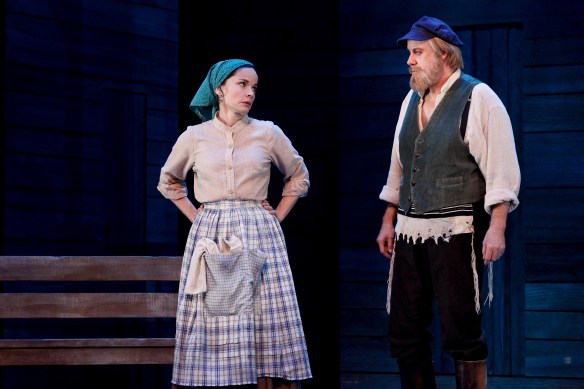
Sigrid Thornton with Anthony Warlow in Fiddler on the Roof. Photo: Jeff Busby

With 40 years of high-profile acting credits to her name, Sigrid Thornton is Australian showbiz royalty. But resting on her laurels clearly has zero appeal. Instead, she is always on the look out for roles that will challenge her and teach her something new.

Take the new Australian production of Fiddler on the Roof in which she plays Golde, the wife of Tevye (played by Anthony Warlow) the milkman with five daughters who tries to hold onto tradition in a changing world.

Directed by Roger Hodgman, the production opened in Melbourne at the end of last year and has its official Sydney opening tonight.

“It’s my second musical. I have to laugh because I never imagined that I would ever work in musical theatre but it started with A Little Night Music (for Opera Australia in 2009, also with Warlow). And I love it, I absolutely love it,” says Thornton.

“There’s something about having (a score). This is really from Anthony’s mouth so I’ll quote him in saying that it’s a soundtrack for your performance – because that is exactly what happens. Having musical accompaniment, working with an orchestra and actually singing some of your emotions is very exciting. I’m on a huge learning curve. I’m surrounded by people who have been doing it for a very long time and that is an attraction.”

This time around Thornton decided to take singing lessons before going into rehearsals.

“That was an attraction for me, a genuine pull. I said ‘if I’m going to tackle this at all I wanted to improve my singing voice,’” she says brightly.

“Now, I’m not in the job to sing like Anthony or indeed any of the other singers in the show but having said that I fancy that my voice has definitely strengthened during the course of the run. I always wanted to be able to pull off a song better, simply for my own pleasure. I never imagined I’d be able to put it to professional use but it’s been a gift.

“It’s always a gift to keep learning. It sounds terrifically corny but that’s why I’m still doing what I do. I like to keep stretching it out and discovering what I can and can’t achieve. You are always discovering the limitations and boundaries of your skills but you want to try and extend those as much as possible,” she says.

Fiddler2

Sigrid Thornton as Golde in Fiddler on the Roof. Photo: Jeff Busby

Thornton has a small, light singing voice, it must be said, but she creates a strong, believable character as Golde.

Set in 1905 in a small Jewish village in Tzarist Russia, which the inhabitants are forced to leave at the end of the show, Fiddler on the Roof is a musical theatre classic with a much-loved score including songs such as If I Were a Rich Man, Tradition, Matchmaker and Sunrise Sunset.

“It’s about a marginalised people but fundamentally it’s about love and family and community and connection and so they’re universal themes. Despite the fact that the show has been around a long time, the refugee thing is more current now than ever,” says Thornton.

Prior to rehearsals, Thornton knew the show “to the extent that a musical tourist would know it. I’d seen the film many years ago and I’d seen Topol (playing Tevye on stage) maybe 11 or 12 years ago,” she says.

“This is a very different production. One of the major differences is that it is a new orchestration. The most recent London production negotiated to do a new orchestration, which is a very complex thing as you can imagine, and so we were able to ride with that and it’s very beautiful. It’s much simpler, much more folky and it’s probably more true to the music culture of the day.”

With her children now grown-up, Thornton has been able to take on plenty of work in recent years.

“I’ve always been a career mother but I actually have had long periods away from work for reasons of family. But the kids are now 24 and 30 so they are adults,” she says.

She has certainly been busy. Last year, she received accolades for her performance as Judy Garland in the Channel Seven miniseries Peter Allen: Not the Boy Next Door. She has joined the cast of Wentworth, Foxtel’s contemporary re-imagining of Prisoner, playing a cosmetic executive accused of murder.

“I have the honour and privilege apparently of being the only original Prisoner cast member to appear on Wentworth,” she says.

She also has a role as a cyber-security executive in the second series of the ABC’s acclaimed political drama The Code and features in the Cairnes Brothers’ much anticipated second feature Scare Campaign.

“It’s actually been quite a roller-coaster year now that I think about it,” she says of the past 12 months or so.

“That was another attraction to Fiddler – to play a serious character role in something that was a different medium because I’ve done quite a lot of films and television recently. That’s been really exciting but I wanted to try something completely different as Monty Python would say.”

Now 57, Thornton says she needs “to explore what’s out there for women my sort of age. There are still limitations for women but I think the gap will gradually close on that score. I think it’s really interesting looking at what’s coming out of the States. I was browsing through Variety the other day (and looking at) the pilots that are being made in the States and the majority seemed female driven and I was quite interested to see that.

“I’m an optimistic type. That’s my personality. I think in general equality and opportunity for the sexes (in Australia) has still got a fair way to go for a country that’s highly developed in all sort of ways. But it is changing and it’s changing for the better.”

Fiddler on the Roof plays at the Capitol Theatre, March 24 – May 6. Bookings: Ticketmaster 136 100

 A version of this story ran in the Sunday Telegraph on March 20
Ghost the Musical

Theatre Royal, March 18 & 19

Ghostwheel

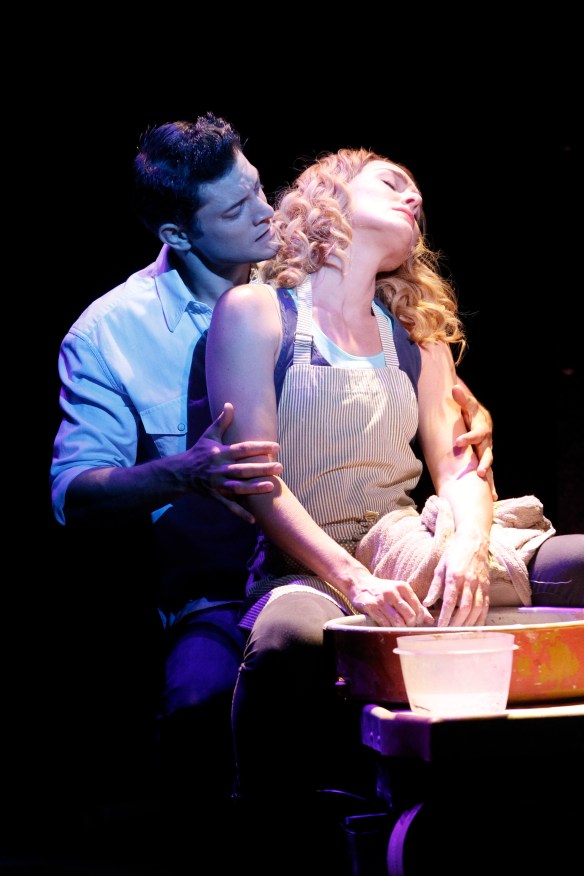
Rob Mills and Jemma Rix as Sam and Molly. Photo: Jeff Busby

Based on the hugely popular 1990 film starring Demi Moore and Patrick Swayze, Ghost the Musical has a lot to live up to – but happily it has been translated to the stage with plenty of whiz-bang flair. It’s certainly not the greatest musical ever written but it’s great entertainment.

Adapting his own Academy Award-winning screenplay, Bruce Joel Rubin sticks fairly faithfully to the film with a few minor changes to the supernatural love story-cum-thriller.

High-flying banker Sam Wheat (Rob Mills) and his sculptor girlfriend Molly Jensen (Jemma Rix) have just moved into their dream loft apartment in Brooklyn. Returning home from a romantic dinner, Sam is killed in a street mugging but finds himself trapped between this world and the next as he tries to save Molly from mortal danger.

Directed by Matthew Warchus (Matilda the Musical), the production creates a tangible sense of the gritty New York world where the story is set. The show has a cinematic feel, not just in its use of Jon Driscoll’s dynamic video projections – which help establish the different locations and support a number of the illusions including the subway scene – but in the way Warchus keeps the action flowing swiftly and seamlessly.

Stage illusionist Paul Kieve does an ingenious job of creating spectacular supernatural effects on stage, from Sam passing through a solid door to departed souls being whisked to heaven or hell.

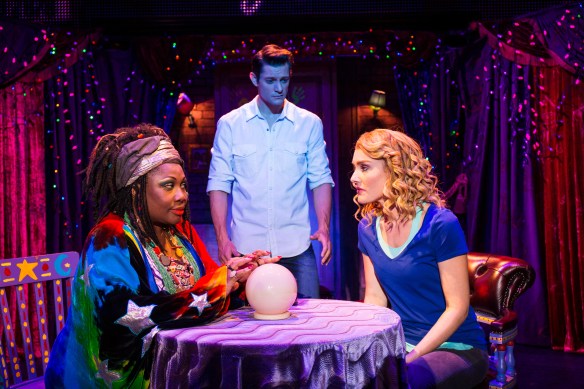
Having Sam in a white shirt under pale blue lighting, with a slight reverb on his voice, works well to differentiate him from the living characters. Bobby Aitken’s sound effects heighten the supernatural aspect, while Hugh Vanstone’s coloured, rock concert lighting is also integral to the visual wizardry.

And, yes, the iconic pottery wheel scene with its wet, slippery clay is there but at a different point in the story when Sam is already dead. It’s much less erotic, which is a sensible, tasteful decision, but the scene is so short you can sense disappointment from the audience.

The book and lyrics are humdrum at times and the pop rock score by Dave Stewart of the Eurythmics and heavyweight producer Glen Ballard isn’t wildly memorable. Nor do the songs always move the action forward. However, they are catchy enough, while the best – such as Molly’s lyrical ballads With You and Nothing Stops Another Day – have lovely melodies. The Righteous Brothers’ iconic Unchained Melody from the film is used effectively as a motif through the show.

Too often, Ashley Wallen’s uninspiring choreography looks as if the ensemble members are dancers in a music video clip rather than their movement supporting and adding to the scene. However, the physical language used for Sam as he starts to negotiate the world as a ghost is cleverly done. Accompanied by swooshing sound effects that seem to slice the air, the movement creates a believable illusion of Sam passing through bodies and being unable to grip objects. Mills, David Denis as the subway poltergeist and David Roberts as Carl all handle the physicality convincingly as they are thrown around in supernatural fight scenes.

GHOST3

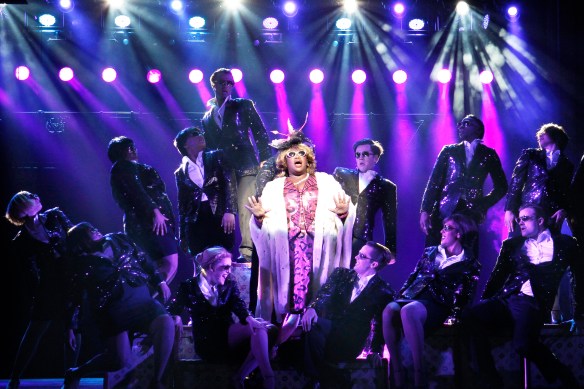
Wendy Mae Brown and ensemble cast. Photo: Jeff Busby

The musical really takes off with the appearance of Oda Mae Brown, the phony psychic who is astonished to discover she can hear Sam. British actor Wendy Mae Brown almost puts Whoopi Goldberg in the shade with her larger-than-life, sassy, gloriously comic characterisation. She has a rich, honey-smooth voice, nails every comic moment and raises the roof with her gospel-infused numbers.

Rob Mills and Jemma Rix have a nice rapport and work well together vocally. Rix conveys Molly’s heartache without becoming soppy and her voice is gorgeous whether she’s unleashing a powerhouse belt or touching the heart with a pop ballad.

Mills has always been hugely likeable on stage but here he matches it with a performance that delivers dramatically and emotionally. We share his frustration and his shock at Carl’s betrayal, while his grief and love for Molly feel real. His singing is also stronger than ever, and he really rocks his big number I Had a Life.

David Roberts plays Carl with just the right mix of easy charm and ruthlessness without overdoing it in a strongly acted performance. Ross Chisari is suitably thuggish as hood-for-hire Willie Lopez and David Denis exudes plenty of agro as the hip-hop subway ghost.

For all its flaws, Ghost the Musical is cleverly staged and extremely entertaining. It sweeps you up in its story-telling and while the flashy staging ramps up the wow factor, the emotional story still shines through. Clearly some remained untouched but to my surprise I was in tears at the end, and I wasn’t alone.

Ghost the Musical plays at the Theatre Royal until May 14. Bookings: www.ticketmaster.com.au 136 100

 A version of this review ran in the Sunday Telegraph on March 20
HUANG YI & KUKA

Everest Theatre, Seymour Centre, March 16

HuangKuka

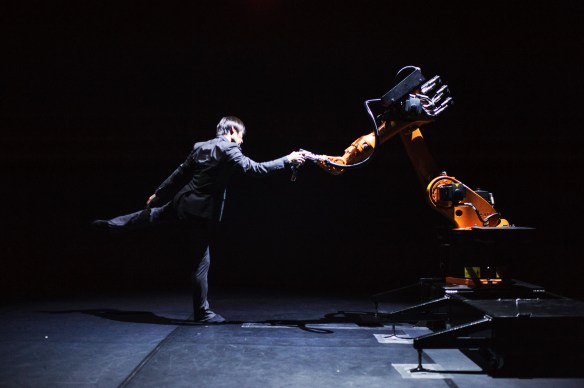
Huang Yi and a robotic KUKA in New York in 2015. Photo: Jacob Blickenstaff

As a child, Huang Yi longed for a robotic companion. In his 2013 work, HUANG YI & KUKA he dances with one.

The Taiwanese dancer/choreographer was born into a wealthy family. But, as he explains in the show’s program, when he was 10, investment losses led to his parents going bankrupt, forcing them to move from a luxurious home to a small room.

Witnessing his parents’ distress, Yi felt that he needed to be the perfect child and became emotionally detached. His favourite cartoon was the Japanese manga series Doraemon, which featured a robotic cat that solved all its owner’s problems.

Says Yi: “For me, HUANG YI & KUKA is a process of beautifying the sorrow and sadness when I grew up. It is the expression of loneliness, self-doubt, self-realization, and self-comfort. I was trying to make a beautiful illusion just to assure others that everything was fine. I wanted to remind us of our simplest hope from the very beginning, that we are all just grown up kids, but still kids.”

KUKA (named after the German robotics company that manufactures it) is very obviously a machine – a big, orange, robotic, mechanical arm designed for factory work that sits on a solid black base. This particular robot is apparently a KR16-2 model and was provided by KUKA Australia. But its long spine is very flexible – it can spin around and undulate – and as Yi interacts with it, the results are surprisingly touching.

The piece opens with Yi sitting up slowly in a square of light (a lovely image), while KUKA creates its own field of light with a torch it holds. The work unfolds in semi-darkness with Yi and the robot illuminated by spotlights. Sometimes KUKA uses its torch and sometimes a green or red laser.

In the first three sections, Yi – who is a lovely dancer – interacts with the robot. He reaches towards it and dances in and around it; at other times he sits a little way off on a chair.

Their movement frequently mirrors each other with a surprising similarity: the ripple of a spine, the spin of an arm, a gentle touch of the hand. Increasingly, the robot feels like a curious, sensate being, even though we are always aware of the clank, buzz and hiss as it moves. At times it resembles a giant bird.

These sections have a bittersweet air of melancholia. The music by Arvo Pärt and Mozart among others (it’s a shame the program didn’t list the music used) contributes to the emotion in no small measure.

HuangKuka2

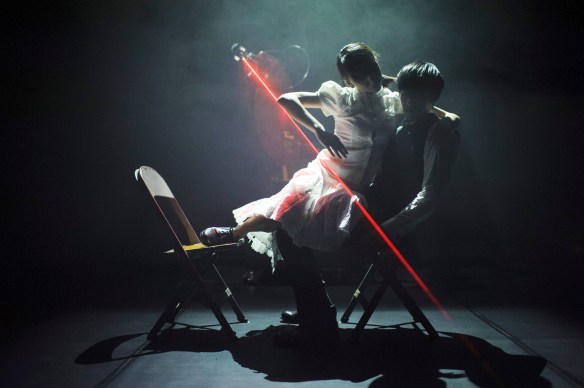
Lin Jou-Wen and Hu Chien. Photo: Jacob Blickenstaff

In the final section, two other dancers – Hu Chien and Lin Jou-Wen – sit on two chairs facing each other in front of the robot. Their jerky movement suggests mechanical humans being manipulated by KUKA and its laser. The inference is that there is a fine line between us controlling technology and technology increasingly controlling us.

Given that it apparently takes around 10 hours to program one minute of robotic movement, HUANG YI & KUKA is an amazing achievement and clearly an act of love on Yi’s part though the work does feel over-extended, particularly a section with a metronome.

The Everest Theatre is not an ideal venue. The work cries out for a more intimate setting and because it’s performed in half-light some had trouble seeing. Sitting near the back of the theatre, my plus one struggled to make out parts of it and found the experience frustrating.

On the other hand, I was charmed by so many little moments – the way the robot delicately tips a chair towards Yi, for example – and found much of it beguilingly beautiful.

HUANG YI & KUKA plays at the Seymour Centre until March 19. Bookings: www.seymour.com or 02 9351 7940

Swansong

Old Fitz Theatre, March 15

Swansong

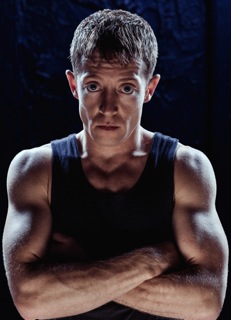
Andre de Vanny. Photo: Robert Catto

In the late-night 9.30pm time slot at the Old Fitz Theatre in Woolloomooloo, Andre de Vanny is performing Connor McDermottroe’s solo show Swansong. Returning after a brief season in the same venue at the end of last year, it’s a sterling performance that is very much worth catching.

McDermottroe is an Irish actor, writer and director, who lived in Australia for 10 years in the 1980s after coming to the Sydney Festival with the Druid Theatre Company. Swansong is set mainly in his native Sligo and centres on a troubled, violent misfit called Occi Byrne, the illegitimate child of a single mother in the Catholic West of Ireland whose life has been lived on the margins for as long as he can remember.

Occi suspects that an unfortunate but typically rash, barrel-rolling incident as a child may have shaken his head a bit loose. Be that as it may, he is full of uncontrollable rage that can bubble over in an instant. One particular piece of name-calling is guaranteed to get him really riled and then look out. At the same time, he has a poet’s eye as well as a keen sense of self-awareness and can spin an eloquent, compelling yarn.

It’s similar terrain to Enda Walsh’s Misterman and Mark O’Rowe’s Howie the Rookie, both given superb productions in recent times at the Old Fitz. Swansong may not be in quite the same league as a play, though there is plenty to admire and enjoy in the writing. But De Vanny’s performance is every bit as electrifying.

We meet Occi feeding a swan he has named Agnes. Swans mate for life, he tells us, but Agnes is alone after two swans fought over her and died. Instead, Occi is there for her, bringing her bread and finding strength in her grace and beauty. From there, he takes us on a journey through his miserable life from school days to a disastrous attempt to join the army.

After an appalling incident at the social security centre, Occi spends time in a psychiatric hospital where he glimpses salvation in the form of a depressive young woman called Mary. There’s also a blissful afternoon on an island while he is working on a fishing trawler. But with Occi’s explosive temper happiness isn’t destined to last.

Directed by Greg Carroll, De Vanny keeps the audience gripped for the play’s 80-minute duration. Wiry, compact and muscly with blazing eyes, he is able to spin on a dime – dancing around like a boxer, cheery, optimistic and laughing one minute; the next, his body contorted into a tense knot of coiled energy, eyes cold and crazed. Physically and vocally, it’s an astonishing performance, while emotionally he takes you through every twist and turn of Occi’s psychotic personality.

De Vanny even manages to elicit empathy. Against the odds, you care about Occi and can’t help but be moved by his awful existence – a tribute to both the writing and the performance.

Swansong plays at the Old Fitz Theatre until March 26. Bookings: oldfitztheatre.com

80 Minutes No Interval

Old Fitz Theatre, March 15

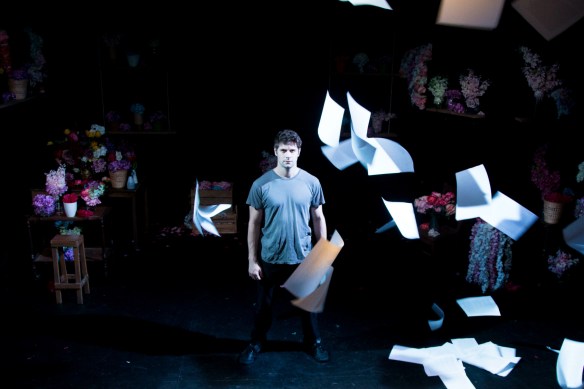
Ryan Johnson in 80 Minutes No Interval - 2 (c) Rupert Reid

Ryan Johnson as the hapless Louis in 80 Minutes No Interval. Photo: Rupert Reid

As it says on the packet, 80 Minutes No Interval runs for 80 minutes without an interval – which would doubtless please Claire, the girlfriend of the play’s hapless anti-hero Louis, who has no great love of theatre, particularly of the lengthy, pretentious variety.

Written and directed by Travis Cotton, and produced by Thread Entertainment in association with Red Line Productions, 80 Minutes No Interval is a ripping black comedy, which turns a satirical gaze on subsidised theatre, theatre critics, publishing, perfectionism and cursed bad luck.

Louis (Ryan Johnson) has an unhappy knack of detonating pretty much everything he touches. An aspiring but so-far failed novelist, he is sacked from his job as a newspaper theatre critic when his editor comes across a small red box robot, which uses algorithms to write better reviews than any mere mortal. Later Louis purports to be making a decent living as a freelance theatre reviewer (which had theatre reviewers chortling).

The kind of diner who would try the patience of the most solicitous waiter, Louis’s restaurant proposal to long-suffering (and clucky) girlfriend Claire (Sheridan Harbridge) is memorable for all the wrong reasons. His parents want him out of their investment property and the publisher who shows an interest in his latest novel– as long as he changes it and wracks up an army of Twitter followers – may not have quite the eye he once had. From there, it just goes from bad to worse.

80 Minutes No Interval rocks along with many laughs on the way (though I didn’t find it as wildly funny as some of the audience around me who roared out loud for much of it). The scene in the restaurant as an OCD Louis tries to order is a gem and Harbridge delivers a monologue, which is comic gold, about all that is wrong with theatre from seven-hour shows with dinner breaks, to Perspex boxes, blue faces and a litany of other clichés (many seen on Sydney stages in recent years).

As for the scene between Louis and the ruthlessly commercial publisher Dan Kurtz (an outrageously funny, outsized turn by Robin Goldsworthy), it’s gross-out hilarious.

Ryan Johnson, Jacob Allan & Sheridan Harbridge in 80 Minutes No Interval (c) Rupert Reid

Ryan Johnson, Jacob Allan and Sheridan Harbridge. Photo: Rupert Reid

Cotton’s writing has a great deal of comic flair but after a while the play does feel a bit like an over-extended skit with loads of things thrown into the mix, not all of which are followed through or fully come together. However, the show is deftly directed and staged with a set design by Georgia Hopkins, which includes a lovely reveal.

Johnson is the perfect foil to all the comical carry-on, playing things straight with an endearing performance as Louis. The rest of the cast, which also includes Jacob Allan as the admirably restrained waiter and Julia Rorke as a young florist, let rip with performances that knock the comedy out of the park though at times it feels as if they are all doing their own thing rather than responding to what’s happening around them.

A nip and tuck wouldn’t go astray, but 80 Minutes No Interval is often wickedly funny with serious points to make, and clearly tickled many in Tuesday’s packed house.

80 Minutes No Intervals runs at the Old Fitz Theatre until April 9. Bookings: www.oldfitztheatre.com

Make Believe with Stage Illusionist Paul Kieve

SPOILER ALERT: No illusions are explained in the making of this story but some plot details and special effects are described so if you want to go to see Ghost the Musical without knowing anything about it, avert your eyes.

Stage illusionist Paul Kieve has collaborated with director Matthew Warchus on a number of projects over the last 20 years including Ghost the Musical, Matilda the Musical and Tim Minchin’s forthcoming musical Groundhog Day.

Paul Kieve

Stage illusionist Paul Kieve. Photo: supplied

“I’ve worked with him many times and I always say to him, ‘Matthew, if you want to do great stuff, you’ve got to put the magic in really early,’” says London-born Kieve.

That was certainly the case with Ghost the Musical. In fact, the entire set design was built around the show’s most famous illusion, which sees the deceased Sam Wheat walk through a closed door.

“It’s one moment in the story. It lasts 45 seconds in our version but although you wouldn’t know it, everything about the set was dictated by it,” says Kieve.

“We had to put that in first and work everything else backwards. It’s very unusual for the design to be worked out backwards. And to be worked out backwards from an illusion is almost unheard of. It was a long and not always easy process. As the original set designer Rob Howell – who also did the West End and Broadway productions – said at the time, normally as a designer you want your best ideas on show and in this, in some respects, the best ideas are hidden because there is all this other stuff going on that you don’t know about.”

Based on the blockbuster 1990 film starring Demi Moore and Patrick Swayze, Ghost the Musical premiered in Manchester in 2011 then moved to the West End and Broadway. It was redesigned for a UK tour, and it is that touring version, which is now being used in Australia where the show arrives in Sydney this week after seasons in Adelaide and Melbourne.

“There’s no difference to what you see, it’s just some of the technical side and some of the engineering is reduced but it looks the same,” says Kieve.

Kieve’s mother was an actor so he was taken to the theatre regularly from a young age. He began doing magic as a 10-year old when he was given a magic set as a birthday present and by his teens was performing as a professional magician.

“Then a local theatre – the Theatre Royal, Stratford East where Joan Littlewood started out – asked me to work on The Invisible Man, which had never been done on stage before. I was slightly terrified and threw myself in the deep end and worked on it for four months. We did all these daft things like bicycles cycling about by themselves and the Invisible Man unwrapping the bandages from around his head and smoking a cigarette. They became quite famous effects and the show went into the West End and launched me into that side of things. Before I knew it people were asking me to do other stage effects so I pretty much learned on the job,” says Kieve.

He first worked with Warchus in 1995 on a production of Peter Pan for West Yorkshire Playhouse and is now an associate artist at the Old Vic where Warchus is artistic director. They are currently collaborating on Groundhog Day: The Musical, which previews at the Old Vic from July. Kieve’s many other credits include the film Harry Potter and the Prisoner of Azkaban and Kate Bush’s 2014 tour Before the Dawn.

GHOST2

Wendy Mae Brown as Oda Mae Brown, Rob Mills as Sam Wheat and Jemma Rix as Molly Jensen in Ghost the Musical. Photo: Kan Nakanishi

For anyone who doesn’t know about Ghost, it’s a supernatural love story between high-flying banker Sam Wheat and his artist girlfriend Molly Jensen. They have just found their dream loft apartment in Manhattan. Walking home from a restaurant, Sam is killed in a street mugging. However, his spirit is trapped between this world and the next as he attempts to save Molly from mortal danger by communicating through a shyster psychic called Oda Mae Brown, who to her astonishment can actually hear Sam from beyond the grave.

“When Ghost came along, Matthew wanted it to be this beautiful love story but he also wanted to have this juxtaposition of the beautiful soft story and a bit of a rock concert feel to some of the lighting,” says Kieve.

“He also wanted it to be like a magic show and for the magic to be really central to it. We didn’t really know if it was going to work but there was something about this story that completely lends itself to illusion because I suppose it’s asking the audience to believe – and magic questions what you believe and what you’re seeing.

“The reason I think the magic works very well in it – and I’m not talking myself up, I’m talking about the actual context and why an audience enjoys the magic in it – is because the whole story you’re wanting Molly to believe that Oda Mae really is in contact with Sam. You want Molly to listen to Sam from beyond (the grave). You want that moment to happen, so I think that whenever anything magical happens you are on the side of it happening,” says Kieve.

“There’s that famous scene in the movie where Demi Moore dances with Whoopi Goldberg (who played Oda Mae) and then Demi Moore closes her eyes and feels Sam there. The show is a lot about that. It’s about what people are feeling and what they are sensing – and at its best, magic encourages that. It should be about a sense of wonder, a sense of astonishment, a sense of amazement. So it’s a great vehicle because it is asking these very profound questions about if someone dies will you ever see them again?

“I saw it in Adelaide and there was a woman in front of me who was absolutely sobbing (when they dance) and I think it’s because it’s such a beautiful idea that comes true; that in the end Molly does believe and she does see Sam.”

The show contains various illusions besides Sam passing through a solid door including subway passengers being thrown through the air and spirits leaving dead bodies. It also features dynamic video projections.

“Technically it’s a very interesting piece because it really was a collaboration between the video and the movement and the acting and the storytelling,” adds Kieve. “Bruce Joel Rubin (who wrote the original Academy Award-winning screenplay and the book and lyrics for the musical) was around and he wrote parts of the script to help make the illusions work because we had to set things up without (the audience) knowing.”

Kieve cites the sequence in the subway with a poltergeist as a good example of how all the various departments collaborated, with choreography, illusion and video all playing their part.

“It’s really inventive. It’s like you are looking through the train like an X-ray and you see what’s going on inside it and you see it from different perspectives. At one point you are looking down the train as if you are standing at one end of the carriage and then it’s as if you are seeing through the side of it and it keeps shifting perspective,” says Kieve.

The show also uses a lot of imagery around shadows to suggest the spirit world. “Even in the opening scene in (the song) Here Right Now, Sam and Molly are dancing and there’s a shadow of them dancing in the air almost. It’s not just to make it look pretty. It’s the idea that all the time there is this other world, a secondary ghost world going on,” says Kieve.

GHOST3

Wendy Mae Brown and ensemble cast in Ghost the Musical. Photo: Jeff Busby

Though Kieve is hardly going to reveal how any of the illusions work, he admit that state-of-the-art lighting is crucial to some of it – though many of the effects use time-honoured magic techniques.

“I love the history of illusion and some of the effects that appear to be state-of-the-art are drawing on techniques that are over 100 years old. We are combining them with modern lighting, and the way that we can get into the and out of them so precisely, and the way they can be cued by computers – but the essence of some of them are ideas that have been around a long time.

“I’m also using psychological techniques – (guiding) where you are looking and where your eye is drawn,” says Kieve.

One of his favourite illusions in the show is also one of the least flashy. “It’s simply a letter that Molly reads. Sam has written it to her but the medium can somehow read it because Sam is reading it to her and then the letter just folds itself up in Molly’s hands. It’s really the pivotal moment when she realises that Sam is really there. It’s such an important moment because it’s the moment that she does believe. It’s not really a technological moment but it’s where the story and the effects combine and that’s when you get this gold dust when magic carries the weight of the story behind it.”

Casting his mind back over a career spent creating illusions, Kieve says that “it’s fun but it can be extraordinarily frustrating as well and you can get things wrong. You don’t always know if it will work, especially with something that hasn’t been done before like walking through the door.

“I can remember very distinctly being quite anxious about it because it was so audacious. You go, ‘what happens if (it doesn’t work)? But then you go, ‘we’re not brain surgeons. What happens if? You find another way to tell that part of the story.’ It’s risky but playfully risky as long as you’ve got a director who’s got the nerve and trusts you. I have to say that 99 percent of the time I find a way.

“In Ghost some of the trickiest moments were when someone dies and the spirit splits from the physical body. We’d worked it out and had got to the last death – of Carl – and we realised we couldn’t do it in the same way just because the body couldn’t be left in the middle of the stage. So we had to restage it in about five minutes – and that’s the version we use. Sometimes necessity is the mother of invention.”

Ghost the Musical plays at the Theatre Royal, Sydney, March 18 – May 14 and at the Crown Theatre, Perth, May 21 – June 12. Bookings: ticketmaster.com.au or 136 100

Machu Picchu

Wharf 1, March 8

STC_2016_MachuPicchu_C1_3690

Lisa McCune and Darren Gilshenan in Machu Picchu. Photo: Brett Boardman

After the success of Sue Smith’s previous plays Kryptonite in 2014 and Strange Attractor in 2009, her latest drama Machu Picchu was keenly anticipated – particularly with Lisa McCune and Darren Gilshenan in the lead roles.

But despite the best efforts of McCune and Gilshenan, the play itself feels underdeveloped, while the production directed by Geordie Brookman does it no great favours.

Commissioned by Sydney Theatre Company, Machu Picchu is a co-production between STC and the State Theatre Company of South Australia.

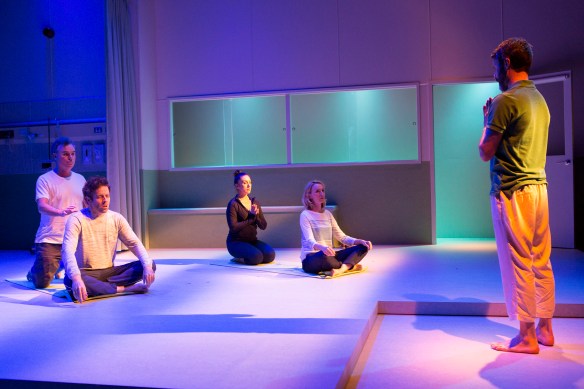
In a program note, Smith reveals that she was diagnosed with non-Hodgkin lymphoma a month before Kryptonite went into rehearsals. Machu Picchu was written in response to that experience. The play isn’t about cancer but explores how you deal with a life-threatening or life-changing event, and how that might make you reassess and change attitudes and priorities.

Gabby (McCune) and Paul (Gilshenan) are both successful engineers and appear to live a charmed life, though after 20 years their marriage has gone off the boil. Then, on the way home from attending a disastrous mindfulness retreat, their car crashes into a kangaroo. Gabby escapes unharmed but Paul is left a quadriplegic.

STC_2016_MachuPicchu_C1_4452

Darren Gilshenan and Luke Joslin. Photo: Brett Boardman

Machu Picchu takes its name from the Inca city: an engineering marvel both admire and have long planned to visit. It represents the missed opportunities and compromises so many of us make in the busy whirl of life today. With its extraordinarily strong foundations, which have ensured its survival, the ancient site is also a resonant image for relationships.

The play shifts back and forth in time, so that we see Gabby and Paul’s relationship before and after the accident. With Paul experiencing hallucinations from the medication, the play also moves between reality and more surreal scenes but this hasn’t been fine-tuned enough in the writing. Brookman’s direction does little to help and the shifts in tone and style feel somewhat clunky.

McCune and Gilshenan both turn in accomplished performances. McCune plumbs Gabby’s guilt, loneliness and frustration beautifully, while Gilshenan brings a dry humour to the role of Paul, convincingly portraying his physical limitations, pain and indignity as well as the emotional turmoil, all of which leave him wondering whether he wants to live.

Though the chemistry between McCune and Gilshenan doesn’t totally fire, the scenes between them are the play’s strongest.

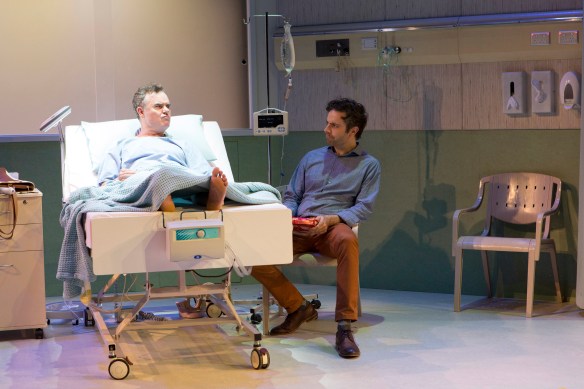
The supporting characters, however, are sketchily drawn. Best friends Marty (Luke Joslin) and Kim (Elena Carapetis) – who have their own flimsy IVF story – come across as crass, insensitive and self-absorbed when visiting Paul in hospital. If there was any sense of subtext, we might feel they are nervous, unsure what to say or perhaps trying to hide their distress. As it is, it’s hard to believe Paul and Gabby could be close friends with such boorish people.

Paul and Gabby’s daughter Lucy (Annabel Matheson), a doctor, is also conveyed in a few broad strokes, while Renato Musolino does what he can with the Lou, the psychologist from the retreat who rather improbably reappears and tries to help Paul find meaning in life.

STC_2016_MachuPicchu_C1_5077

Darren Gilshen, Luke Joslin, Elena Carapetis and Renato Musolino. Photo: Brett Boardman

Jonathon Oxlade’s drab, unattractive set (lit by Nigel Levings) has a curtained hospital bed on one side of the stage and what feels like acres of poorly used, empty space on the other. (It may well sit better in the Dunstan Playhouse when the play goes to Adelaide). The hallucinations (which include Elvis for some reason) aren’t staged with any great imagination and visually it all feels rather bland and clichéd.

Machu Picchu explores interesting themes we can all relate to but it needs further dramaturgical work if it is to draw us in, provoke us and touch us emotionally. At present, it is only part way to becoming a compelling drama.

Machu Picchu plays at Wharf 1, Sydney until April 9. Bookings: 9250 1777. Dunstan Playhouse, Adelaide Festival Centre, April 13 – May 1. Bookings: BASS 131 246

A version of this review ran in Daily Telegraph Arts online on March 11

Buckingham Palace drama is no fringe show

CharlesIII_040915_photoRichardHubertSmith-4627

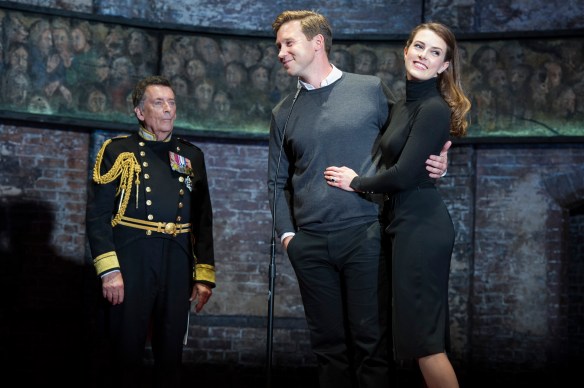
Robert Powell as Charles with Ben Righton and Jennifer Bryden as the Duke and Duchess of Cambridge in King Charles III. Photo: Richard Hubert Smith

To cut or not to cut a fringe? Without being too superficial about it, you can’t play the Duchess of Cambridge – Kate Middleton as was –without taking her lustrous locks into account, even if you aren’t attempting an impersonation.

“It’s amazing really to make the front cover of most newspapers just for the very fact that you’ve had a hair cut. When her fringe was cut (in September) suddenly that was massive news,” says Jennifer Bryden who plays Kate in King Charles III, the phenomenally popular, award-winning play by British playwright Mike Bartlett.

In fact, Bryden won’t be sporting bangs when the British production arrives at Sydney Theatre Company later this month.

“I wanted to. I angled for it but because we weren’t doing impersonations they felt that actually having long dark hair was enough. So I’ve kept mine long and we put it in hot rollers,” she says.

Ben Righton who plays William has a much healthier head of hair than the Duke of Cambridge with his receding thatch.

“He was slightly dreading the fact that they were going to suggest shaving a bald patch,” says Bryden with a laugh.

King Charles III premiered at London’s 325-seat Almeida Theatre in 2014. Directed by Rupert Goold, it quickly became the hottest ticket in town and transferred to the West End. When a Broadway season was confirmed, a second company was formed to take the play on a UK tour. Led by Robert Powell as Charles, that company is en route to Sydney.

Described as “a future history play”, Queen Elizabeth II is dead and Charles finally ascends the throne, Camilla at his side. But when he refuses to sign a bill restricting the freedom of the press, he triggers a constitutional storm. With civil war brewing, there are suddenly tanks outside Buckingham Palace.

Praised by New York critics as “flat-out brilliant” and “breathtakingly audacious”, Bartlett’s Buckingham Palace drama about a monarchy in crisis is written in iambic pentameter, giving the play a Shakespearean feel infused with a dash of Fleet Street.

Righton says he was “blown away” when he read the script. “That kind of writing does a lot of the work for you because it tells you which words to stress. It forces you into a style of talking. What is brilliant about Mike’s script is it refers to all kinds of modern things but in verse. I love it. It pushes the play along at a wonderful pace,” he says.

Will and Kate are among the most photographed people on earth but both Righton and Bryden decided to focus on the script itself rather than taking a forensic look at the young Royals when preparing for their audition.

“That turned out to be the right decision. Something we were told early on in rehearsals is that this wasn’t about impersonating. We were to approach the text as we would any text and approach the character as we would any other character. And only then, at the end, were we allowed to add suggestions of mannerisms that we had observed in real life,” says Bryden.

“They were never after imitations,” agrees Righton. “It’s like an alternative reality this play, a ‘what if’ Charles were to take the throne.”

Jennifer Bryden and Ben Righton in KCIII Tour. Credit Richard Hubert Smith

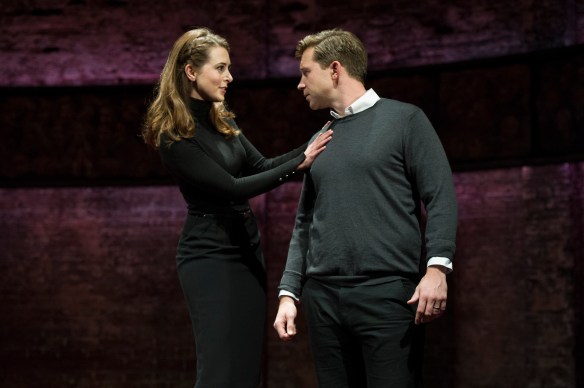
Jennifer Bryden and Ben Righton as Kate and Will in King Charles III. Photo: Richard Hubert Smith

When it came to observing mannerisms, Righton noted that the Duke of Cambridge speaks in a “breathy” way, fiddles with his hands a lot and often has them in his pockets. “He’s left-handed. I’m right-handed so I’ve had to teach myself to be left-handed,” says the actor.

“If you look at Will for any length of time he’s – I’m trying to find a nice way of putting this – but he’s quite bland. He’s very straightforward and polite and he smiles a lot so there’s not a lot to go on. He’s a blank canvas.

“Because he’s been photographed since he was born you feel you know so much about him but you realise that we don’t. They’ve done a very good job of keeping his life private and what makes the bloke tick is very hard to find out anywhere. I know two people who went to school with him and I tried to get them to tell me a bit about him but they were very loyal and haven’t said a word. I can’t get anything out of them,” says Righton.

Bryden believes that the way Kate dresses has a strong influence over the way we perceive her. “I am lucky with the silhouettes of the costumes she wears and the heels. Once I was in costume that really helped.

“It’s amazing what the power of the imagination does,” adds Bryden. “In real life I don’t think any of us look particularly like the members of the Royal Family. There are similar shapes, colourings and heights but that’s about it. But actually once we’ve got the costumes on and the characters are introduced in the first scene, the power of the imagination lies with the audience to see the person they are used to seeing in the public eye.”

Beneath the fashionable outfits and flowing hair, there’s a backbone to Bartlett’s Kate that comes as a surprise. Portrayed as a shrewd political operator, who supports and motivates William, she has been compared to Lady Macbeth.

“She definitely wears the royal trousers…. In our play she’s a very commanding figure,” says Righton with a chuckle.

Careful not to give too much away, Bryden says: “She is the key operator, the person who makes the changes in the action of the play. She’s the one person within the Royal Family who can look at what’s going on objectively because everyone else is too tied up with their own family drama. Because Kate is new to all this, she is the one with the outside eye.”

Before she had any idea that she would be auditioning for the play, Bryden saw King Charles III in the West End from a seat in the gods with a friend of hers.

“It was so fascinating in the interval hearing all the discussions. So often everyone just makes and a beeline for the bar and it’s about what they’ve been doing that day. Here, everyone was talking (about the play), whether it was politics or family or actors playing real people or the monarchy. It was amazing. My friend said, ‘you should play that part one day,'” says Bryden.

None of the Royal Family has been to see the play. However, Tim Piggott-Smith who played Charles in the original production, received a letter from a member of the staff at Clarence House, Charles’s official London residence, pointing out that Charles doesn’t wear a wedding ring.

“I think everyone has taken that as a bit of a nod that they’re watching and hopefully approve,” says Bryden.“I’m sure they know all about it but I don’t think they would ever come and see it.”

King Charles III, Roslyn Packer Theatre, March 31 – April 30. Bookings: www.sydneytheatre.com.au or 02 9250 1777

A version of this story ran in the Sunday Telegraph on March 13

Lisa McCune and Darren Gilshenan in Machu Picchu

2016 STC MACHU PICCHU Lisa McCune by James Green 2106

Lisa McCune. Photo: James Green

Australian sweetheart Lisa McCune, who shot to fame at age 22 as Constable Maggie Doyle in Blue Heelers, is about to take on her first middle-age roles. And it feels like “the right fit”, she says.

Best known for her television work and, more recently, her roles in musicals such as South Pacific and The King And I, McCune returns to straight theatre in a new Australian play called Machu Picchu opening tonight in Sydney in which she plays Gabby, a middle-aged civil engineer, whose life and marriage is upended when her husband is involved in a serious car crash.

In May, she plays Sally, a former showgirl who is now 49 but “still remarkably like the girl she was thirty years ago” in a concert version of the Stephen Sondheim musical Follies in Melbourne.

McCune, who recently turned 45, still looks extremely youthful herself but is very happy to embrace the more mature roles coming her way.

She describes Machu Picchu as: “a grown-up play about relationships and mid-life” and “a fascinating subject matter.

“It’s my first role playing (a middle-aged woman). Well, I suppose Anna in The King and I was too. But it’s a more mature part of my life as well so that is interesting to me. It’s not the ingénue any more. And it’s really nice to explore that,” says McCune.

“I don’t consciously go ‘oh these characters are older’. I think it’s just that feeling of the right thing. I certainly not going to be botoxing to try and play ingénues who are in their late 20s. It’s just where you start to fit I think.”

Though she denies giving too much thought to getting older, McCune admits that she felt different the second time she played the vivacious nurse Nellie Forbush in South Pacific.

“It’s funny, I did the first season of South Pacific (in 2012). By the time I came back to it a year later, I thought ‘I can’t play this any more’. I’m actually getting too old to play her and that’s when I did Anna and that felt right.

“It’s nice with this play (Machu Picchu) that it hasn’t been done before and there are no comparisons. We’re starting from scratch.”

Machu Picchu is a co-production between Sydney Theatre Company (who commissioned it) and the State Theatre Company of South Australia. It is written by Sue Smith, whose TV credits include Brides of Christ and Mabo and whose last play Kryptonite was premiered by STC in 2014.

It centres on a middle-aged couple who seem to have it all, but who must reassess their lives, priorities and relationship when the husband Paul is left a paraplegic after a car crash. The play moves back and forth in time, so that we see them before and after the life-changing accident.

Machu Picchu is worlds removed from the lavish musicals McCune has performed in of late, throwing up many questions about how you live your life after such an event. McCune’s character also wrestles with a lot of guilt.

McCune agrees it’s “tricky subject matter” but says the play has “many humorous moments” and “great heart. I think Sue’s language is really beautiful and her observations are fantastic,” she says.

In rehearsals, McCune found that performing in a straight play has required her to flex different acting muscles.

“It sharpens different things and that’s great. It’s the different language. A musical heightens things in different spots whereas when its just text, not backed up by songs, it doesn’t happen that way. So for me, it’s a new experience again. I’m finding it challenging – which is what you want out of your work really.”

Darren Gilshenan, who plays Paul, believes the role is very different to the parts McCune is usually cast in.

“I think she’s really excited that people will see her in a different guise and see what she’s capable of. This allows her to dig deep and find a lot of ugliness as well that you wouldn’t normally associate with Lisa,” he says.

Gilshenan is a fine comedy actor whose numerous credits include the seemingly hapless but kindly, occasionally wily neighbour Jack in Channel Nine’s Here Come the Habibs!, Uncle Terry in ABC-TV’s The Moodys and Bell Shakespeare’s hilarious production of The Servant of Two Masters.

McCune and Gilshenan have worked together once before: in the musical Urinetown for STC in 2006.

“I’ve admired his work for a long time. He was one of the reasons I wanted to do (Machu Picchu),” says McCune.

On the face of it, it seems almost perverse to cast an actor renowned for his physicality as a character in a wheelchair. But Gilshenan’s physical skills will be tested in Machu Picchu. “The level of detail that happens in the nine months (Paul is) in hospital, his development physically through rehab and the various stages needs to be very clear,” he says.

“I was saying to my wife after the first couple of day’s rehearsal that the scope of this piece emotionally, physically and intellectually, and what I can do with it, is fantastic. It’s a dream role.

“A lot of the comedy I’ve done recently is based on humour through the pain and truth of flawed individuals. But there’s always an awareness you’re in a comedy, whereas in this it’s really surprising where the real tragedy is at times. In the awfulness of the situation, there also a lightness and a comedy in there too.”

Smith has described the play as “both a grand love story, and a deeply ordinary one”, as well as a celebration of courage.

“That’s the part I love about it,” says McCune. “I’m such a romantic. I think the romantic side of it is really beautiful. It’s about a couple who are somehow meant to be together and how they are going to travel the next part of their life that’s really hard. It’s a tricky subject matter. I think Darren has had a lot to contemplate for his role.”

Asked if anything has happened in her own life to make her stop and take stock, McCune says: “I think for me the biggest turning point in my life was having children.”

McCune, who has never commented on her reputed relationship with opera singer Teddy Tahu Rhodes, has three children aged 15, 13 and 11 with her husband Tim Disney.

Machu Picchu rehearsed in Adelaide and has a season there after its Sydney run – which means a fair amount of time away from her Melbourne-based family.

“It’s one of the lines in the play: ‘work is work and it must be attended to,’” says McCune.

“It’s a different part of my life. Isn’t it funny: that’s what the play is about. It’s about living your life. And I guess for me I’m a better mum when I am doing some work. I think I feel more content. I’m happier and I’m happy to go and really throw myself back my life at home. I kind of need it.

“The kids are fantastic. They are a little bit older now and they understand that that’s the life that we’ve chosen (and) that they’re a part of. So they are OK and we just make sure we talk about it with them. And they’ll come away for holidays. Once you start throwing in holidays, you’re not actually away for that much.”

Machu Picchu plays at Wharf 1, Sydney until April 9. Bookings: 9250 1777. Dunstan Playhouse, Adelaide Festival Centre, April 13 – May 1. Bookings: BASS 131 246

 A version of this story ran in the Sunday Telegraph on March 6


CounterMove

Roslyn Packer Theatre, Sydney, February 29

Cacti

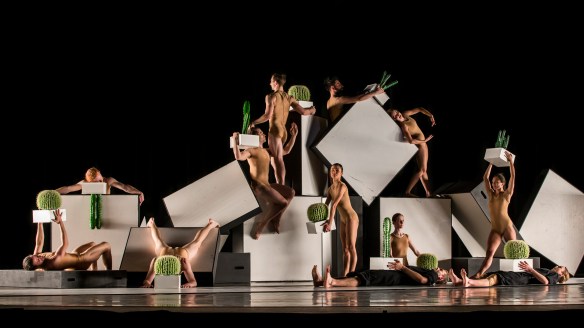
Sydney Dance Company in Cacti. Photo: Peter Greig

“This is a bit weird isn’t it,” mutters one of the dancers in Cacti to a huge laugh from the audience.

Created by Swedish choreographer Alexander Eckman in 2010, Cacti is a rare thing: a genuinely funny contemporary dance work. Sydney Dance Company first performed it in 2013 and is now reviving it alongside a new work by Rafael Bonachela as part of a double bill called CounterMove.

Poking fun at alienating, self-absorbed contemporary dance and at critics who indulge in a pretentious search for meaning, Cacti features 16 dancers, each with their own square, wooden platform (and later a cactus), a string quartet, an orchestral soundtrack and a wanky, jargon-laden voice-over analysing the work.

Cacti begins with the dancers in flesh coloured tops, black baggy pants and skullcaps kneeling on their separate wooden tiles. Seemingly trapped, they beat out rhythms, sprint on the spot in perfect unison, writhe, leap, fall and strike poses in a joyous display of exuberant physicality before larking around with their upended rostra and creating a large sculpture.

In a very funny duet performed by Charmene Yap and Bernhard Knauer, their humdrum thoughts are revealed via a voice-over as they dance. (“Look out for my head” and such like).

It’s lovely to actually laugh out-loud at contemporary dance and to see the dancers matching their glorious physicality with such animated facial expressions. Using wit to make a spiky point, Cacti is a breath of fresh air. Oh, and there’s a dead cat.

LuxTenebris

Nelson Earl, Holly Doyle, Fiona Jopp and David Mack in Lux Tenebris. Photo: Peter Greig

Bonachela’s Lux Tenebris, meaning light and darkness, was choreographed to a visceral electronic score commissioned from Nick Wales that buzzes, throbs, pulses and thumps, sending vibrations through the body.

Performed in shadows, we glimpse the dancers through the glowering half-light of copper-coloured light bulbs and shards of wan illumination (design by Benjamin Cisterne). Often, the effect is similar to a roving spotlight picking out people in the middle of already unfolding situations.

Clad in casual streetwear, the dancers hurl themselves into a frenzy of highly physical movement, kicking, whirling and whipping their way through solos, duets and various groupings.

Two beautiful, sexy duets between Charmene Yap and Todd Sutherland to more gentle music are like lulls in a storm. Acrobatic yet poetic, they resonate with the human yearning for connection before the work powers back into top gear.

Lux Tenebris has a slightly uneasy, disquieting air of mystery. Eventually the pounding score and ferocious physicality starts to feel relentless but the kick-ass choreography is incredibly exciting and the dancing is extraordinary.

CounterMove plays at the Roslyn Packer Theatre Walsh Bay, Sydney until March 12, Canberra Theatre Centre, May 19 – 21, and Southbank Theatre, Melbourne, May 25 – June 4

 It then goes on a regional tour:

 NSW: Wollongong, June 17 – 18, Orange, June 22, Newcastle, June 25, Port Macquarie, June 29

QLD: Rockhampton, July 2, Gladstone, July 6, Cairns, July 9 – 10, Gold Coast, July 15 – 16

NT: Darwin, July 29

WA: Geraldton, August 3, Mandurah, August 6, Albany, August 9, Bunbury, August 13

NSW: Bathurst, August 20, Griffith, August 24, Dubbo, August 27

A version of this review ran in the Sunday Telegraph on March 6