Hay Fever

Drama Theatre, Sydney Opera House, April 15
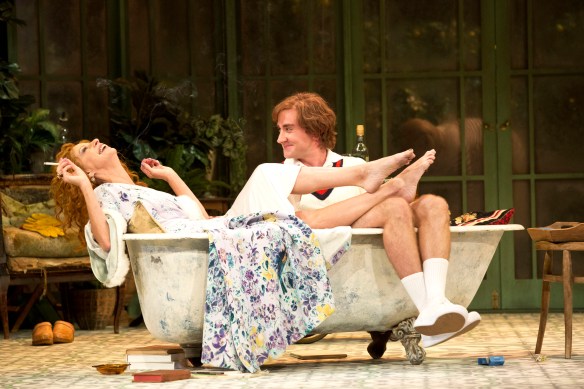
2S4A3322-2

Heather Mitchell and Josh McConville. Photo: Lisa Tomasetti

Noel Coward wrote Hay Fever when he was just 24 but already a star in the making. A comedy of gleefully bad manners, it was a huge hit when it premiered in 1925 despite lukewarm reviews and is still much performed.

Coward’s plays are deceptively difficult to do well. If the actors only give us superficial flamboyance and witticisms, the humour can all too easily fall flat. But Imara Savage has directed a fabulously funny production for Sydney Theatre Company that has a fresh edge and contemporary energy while still retaining a feel of the period.

The play is set in the household of the eccentric Bliss family. Judith Bliss (Heather Mitchell) is retired actress, determined to keep performing even if she no longer has a stage. Her husband David (Tony Llewellyn-Jones) is a novelist and their grown-up children Sorrel (Harriet Dyer) and Simon (Tom Conroy) still live at home, without appearing to work.

All four invite a guest for the weekend without telling each other, thrusting them into a maelstrom of games and idiosyncratic carry-on that leaves their visitors reeling.

Essentially a lightweight comedy, Hay Fever offers the audience a vicarious thrill in experiencing life with such wayward “artistic” types. But it also celebrates bohemian freedom and vitality, and contrasts that with the rather stuffy, conservative mores of “ordinary” people and their concerns about sex and class.

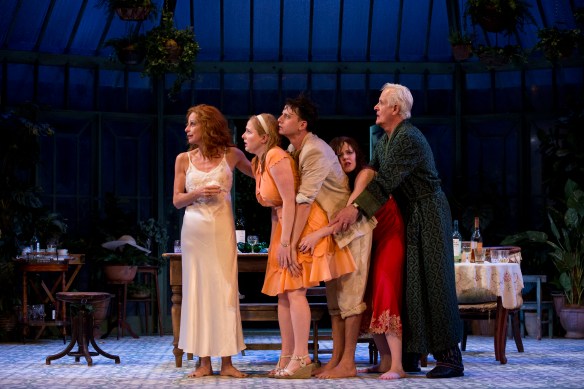
Alicia Clements’ wonderful design isn’t period specific but subtly combines elements from the 1920s with later decades, setting the action in an attractively ramshackle conservatory full of greenery and eccentric touches like a bathtub for a sofa. Only the inclusion of wheelie suitcases and the decision to have Judith lip synch to Amy Winehouse’s Back to Black when she offers to sing at the piano sit a little oddly.

Clements’ costumes are also terrific with all the Blisses in a permanent state of semi-undress or dressing gowns and the outfits of the other characters speaking reams about their personalities from the anxious Jackie’s girly cotton frocks and Alice band to the vampy Myra’s stylish couture.
2S4A3666

Heather Mitchell, Briallen Clarke, Tom Conroy, Harriet Dyer and Tony Llewellyn-Jones. Photo: Lisa Tomasetti

Savage’s excellent cast combines wit with truth. Towards the end of the play, some of the performing becomes broadly comic and more farcical but overall the characters all feel very real.

Mitchell is sensational as Judith, a whirling dervish at the heart of the play. Her comic timing is immaculate and she is gloriously funny as she tears up the stage. Llewellyn-Jones is distinguished yet grouchy as the rather self-absorbed David. Dyer plays Sorrel with a contemporary edge as a young woman testing who she is, while Conroy’s Simon affects a nonchalant flamboyance.

Helen Thomson as the chic, sardonic Myra, Alan Dukes as the proper “diplomatist” Richard, Josh McConville as the rather gung-ho sportsman Sandy, and Briallen Clarke as the mousey, nervous Jackie are the perfect foil as the beleaguered guests. Genevieve Lemon is also very funny in a broadly comic portrayal of the exasperated housekeeper.

The Bliss family can become rather unlikeable in productions but Savage avoids that, ensuring that their love for each other comes across as strongly as their hilariously appalling behaviour.

Hay Fever plays at the Drama Theatre, Sydney Opera House until May 21. Bookings: www.sydneytheatre.com.au or 02 9250 1777
The Peasant Prince

Lendlease Darling Quarter Theatre, April 9

Peasant Prince1

Jenevieve Chang, John Gomez and Edric Hong. Photo: Heidrun Lohr

Monkey Baa Theatre Company has a reputation for its delightful stage adaptations of children’s books and The Peasant Prince is another charmer.

It tells the true story of Li Cunxin (pronounced Lee Schwin Sing), whose autobiography Mao’s Last Dancer was published in 2003 and subsequently made into an Australian film by director Bruce Beresford. Li also wrote a picture book about his life called The Peasant Prince, illustrated by Anne Spudvilas, and it is that version that Monkey Baa’s creative directors Eva Di Cesare, Sandie Eldridge and Tim McGarry have drawn on for their stage adaptation for children aged 6+.

Born in a village in Shandong Province in China, Li was the sixth of seven sons in an impoverished but very loving peasant family. An extraordinary opportunity came knocking when a delegation from Madame Mao arrived in the village looking for talented children to attend the Beijing Dance Academy. After initially being overlooked, Li was chosen as one of just 15 children from around the country and at age 10 he left his home for Beijing.

The training was relentlessly tough and Li was terribly homesick, but eventually he found the courage, fortitude and determination to succeed. Selected by Ben Stevenson, the artistic director of Houston Ballet, to go to the US on a cultural exchange, Li defected. After a diplomatic standoff when he was held in the Chinese Embassy, he was eventually released a free man.

Li danced with Houston Ballet for 16 years and was a guest artist around the world. After meeting Australian-born dancer Mary McKendry in London, they married and came to Melbourne in 1995 where he danced with the Australian Ballet. Li is now artistic director of the Queensland Ballet.

The Peasant Prince begins with Li waiting backstage to make his debut in The Nutcracker for Houston Ballet, with his parents in the audience. It then rewinds to tell his story up to that point.

The script by Di Cesare, Eldrige and McGarry is succinct without it ever feeling that it is just ticking off plot points. A story Li loved his father to tell him about a frog acts as a metaphor for what is to come and the writers create many lively little vignettes that speak reams about Li’s life and relationship with his parents and brothers, a dance teacher who encouraged him, and Stevenson.

Peasant Prince2.jpg

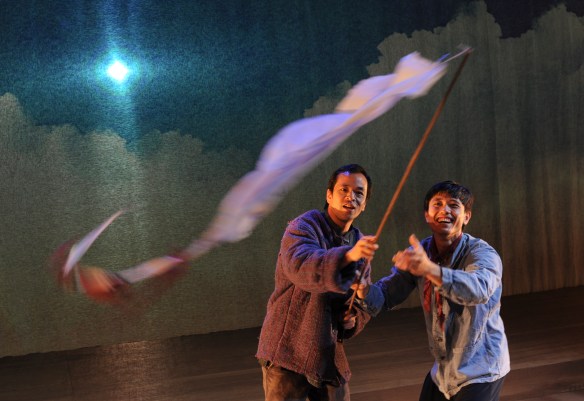
Jonathan Chan and John Gomez Goodway. Photo: Heidrun Lohr

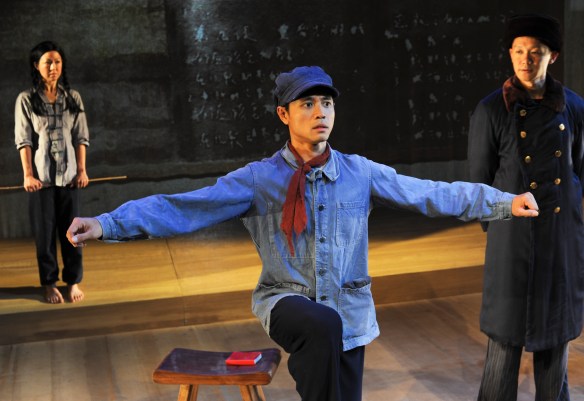
McGarry’s direction, with movement by Danielle Micich, keeps the action moving swiftly on a minimal but very effective set by Michael Hankin featuring David Bergman’s beautiful video designs, which locate scenes as the story moves from the village to a school room to the dance academy and onto Houston. Hankin’s costuming is also very evocative, as is Daryl Wallis’s music.

The early scenes in China work wonderfully well with simple staging effects proving extremely eloquent. There’s a lovely sequence in which Li’s mother uses a blanket in various ways to suggest feeding, washing and drying her son with loving care. At the dance academy, two performers merely hold a pole to create a ballet barre.

The Houston scenes don’t have quite the same flow. A ballet rehearsal feels a little overlong and the coercion Li suffers in the Chinese Embassy doesn’t have the same clarity as the rest of the storytelling; I imagine children will be asking what was happening at that point. But overall it’s beautifully told.

As Li, John Gomez Goodway brings a wide-eyed, open-hearted exuberance and emotional vulnerability to the role that is very endearing. The other three actors – Jonathan Chan, Jenevieve Chang and Edric Hong – each play several roles and do an impressive job of slipping quickly between them to create various well-defined characters.

Running around 55 minutes, The Peasant Prince tells an inspiring story about courage, resilience, family love and following your dreams that kept the young audience engaged.

Li Cunxin was at the opening. Asked to make a short speech afterwards, which he hadn’t anticipated, he said he was deeply moved by the production. I imagine that young audiences will be touched, amused and inspired by it too.

The Peasant Prince plays at Lendlease Darling Quarter Theatre until April 20 and then tours to 37 Australian venues. See www.monkeybaa.com.au for details.

Aldo Mignone is Happy that the Old Fitz is also a Place to Call Home

Aldo Mignone

Actor Aldo Mignone. Photo: supplied

Aldo Mignone, who plays Italian dreamboat Gino Poletti in A Place to Call Home, knew that the Australian period drama had a strong fan base but he had no inkling that it was tipped to feature so strongly in this year’s TV Week Logie nominations.

“You know how I found out? I saw in the Sunday Telegraph that (fellow cast members) David (Berry) and Abby (Earl) were in Melbourne for the nominations,” says the handsome young actor with a laugh.

The tipsters were right. A Place to Call Home has five Logie nominations including the viewer-voted Best Drama and the peer-voted Most Outstanding Drama.

“It’s amazing. I’m really proud that we’ve been nominated because we’ve got such a hard-working team. So fingers crossed,” says Mignone.

Set in rural NSW in the 1950s, A Place to Call Home moved to Foxtel last year thanks to fans campaigning to save the show when Network Seven dropped it after two series.

Mignone’s character is the son of Italian farmhands, who marries the beautiful Anna Bligh (Earl) daughter of the wealthy family his parents worked for. At the end of series three their marriage was under strain after Gino’s attempts at winemaking left him in debt. Filming is now underway on the fourth season.

“Things were pretty rough there towards the end,” says Mignone of Gino and Anna’s relationship.

“I’m probably not allowed to say much but (season four) is picking up from there. The marriage almost feel apart there for a second but now we have to rekindle that and tackle the real world: how are we actually going to make a living?”

For the last month, Mignone has also been rehearsing a play called Belleville, directed by Claudia Barrie, which opens at the Old Fitz Theatre on Friday. (The scheduled opening had to be delayed a week when Emily Eskell had to withdraw unexpectedly from the production and was replaced by Taylor Ferguson).

Chatting at the Woolloomooloo pub venue, Mignone admits he wouldn’t normally take on something else while filming but says that he couldn’t resist the chance to perform in Belleville – his first professional stage play.

“I’ve been coming here for quite a while and the work they put on is absolutely amazing. These guys are at the top of their game and I really wanted to be part of what is happening at the Fitz. It’s become quite a little theatre Mecca thanks to Red Line Productions (who currently run the venue),” he says.

Mignone met Barrie when he went to see a friend performing in her powerful production of Philip Ridley’s Shivered last year, also for Mad March Theatre Company.

“She likes a dark play,” laughs Mignone. “She is doing a wonderful job at Mad March Hare Theatre. She’s just a little powerhouse.”

Belleville, by American playwright Amy Herzog, is about young American newlyweds who move to Paris where their fraught relationship quickly begins to unravel.

Mignone, who plays their landlord Alioune, describes it as “an emotional, psychological thriller: this idea of finding happiness and how far one will go, and lie, in order to realise that.

“It’s not a terribly big role but I really wanted to be part of it. I think it’s incredible writing and it really gripped me when I read it. Fortunately I was able to accommodate that with A Place to Call Home.”

Where Gino is an Italian catholic, Alioune is French Muslim – “but that’s not the focus by any means in the play. It’s just his background,” says Mignone.

However, the chance to explore such different characters is what appeals to him about acting: “I like the idea of being caught up in different jobs, different ideas, different cultures for each role. It takes you to different places,” he says.

Born into an Italian family in Adelaide where his father is a doctor and his mother manages his medical practice, Mignone has four older sisters who used to dress him up and put on plays as kids. Later, they would take him to the theatre with them. “I just got caught up in it,” says Mignone, who went to NIDA but left two years into the course.

“There were just some disagreements,” he says. “I think the school is a good school. I think it disciplines you and you learn quite a bit but I was trying to do some outside work and I just wasn’t happy with the way it was handled so I decided to leave. Then I was in limbo for a bit working in hospitality and doing what you can to get by and then fortunately I landed A Place to Call Home.”

It was through his sister Louisa, who is also an actor, that he was cast as Gino. As luck would have it, Louisa – who performed in Mortido with Colin Friels at Belvoir last year and now lives in Los Angeles – was assisting at auditions for A Place to Call Home.

“At the time I didn’t have an agent and she said, ‘you should definitely see my brother for this role’. It was like, ‘Lou, thank you so much, that’s amazing.’ I was really so nervous. I had to sing this opera song and I’m a terrible singer but it got me the role,” says Mignone.

Whether A Place to Call Home goes into a fifth season remains to be seen. “People are talking in an excited way that it’s going so well so I wouldn’t be surprised if we did go ahead with a fifth season,” says Mignone, “but you never know until you are there on set filming.”

Belleville, Old Fitz Theatre, Woolloomooloo, April 20 – May 12. Bookings: oldfitztheatre.com/belleville

 A version of this story ran in the Daily Telegraph on April 15


The Original Grease

Reginald Theatre, Seymour Centre, April 8

GreaseCompany

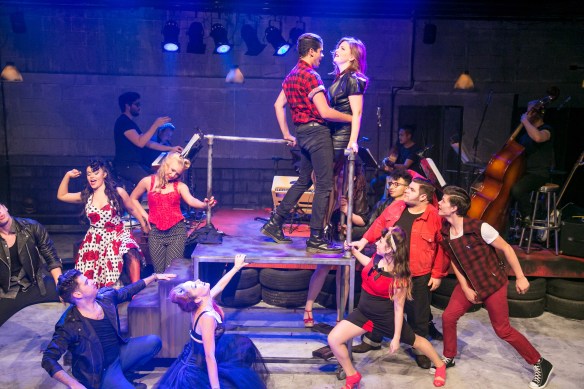
Members of the company of The Original Grease with Brendan Xavier as Danny and Emily Hart as Sandy centre. Photo: Michael Francis, Francis Fotography

“Before Grease was the word, it was raw, raunchy and risqué,” writes director Jay James-Moody in the theatre program for The Original Grease.

As the title suggests, The Original Grease is at attempt to return the popular musical to the grittier, edgier show that it was when it premiered in 1971 in Chicago at the 300-seat Kingston Mines Theatre, a disused tram shed.

In fact, it’s not strictly that original 1971 production but a hybrid version, reconstructed by Jim Jacobs (who originally wrote Grease with Warren Casey) and director PJ Parapelli for the American Theatre Company, who staged it in Chicago in 2010. Warmly received, James-Moody chased the rights for years.

It’s very interesting to see where the show came from and how it has changed over the years, particularly in the wake of the 1978 film starring John Travolta and Olivia Newton-John when the sharper edges were knocked off it, the swearing toned down and the whole thing made more family-friendly. Those changes, along with the perky new songs that were added, made their way into subsequent stage productions and Grease evolved from something small and grungy to a more sanitised, bubblegum, crowd-pleasing entertainment.

However, historical interest aside, this production by indie musical theatre company Squabbalogic never really flies. In part that’s the production itself and in part it’s the inexperience of the youthful cast that James-Moody has gathered, not helped by the lack of punchy rock ‘n’ roll oomph to many of the songs.

The score assembled for The Original Grease predominantly features songs from the 1971 Chicago production, some of them little known, such as a comic number for Patty Simcox called Yeeughh! and Miss Lynch’s In My Day, both cut prior to the show going to Broadway in 1972.

There are also a few numbers that didn’t even make it to the 1971 Chicago debut and an underwhelming song for Danny called How Big I’m Gonna Be, written for the 2010 version from chords and lyrics that Jacobs and Casey sketched long ago.

The songs written for the film have all been removed. So, no Summer Nights, Sandy, Hopelessly Devoted or You’re the One That I Want. Nor will you hear the song Grease as you know it but a different one with the same title, while Kenickie sings Alone at the Drive In Movie rather than Danny.

It’s fascinating to hear the beginnings of Summer Nights in Foster Beach (the number it replaced) and likewise All Choked Up, which made way for You’re the One That I Want. But you can see why numbers were changed. There aren’t any lost musical gems here.

Grease1

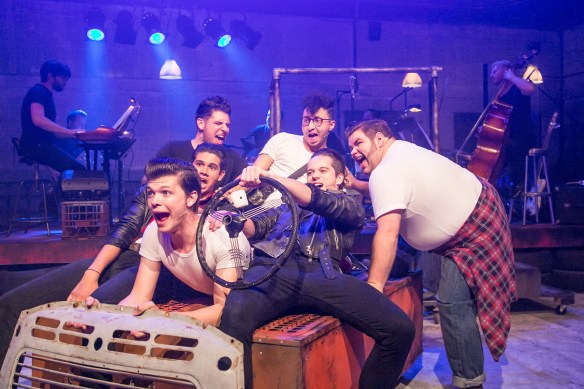
Timothy Shead, Aaron Robuck, Brendan Xavier, Doron Chester, Temujin Tera, Jason Mobbs-Green. Photo: Michael Francis, Francis Fotography

Drawing on Jacobs’ own experience, Grease was originally about teenagers from the tough, working class suburbs of Chicago. There are scenes showing them roaming the streets at night, trying to get a homeless man to buy them booze, with a police officer forever on their case (shades of West Side Story), while their conversations include more swearing, sexist and racist comments, and slang than in later versions of the show.

You certainly get more of a sense of teenagers from the rough side of town but essentially it’s the same story as the one we know. It’s more of an ensemble piece though. Sandy and Danny are less fore-grounded, even though their story still tops and tails the show, and there’s a lot more dialogue.

James-Moody has assembled a cast of young performers, not long out of their teens. Brendan Xavier who plays Danny Zuko is 18. Where most productions cast older, their youthfulness adds a level of authenticity. However, their inexperience as performers shows. They certainly perform with energy though it’s often unfocussed and lines are sometimes hard to hear, while more acting nuance is needed to carry the dialogue scenes.

As for the musical arrangements, there’s little raw 1950s rock ‘n’ roll edge to the songs and without that punch the show doesn’t lift with the musical numbers. Even Born to Hand Jive doesn’t really rock. And with the six-piece band conducted by Benjamin Kiehne sitting centre-stage, it seems a lost opportunity not to have them looking (and playing) like 1950s rockers.

James-Moody’s production is modestly staged on a minimal, gritty set (designed by Georgia Hopkins) with a metal platform and a few tyres, which works well enough. There are some lovely touches like the inventive way James-Moody has the boys create Greased Lightning with a few bits and bobs including a car fender and a steering wheel. But much of the staging feels messy, while a moment of nudity just feels awkward. Brendan Hay’s costuming is pretty spot-on and adds plenty of colour, even if some of the girl’s outfits feels a little risqué for the 50s.

Coral Mercer-Jones is a standout as Rizzo and her soulful rendition of There Are Worse Things I Could Do is a musical highlight. Matilda Moran is a hoot as a goofy Patty, Daniella Mirels is a vulnerable Frenchy, the beauty school dropout, and Stephanie Priest is sweetly funny as Jan – with a cute, touching scene between Jan and Jason Mobbs-Green as Roger (“Rump”) when they surprise themselves by hooking up.

The Original Grease is a great opportunity to get a sense of how Grease began and how it has changed over the years. It’s reasonably enjoyable but the production never really soars and as it ambles along it starts to feel long and increasingly flat. As a friend said: “it’s interesting historically but it’s not a version I’d want to see again.”

The Original Grease plays at the Reginald Theatre, Seymour Centre until May 7. Bookings: www.seymourcentre.com or 02 9351 7940

King Charles III

Roslyn Packer Theatre, April 2

King Charles III_STC_credit Prudence Upton 066

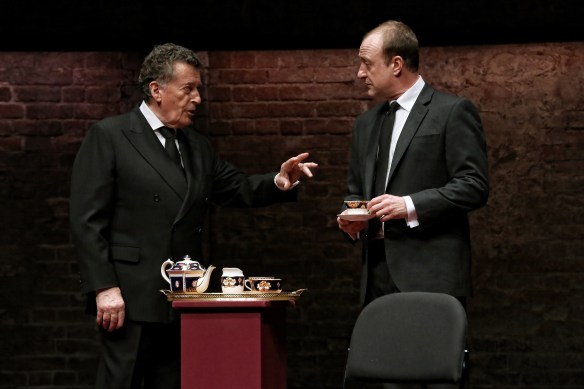
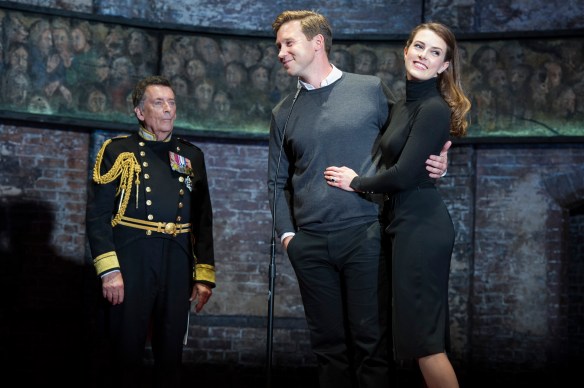
Robert Powell as Charles and Tim Treloar as the Prime Minister, Mr Evans. Photo: Prudence Upton

Queen Elizabeth II is dead. Long live King Charles III – or maybe not.

Unlike the Queen, who never meddled in affairs of State, Charles hasn’t even made it to his coronation when he astonishes the Prime Minister by refusing to sign a bill restricting the freedom of the press. With neither Charles nor Parliament prepared to budge, a constitutional crisis looms. Before long there’s unrest on the street and a tank parked outside Buckingham Palace.

So begins Mike Bartlett’s fascinating play 2014 King Charles III. Directed by Rupert Goold for London’s Almeida Theatre, it has had hugely successful seasons in the West End and on Broadway. Now a British company led by Robert Powell as Charles, which has been touring the play around the UK, is in Sydney with a finely honed production.

Set in the near future, King Charles III has the ring of one of Shakespeare’s history plays with Charles as a tragic figure: a principled man with a conscience but also a yen to hold more sway than a mere figurehead.

The Duchess of Cambridge, meanwhile, is well aware of the monarchy as a brand, its strength measured in column inches.

There are numerous Shakespearean echoes through the play with references to Lear, Henry IV, Macbeth Richard II and Hamlet. Bartlett has even written most of it in blank verse (apart from scenes featuring Prince Harry and his commoner girlfriend Jess, a Republican arts student from a working class background) using the iambic pentameter as Shakespeare did.

CharlesIII_040915_photoRichardHubertSmith-4190

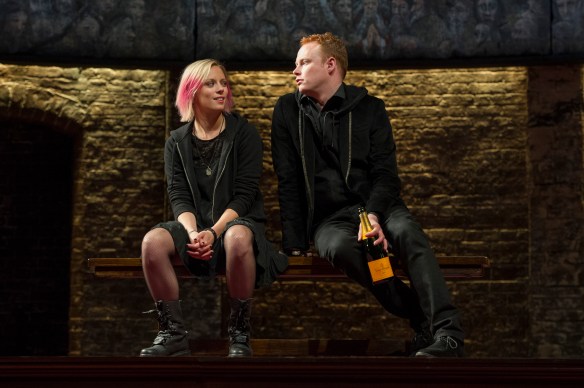
Lucy Phelps as Jess and Rupert Glaves as Prince Harry. Photo: Richard Hubert Smith

It’s a clever, daring concept, which Bartlett has pulled off with considerable skill and wit. The language is actually very accessible, so much so you almost forget that it’s verse at times, while the inclusion of contemporary words and phrases is often very funny.

Though there’s certainly a comic frisson in first meeting the Royal characters – Charles, Camilla, William, Kate, Harry and a certain family ghost proffering conflicting prophecies – the play is by no means a parody. The characters are presented as real and Bartlett canvasses serious issues regarding the role and value (if any) of the Royal Family, the power of the media, and the impact of a rapidly changing society on the mindset of its people.

However, a small section of the opening night audience seemed determined to see the play in superficial terms and laugh at everything, upsetting the rhythm and tension of certain scenes.

What the play doesn’t generate is a great deal of emotional connection. Charles’ fate is unexpectedly moving and Harry’s misgivings and confusion about his role in life are touchingly understandable but mostly it’s a cerebral affair.

Designer Tom Scutt sets the action on a raised dais surrounded by a bare brick wall with darkened doors and a frieze of blurry faces suggesting the populace beyond the palace walls. Using minimal props, Goold stages the action with elegant simplicity. Stylised touches such as the choral singing and the use of Guy Fawkes masks in a street riot are strikingly effective. Only the scenes with the ghost feel unconvincingly staged.

Jocelyn Pook’s score adds plenty of atmosphere, and captures a sense of past and present with music ranging from the opening Requiem to pulsing minimalist chords.

Powell is marvellous as Charles, portraying a dignified but conflicted man driven by an uneasy mix of idealism and frustration after his long wait to become king. As the play unfolds, he also displays a slightly manic attachment to the power of the monarch, while his sense of betrayal is keenly felt.

CharlesIII_040915_photoRichardHubertSmith-4627

Robert Powell as Charles with Ben Righton and Jennifer Bryden as Will and Kate. Photo: Richard Hubert Smith

Jennifer Bryden and Ben Righton do a wonderful job of capturing the clean-cut, photogenic glamour of Kate and Will, before revealing a steely strategic nous.

In a comic sub-plot reminiscent of Prince Hal in Shakespeare’s Henry IV Part I, Harry is portrayed as a disconsolate, troubled figure unsure of his role in life. Dressed in hoodie and jeans, Rupert Glaves conveys a surly passion and vulnerability as he contemplates life with a commoner, rather than the affable ease that the real ginger-headed Prince projects, while Lucy Phelps is a spirited Jess.

Carolyn Pickles is very funny as Camilla, urging her man to stand firm while displaying little understanding of what is unfolding. Tim Treloar is excellent as the Welsh Prime Minister, who is not a million miles from former Labour leader Neil Kinnock, while Giles Taylor exudes a born-to-the-manor confidence as the Tory opposition leader.

King Charles III is excitingly adventurous theatre in the way is plays with form. It also ignites healthy debate. With the Republican issue still unresolved in Australia, the foyer was full of heated discussions afterwards.

King Charles III plays at the Roslyn Packer Theatre until April 30. Bookings: www.sydneytheatre.com.au or 02 9250 1777

 A version of this review ran in the Sunday Telegraph on April 10

Stephen Baynes’ Swan Lake

Joan Sutherland Theatre, Sydney Opera House, April 1

Swan Lake - 1pm Dress Rehearsal

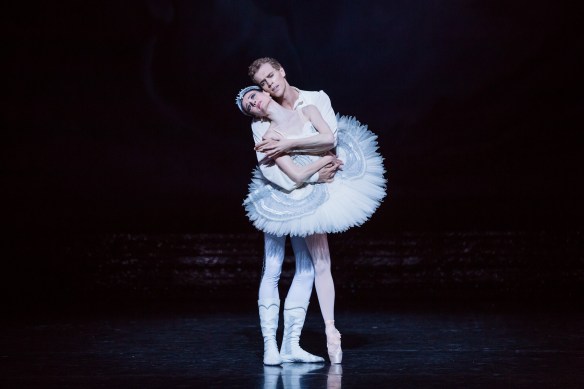
Amber Scott and Adam Bull. Photo: Daniel Boud

Stephen Baynes’ Swan Lake ranges from the ordinary to the sublime, but with Amber Scott giving a divine performance as Odette/Odile, sensitively partnered by Adam Bull as Prince Siegfried, this Australian Ballet revival is ultimately a very satisfying experience.

Baynes was commissioned to create a new Swan Lake for the company’s 50th anniversary in 2012. Artistic director David McAllister wanted a traditional production to stand alongside Graeme Murphy’s stunning modern version, created in 2002 for the company’s 40th anniversary, which drew so cleverly on the love triangle between Prince Charles, Princess Diana and Camilla Parker Bowles.

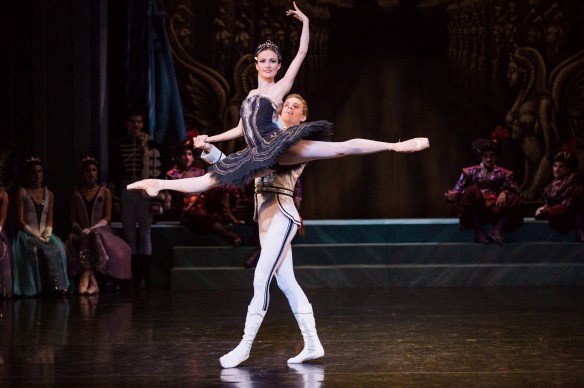
 Baynes has retained most of the Act II choreography for the swans from the 1895 Kirov version – and why wouldn’t you; it’s gorgeous and much-loved – as well as the Black Swan pas de deux in Act III. The rest is his.

He has topped and tailed the ballet with an image of Baron von Rothbart on a funeral boat. In the prelude, a melancholy Prince Siegfried, struggling with the responsibilities of his role as his coming-of-age party approaches, recalls his grief as a young boy at his father’s funeral. A boat glides across the back of the stage carrying his father’s body. Baron von Rothbart appears from behind it and fixes his gaze on the Prince.

At the end of the ballet, Rothbart fishes Prince Siegfried’s body from the lake and lifts it onto the boat. The suggestion that Rothbart holds some kind of sway over the royal family, and the Prince in particular, isn’t developed any further though. Baynes does have Rothbart lounge casually in one of the royal thrones during the Act III divertissements but that comes across as pretty unlikely. And it feels strange that we don’t see Rothbart controlling the swans.

The production gets off to a slow start with a rather ordinary Act I. The court is busy preparing for Prince Siegfried’s birthday. Ambassadors present foreign princesses to him in the hope that he will choose one of them to be his wife, while The Duchess and The Countess vie for the Prince’s attention. However, Siegfried can summon little enthusiasm for anything around him and as the act ends, he is drawn to the solitude of the lake. Thus he meets Odette as a result of his melancholy, rather than being in the forest hunting with friends, which is an interesting psychological reading.

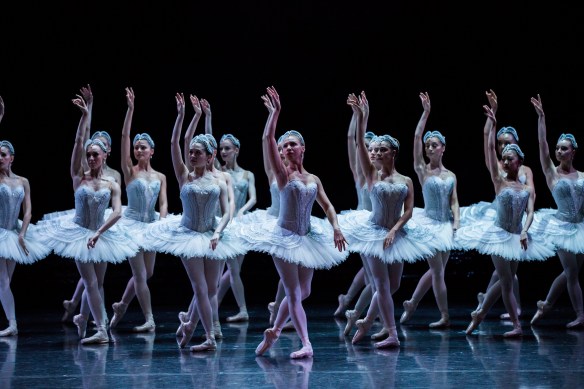
Without a great deal of story-telling or dynamic choreography to enliven it, Act I feels rather long and uninspiring. The ballet takes off in Act II with the swans. The corps de ballet were in great form on opening night (less so, at the matinee the following day) and the beautiful, familiar choreography with the dancers in their white and silvery tutus, moving together in perfect synchronicity to create beautiful formations of swans, is as spellbinding as ever.

Swan Lake Baynes 2016_Photo Kate Longley-0G4A25402016204

Members of the Australian Ballet. Photo: Kate Longley

Most thrilling, however, is Baynes’ own choreography for the swans in Act IV. The way he has them flurry and swirl around the stage, moving apart and then flocking back together as the Prince tries to find Odette among them is absolutely beautiful. Their use of fluttering hands, arms and feet captures the sense of women trapped in swan’s bodies, and Odette’s grief at Siegfried’s betrayal, which has her body just about giving out beneath her, is heart-rending.

It’s a shame that the ending is a bit of an anti-climax with the Prince just running off stage, before being fished out of the water by Rothbart, while Odette is represented by the image of a flying on screen. The fact that she has been freed from Rothbart’s power by the Prince’s sacrifice doesn’t really come across and we feel robbed of that final cathartic, emotional moment.

Designer Hugh Colman has chosen the Edwardian era for the court scenes, with a lovely use of colour in Act III – greens, aquamarines, pinks and purples for the ladies and some vibrant designs for the Spanish dancers and Cossacks, which give the ballet a boost of exuberant energy. The lake meanwhile glitters darkly, moodily lit by Rachel Burke.

On opening night, Amber Scott was everything you want in an Odette/Odile. Her Odette was exquisitely fragile and ethereal. She danced as if there was a little less gravity in the air around her and conveyed emotion with every fibre of her being. The gracefulness of her arms, the undulating flexibility in her back and neck, the delicate, nervous flutter of her feet was utterly captivating.

Her Odile had a similar beauty but bolder strength and the calculated expression on her face conveyed the knowing way she used her charm to trick the Prince. As for her 32 fouettes, she nailed them with a precision that had the audience cheering.

Swan Lake - 1pm Dress Rehearsal

Amber Scott and Adam Bull. Photo: Daniel Boud

Adam Bull was a sensitive Prince Siegfried, partnering her beautifully, his towering height compared to hers working to emphasise how much he wanted to protect her. With his long limbs, the small stage doesn’t give him the space to really let fly with his Act III set pieces but he still generated excitement and his performance convinced dramatically.

Benedicte Bemet as the pushy Duchess and Miwako Kubota as The Countess both danced beautifully and created strong characters, as did Rudy Hawkes as the Prince’s friend Benno. Veteran dancers, Gillian Revie as the Queen, Olga Tamara as Siegfried’s nurse and Stephen Heathcote as The Lord Chancellor each created a strong dramatic presence.

Tchaikovsky’s gorgeous score is, of course, a perennial pleasure and the Australian Opera and Ballet Orchestra performed it superbly under guest conductor Andrew Mogrelia.

I was lucky enough to see Ako Kondo and Chengwu Guo make their debuts as Prince Siegfried and Odette/Odile at the matinee the next day. While not yet as heart-breakingly fragile as the experienced Scott, Kondo danced beautifully, capturing Odette’s feeling of entrapment and sorrow, while her Odile exuded confidence without being wildly different to her Odette. Guo conveyed the Prince’s melancholy convincingly and his set pieces in Act III had the dazzling energy and élan that makes him such an exciting dancer. Their emotional connection to the roles will naturally develop, but it was an impressive debut by both.

Swan Lake plays at the Sydney Opera House until April 20. Bookings http://www.sydneyoperahouse.com or 02 9250 7777

Georgy Girl – The Seekers Musical

State Theatre, Sydney, April 6

GeorgyGirl2

Phillip Lowe, Mike McLeish, Pippa Grandison and Glaston Toft as The Seekers. Photo: Jeff Busby

When The Seekers themselves joined the cast at the opening night curtain call for Georgy Girl – The Seekers Musical to take a bow with the actors who played them, it was the biggest moment of the night, packing an emotion that the musical itself never managed to deliver.

There is much to enjoy musically in this new Australian bio-musical about the group from Melbourne whose beautifully harmonised folk-pop sound won them such extraordinary international success in the 1960s.

Pippa Grandison who portrays Judith Durham is fabulous, while the actors who play the other three Seekers – Glaston Toft as Athol Guy, Mike McLeish as Bruce Woodley and Phillip Lowe as Keith Potger – do as much as they can with underwritten roles.

Together they do a great job of capturing The Seekers’ distinctive sound and gorgeous harmonies with crowd-pleasing performances of their hit songs such as I’ll Never Find Another You, A World of Our Own, The Carnival Is Over and Georgy Girl.

But the musical is hamstrung by a baggy book, which is in serious need of dramaturgical development. Written by Patrick Edgeworth, Durham’s brother-in-law, the show conveys information rather than actually dramatising events, with perfunctory dialogue setting up the songs.

Charting the Melbourne beginnings and extraordinary rise of The Seekers who went to London in 1964, the focus is very much on Durham who is characterised mainly by her worries about her weight (with a running gag about her not knowing what to wear), her lack of interest in fame, and her fear that at 24 she is an old maid.

Four years after hitting the heights, Durham famously decided to leave The Seekers just as America beckoned. The musical depicts her marriage to jazz pianist Ron Edgeworth with whom she subsequently toured then jumps forward to The Seekers’ 25th anniversary reunion and winds up (without any establishing set-up) with I Am Australian, which Woodley co-wrote in 1987.

Other characters are not developed in any depth so that the three “boys” in the band remain one-dimensional figures with little sense of what really made them tick or how their lives panned out.

GeorgyGirl

Phillip Lowe, Mike McLeish, Pippa Grandison and Glaston Toft. Photo: Jeff Busby

Creating a show about The Seekers clearly has nostalgia appeal but problematically the wholesome, clean-cut foursome didn’t lead a particularly dramatic life. Using his brother and Durham’s future husband Ron (Adam Murphy) as a cheesy MC-like narrator, Edgeworth’s book acknowledges as much with comments like: “Other bands trashed their hotel rooms, The Seekers cleaned theirs up.”

Compounding that, the most dramatic, emotional story elements are cursorily dealt with, while other less interesting incidents are given more stage time. So, for example, there is a scene with Durham in hospital having had her appendix out when the boys visit and sing her to sleep with a rendition of Morningtown Ride (which the narrator then tells us never happened). Ho-hum.

Yet Durham’s near fatal car accident, after which she spent six months learning to walk again, and the brain haemorrhage that could have ended her singing career, are both dispensed with in a few short phrases. The death of her beloved husband from motor neurone disease is also depicted in quick-smart time.

The musical is full of missed emotional opportunities and loose ends. Judith’s sister Beverley (Sophie Carter) reluctantly leaves London when the doctor says one of them must go home to Balwyn to help their mother who has emphysema. Later Beverley is back in London with no explanation (and pregnant for what seems like an inordinately long time).

And did we really need to see a dream sequence in which John Ashby (Ian Stenlake), The Seekers’ tour manager and Durham’s cheating ex-boyfriend, sings Tom Jones’ It’s Not Unusual, complete with gyrating choreography?

Where the musical scores is with The Seekers’ songs and the quality of the lead casting. In a warm, lively performance, Grandison really captures Judith Durham’s girl-next-door quality and manages to convey a similar physical quality helped by the costuming. Her singing is gorgeous, with a sweet purity not unlike Durham’s, and she is in top form vocally whether she’s singing jazz, blues or folk.

Lowe, McLeish and Toft are also terrific, making as much of the thin characterisation as they can and creating likeable figures. Together their music-making is spot-on. Props too to Stephen Amos, the musical supervisor, arranger and orchestrator, and to the 11-piece band under musical director Stephen Gray.

Murphy adds plenty of ham to the cheese as the narrator in sparkly jacket. Carrying a great deal of the show’s momentum on his shoulders, he certainly lifts the energy levels and extracts as many laughs as the script allows, while delivering the frequent lame jokes with a knowing shrug.

GeorgyGirl60

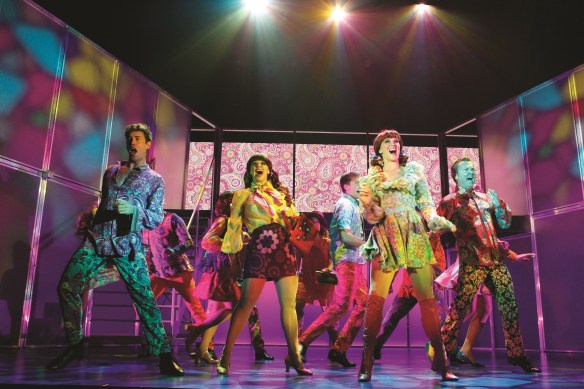
The cast of Georgy Girl in Carnaby Street attire. Photo: Jeff Busby

Shaun Gurton’s set is basic to say the least with flimsy-looking metallic grey walls, a moveable staircase and a screen for footage. The costumes (Isaac Lummis) and choreography (Michael Ralph) add plenty of colour and movement, but also plenty of clichés from the up-tight gents in bowler hats who strut their stuff when The Seekers arrive in London to psychedelic outfits that look like a parody of 1960s fashion, not to mention the glitzy shamrock green outfits for two Irish lasses, used along with other equally obvious outfits to illustrate a Seekers tour.

Director Gary Young keeps the show moving with a fair amount of pace but without building emotional moments and tension. Running two hours and 40 minutes (including interval), it feels long. It’s the songs that keep the musical buoyant. For many audience members, that will be enough. There have apparently been plenty of standing ovations as audiences relish the nostalgia trip and the music. But it could have been so much better.

Georgy Girl is at the State Theatre until June 5. Bookings: www.ticketmaster.com.au or 136 100

Turandot: Handa Opera on Sydney Harbour

Fleet Steps, Mrs Macquarie’s Point, March 24

Turandotdancers

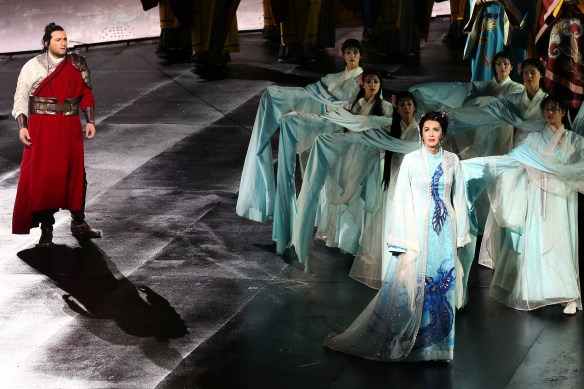
Riccardo Massi and Dragana Radakovic. Photo: Prudence Upton

Spectacle is a pre-requisite for Opera Australia’s Handa Opera on Sydney Harbour – and Turandot doesn’t disappoint, offering plenty of visual thrills without resorting to tacky glitziness. Nor does it ever feel that the stage is full of colour and movement just for the sake of it.

What’s more, with Dragana Radakovic as Turandot and Riccardo Massi as Calaf, the production is led by principal singers who are able to command the huge space with their magnetic presence and powerhouse vocals.

 Set in a fantasy China, Puccini’s final (and unfinished) opera tells a barbaric tale. Turandot, the ice-cold princess, demands that her suitors are beheaded if they fail to answer three riddles. The score includes many glorious melodies (some of which draw on Chinese tunes) and, of course, the well-known aria Nessun dorma.

Given the one-dimensional stereotyping of Asian women in Turandot and Puccini’s Madama Butterfly, Chinese-born New York-based director Chen Shi-Zheng has knocked back many offers to direct both operas, but allowed himself to be talked into it now by OA artistic director Lyndon Terracini.

In interviews, Chen has said that he aims to present Princess Turandot as a more complex and believably human figure, while also seeing her as an embodiment of China with its centuries-old suspicion of the West.

Whether he achieves that is debatable. Despite a superb performance from Radakovic, Turandot (who explains in an Act II aria why she hates the foreign princes who come to woo her) doesn’t really come across as any more nuanced a character than usual.

Be that as it may, Chen’s production tells the story with great clarity. He uses the vast stage well and is adept at ensuring the focus is where it needs to be.

TurandotDragon

The Turandot set with fire-breathing dragon. Photo: Prudence Upton

Dan Potra’s design is dominated by two major set pieces. On one side there is a giant, fire-breathing dragon whose tail suggests the Great Wall of China onto which images are projected. There’s also a towering pagoda studded with sharp spikes resembling dragon scales, from where Turandot looks down on the world below. The tower has a (wobbly) drawbridge on which she gradually descends with each riddle that Calaf guesses correctly.

The dragon imagery extends to Turandot’s gorgeous, shimmering silvery white and blue gown. Potra’s costuming makes clever use of colour, pattern and sparkle without over-doing it, while Scott Zielinski’s dramatic, coloured lighting creates many stunning effects. The one design element that looks odd is the Emperor’s throne, which moves through the air on a crane like a gigantic flying sofa.

Handa Opera on Sydney Harbour is now in its fifth year and fireworks have become an expected feature. Turandot doesn’t offer many obvious moments for their inclusion so they explode after Nessun dorma. It’s not ideal but given the audience’s rapturous response to that most famous of arias it works OK, though keeping them to the end might have been better.

Chen has also done the choreography, which draws on martial arts for the guards, while Turandot’s female attendants glide around the stage, sending their billowing sleeves flying through the air. As with his direction, the movement serves the story and production beautifully.

Radakovic, a Serbian dramatic soprano, is an impressive, imperious Turandot with an exciting, powerful voice that has a glinting, steely quality at times, which suits the character.

Massi is magnificent as Calaf. The Italian tenor is a tall man, giving him a commanding, heroic presence. He exudes enormous charisma and warmth, matched by his beautiful, rich, burnished voice. In a sensitive rendition of Nessun dorma he builds the aria perfectly, bringing the house down as he soars to the climactic top B.

(The production features two alternating casts, with Daria Masiero as Turandot and Arnold Rawls as Calaf heading the other).

TurandotLiu

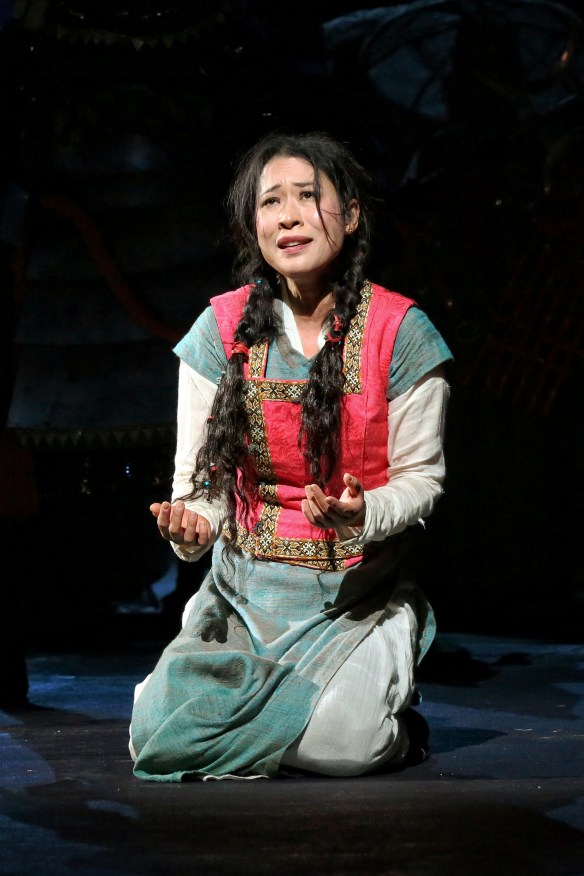
Hyeseoung Kwon as Liu. Photo: Prudence Upton

Liu, the slave girl who secretly loves Calaf, is at the emotional heart of the opera. Hyeseoung Kwon who has sung the role previously for OA is heartbreaking. She sings with a moving lyricism, while portraying the character with more strength and resolve than is often the case. Her torture has you wincing and her suicide is very moving.

There is terrific work from Luke Gabbedy, Benjamin Rasheed and John Longmuir as the comic courtiers Ping, Pang and Pong who have plenty of choreography to negotiate while singing. Conal Coad as the blind Timur, David Lewis as the Emperor and Gennadi Dubinsky as the Mandarin all offer strong support, while the chorus is marvellous.

The Australian and Ballet Orchestra, conducted by Brian Castles-Onion, gives a fine account of the score and while you are always aware of the amplification, Tony David Cray’s sound design is clear.

With its combination of spectacle, clear story-telling and superb singing, Turandot should appeal to both regular opera-goers and newcomers. Having Chinese as well as English surtitles is also an astute move as OA seeks to broaden the audience for what has become a key event on Sydney’s arts calendar.

Turandot: Handa Opera on Sydney Harbour, Fleet Steps, Mrs Macquarie’s Point; until April 24. Bookings: 02 9318 8200, opera.org.au/Harbour

 A version of this review ran online for Daily Telegraph Arts

Fiddler on the Roof

Capitol Theatre, March 29

FiddlerWarlow

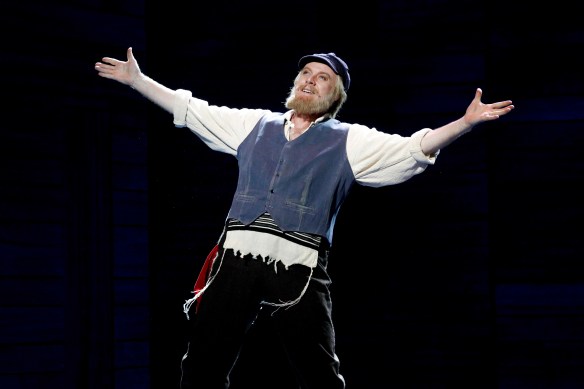
Anthony Warlow as Tevye. Photo: Jeff Busby

Anthony Warlow is without question one of Australia’s greatest musical theatre performers – and he proves his star power once again with a sublime portrayal of Tevye in Fiddler on the Roof.

The 1964 musical by Jerry Bock, Sheldon Harnick and Joseph Stein is a much-loved classic for good reason. The glorious score with its stirring, achingly beautiful melodies includes songs such as If I Were a Rich Man, Tradition, Matchmaker and Sunrise Sunset.

Meanwhile, with the number of refugees in the world today, the theme of religious persecution and displacement feels as resonant and relevant as ever – though the story is as much about love, family and community, with plenty of humour as well as heartache.

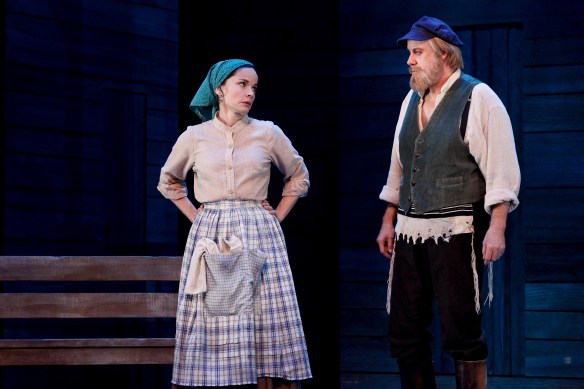
Fiddler is set in 1905 in the small Jewish village of Anatevka in Tzarist Russia. Tevye is a poor milkman, with five daughters, who struggles to hold onto tradition in a changing world. This new Australian production, directed by Roger Hodgman, is fairly traditional and solidly staged without being particularly inventive but it is deeply felt and beautifully performed. Richard Roberts’ no frills set is simple but effective: a wooden box with cutout shapes for the houses, which are wheeled forward and spun around to reveal interiors.

Dana Jolly has done a fine job of reproducing Jerome Robbins’ original choreography, which feels wonderfully authentic to the time and culture. The ensemble dancing is terrific, exuding an exuberant, robust energy particularly in the wedding scene.

There are lively, new orchestrations with more of a folksy feel, and the sound from the ten-piece orchestra under musical director Kellie Dickerson is rich and vibrant.

Fiddler1

Sigrid Thornton with Anthony Warlow in Fiddler on the Roof. Photo: Jeff Busby

Warlow’s Tevye is playful, sprightly and big-hearted, giving way to a moving gravitas. His acting and comic timing are impeccable. His wry conversations with God are accompanied by a lovely twinkle in the eye, while his outbursts of blustering anger are always tangibly underpinned by love and his own internal struggle. Meanwhile his vocals are masterful, the gorgeous tones flecked with the emotion of each lyric.

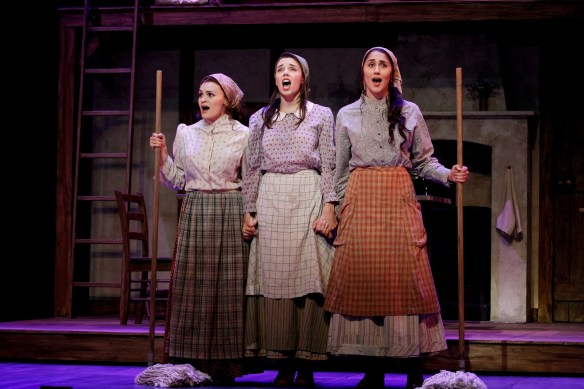
As his wife Golde, Sigrid Thornton has a small, light voice (made more obvious when she sings with Warlow) but she gives a strong characterisation even if it becomes a little strident at times. Teagan Wouters, Monica Swayne and Jessica Vickers each create detailed characters as Tevye’s tradition-defying daughters Tzeitel, Hodel and Chava, and Swayne charms with a heartfelt, beautifully sung rendition of Far From The Home I Love.

Fiddlerdaughters

Jessica Vickers, Teagan Wouters and Monica Swayne as Chava, Tzeitel and Hodel. Photo: Jeff Busby

Blake Bowden brings charisma, fiery passion and lovely vocals to the role of Perchik, the idealistic, revolutionary student. Singer-songwriting Lior gives a gentle portrayal of the humble, hard-working tailor Motel and after a slightly hesitant start on opening night, his rendition of Miracle of Miracles shines, bringing a different vocal texture to the show.

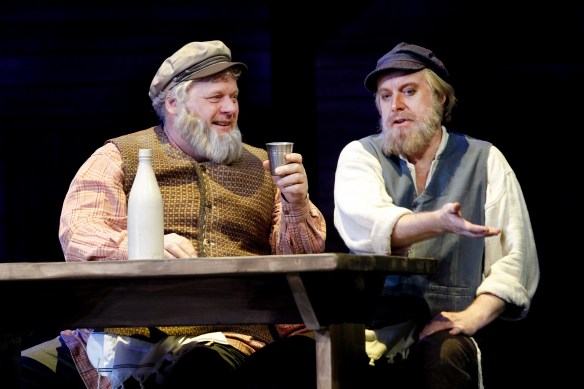
Mark Mitchell is a strong presence, physically and vocally, as the wealthy butcher Lazar Wolfe playing him with such truth and depth that you empathise with the character much more than you might. On the other hand, Nicki Wendt’s broadly comic portrayal of the matchmaker Yente feels a little too much like a well-oiled stereotype lacking in genuine humanity and some of the humour goes begging.

FiddlerMitchell

Mark Mitchell and Anthony Warlow. Photo: Jeff Busby

At the centre of it all is Warlow in a magnificent, unforgettable performance – one that musical theatre fans won’t want to miss.

Fiddler on the Roof plays at the Capitol Theatre until May 8. Bookings: www.ticketmaster.com.au or 136 100