Seventeen

Belvoir St Theatre, August 5

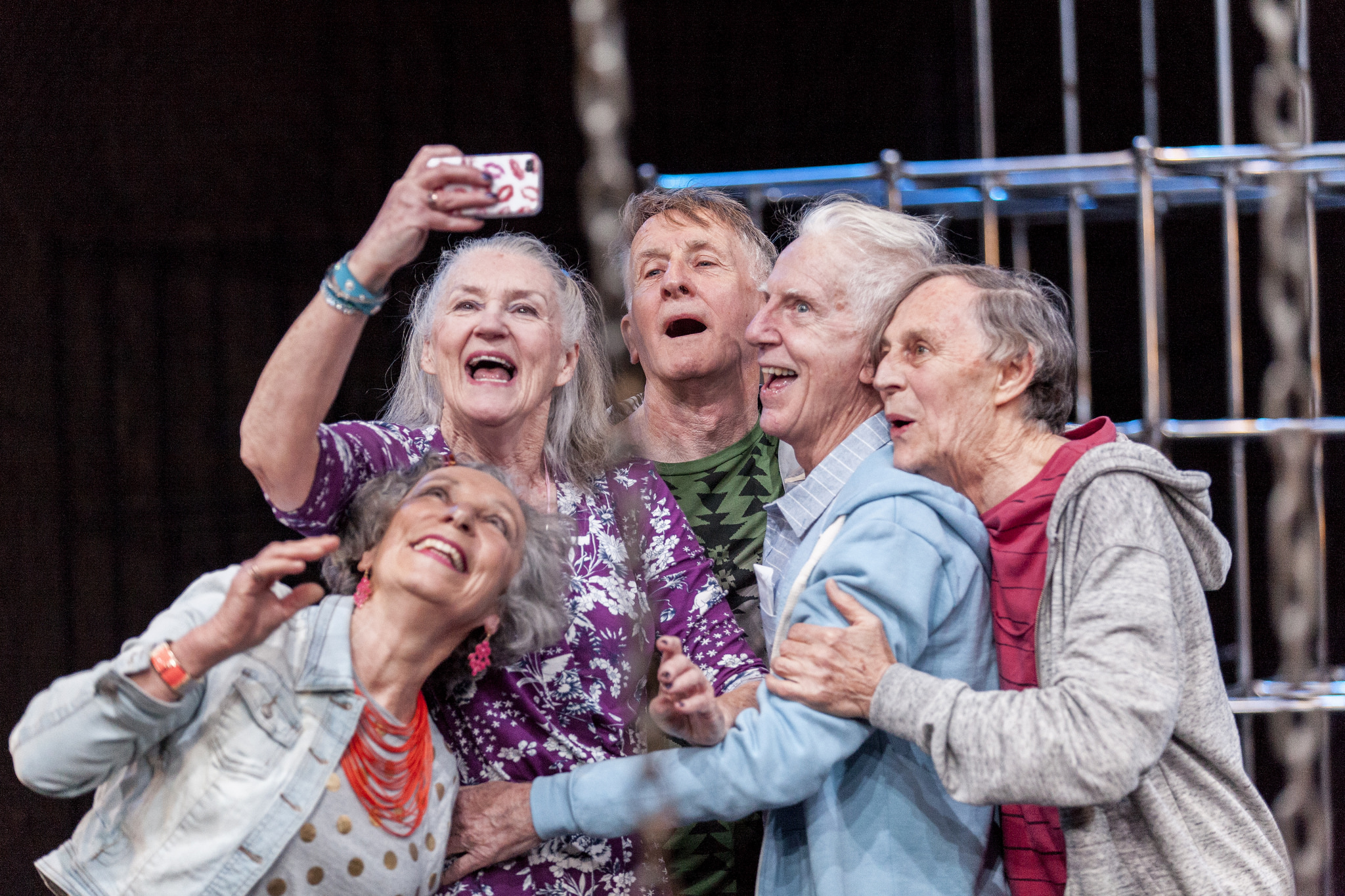
Anna Volska, Maggie Dence, John Gaden, Peter Carroll and Barry Otto. Photo: Brett Boardman

Anna Volska, Maggie Dence, John Gaden, Peter Carroll and Barry Otto. Photo: Brett Boardman

Sure, it could easily have been another song in the event but it’s quite a moment when the veteran cast of Seventeen dances to Taylor Swift’s Shake It Off. Famously, it nearly didn’t happen. When rights to the song were denied at the last minute, director Anne-Louise Sarks took to Twitter. The campaign went viral with Swift tweeting her permission, gifting the production invaluable publicity.

Written by Matthew Whittet, Seventeen is a very sweet play. On the last day of high school, a small group of friends gather in the park to party the night away before they all go their separate ways and life changes forever. As they drink too much, dance and play truth and dare, anxieties, fears and secrets bubble to the surface.

It could be performed by young people but Whittet wrote it for 70-year olds, adding another level of poignancy to his examination of those uncertain years on the cusp of adulthood when you ponder who you are and what you hope to become.

And so we have a cast of esteemed older actors in the roles. There’s the loud, pushy ringleader Mike (John Gaden), his quieter, more sensitive best mate Tom (Peter Carroll) who is heading interstate to Melbourne University, Mike’s pretty, popular girlfriend Sue (Maggie Dence) and Sue’s brainy friend Edwina (Anna Volska) who rarely lets her hair down.

Joining them are the uninvited Ronny (Barry Otto), the weird, misfit kid that no-one likes, and Mike’s 14-year old sister Lizzy (played by the younger Genevieve Lemon) who won’t go home no matter how much they tell her to piss off.

The company spent time during rehearsals with some 17-year olds to get back in touch with a teenager’s energy, physicality and way of talking – and they all do a great job. Carroll and Gaden, in particular, climb the playground equipment and get their groove on with the ease and exuberance of people decades younger (movement by Scott Witt).

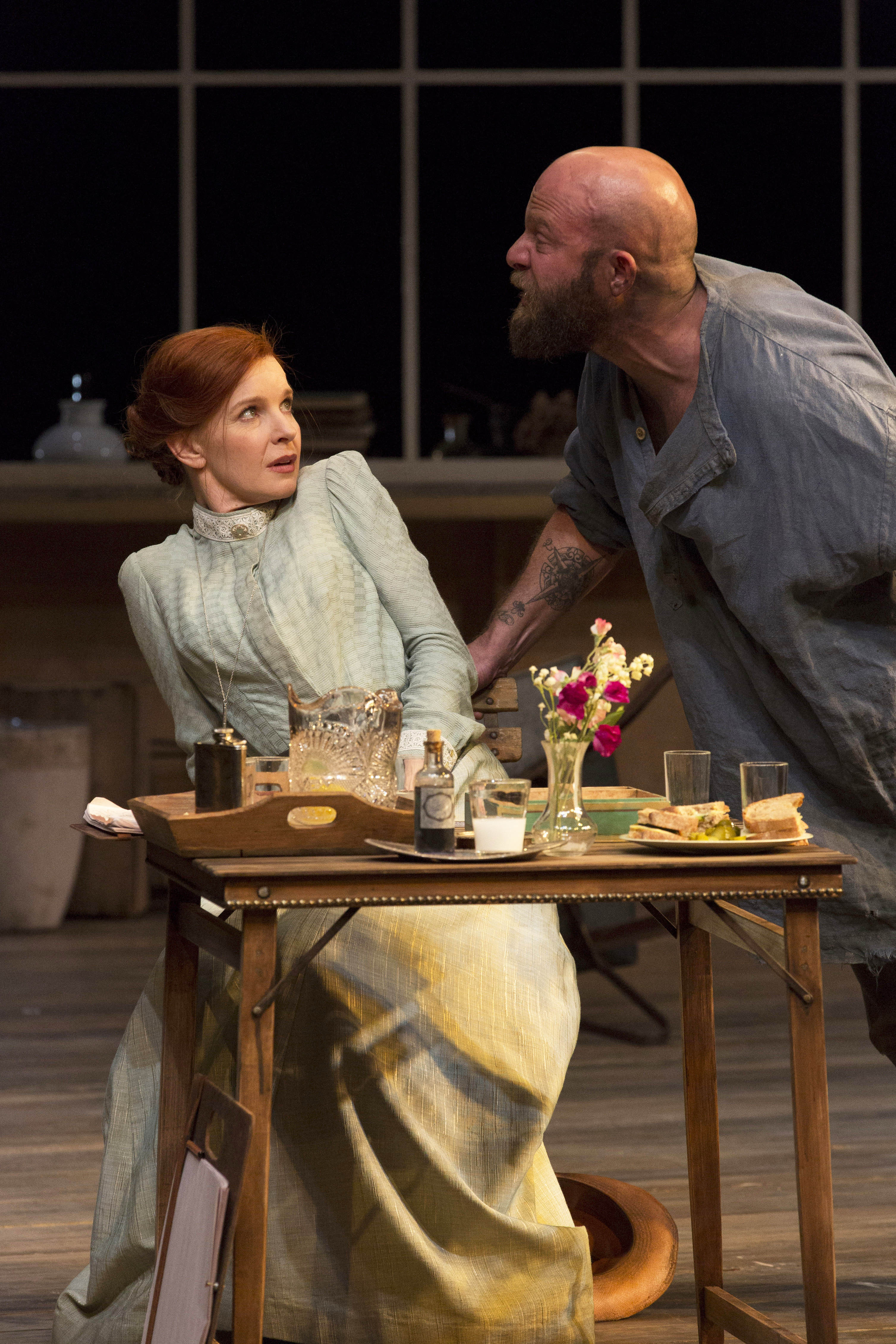
There are a few clunky moments as Whittet sends characters off stage to allow others to remain alone, which feel a bit engineered, but overall Sarks’ production is nicely staged on Robert Cousins’ playground set, with very clever costuming by Mel Page.

The performances are exceptional. After initial laughter at seeing septuagenarians larking around, saying “fucktard” and dancing to contemporary pop songs, we accept the convention as the actors draw us into the character’s emotional dilemmas.

There are lovely moments for all the characters, while Otto’s portrayal of the sad, alienated Ronny is heartbreaking.

The characters can’t believe how quickly their high school years have flown. Young people will doubtless relate to that, but Seventeen will probably speak loudest to people whose teenage years are long in the past and for whom the passing of time and sense of nostalgia will strike even more of a chord.

Whittet writes with love, tenderness and a gentle optimism. He doesn’t tell us what happens to the characters – which would arguably make for an even stronger play – but he leaves us hoping against hope that things will turn out well for all of them.

Seventeen runs until September 13. Bookings: www.belvoir.com.au or 02 9699 3444

 A version of this review ran in the Sunday Telegraph on August 9

The Present

Roslyn Packer Theatre, August 8

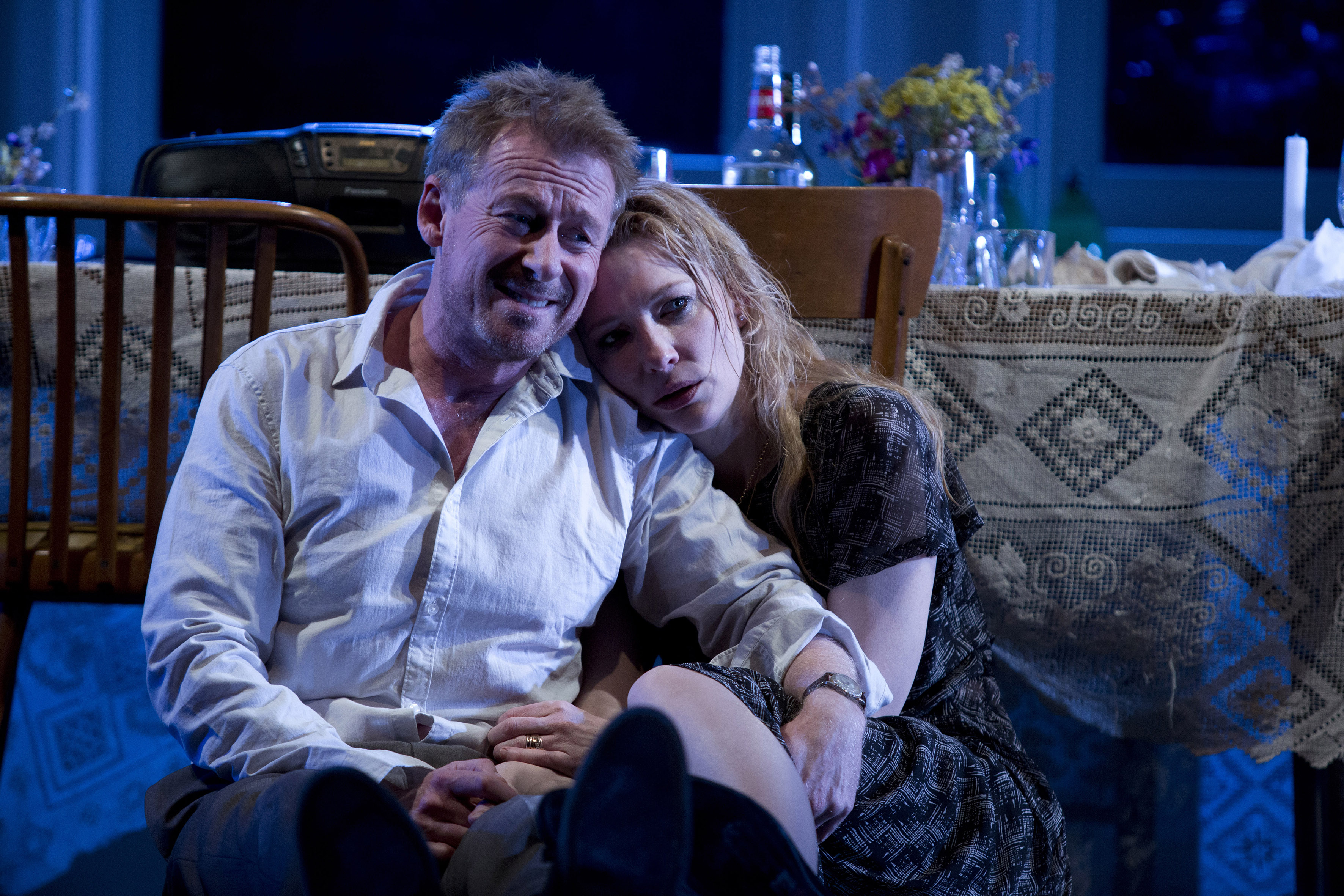
Richard Roxburgh and Cate Blanchett in The Present. Photo: Lisa Tomasetti

Richard Roxburgh and Cate Blanchett in The Present. Photo: Lisa Tomasetti

Chekhov famously said that if there’s a gun on stage, then eventually it must be used. In his latest Chekhov adaptation, The Present, Andrew Upton wastes no time, starting the tragicomedy with a bang.

In fact, Upton has the characters pull the trigger several times before the play’s dramatic conclusion – just some of the fireworks, emotional and literal, that punctuate and power this blisteringly brilliant Sydney Theatre Company production.

Upton has adapted a number of classic Russian plays with considerable success – Chekhov’s Uncle Vanya and The Cherry Orchard, Maxim Gorky’s Philistines and Children of the Sun, and Mikhail Bulgakov’s The White Guard – but The Present is arguably his best yet.

Written around 1878, Chekhov’s sprawling, untitled first play – often called Platonov after its central character – would run around five hours in its original form but Upton has condensed it to a gripping three hours including interval.

He has updated the action from pre-revolutionary Russia to the mid-1990s, post-Perestroika, another period of great change and disillusionment. Instead of the main protagonists being 20-something as Chekhov had them, they are in their 40s, intensifying their feelings of yearning, regret and frustration.

The play is set in the country house of Anna Petrovna (Cate Blanchett), the widow of an older, powerful General, where a group of friends and acquaintances gather to celebrate her 40th birthday. Among them are local doctor Nikolai (Toby Schmitz), Anna’s stepson, the slightly nerdy, awkward Sergei (Chris Ryan) and his brittle new wife Sophia (Jacqueline McKenzie), a doctor who has recently returned from working overseas.

Anna has also invited two powerful landowners (David Downer and Martin Jacobs) hoping one of them might marry her, securing her land and fortune.

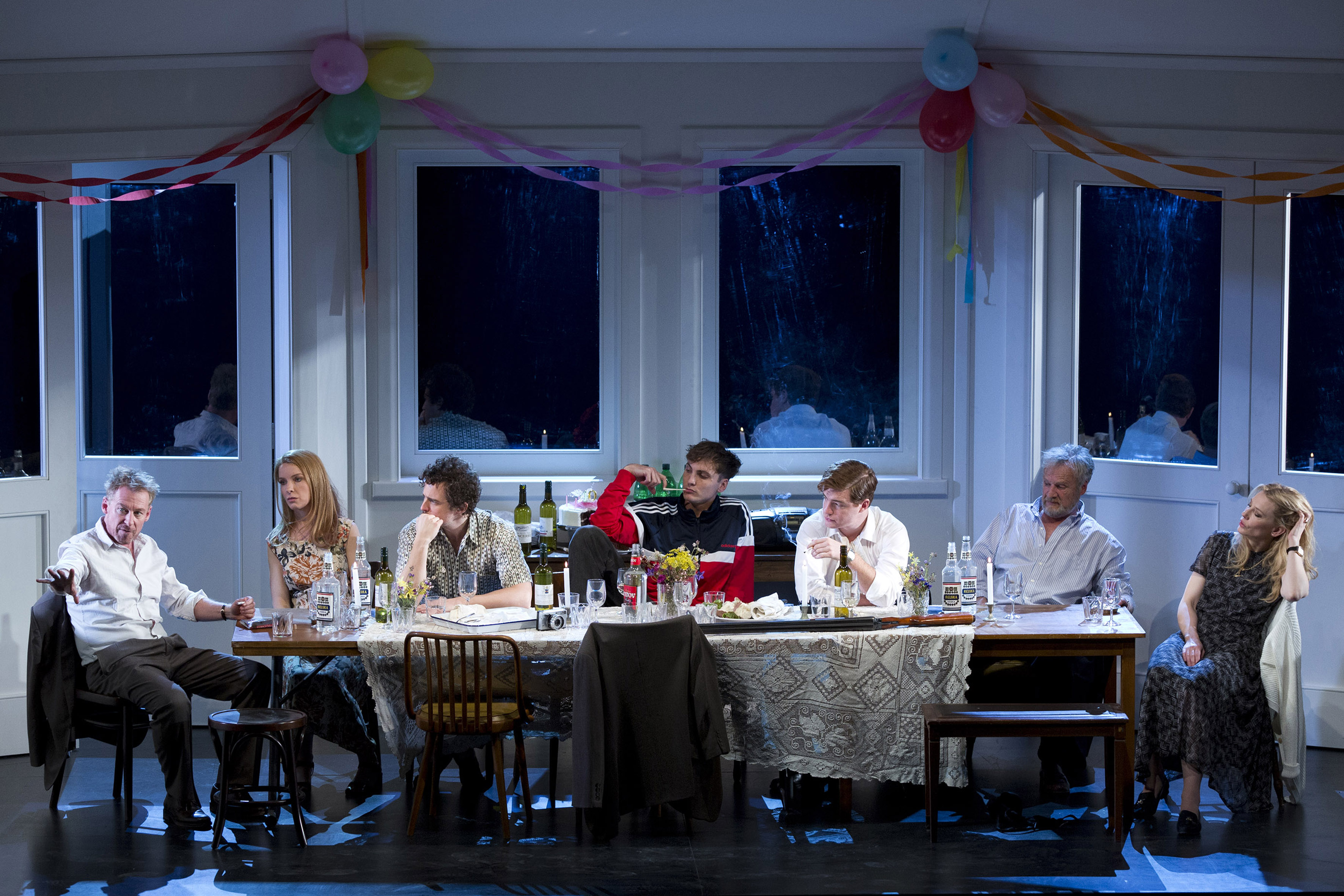
Richard Roxburgh, Jacqueline McKenzie, Chris Ryan, Eamon Farren, Brandon McClelland, Martin Jacobs and Cate Blanchett. Photo: Lisa Tomasetti

Richard Roxburgh, Jacqueline McKenzie, Chris Ryan, Eamon Farren, Brandon McClelland, Martin Jacobs and Cate Blanchett. Photo: Lisa Tomasetti

At the heart of the play is Mikhail Platonov (Richard Roxburgh), who has not fulfilled his brilliant promise as a young intellectual and is now a womanising schoolteacher.

Mikhail brings his sweet but gauche wife (Susan Prior) and baby son. However, his roving eye soon alights on Sophia, a former flame, and Nikolai’s gorgeous girlfriend Maria (Anna Bamford) – though it’s clear his heart belongs to Anna.

Irish director John Crowley helms a superbly paced production on Alice Babidge’s impressive, almost-naturalistic set, which moves from a verandah outside the dacha to a small balloon-festooned summerhouse to a night scene in swirling mist, and back to the dacha for the morning after, this time inside. It’s brilliantly lit by Nick Schlieper with a powerful sound design by Stefan Gregory who uses music by The Clash and Joy Division’s Love Will Tear Us Apart to punctuate scenes.

Together Upton, Crowley and the magnificent cast nail the Chekhovian balance between laughter and tears as the characters struggle to deal with life in the here-and-now.

The first of the four acts is a slow burn as the guests arrive. Tensions and animosities simmer beneath the desultory chat, with conversations cutting across each other, all of which is performed with a convincingly spontaneous feel. Then, in the aftermath of lunch, the play suddenly explodes into shattering life.

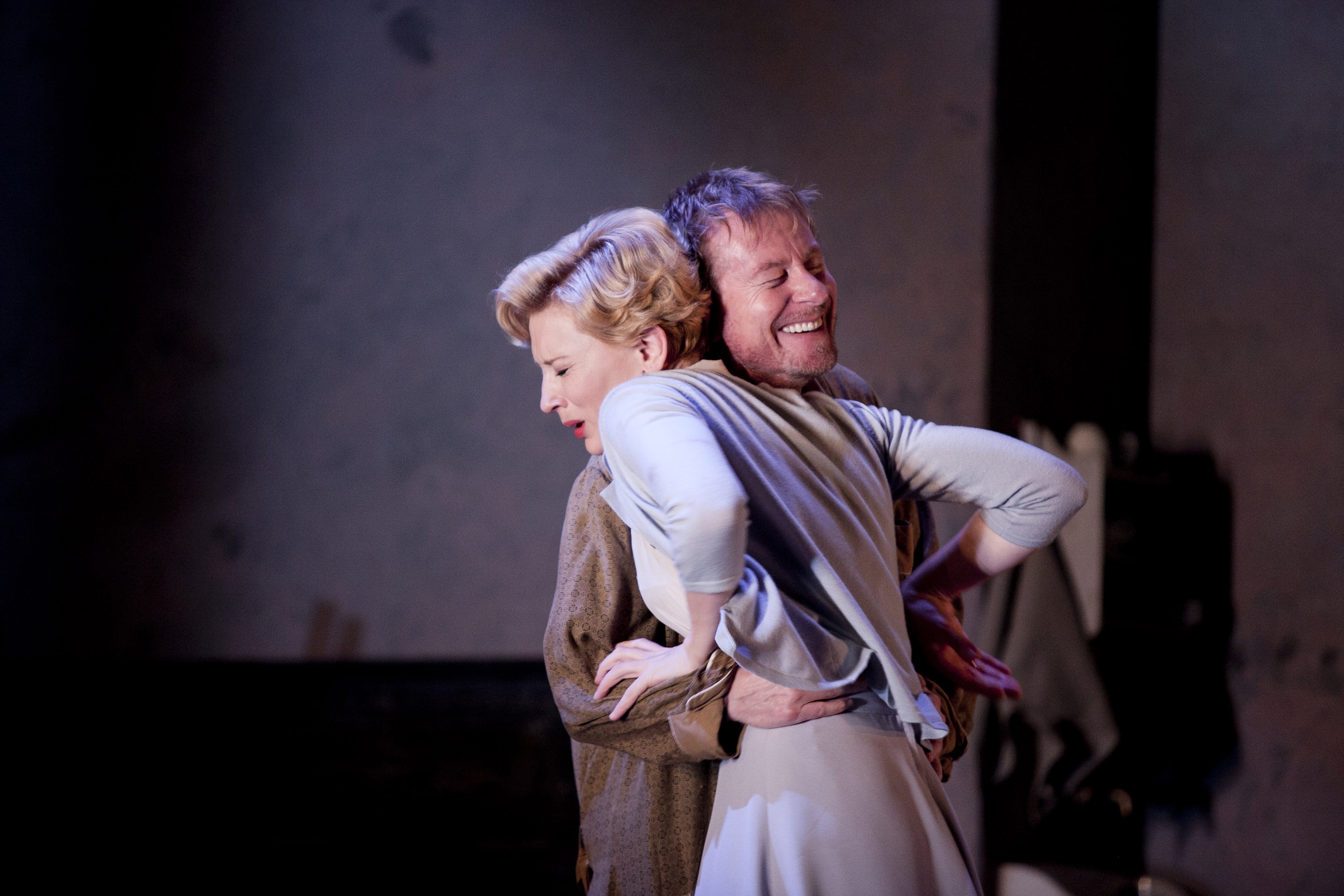
Roxburgh gives one of the performances of his career as Mikhail, capturing his wit and charisma but also his world-weary vulnerability and self-loathing. Blanchett is equally virtuosic as Anna, moving from bored containment to drunken abandon. Both draw on deep, uninhibited emotional reserves and the chemistry between them is electric.

But it’s a genuine ensemble piece with superb performances from the entire 13-strong cast (which also includes Eamon Farren, Brandon McClelland and Andrew Buchanan). As Upton prepares to leave STC at the end of the year, The Present is a thrilling parting gift.

The Present plays at the Roslyn Packer Theatre until September 19. It is sold out but $20 Suncorp tickets are released at 9am each Tuesday for performances during the following week. They are available online at http://www.sydneytheatre.com.au in person or by calling 02 9250 1929.

A version of this review ran in the Sunday Telegraph on August 16

Blonde Poison

Old Fitz Theatre, July 30

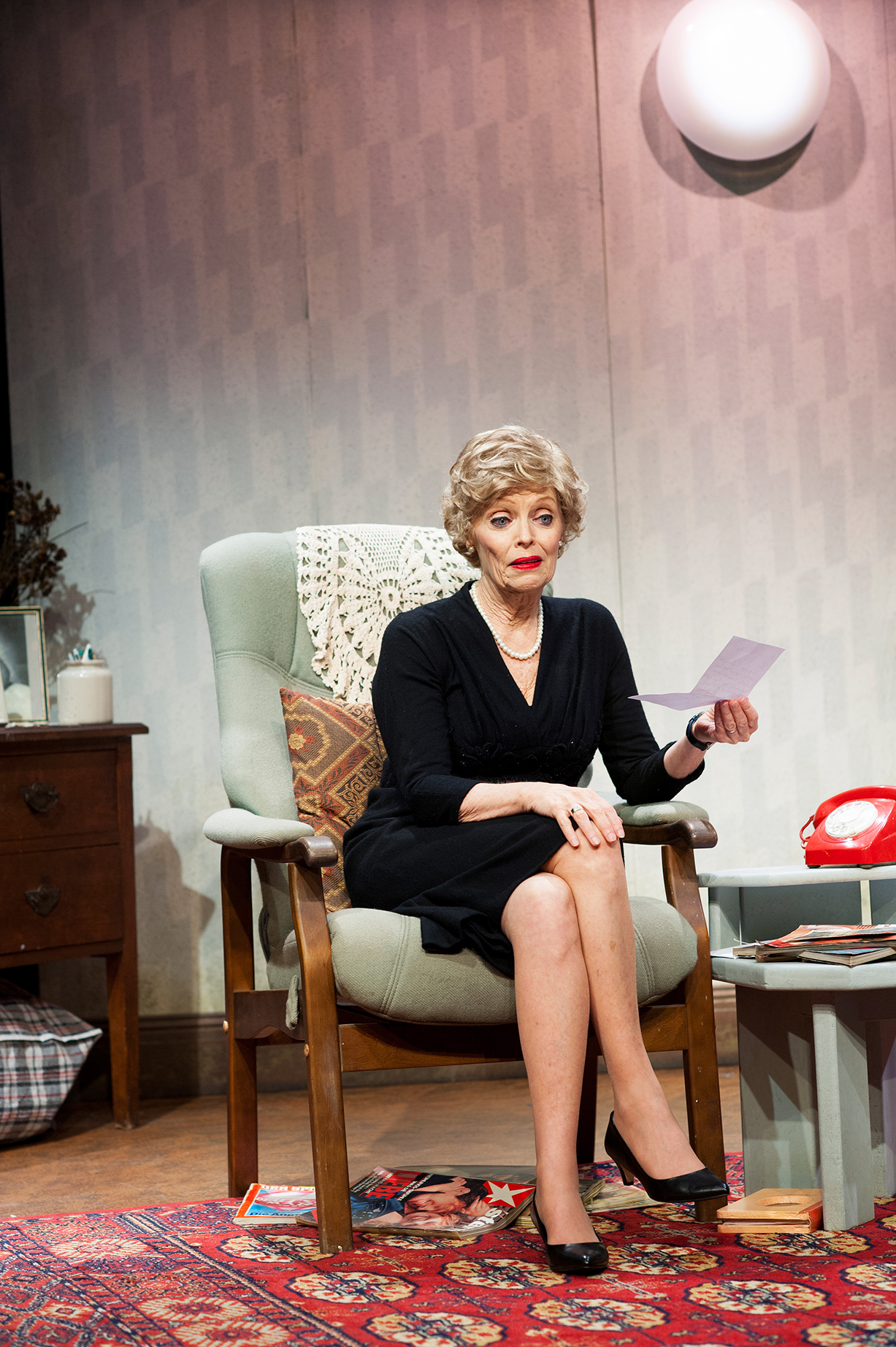
Belinda Giblin as Stella Goldschlag. Photo: Marnya Rothe

Belinda Giblin as Stella Goldschlag. Photo: Marnya Rothe


Gail Louw’s one-woman play Blonde Poison tells the confronting, true story of Stella Goldschlag, taking its title from the nickname the Nazis gave her.

Also known as “the blonde ghost”, Berlin-born Goldschlag was 18 when World War II began. Very beautiful with blonde hair and blue eyes, she looked Aryan but was actually Jewish. Living illegally in war-torn Berlin, she was captured and tortured by the Gestapo. In order to save herself and her parents from Auschwitz, she agreed to become a “greifer” or “catcher”, informing on Jews in hiding. Because of her, up to 3000 Jews are said to have been sent to concentration camps.

The play requires an extraordinary performance to keep you riveted for its entire 90 minutes – and it gets it from Belinda Giblin in a production currently playing at Sydney’s Old Fitz Theatre, produced by Adam Liberman in association with Red Line Productions.

Louw is a British playwright, whose grandparents died during the Holocaust. She based her play largely on a book by David Wyden, a journalist who had been smitten with Goldschlag at school and interviewed her when she was in her 70s. Wyden’s family was able to escape Berlin in 1937 and go to the US, but Goldschlag’s family didn’t have the means or the connections.

In the play, Goldschlag – now living as a recluse – is waiting nervously for Wyden to arrive and begins going over in her mind all the questions he is bound to ask about her life.

Louw has Goldschlag tell her story in fairly straightforward fashion but she doesn’t dodge the moral complexities, with our sympathy shifting back and forth. Jennifer Hagan directs the play with understated sensitivity, eschewing bells and whistles and Giblin gives one of the performances of her career with an emotionally layered portrayal that is full of nuance and complexity.

Brought up to think of herself as “a princess” by her father and beloved Mutti, Giblin portrays a vain woman with a strong sense of entitlement and a keen awareness of her sexual power. At the same time, she is a victim of her time and place, who makes difficult choices in order to survive.

At times, we understand and empathise with Goldschlag; at other times we are taken aback by her ruthlessness and her candid admission that she loved the power and privilege her acts of betrayal conferred on her. One particular incident, where she nearly seals the fate of a Jewish boy in the Hitler Youth, and describes the thrill she experiences is particularly unsettling. Giblin plays it all beautifully without ever judging the character. She also conveys Goldschlag’s heartbreak when her daughter is taken away from her as a baby and later rejects her.

Belinda Giblin. Photo: Marnya Rothe

Belinda Giblin. Photo: Marnya Rothe

Derrick Cox has designed a small, shabby apartment that makes for a convincingly naturalistic setting in which a basket of rag dolls sits oddly for such a stylish, tough woman: a sad, almost pathetic, substitute for or reminder of the daughter she lost.

The play itself is a bit long-winded and repetitive and could easily be trimmed. However, Hagan’s production (with sound by Jeremy Silver and lighting by Matthew Tunchon) is powerfully evoked. But it’s Giblin’s portrayal of a flawed human being that makes the play soar, keeping us gripped, fascinated, appalled and moved as we contemplate what we would have done in her place.

Blonde Poison runs at the Old Fitz Theatre, Woolloomooloo until August 15. Bookings: http://www.oldfitztheatre.com

Of Mice and Men

Reginald Theatre, Seymour Centre, July 16

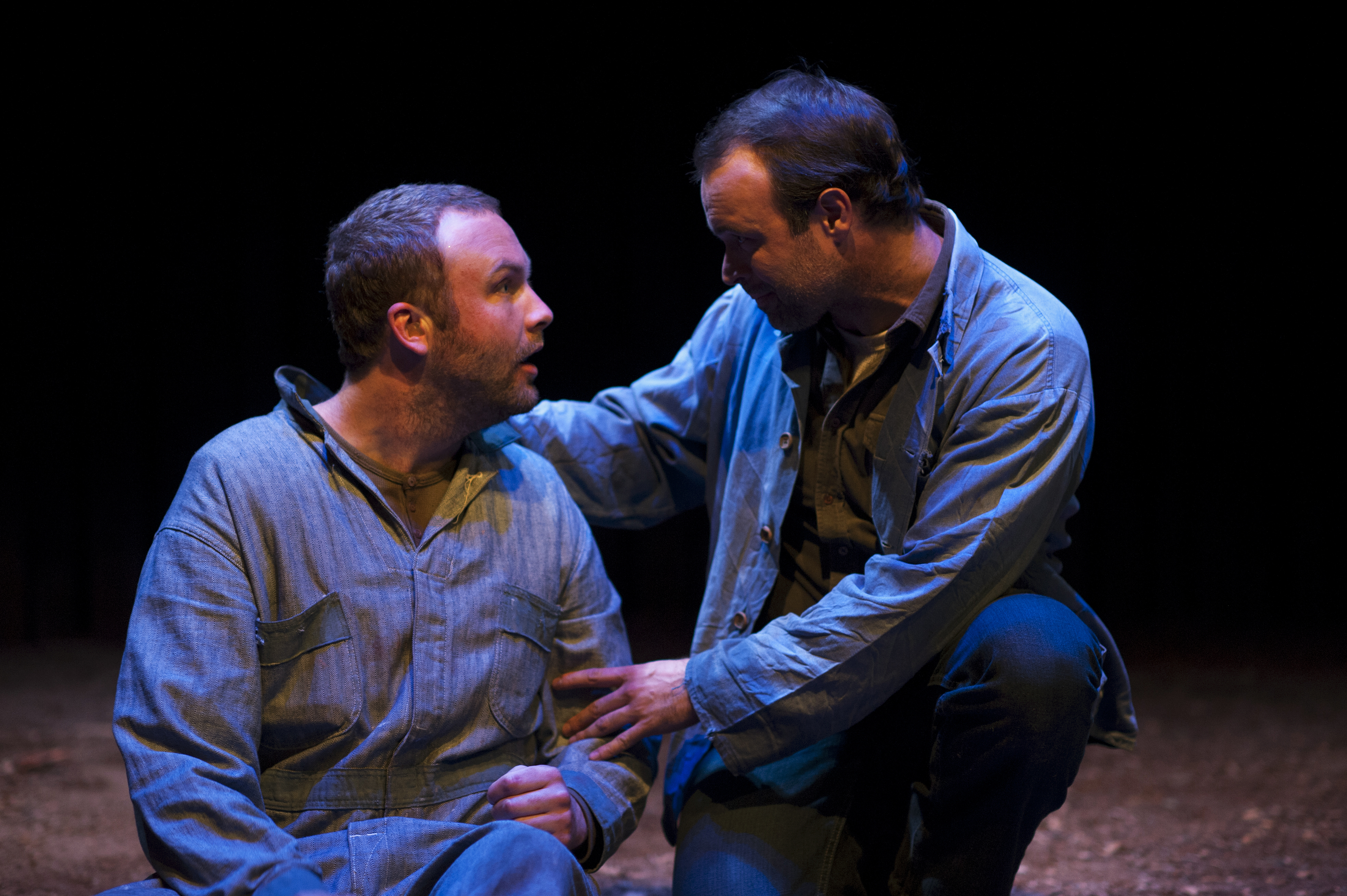
Andrew Henry and Anthony Gooley. Photo: Marnya Rothe

Andrew Henry and Anthony Gooley. Photo: Marnya Rothe

Iain Sinclair has directed a production of John Steinbeck’s Of Men and Men for Sport for Jove that feels heartbreakingly truthful.

Steinbeck himself adapted the play from his classic 1937 novella set during the Depression. Two itinerant ranch workers George Milton (Anthony Gooley) and Lennie Small (Andrew Henry) have been roaming California looking for work. To keep them going, George inspires Lennie with the dream that one day they will buy their own property (from some elderly folk he knows) where they will keep a few animals including Lennie’s longed-for fluffy rabbits.

The trouble is that Lennie is a bit soft in the head. A gentle-minded giant who doesn’t know his own strength, he keeps petting small animals to death. Arriving at a farm, George tells Lennie to say nothing, keep his head down and do what he says in the hope that they will be left alone and all will be well. And Lennie so wants to do the right thing but when situations conspire against him, he just can’t help himself.

Sinclair has directed a beautiful, understated production that unfolds at an unhurried pace, while still building the feeling of inexorable tragedy. It is a clear, empathic reading that strikes at the heart, while the play feels as timely as ever given the vast numbers of displaced, disenfranchised, struggling people the world over.

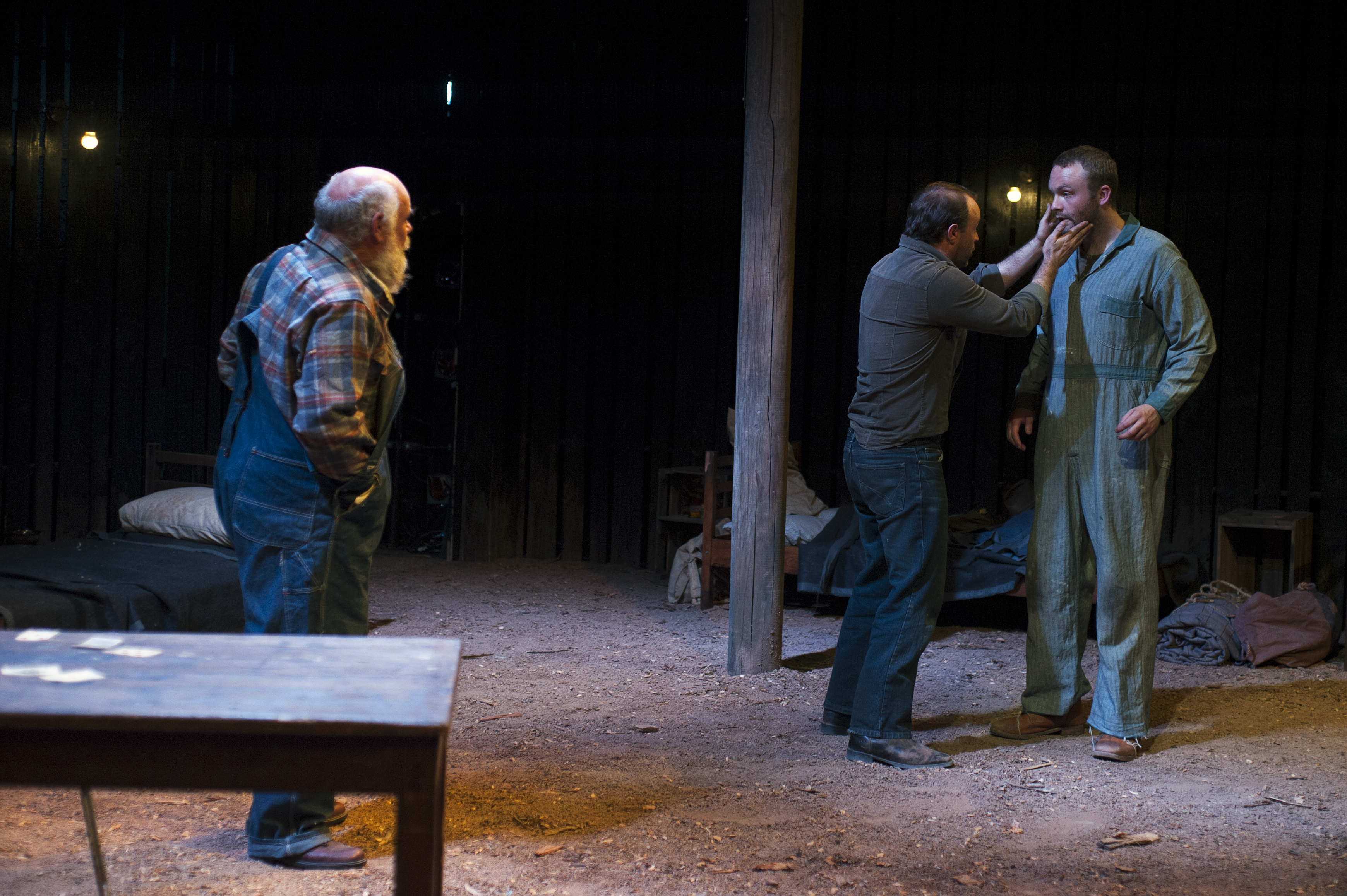
Michael Hankin’s set design – a wooden slatted wall, four long wooden poles and a dirt floor with wood chips, along with basic wooden beds, tables and crates – feels just right, while Sian James-Holland’s lighting creates changing moods and captures the passing of time.

Sinclair has cast it perfectly – right down to the poor old dog, which is taken out and shot because it is stinking up the place. It’s a tense moment as we wait, seemingly for ages, to hear the shot – foreshadowing things to come.

Laurence Coy, Anthony Gooley and Andrew Henry. Photo: Marnya Rothe

Laurence Coy, Anthony Gooley and Andrew Henry. Photo: Marnya Rothe

Henry gives an unforgettable performance as Lennie. He is a tall man and naturally slim but he stacked on around 20 kilos for the role. It certainly gives him a sense of bulkiness, emphasised by the way he stands very squarely and solidly when still, feet planted apart, and lumbers around the stage in his dirty overalls.

He also captures Lennie’s naivety beautifully with a slightly bemused expression. When something delights him, he gives this childish little jump of joy accompanied by a beatific smile. At times, it’s almost unbearably touching, knowing what’s coming.

Gooley balances him perfectly as the loyal, steady George who battles constant frustration but stands by Lennie through thick and thin. The two of them really do convey the feeling of a long-standing relationship and of great love.

They are surrounded by an impressive ensemble: Christopher Stollery as Slim, a decent man with natural authority, Laurence Coy as Candy, an old-timer who has lost one hand and who allows himself to dream of a better future with George and Lennie, John McNeil as the bullish Carlson, Tom Stokes as the young, inexperienced Whit, Andre de Vanny as the boss’s aggressive son Curley, Anna Houston as Curley’s unhappy wife, Terry Serio as the Boss (who also plays some guitar blues), and Charles Allen as the segregated black worker Crooks.

Running around two hours and forty minutes including interval, the production keeps you gripped throughout. As it moves to its shattering conclusion you can feel people holding their breath. On the night I saw it there was a long silence at the end – a mark, I think, of how deeply affected people were.

Of Mice and Men plays at the Seymour Centre until August 1. Bookings: www.seymourcentre.com or 02 9351 7944

Ghost Stories

Drama Theatre, Sydney Opera House, July 10

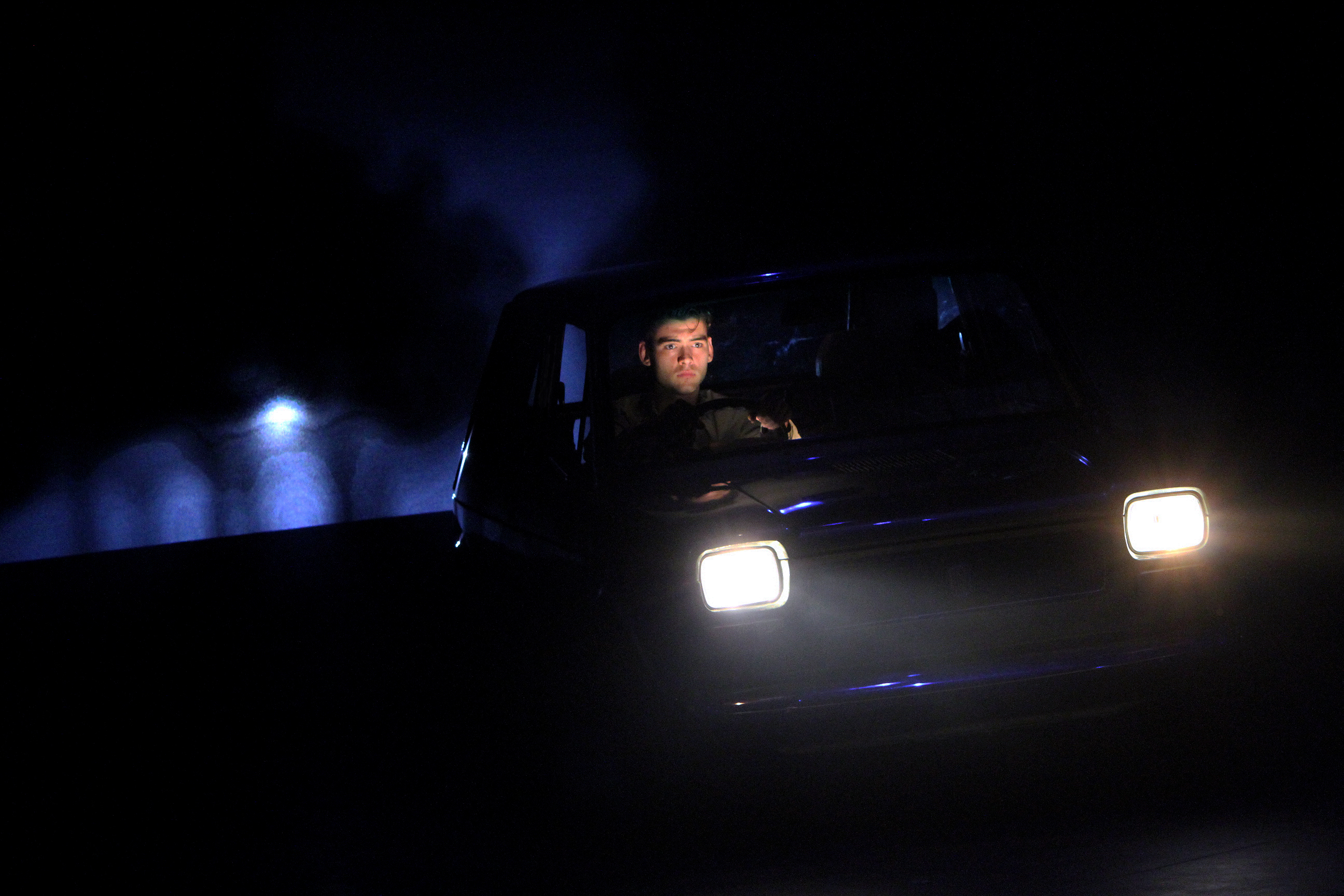
Aleks Mikic as an unlicensed driver in Ghost Stories. Photo: Liam O'Keefe

Aleks Mikic as an unlicensed driver in Ghost Stories. Photo: Liam O’Keefe

“Are you brave enough to book?” asks the Sydney Opera House website, warning that Ghost Stories “contains moments of extreme shock and tension. We strongly advise those of a nervous disposition and pregnant women carefully consider their decision to attend.”

In an interview, one of the cast said that he was prepared for people to “freak out” or even leave theatre, adding: “There is nothing in the theatre they can compare this to and I think a lot of people will be uncontrollably scared.”

Well, I’m a complete wuss when it comes to horror films but I didn’t find the play particularly scary at all.

Written by Jeremy Dyson and Andy Nyman, the West End hit is presented here by Prince Moo Productions and directed by Peter J. Snee with an Australian cast.

It begins with an illustrated lecture by Philip Goodman (Lynden Jones), a genial professor of parapsychology. As he describes three supernatural cases, which he tries to explain logically as emanations from a guilty mind, they are enacted on stage.

Using familiar tropes from the horror genre, there’s a nightwatchman (John Gregg) at a deserted warehouse, a young man (Aleks Mikic) driving home late at night on an isolated country road, and a man (Ben Wood) whose pregnant wife won’t go into the nursery. Most of it takes place in darkness illuminated with flashes from torches, car headlights and a nightlight.

The soundscape is certainly eerie. Whistling wind and dripping sounds give the feeling of a haunted house as you enter the theatre and as the night unfolds creaks, rumblings and sudden loud crashes and roars ramp up the tension. But that’s about it for the fear factor. The plot climaxes are a letdown and several special effects are comical, even naff.

Glimpsing an actor through the front scrim heading off stage carrying a supposedly terrifying creature punctures the illusion still further.

Still, there are plenty of laughs and a few surprises, and it’s well performed with a particularly enjoyable performance from Jones as the Professor. Just don’t expect to be terrified out of your wits.

Ghost Stories plays at the Drama Theatre until August 15. A version of this review ran in the Sunday Telegraph on July 12

Sydney Theatre Company brings Chekhov into The Present

A week into rehearsals, Cate Blanchett, Richard Roxburgh and Jacqueline McKenzie discuss The Present – Andrew Upton’s new adaptation of Chekhov’s Platonov
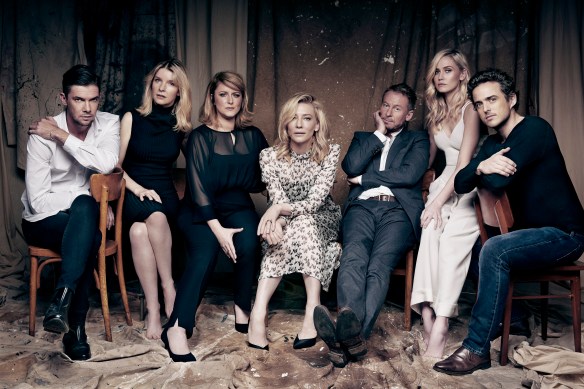
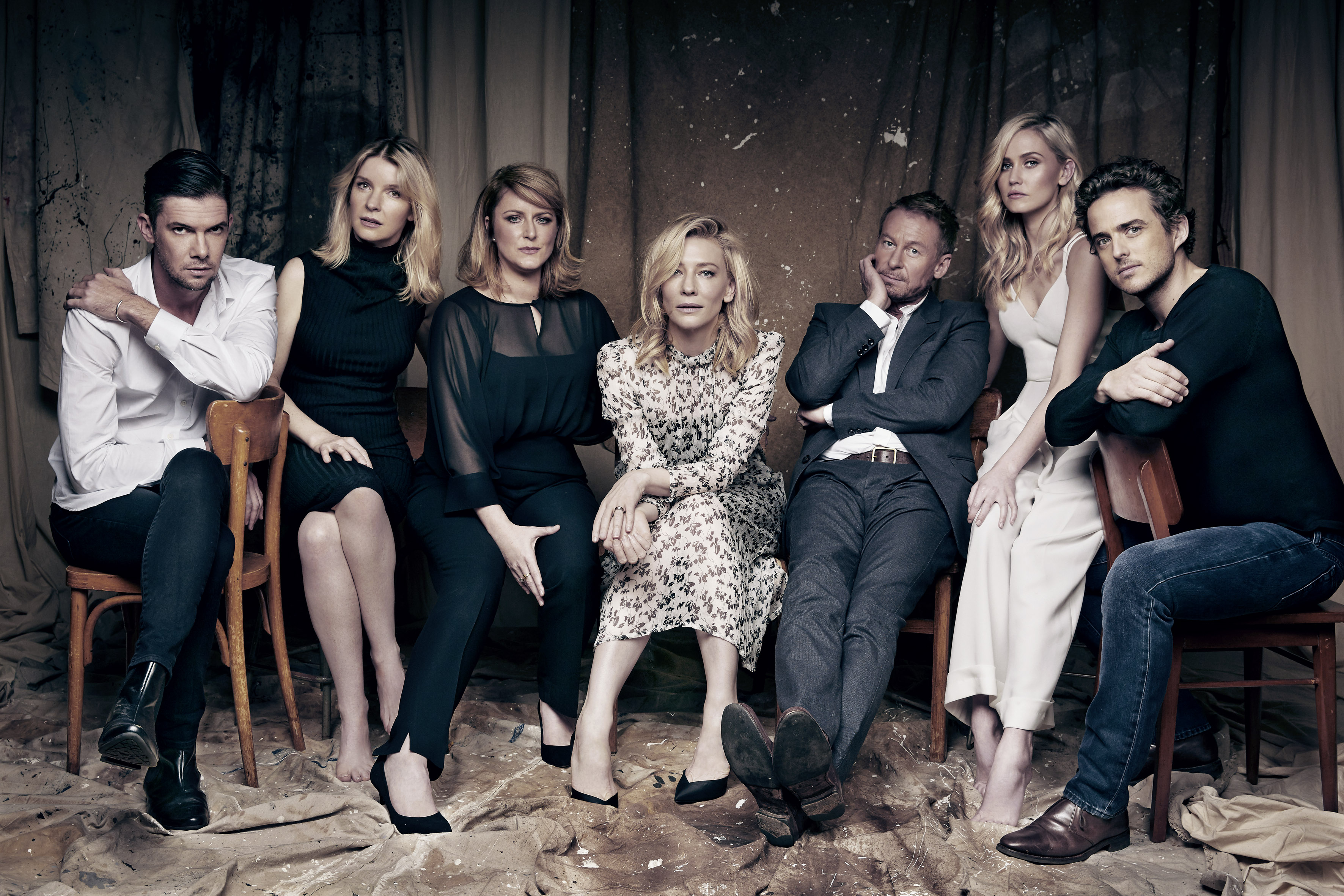
Toby Schmitz, Jacqueline McKenzie, Susan Prior, Cate Blanchett, Richard Roxburgh and Anna Bamford are among the 13-strong cast for The Present at Sydney Theatre Company. Photo: Steven Chee

Toby Schmitz, Jacqueline McKenzie, Susan Prior, Cate Blanchett, Richard Roxburgh, Anna Bamford and Chris Ryan are among the 13-strong cast for The Present at Sydney Theatre Company. Photo: Steven Chee

Cate Blanchett is widely regarded as one of the finest stage actresses of her generation. We’ve been incredibly lucky to see her give unforgettable performances in a number of Sydney Theatre Company productions over the last few years including A Streetcar Named Desire, The Maids, Gross und Klein and Uncle Vanya.

But with the family relocating to the US when her husband Andrew Upton’s contract as artistic director of STC concludes at the end of this year (after eight years, five of them shared with Blanchett), the chances are we could be about to see her on a Sydney stage for the last time in a while.

Blanchett co-stars with Richard Roxburgh in The Present, adapted by Upton from Anton Chekhov’s sprawling first play Platonov. Directed by John Crowley, the production plays at the Roslyn Packer Theatre from August 4. The season is all but sold out but a final limited release of tickets will go on sale on Thursday July 9.

Blanchett and Roxburgh wowed audiences and critics alike when they performed together in Upton’s 2010 adaptation of Chekhov’s Uncle Vanya in Sydney, Washington and New York. As you’d expect, their reunion has made The Present one of the hottest tickets in the STC’s 2015 season.

The rest of the 13-strong ensemble is pretty extraordinary too, among them Jacqueline McKenzie, Toby Schmitz, Anna Bamford, Chris Ryan and Susan Prior who recently won an AACTA Award for The Rover.

“It’s a great bunch,” says Blanchett.

“It is an incredible cast. Looking around the table and listening to the voices when we were doing our first read-through, it was just absolutely stunning,” says McKenzie.

“But if you had seen (Blanchett and Roxburgh in) Uncle Vanya and their amazing chemistry and work together, as an actor you want to be a part of that. So that’s really how you can collect such an amazing group of people because we all want to be in amongst it. It’s Andrew’s writing too. He’s an extraordinary adaptor,” adds McKenzie who performed in Upton’s adaptation of Maxim Gorky’s Children of the Sun for STC in 2014.

“So you’ve got Chekhov, you’ve got Upton, you’ve got the Rox and you’ve got the Blanchett – and then you’ll get anyone.”

Chekhov’s first play – commonly known as Platonov after its central character – was an unstructured epic, which would have run for more than five hours if staged in its original state. The manuscript was discovered and published 16 years after his death. There have been various adaptations over the years including Michael Frayn’s Wild Honey.

 “You couldn’t do it (as written). It was a mad thing. That’s why it ended up in a Chekhovian sock drawer and he never pulled it out again,” says Roxburgh.

“The play was a broken thing, a play without a name,” says Blanchett. “Andrew has taken the fragments as a starting point, really, the characters and the basic situations.

“We’ve got this box set of rather crusty old sepia Chekhovs done by the BBC in the 70s. It’s quite useful to see just the bare bones of the storytelling. It’s very, very English (depicting) Russians as eccentrics but I went back and looked at Platonov the other night and it doesn’t make a lot of sense, and certainly the women don’t make any sense. What Andrew has done is really teased out not only the relationships but the states of being that all the various women represent in the piece.”
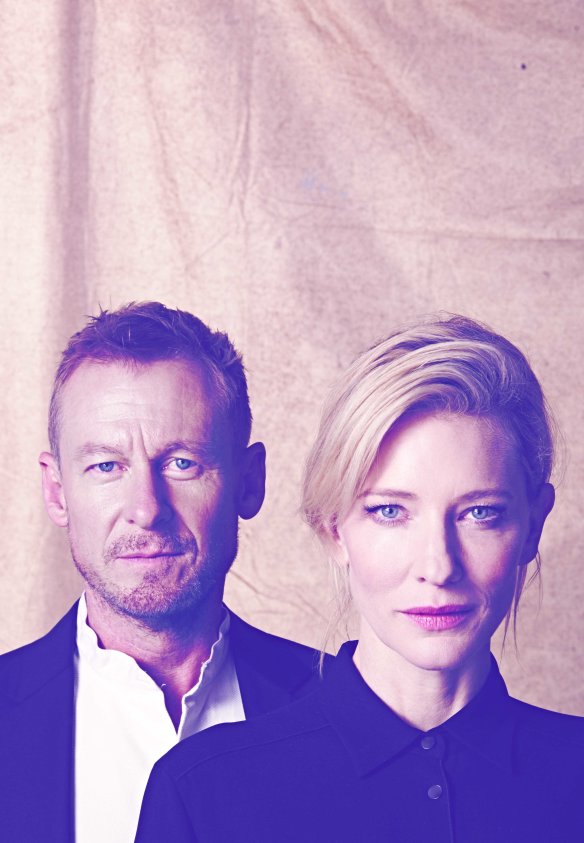
Richard Roxburgh plays Mikhail Platonov and Cate Blanchett plays Anna Petrovna in The Present. Photo: James Green

Richard Roxburgh plays Mikhail Platonov and Cate Blanchett plays Anna Petrovna in The Present. Photo: James Green

Roxburgh plays Mikhail Platonov, once considered a great intellectual but now a disillusioned, wittily acerbic provincial schoolteacher, though still something of a Lothario. Blanchett plays Anna Petrovna, the widow of a much older General who she married in her 20s, and McKenzie plays Sophia, a former flame of Platonov’s who is now married to Anna Petrovna’s stepson.

Set in a country summerhouse where a group of old friends gather for Anna Petrovna’s 40th birthday party, the play is awash with yearning, shattered dreams and vodka.

Blanchett says that they are still discussing whether Anna Petrovna is also a former flame of Platonov’s.

“There is a sense that they are soulmates. Anna Petrovna is not at the centre of it but she’s the catalyst for the collision of desire and longing that happens around her 40th birthday.”

Upton has a fascination with late 19th century and early 20th century Russian drama and has adapted several plays of the era: Gorky’s Philistines and Mikhail Bulgakov’s The White Guard for London’s National Theatre, along with Chekhov’s The Cherry Orchard and Uncle Vanya, Gorky’s Children of the Sun and a revised version of The White Guard for STC.
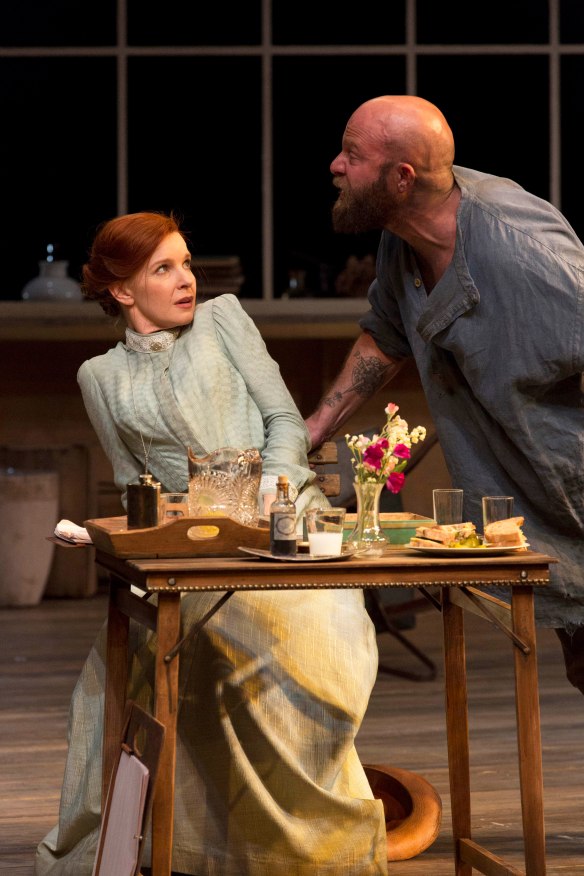
Jacqueline McKenzie and Yure Covich in STC's Children of the Sun. Photo: Brett Boardman

Jacqueline McKenzie and Yure Covich in STC’s Children of the Sun. Photo: Brett Boardman

His acclaimed adaptations are sparklingly colloquial, muscular and very funny but underpinned with melancholy, and speak very clearly to us today.

Upton has updated Platonov to the mid-1990s, to Russia post-Perestroika, and has the characters in their 40s rather than their 20s as in the original.

“What I like about the updating – Andrew’s updated it to 1995 I think we’ve settled on – is that when Chekhov was writing there was the sense of Russia in transition but it was quite a dangerous time politically and morally. Setting it in the mid 1990s, Russia is once again in that similar state of transition. With the wisdom of hindsight you see that there was a real chance for change,” says Blanchett.

“What is beautiful about it is that it really mirrors the state the characters are in. There’s still that opportunity to change. When you’re in your 40s, as we know, life’s not over.”

“It becomes so much more make and break than in your 20s when you’ve got the whole world laid out in front of you,” says McKenzie.

“It has that depth of meaning when someone is approaching the middle of their life,” agrees Blanchett. “Had the characters been in their 20s, there’s a self-centredeness to it whereas there’s a desperate futility and sadness about it. Suddenly the play has a purpose and an energy and an ache inside it.”

“It has a much darker depth to it, doesn’t it? It’s really fabulous,” says Roxburgh.
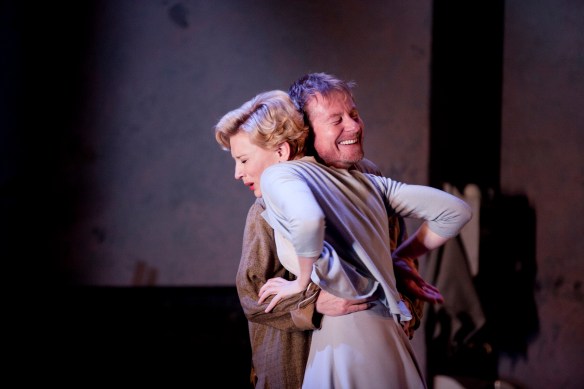
Cate Blanchett and Richard Roxburgh in STC's Uncle Vanya. Photo: Lisa Tomasetti

Cate Blanchett and Richard Roxburgh in STC’s Uncle Vanya. Photo: Lisa Tomasetti

Upton’s adaptation of Uncle Vanya, set in the 1950s and directed by Tamas Ascher, got the tightrope balance between laughter and tears just right. The highly physical production verged on slapstick at times with pratfalls, pillow fights and drunken dancing. Blanchett’s elegant Yelena cooled her sudden ardour by standing in front of an open fridge. Hugo Weaving’s Astrov did a boisterous, drunken jig then fell backwards through a window. But for all the laughter you never lost sight of their misery.

The Present has “a different spirit”, says Roxburgh. “I think the fact that it has a contemporary setting gives it a different quality. What is I would say is that what is incredibly manifest is this energy in the storytelling. There’s a fantastic energy to it that gets pushed and pushed.

“It’s people in extremis. Things unfold that push people to their various breaking points and that can be terrible and hilariously funny, so it does explore all those things. But it’s by no means slapstick. It feels very real. It is people in extremis. To my mind that’s the definition of great theatre.

“But it is hilariously funny. I was rolling about laughing when I read it, which is not what you expect when you read an adaptation of Chekhov. But it’s never silly. It really feels like Chekhov, but not as you’ve ever got him.”

“The dialogue is fantastic,” says McKenzie. “It’s very witty, very fast. It’s like throwing little darts across the room. I’m laughing on stage. I have to stop.”

“John Crowley has a terrific way of putting it, which is that it seems like all of the scenes are not the scenes you’re supposed to be seeing,” says Roxburgh. “They are the grabbed moments in between. There’s a dinner, there’s a lunch, but you don’t see those, you see everything around that, the accidental moments or the catastrophic conclusion of the lunch. It’s a kind of string of all these broken, wrong moments.”

“Those points of genuine contact are like a life raft,” says Blanchett. “They happen occasionally when people do connect in the play. I was reading one of Chekhov’s short stories the other night, I think it was The House with the Mezzanine. It’s a brilliant story and it was describing a painter who was having a conversation with someone he was lodging with and he said that this lodger had the student’s predilection for turning a conversation into an argument. And that’s why this feels like a young play. Conversations very quickly turn into argument, sometimes fierce and sometimes frivolous. But there’s that cut-and-thrust in the play. My character is constantly saying: ‘can everyone just stop being mean!’”

“The crafting of the writing is very finessed,” says Roxburgh. “There’s a lot of overlap in it, which I reckon had Chekhov lived into these times he would have used because his sense of rhythm was so beautiful. It obviously wasn’t a thing of the time but the overlapping dialogue just creates this constant feeling of the shadow play of life. It feels just like we are with one another.”

The three actors speak very highly of Crowley, who has directed in London and on Broadway. McKenzie says that during the first week he got them all to research different aspects of Russian culture and politics from Russian oligarchs to Perestroika.

“I got post-Soviet country houses, where this is set. But it was fantastic because we all came together and shared our findings. It was so great because normally you all do your research yourself. I’ve got a six-year old now and my situation isn’t as free to sit in a library for hours obsessing, which is what I used to do.”

Working with Crowley “is about discovery”, says McKenzie. “What happens with actors a lot of the time is that things happen osmotically. He allows that to happen at the different paces that people work at. It’s just very generous. I tell you, I trust him. I really do. I don’t feel any agenda other than to find the best play.”

“And he seems to have great taste as well,” says Roxburgh “I saw his production of The Pillowman in London. It was a beautiful, very classy piece of work.”

Blanchett and Upton met Crowley when they were living in London. “We’ve been talking about working together for a long time. We’ve been trying to lure him here but dates and situations didn’t work so it’s great that it has now,” says Blanchett.

Asked if it’s hard to return to a rehearsal room when you have a young baby, Blanchett responds with an emphatic “yes!”.

She and Upton adopted baby Edith from the US earlier this year and have said that they and their three sons are “besotted”.

“I feel a bit sleep deprived,” she admits. “But you have to work with whatever state you’re in and turn it into a positive. Sometimes it can be good to be a bit tired in a rehearsal room because your defences are down, your guard is down.”

“You seemed to be working very well this morning in your mad aria!” chuckles Roxburgh.

“But Chekhov is excruciating (to rehearse),” rejoins Blanchett. “The couple of times I’ve had the fortune to work on Chekhov it’s really difficult. There’s nothing to hide behind. That’s why it was so wonderful touring Vanya because by the time we got to New York and we’d done three seasons of it, it had gone to another level. When you work on great writing – and what Andrew has written is really great – it’s difficult to get there but the longer you live with it, the richer it becomes, the more it feeds you and the more the company can bring to it.”

“I’m not finding it excruciating,” says Roxburgh cheerily. “I’m having great fun.”

The Present plays at the Rosyln Packer Theatre (formerly Sydney Theatre), August 4 – September 19. A final limited release of tickets will go on sale to the public at 9am on Thursday July 9. Bookings can be made at www.sydneytheatre.com.au, by phoning 02 9250 1777 or in person at the Wharf box office.

 STC also has its Suncorp Twenties program, which makes a limited number of $20 tickets available to each production, even if a season is otherwise sold out. Suncorp tickets are released at 9am each Tuesday for performances during the following week. They are available online, in person or by calling 02 9250 1929.

 A version of this story appeared in the Sunday Telegraph on July 5

Mother Courage and her Children

Belvoir St Theatre, June 10

Robyn Nevin and the cast of Mother Courage. Photo: Heidrun Lohr

Robyn Nevin and the cast of Mother Courage. Photo: Heidrun Lohr

Mother Courage is one of the great theatre roles for women. Physically and emotionally demanding, she is on stage for virtually the entire play as she navigates her profiteering way through the horror of war, losing all three of her children in the process.

Robyn Nevin makes the role her own in this exuberant, economically staged Belvoir production directed by incoming artistic director Eamon Flack.

Written by Bertolt Brecht in the late 1930s, Mother Courage and her Children was his response to the rise of fascism in Germany and Germany’s invasion of Poland. He set the play during the Thirty Years War (1618 – 1648), a long, arduous, pointless, religious conflict. (Some things never change). A wily refugee called Anna Fierling – or Mother Courage as she is known – follows the troops with her three grown-up children and a cart from which she sells food, liquor and other goods, doing whatever it takes to survive. She is desperate for her children not to become casualties but when the chips are down she is unable to protect them.

A rage against war, capitalism and man’s inability to learn from history, it’s a tough play about both the surrender and resilience of humanity during extreme times.

Using a sharp new translation by Michael Gow and new music by Stefan Gregory for the songs, Flack’s production bristles with as much vitality as brutality, with snappily choreographed scene changes keeping the action moving.

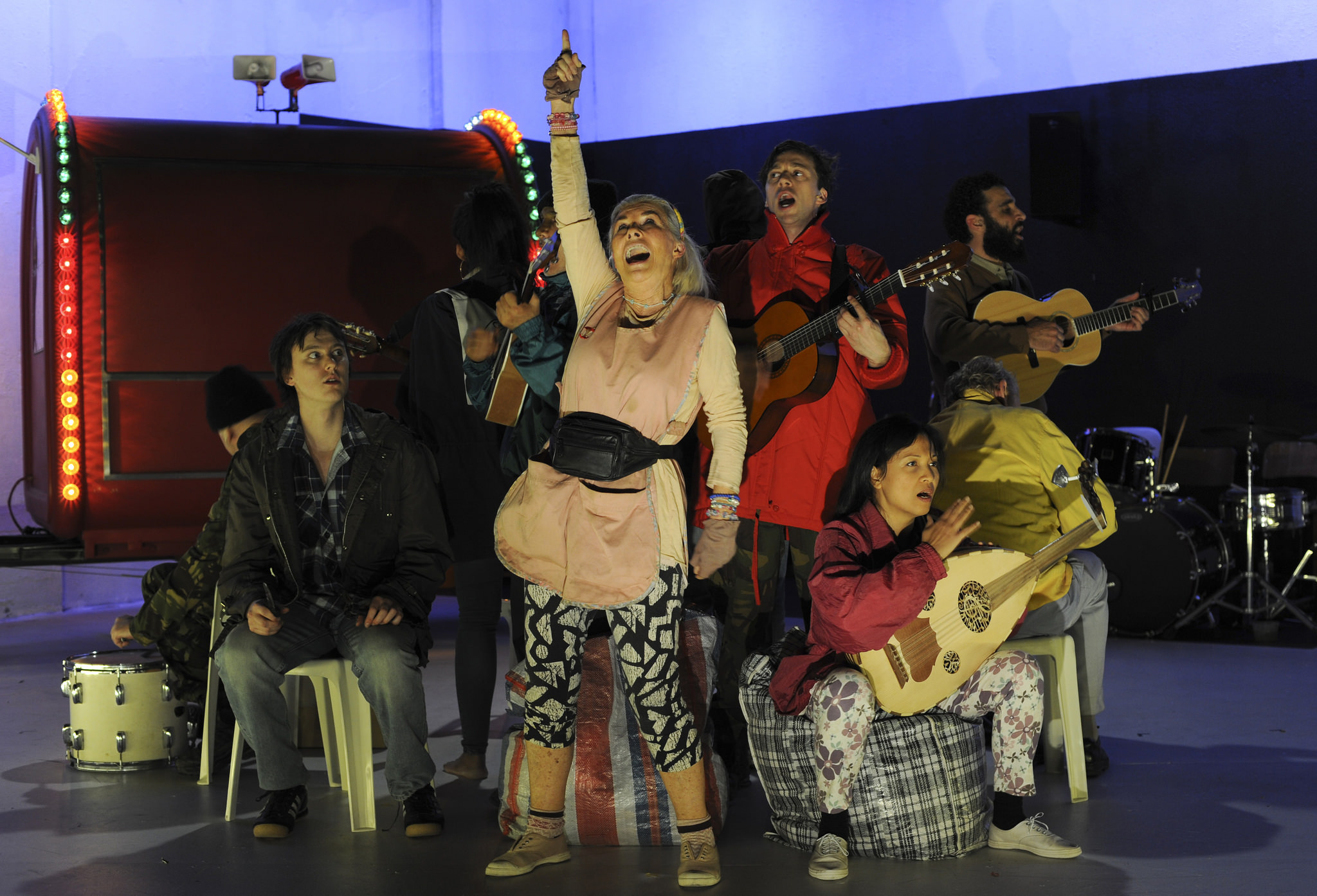
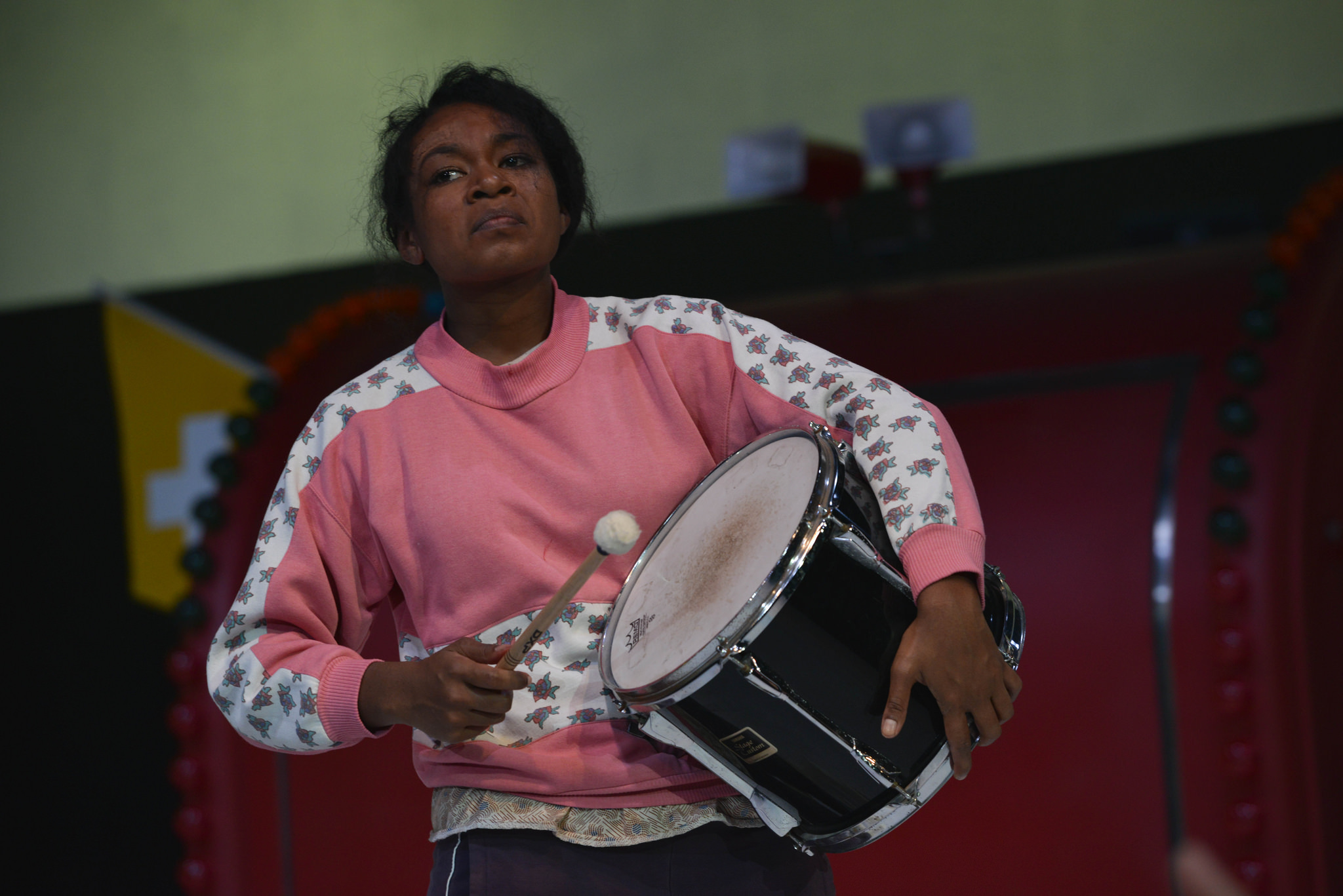
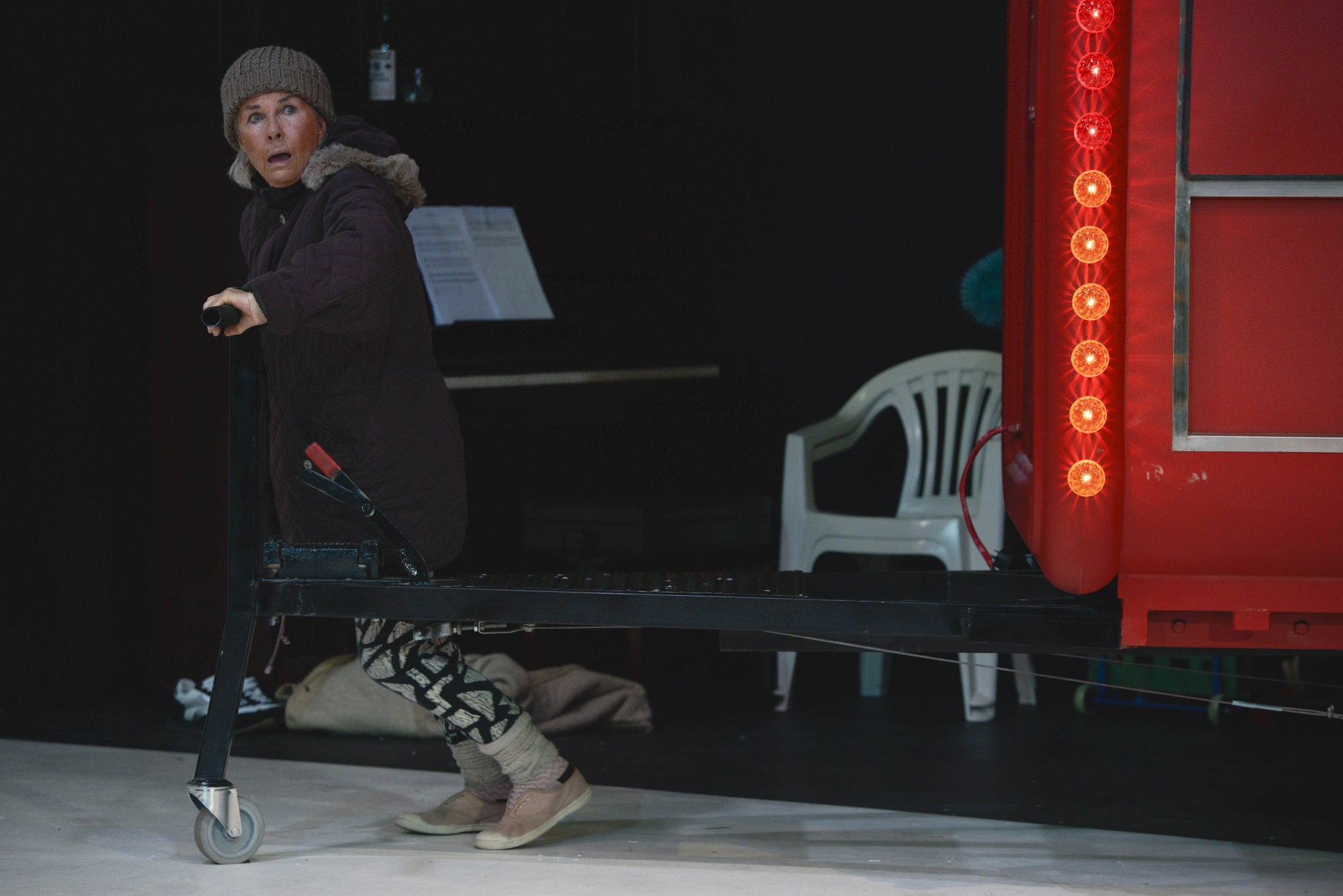
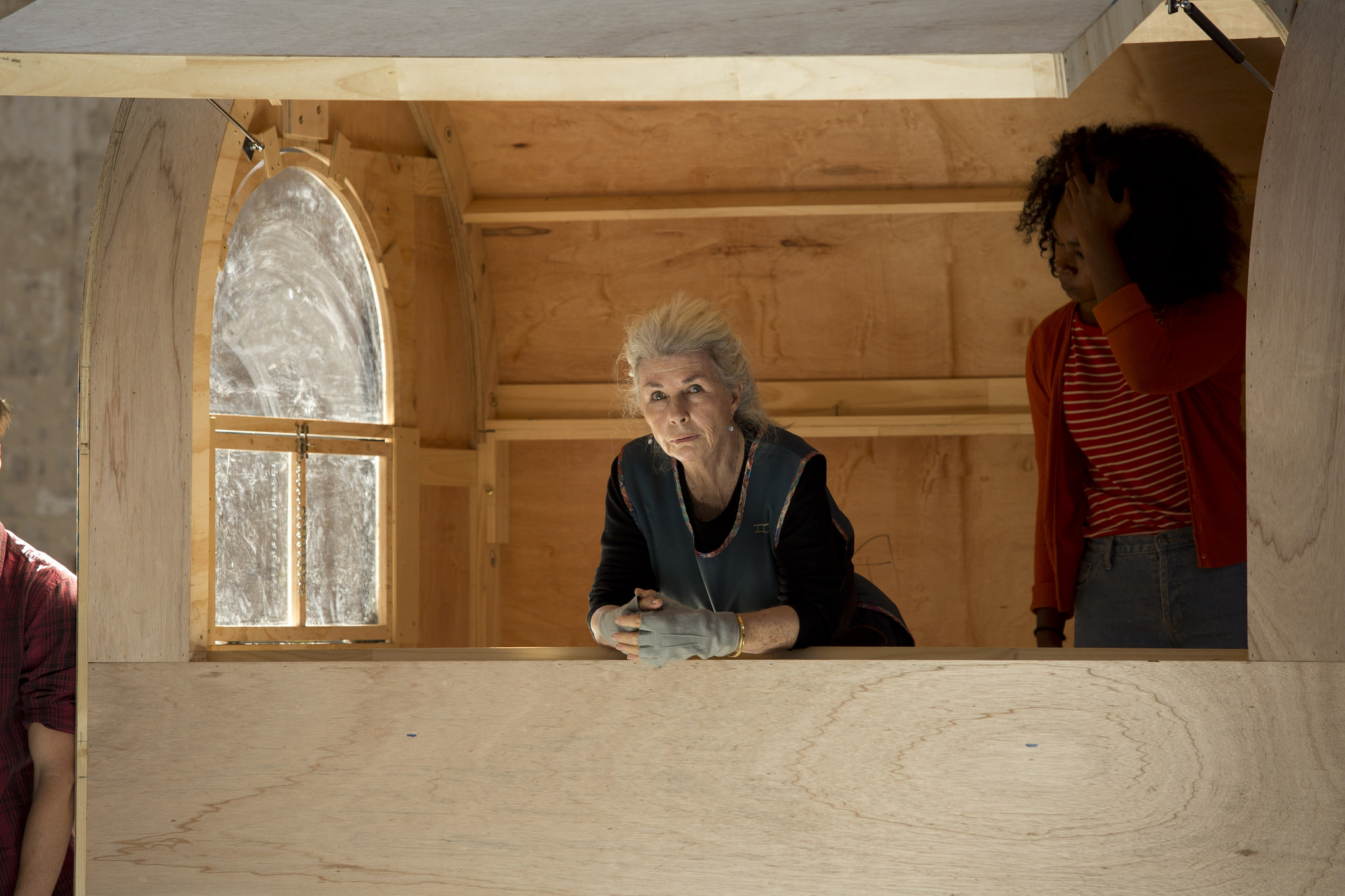
Robert Cousins’s set has a black painted area in the corner resembling a backstage room with props and musical instruments where the actors often sit when not performing: a constant reminder that we are watching theatre being made. Alice Babidge’s contemporary costuming includes military gear and clothes the characters might have got from op shops or the cheapest of stores as they struggle to keep body and soul together.

The centerpiece of the design is the cart, which is here bright red with circus-like coloured lights, pictures of hotdogs and other junk food as well as cheap tat like plastic beach thongs. Other than that the stage is bare apart from a few plastic chairs, while firecrackers exploding in a metal bucket help evoke the sounds of war.

Emele Ugavule as Kattrin. Photo: Heidrun Lohr

Emele Ugavule as Kattrin. Photo: Heidrun Lohr

Flack has mustered an excellent ensemble cast, who play various characters and musical instruments, and each nail their moments. Paula Arundell is gloriously funny as the feisty prostitute Yvette and sings up a storm, delivering the Song of Fraternisation standing on a plastic chair, while newcomer Emele Ugavule is very touching as Mother Courage’s mute daughter Kattrin. Tom Conroy and Richard Pyros are also particularly strong as Mother Courage’s two sons.

But the production is driven by Nevin’s riveting portrayal of the fast-talking, pragmatic Mother Courage. While the character rarely betrays any emotion, Nevin still manages to convey the tragedy that envelops and batters her, as well as her wicked sense of humour. We glimpse emotions flit across her face only to be immediately concealed; we see her body droop just a tiny bit then steel itself.

Though she’s no singer or dancer, she also throws herself into both with endearing gusto, touchingly reinforcing the fact that Mother Courage will do whatever it takes.

Robyn Nevin as Mother Courage. Photo: Heidrun Lohr

Robyn Nevin as Mother Courage. Photo: Heidrun Lohr

Then there are the brief flashes of tenderness that strike at the heart. The way she spoons soup into her daughter’s mouth like a mother bird ­– an unspoken vow that she won’t desert her child – is an unforgettably poignant moment.

The famous, final image of her pulling her cart alone, having lost all her children, hits hard as the lights snap off.

Mother Courage plays at Belvoir St Theatre until July 26. Bookings: www.belvoir.com.au or 02 9699 3444

A version of this review ran in the Sunday Telegraph on June 14

Robyn Nevin plays Mother Courage

Robyn Nevin has had a long, illustrious stage career, but 2015 could be one of her most memorable years yet.

Robyn Nevin with Mark Leonard Winter and Eryn Jean Norvill in a promotional image for Suddenly Last Summer. Photo: James Green

Robyn Nevin with Mark Leonard Winter and Eryn Jean Norvill in a promotional image for Suddenly Last Summer. Photo: James Green

She started it as the ruthless Mrs Venable in Tennessee Williams’ Suddenly Last Summer for Sydney Theatre Company, earning rave reviews, and will end the year there playing the Fool to Geoffrey Rush’s King Lear in a production directed by Neil Armfield.

Currently, she is preparing to play Mother Courage in Bertolt Brecht’s great anti-war play Mother Courage and her Children for Belvoir, directed by in-coming artistic director Eamon Flack, who helmed Belvoir’s superb 2013 production of Angels in America in which Nevin also performed.

“It’s a wonderful year. I’m one very grateful woman,” says Nevin, now 72, during a break in rehearsals.

Best known as one of our leading stage actors, Nevin has found a whole new fan base since playing the posh, bigoted Margaret in the ABC-TV comedy Upper Middle Bogan.

She looks set to boost her screen profile still further with her performance in Brendan Cowell’s new film Ruben Guthrie, a black comedy based on his play, which opened the Sydney Film Festival this week before its general cinema release on July 16.

Ruben is a hard-living advertising executive who tries to get sober when he nearly kills himself jumping off a roof while pissed. Nevin plays his well-heeled mother, who keeps pushing him to go back on the bottle, because she finds him more fun when he drinks.

“It’s a great role. She’s fantastic,” says Nevin enthusiastically.

“She was a hard character to understand because I’m a great believer in Alcoholics Anonymous and the 12-step program. I know people who’ve been saved by those programs. I value them very highly. She’s got one fabulous line where she says, ‘Oh, I don’t think that’s very impressive, do you, one day at a time?’ She’s just a brute, a wonderful character. I loved it. I had a wonderful time doing that film and Brendan was wonderful directing it. It’s a quintessentially Sydney story in its outlook and tone and visually. In a way, it’s a wonderful celebration of Sydney and a terrible indictment of it at the same time.”

Robyn Nevin during rehearsals for Mother Courage.  Photo: Lisa Tomasetti

Robyn Nevin during rehearsals for Mother Courage. Photo: Lisa Tomasetti

Anna Fierling – or Mother Courage as she is known – is yet another formidable character in Nevin’s armory (joining the likes of Miss Docker in Patrick White’s A Cheery Soul and Ana in Lally Katz’s Neigbourhood Watch). A refugee with three children and a cart, from which she sells food, liquor and other provisions, she buys and sells her way through a pointless, religious war, putting profit above all else. During the play, her three children are all killed.

Brecht wrote it in 1939 in response to the rise of fascism in Germany and Germany’s invasion of Poland.

Nevin directed the play for STC in 2006, choosing it as the first production for her newly formed ensemble, the STC Actors’ Company, with Pamela Rabe in the title role. Since then, it’s been on her bucket list of roles.

“I didn’t feel it was finished business although it was a very successful production. I loved getting to know the play and so I just thought, ‘yes, that’s a role I could one day have a go at,’” she says.

She programmed it at STC, she says, because she considers it “a great ensemble piece. It’s a very powerful piece of theatre. It’s arresting and gripping and entertaining and it’s a challenge for a company. Brecht has written it in such a way that there are 12 scenes and each scene requires a complex transition, which needs to be made slick and easy.

“In a small space, that takes a lot of time and effort and everyone is involved in that. I think audiences love watching a production unfold with ease and skill in a deft kind of way and Eamon is brilliant at that. But it’s taken an awful lot of time and it does require trust in each other. We all have to work very carefully in concert with each other, which I like about the piece itself. I like being part of a team. I’m addicted to the notion of an ensemble. I think they work, I think they’re very valuable and everybody gets better as a result of being in an ensemble production because so much is required of everyone.”

Asked whether she ever considered playing the role herself in the STC production, she gives the idea short shrift.

“I couldn’t possibly have considered playing it because I couldn’t give myself the lead role in the first play (by the STC Actors Company). The commentary from the media would have been too much for me to handle at that stage. They would have just thought it was personal vanity and I was not ambitious in that way at all. I gave opportunities to other people and rarely took the best opportunities for myself. And that was an occasion where I thought it would just look like hubris for me to lead the company in the first, inaugural production of the Actors’ Company so I directed it instead.”

Flack’s production for Belvoir features a new translation by Australian playwright Michael Gow and new songs by Stefan Gregory.

Brecht originally set the play in the 17th century during the Thirty Year War, but the Belvoir production has a contemporary setting. Nevin describes Gow’s translation as “ short, sharp and to the point. It’s got a directness, which I like. The lyrics are wonderful; the songs are fantastic….. It’s completely new compositions, it’s absolutely wonderful (music) by Stefan Gregory. He last did the entire musical score for Suddenly Last Summer. That was brilliant too.

“I don’t know how to describe (the Belvoir) production but it’s a thrill to be in it so I think it will be thrilling to see.”

An example of Brecht’s epic theatre, he wrote it to engage the audience intellectually rather than emotionally and apparently rewrote the role of Mother Courage when audiences sympathised too much with her.

Robyn Nevin rehearses Mother Courage. Photo: Lisa Tomasetti

Robyn Nevin with Anthony Phelan in rehearsals for Mother Courage. Photo: Lisa Tomasetti

Nevin says she doesn’t spend time wondering how audiences will relate to the character.

“I just play one moment at a time and one action at a time. I play the action of the scenes; the meaning will be determined by the audience. I can’t preoccupy myself with what sort of person she is. She is defined by her actions so if I play the actions then the audience will judge as they will judge. But if you want to know what I think…..” she adds with a huge laugh.

She then cites a horrendous scene, which they have just been rehearsing, in which Mother Courage’s daughter Kattrin returns having been brutally raped. Her mother tells her that she is lucky she’s not better looking or it could have been worse.

“That’s the tough job that Brecht gives the actors to do. He makes them say things that shock the audience horribly, (telling) a girl who’s just been raped that she probably would have been raped over and over if she’d been attractive enough. That’s actually what the woman is saying, and it’s hard to say, but that’s her way of dealing with it,” says Nevin.

“But in a minute she talks about Kattrin is a very different way, which shows her concern but is in no way sentimental, never sentimental. Over the course of the play she’s tough, she’s pragmatic, she’s only concerned about survival through trade even as her three children are killed.

“Brecht wrote that but he can’t stop that well of emotion, he can’t separate an audience from their humanity. (But) in a way the play is saying, ‘what good is humanity during war?’

“One of the songs really speaks to this quite clearly. It’s the Song of Solomon. One by one they describe the qualities of the great men of history and each one of them died for their good qualities: their wisdom, their courage. So what’s the point of being brave, of being wise, of telling the truth, of fearing God? So you’re playing characters who crush their better qualities in order to survive.”

Funnily enough, it’s King Lear that Nevin has been having nightmares about during Mother Courage rehearsals, rather than the Brecht.

“I’ve already had my Lear nightmare in which we were about to go on stage and I didn’t know a word, not a word. I was asking for a script and no one had one because they all knew theirs and they’d left it at home. Just terrifying! Then we went on stage and Geoffrey lay back and didn’t say a word and I thought, ‘well if he’s not going to speak, I’m not going to speak.’ It was just awful.”

Nevin laughs. “I should be having nightmares about Mother Courage, I’m already having nightmares about Lear.”

Accepting the offer to play the Fool was “a hard decision”, she says. “I don’t even know where to begin with the Fool but the thought of being in a (rehearsal) room with Neil doing a Shakespeare was exciting because I haven’t done a Shakespeare with Neil. I’ve done very few Shakespeares so that’s very exciting.”

Mother Courage and Her Children plays at Belvoir St Theatre, June 6 – July 26. Bookings: www.belvoir.com.au or 02 9699 3444

King Lear plays at Sydney Theatre, November 24 – January 9. Bookings: www.sydneytheatre.com.au or 02 9250 1777

A version of this story appeared in the Sunday Telegraph on May 31

The Merchant of Venice

York Theatre, Seymour Centre, May 23

John Turnbull as Shylock.

John Turnbull as Shylock.

The Merchant of Venice is one of Shakespeare’s problematic plays. It’s technically a comedy but it contains some decidedly dark elements, particularly its uncomfortable anti-Semitism.

Richard Cottrell’s production for Sport for Jove doesn’t bring a strong director’s “take” to bear on the play and isn’t revelatory in the way that the best Sport for Jove productions have been.

Its strength is the great clarity of the storytelling, with a keen focus on the text. Energetically and warmly performed, it’s a solid, enjoyable production with the comedy to the fore.

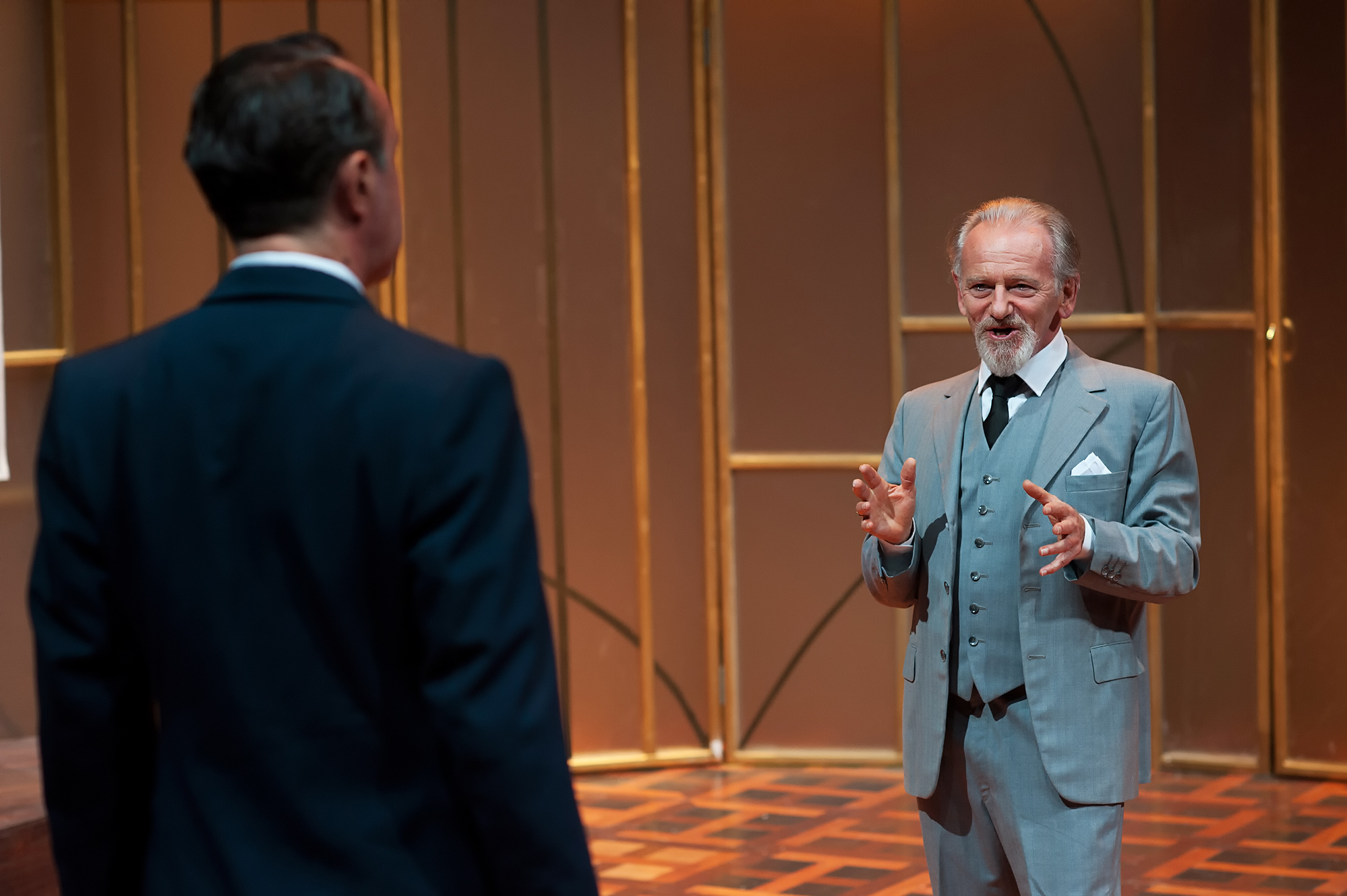
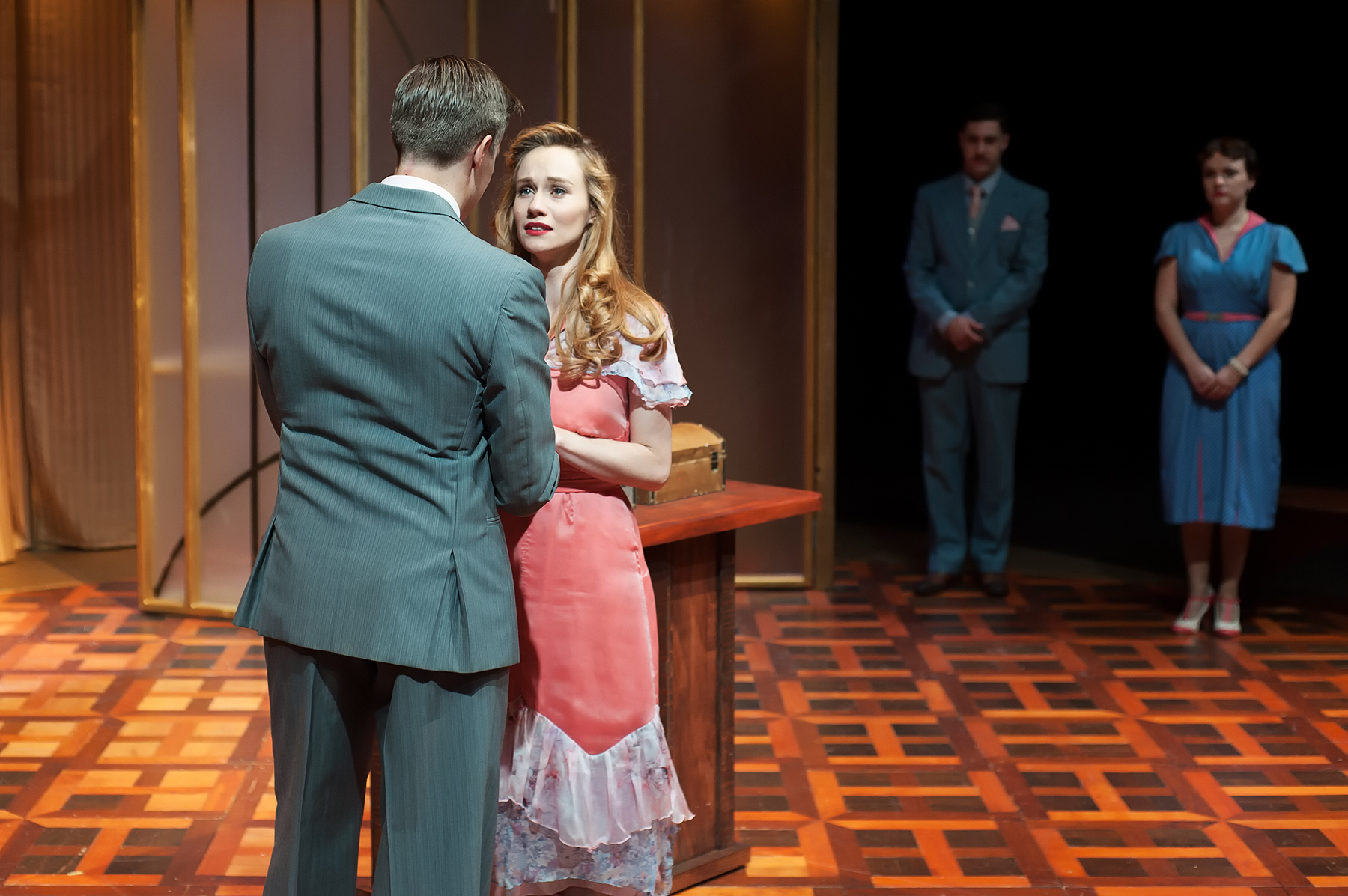
Anna Gardiner’s art deco set with a translucent screen wall and doors at the back and a parquet floor (by Lucilla Smith) locates it during the 1920s or 1930s: an era close enough to our own to feel contemporary but pre-dating World War II and the horrors of the holocaust. (A final image of Shylock’s daughter Jessica, left alone on stage as dark looks are thrown at her, is a nod to what is to come).

The production opens with a burst of We’re in the Money from the musical 42nd Street, which is set in the 1930s during the Great Depression. Beyond that, however, the choice of era seems mainly an aesthetic one, and even that becomes rather lost as the production unfolds.

The costuming doesn’t locate things specifically in the 1930s, the music moves from jazz age to classical, and overall there’s not a strong sense of time or place.

Writing in the program, Cottrell argues that though race is a factor, “the play is about money rather than money lending”.

“Antonio and Shylock represent the getting and spending of money. The relationship between them is not about a Jew and Gentile but about two men who hate each other,” he says.

Portia, meanwhile, is exceptionally wealthy – the main reason Bassanio, who is broke and needs to make a good marriage, was initially attracted to her.

Lizzie Schebesta as Portia.

Lizzie Schebesta as Portia.

It’s true that in the play money makes the world go around, but it doesn’t register here as a touchstone or a key, overarching theme.

Instead, the production foregrounds the comedy and fun, tripping along lightly for much of the evening and generating plenty of laughter on opening night. Occasionally it is almost taken too far. Aaron Tsindos gives such a broadly comic, boomingly voiced portrayal of the Prince of Morocco that it feels dangerously close to racial caricature in a play where race is an unavoidable issue. That said, the audience lapped it up and roared with laughter.

But there’s no getting away from the prejudice at the centre of the play. We hear how Shylock has been called a dog and spat on; we understand why he wants revenge through his pound of flesh yet we shudder at what he is prepared to do, and at his ruthless refusal of mercy.

At the same time, when the judge rules against Shylock and he is ordered to renounce his Judaism it’s a deeply uncomfortable moment, with Gratiano’s boorish jubilation an ugly sight.

As Shakespeare shows, and as we well know, prejudice brings out the worst in people – both those doling it out and those on the receiving end. It’s something we are wrestling with here and now in Australia.

John Turnbull is terrific as Shylock, portraying him as a smart, dignified businessman who has been insulted once too often.

It’s not an unsympathetic portrayal – we see clearly why he behaves as he does – but nor is it an overly sympathetic one. The sight of him sharpening his knife on his shoe, while Antonio removes his shirt, is chilling. His steadfast refusal to grant mercy when the money he is owed and more is offered to him is done with a coldness as steely as his knife. And when he realises his daughter Jessica has left him, he seems only concerned about the money and jewels she has taken with her.

Turnbull keeps all this in balance in a powerful performance.

Lizzie Schebesta invests Portia with a playful intelligence, James Lugton plays Antonio with a mournful sincerity and Chris Stalley makes a dashing Bassanio.

There are strong performances from the rest of the cast, which includes Damien Strouthos as an exuberant Gratiano, Erica Lovell as Portia’s maid Nerissa, Jonathan Elsom as the comical, blind Old Gobbo and Lucy Heffernan as Jessica, along with Darcy Brown, Lucy Heffernan, Jason Kos, Michael Cullen and Pip Dracakis.

There are a few odd touches in the production, such as why does Jessica start out with auburn hair then suddenly appear in a blonde wig? Is she trying to disguise her Jewish heritage and look more like a Gentile or is it part of the spending spree Jessica and Lorenzo go on? I wasn’t sure.

All in all, it may not be the most memorable production of the play but it’s enjoyable, entertaining and well-staged, allowing the play to speak clearly.

The Merchant of Venice plays at the Seymour Centre until May 30. Bookings: www.seymourcentre.com or 02 9351 7940

The House on the Lake

SBW Stables Theatre, May 20

Jeanette Cronin and Huw Higginson. Photo Brett Boardman

Jeanette Cronin and Huw Higginson. Photo Brett Boardman

Criminal lawyer David Rail (Huw Higginson) was supposed to be meeting his wife at their lakeside holiday home to celebrate their wedding anniversary. Instead he wakes up in a sparsely furnished hospital room with a locked door.

The last thing he remembers was working late on a brief at his office. So what happened? And how did he get here?

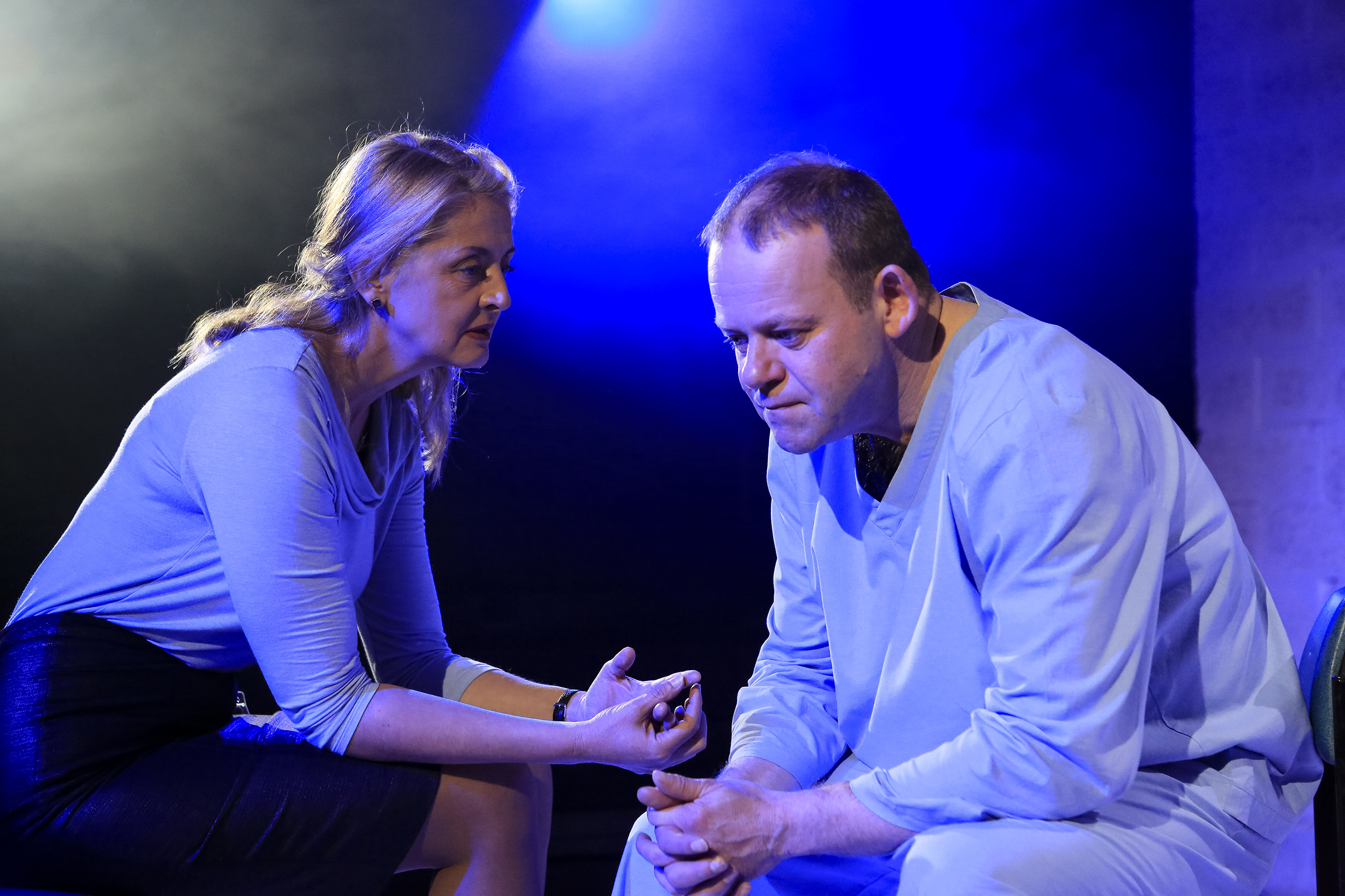
A psychologist called Alice (Jeanette Cronin) explains that he is displaying symptoms of a condition called anterograde amnesia, whereby he is unable to retain new memories, though his long-term memory is fine. (Guy Pearce’s character had the same condition in the film Memento).

Every 15 minutes or so, he forgets what has just happened, so as Alice works with him, they must keep starting again.

As they retrace David’s steps, teasing out fresh information, Australian playwright Aidan Fennessy weaves in new clues leading to a dark secret. To reveal any more of the plot of The House on the Lake would be a crime.

Fennessy’s taut two-hander is a gripping psychological thriller with a twisting kaleidoscope of scenes that spin around themes of lies and truth-telling as well as a trust-betrayal-revenge theory propounded by David. The fiercely articulate David, who is a great believer in logic, also (rather cockily) throws in some Edgar Allan Poe.

Fennessy’s tight script is cleverly written and feels well-researched, with the legal and psychological elements ringing true.

Kim Hardwick directs an absorbing production for Griffin Theatre Company, simply but eloquently staged on Stephen Curtis’s stark, suitably clinical, anonymous set. Martin Kinnane’s lighting and Kelly Ryall’s sound both make strong contributions to an excellent production.

Higginson is superb as David, giving a subtly shifting performance as more gradually comes to light and his condition slowly changes. Cronin offers strong support playing Alice with a brusque, inscrutable professionalism. Initially her performance feels very cold and abrupt but as the play progresses there are hints of something more.

The foyer was buzzing afterwards as people unpicked the play. Some had twigged early; others were surprised. But even if you had your suspicions about where the play was going, it didn’t spoil the experience.

Running 90-minutes, The House on the Lake is an intriguing puzzle of a play, brilliantly staged and hugely entertaining.

The House on the Lake runs at the SBW Stables Theatre until June 20. Bookings: www.griffintheatre.com.au or 02 9361 3817

A version of this review ran in the Sunday Telegraph on May 24