Falsettos

Eternity Playhouse, February 11
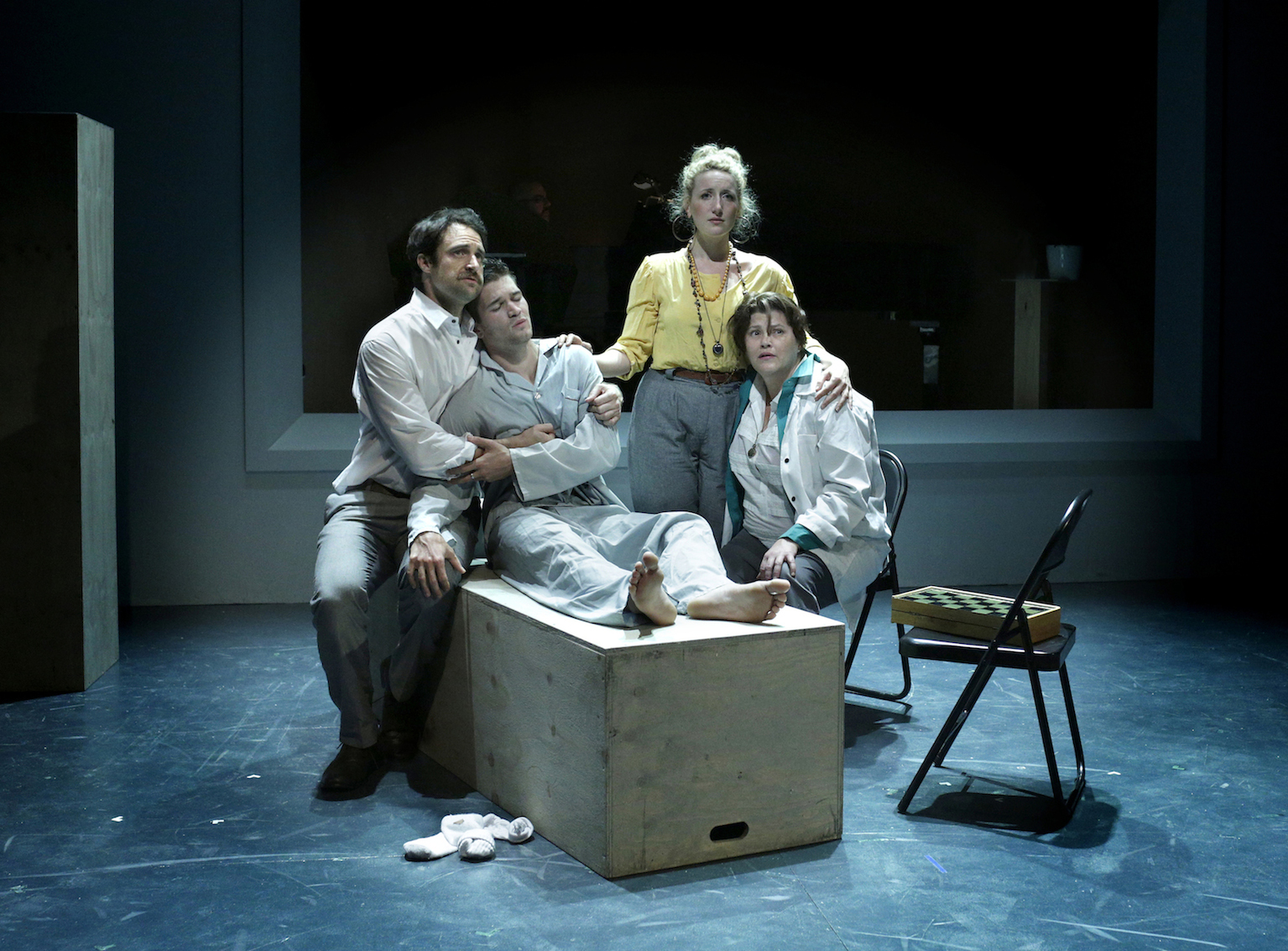
Tamlyn Henderson, Ben Hall, Elise McCann and Margi de Ferranti. Photo: Helen White

Tamlyn Henderson, Ben Hall, Elise McCann and Margi de Ferranti. Photo: Helen White

William Finn’s Falsettos is an intelligent, witty, tender musical. However, the Darlinghurst Theatre Company production has so much stage business going on that it takes a fair amount of time before it finally hits its mark and draws you in emotionally.

With witty lyrics and a beautiful, eclectic score by Finn, who also co-wrote the book with James Lapine, the economical, sung-through show consists of two one-act musicals written a decade apart.

The first act, March of the Falsettos, which premiered in 1981, is set in New York in 1979 against the backdrop of gay liberation. The second act Falsettoland, which premiered in 1991, is set in 1981 when “something bad” – later identified as the deadly AIDS virus – was beginning to ravage the gay community. They were combined as Falsettos in 1992. Two decades on, the times may be different but Falsettos still feels relevant and moving.

It tells the story of Marvin (Tamlyn Henderson), a Jewish father who leaves his wife Trina (Katrina Retallick) and young son Jason (Anthony Garcia on opening night) for a gay man called Whizzer (Ben Hall). However, Marvin wants it all and tries to create a tight knit family with all of them living together. The tensions send Trina off to see Marvin’s shrink Mendel (Stephen Anderson) who she ends up marrying, further complicating the web of relationships.

The second act, in which Jason’s Bar Mitzvah looms, also introduces Marvin’s lesbian neighbours Dr Charlotte (Margi de Ferranti) and Cordelia (Elise McCann).

As Frank Rich so eloquently put it in his New York Times review, the show is not just about Marvin but “about all its people together, a warring modern family divided in sexuality but finally inseparable in love and death.”

As anticipated, the new Eternity Playhouse proves a lovely space for a small-scale musical. The 200-seat venue is intimate enough for the show to be performed without amplification – and therefore with just a piano. Gez Xavier Mansfield’s set has co-musical director Nigel Ubrihien sitting at a grand piano in an alcove built into the back wall of the set, which works a treat – as does Ubrihien’s sensitive accompaniment.

The rest of the set consists of large wooden, coffin-shaped boxes, which may have been chosen to help with the acoustics but make for some fairly clunky scene changing as the cast drags them around.

More problematic is the barrage of stage business from director Stephen Colyer. The first act in particular is so busy, tricksy and over-choreographed that it distracts from the songs and diminishes our emotional connection with the characters.

For the very funny opening number “Four Jews in a Room Bitching”, the actors appear in matching grey pants, white shirts and Groucho Marx-like false noses. Later there’s a blow-up doll, which feels tacky, particularly when Jason is handling it. Retallick wears a steel mesh basket on her head while singing “Trina’s Song”. Quite why she also lines up six kitchen sponges I’m not sure. (The reason for the cast carrying their scores for the opening number and briefly later when Whizzer is ill also eluded me).

For Trina’s big, show-stopping number “I’m Breaking Down” Retallick has to do a workout routine on an aerobic stepper. She still got a well-deserved, rousing response but, as in numerous other instances during the show, it felt that the choreography was competing with the song.

Even Jason’s poignant little musical interludes are accompanied by a distracting pattern of hand movements.

A moment of stillness towards the end of Act I comes as blessed relief. Marvin and Jason sit facing each other. Without moving, Henderson focuses on his son and sings the touching lullaby-like “Father to Son” and for the first time the emotion feels real.
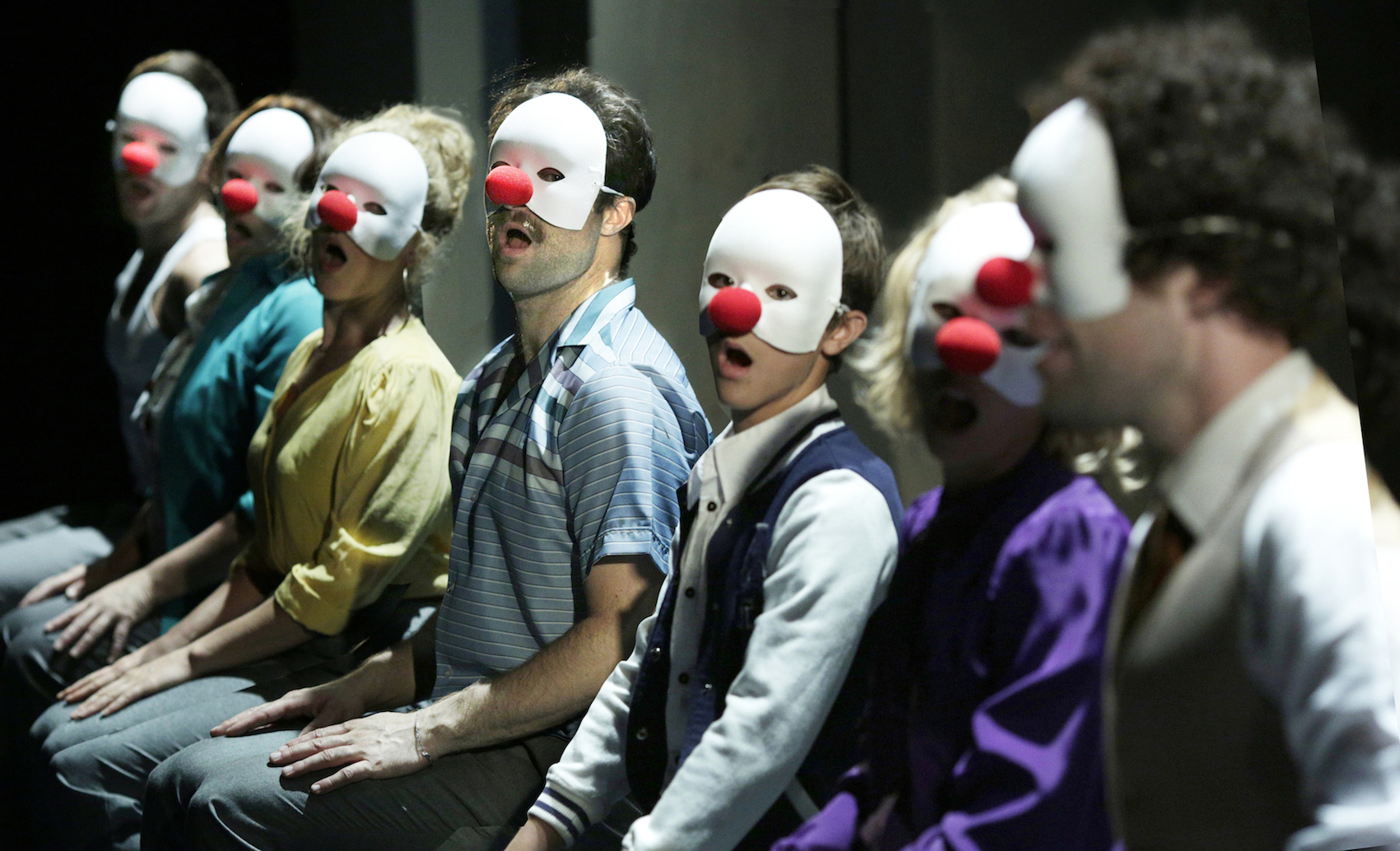
Ben Hall, Margi de Ferranti, Elise McCann, Tamlyn Henderson, Isaac Shaw, Katrina Retallick, Stephen Anderson. Photo: Helen White

Ben Hall, Margi de Ferranti, Elise McCann, Tamlyn Henderson, Isaac Shaw, Katrina Retallick, Stephen Anderson. Photo: Helen White

The second act is a big improvement despite masks with clown noses. Instead of the matching grey and white outfits, the characters appear in colourful costumes that help define their characters and the stage business isn’t so relentless – though why, oh why, in the middle of Marvin’s beautiful love ballad “What More Can I Say”, movingly sung by Henderson to a sleeping Whizzer, does Colyer have him take a pee?

Overall, however, the second act hits its moments. The ensemble number “The Baseball Game” in which the extended family goes to watch “Jewish boys who can’t play baseball play baseball” is very funny and snappily performed. The quartet “Unlikely Lovers” is also a poignant moment, impressively sung by Henderson, Hall, De Ferranti and McCann. And even though the ending of the musical is a little sentimental, Colyer shows more restraint here and allows the material to speak for itself with touching results.

The cast works extremely hard and all have their moment. Retallick captures Trina’s zesty vim and neuroses with an exuberant performance, her renowned comic chops as sure as ever. Henderson does a good job of conveying Marvin’s arc from self-absorption to a more mature appreciation of family and love, becoming ever more engaging as the show progresses, while Anderson brings a kooky warmth to the role of Mendel.

But on opening night it was 13-year old Garcia who all but stole the show, handling Jason’s conflicted emotions superbly well for his age, singing securely and exuding an effortless ease and sense of timing on stage.

There’s no doubting Colyer’s love for the show in which he has found “inspiration, encouragement and consolation” as he writes in the theatre program. Perhaps it’s because of his passion for it that he has tried to do too much with it at times.

Sydney hasn’t seen a professional staging of Falsettos since the wonderful Sydney Theatre Company version in 1994. (The New Theatre also staged a production in 2004, which I didn’t see). Musical theatre aficiandos will therefore be excited at the chance to see it now. It is a beautiful little show and despite my reservations about this production, there’s more than enough in it that’s enjoyable to make it well worth seeing.

Falsettos plays at the Eternity Playhouse until March 16 as part of the Sydney Gay and Lesbian Mardi Gras. Bookings: darlinghursttheatre.com
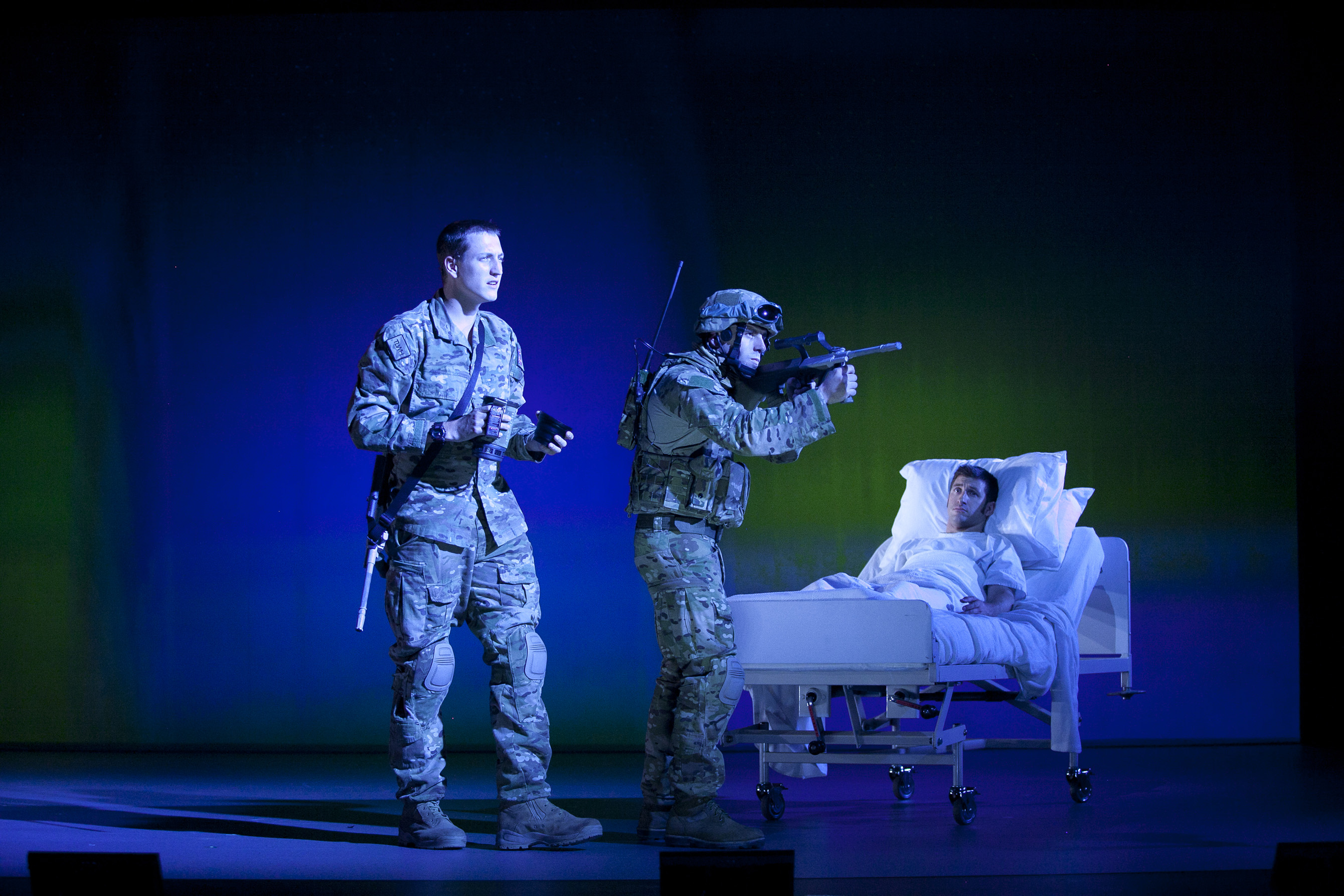
The Long Way Home review

Sydney Theatre, February 8

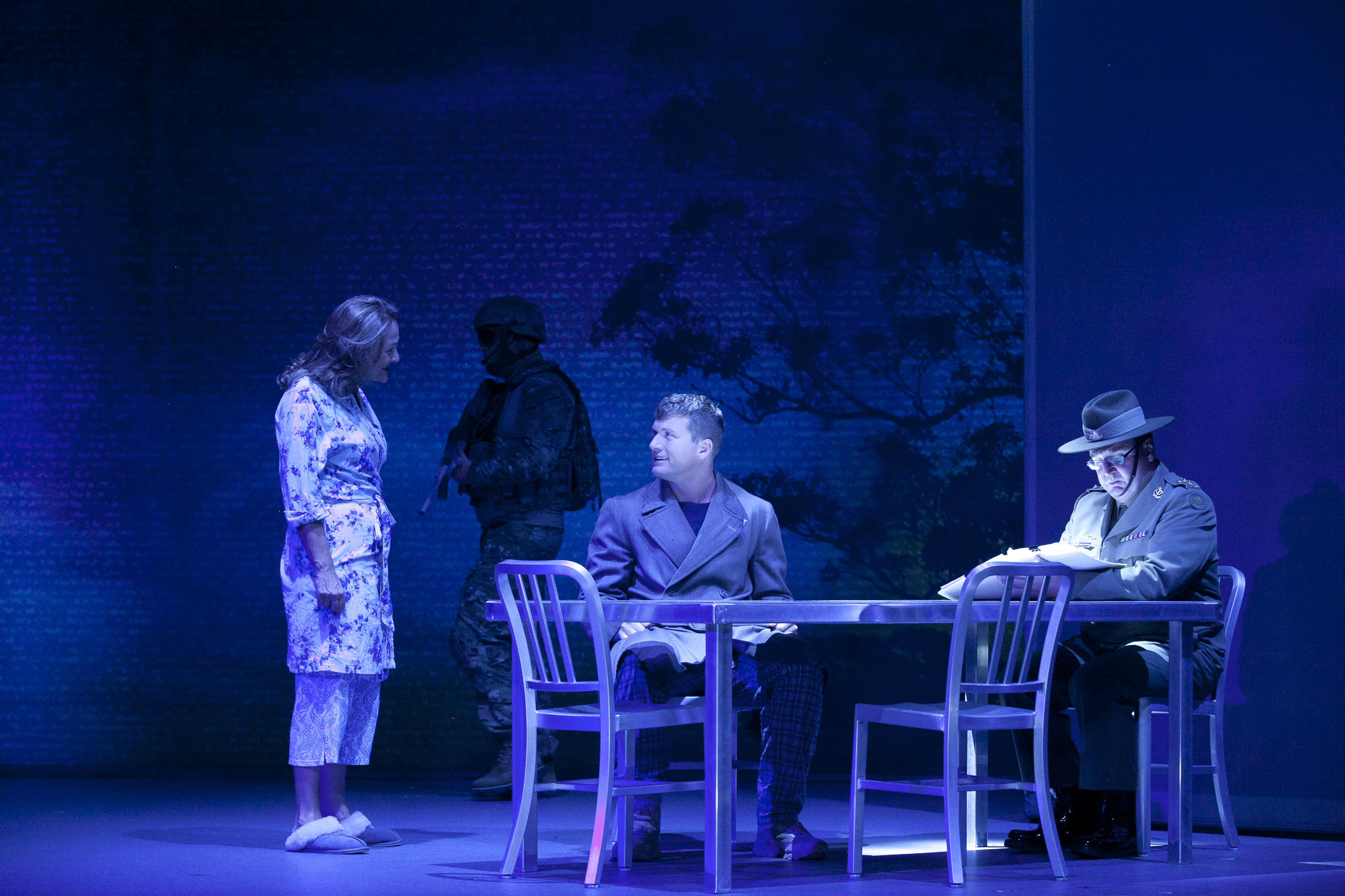
Odile Le Clezio, Tim Loch and David Cantley. Photo: Lisa Tomasetti

Odile Le Clezio, Tim Loch and David Cantley. Photo: Lisa Tomasetti

When Sydney Theatre Company announced that it was co-producing a new work with the Australian Defence Force about returning servicemen and women, it sounded like a wonderful initiative – though quite how it would play out on stage, given that the majority of the cast were to be soldiers, was anyone’s guess.

Well, not only is The Long Way Home a wonderful initiative but an important, moving piece of theatre with the power to make an impact on several levels. As well as offering the general public a glimpse into the experiences of our military personnel, it will hopefully aid the recovery of the participants, and help other returned soldiers suffering post-traumatic stress disorder (PTSD) who see it – many of whom are in denial – to realise that they are far from alone and seek help.

The production was initiated by General David Hurley, Chief of the Defence Force, after he saw a production in London called The Two Worlds of Charlie F based on the experiences of British soldiers. Stephen Rayne, who directed that production, was enlisted by the STC to direct here.

Melbourne playwright Daniel Keene crafted the script after spending a five-week workshop with 15 volunteer soldiers, who had seen active service in Afghanistan, Iraq or East Timor. Twelve of them appear in the play: Will Bailey, David Cantley, James Duncan, Wayne Goodman, Craig Hancock, Kyle Harris, Patrick Hayes, Tim Loch, Emma Palmer, Sarah Webster, James Whitney and Gary Wilson.

They perform alongside five professional actors: Martin Harper, Emma Jackson, Odile Le Clezio, Tahki Saul and Warwick Young. Both Harper and Young have served in the Regular Army and the Army Reserve.

Keene and Rayne decided not to create a piece of verbatim theatre, preferring the dramatic flexibility of a play with characters and several interweaving narratives.

But as Keene writes in the theatre program: “Is The Long Way Home fictional? Yes, and no. Every situation that it presents and every line of dialogue is born out of the experiences of the soldiers who perform in the play. They will play themselves re-imagined. They are bringing their reality into contact with that of their audience.”

What emerges is a tapestry of scenes in Afghanistan and Australia through which we gain an insight into the life of the soldiers during active service – the camaraderie, the terror, the adrenaline, the thrill, the horrific injuries – and then the struggle to readjust to civilian life when they return home with physical and/or psychological injuries.

Linking the scenes are various narrative arcs, the strongest of which follow two soldiers with PTSD, both battling a gnawing sense of loss and uselessness now that they can no longer be soldiers. We have known about PTSD for decades, of course, but The Long Way Home gives it a human face, taking us into the two soldiers’ minds and homes.

One of them, played by Loch, compulsively irons, cleans the house and mows the lawn to give himself something to do when sleep eludes him and hallucinations crowd in on him. The other played by Hancock finds himself becoming increasingly short-tempered and aggressive with his wife.

With professional actors Le Clezio and Jackson as their wives providing a strong emotional anchor in their scenes, both Loch and Hancock are superb, performing with a raw honesty.

As you’d expect, some of the soldiers are more relaxed and convincing on stage than others but overall they do exceptionally well and their physicality when in military mode is naturally utterly authentic.

James Duncan, Patrick Hayes and Gary Wilson. Photo: Lisa Tomasetti

James Duncan, Patrick Hayes and Gary Wilson. Photo: Lisa Tomasetti

Among many strong performances, Wilson plays a mostly comatose soldier with severe physical injuries including brain damage, who occasionally whispers lines from The Odyssey from his hospital bed. His final monologue had many in the opening night audience in tears – civilians and uniformed men alike.

Whitney is also terrific as a soldier giving stand-up comedy a go, with some cringe-makingly awful jokes.

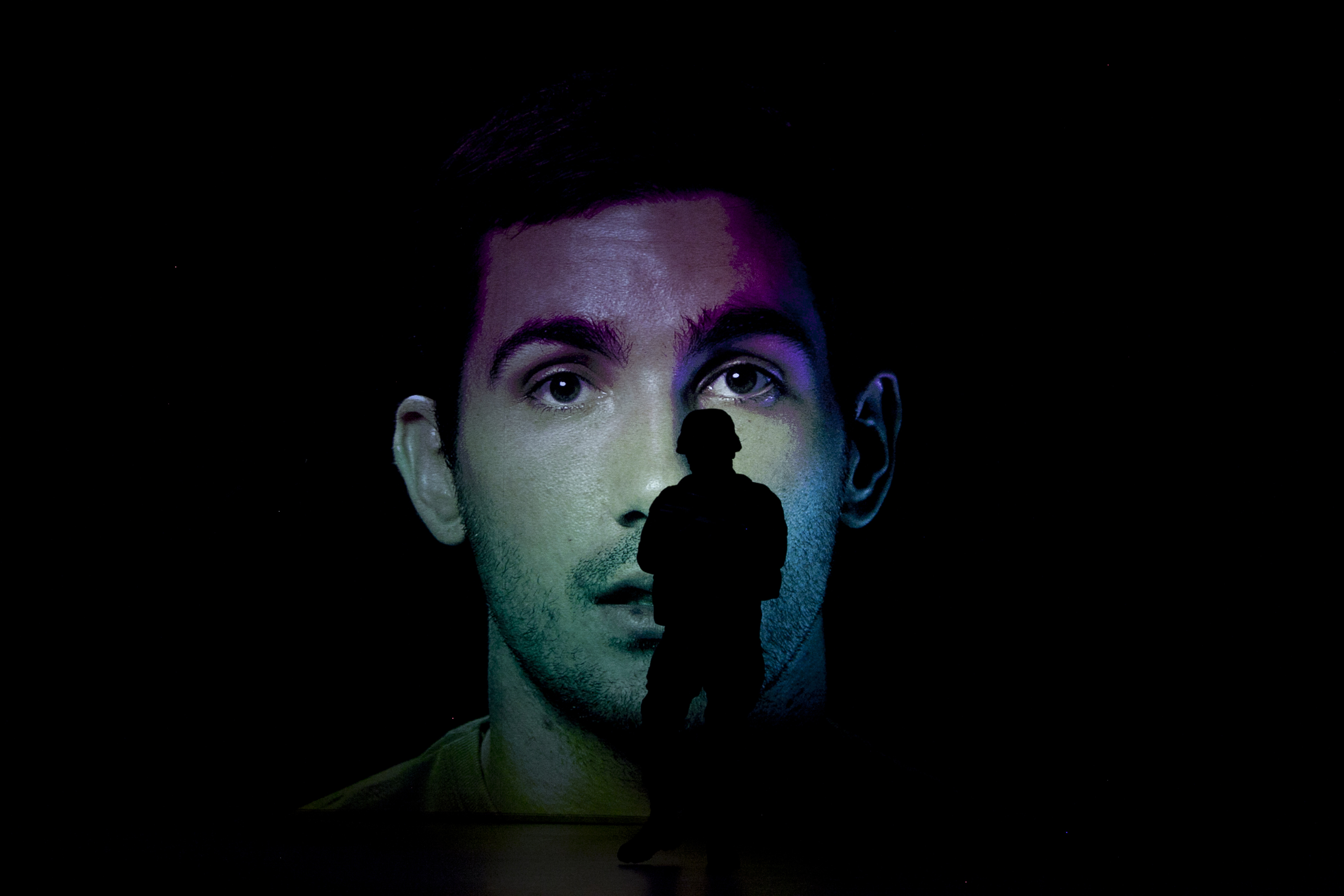
Rayne directs a tight, brilliantly staged production. Renee Mulder’s flexible set with sliding screens and a huge screen at the back, onto which is projected video imagery by David Bergman as well as text and interviews with the soldiers, is highly effective. The recurring image of armed soldiers in combat camouflage silhouetted against the back screen becomes like a leit motif, both familiar and also somewhat sinister.

Will Bailey. Photo: Lisa Tomasetti

Will Bailey. Photo: Lisa Tomasetti

Damien Cooper’s masterly lighting and Steve Francis’ crashing, rock-like soundscape also play a huge role in creating a highly charged, atmospheric space.

Keene’s script is funny, poetic and moving. It captures the robust, droll, F-bombing humour of the soldiers, which has the audience roaring with laughter. The next minute we are holding our breath at the brutal honesty of some of the confessions – from the mistaken killing of civilian women and children to the emotional breakdown of a weeping, traumatised ex-soldier.

Two sketch-like scenes in which a comedy character called Lieutenant Neville Stiffy (Tahki) dissects the “yes” and “no” parts of a soldier’s brain, and the way commands from the top brass filter down to the lower ranks, sit a bit oddly. There are also a few things that don’t quite ring true (would the doctor really talk like that about a patient, in front of him, even if he does appear to be comatose?).

But overall, even if there are no profound insights, The Long Way Home (which runs around two hours and ten minutes including interval) is a remarkable achievement.

The participating soldiers, some of whom had never even been in a theatre before, deserve high praise for opening themselves up in this way and for their commendable performances. Hopefully they will gain something from the experience. (Apparently Wilson’s speech – which was affected by his horrific injuries after a helicopter crash – has developed markedly after working with vocal coach Charmian Gradwell).

Audiences will certainly be enlightened and moved by the play. And if returned military personnel, particularly those suffering with PTSD, do see it – as hopefully they will – one can only imagine how it might speak to them.

The Long Way Home plays at Sydney Theatre until February 15 then tours to Darwin (February 22), Brisbane (February 27 – March 1), Wollongong (March 5 – 8), Townsville (March 14 – 15), Canberrra (March 19 – 22), Melbourne (March 27 – 29), Adelaide (April 1 – 5) and Perth (April 11 – 12). Booking details: www.sydneytheatre.com.au

An interview with Corporal Tim Loch and playwright Daniel Keene can be found here: https://jolitson.com/2014/01/28/the-long-way-home/

Verity Hunt-Ballard interview

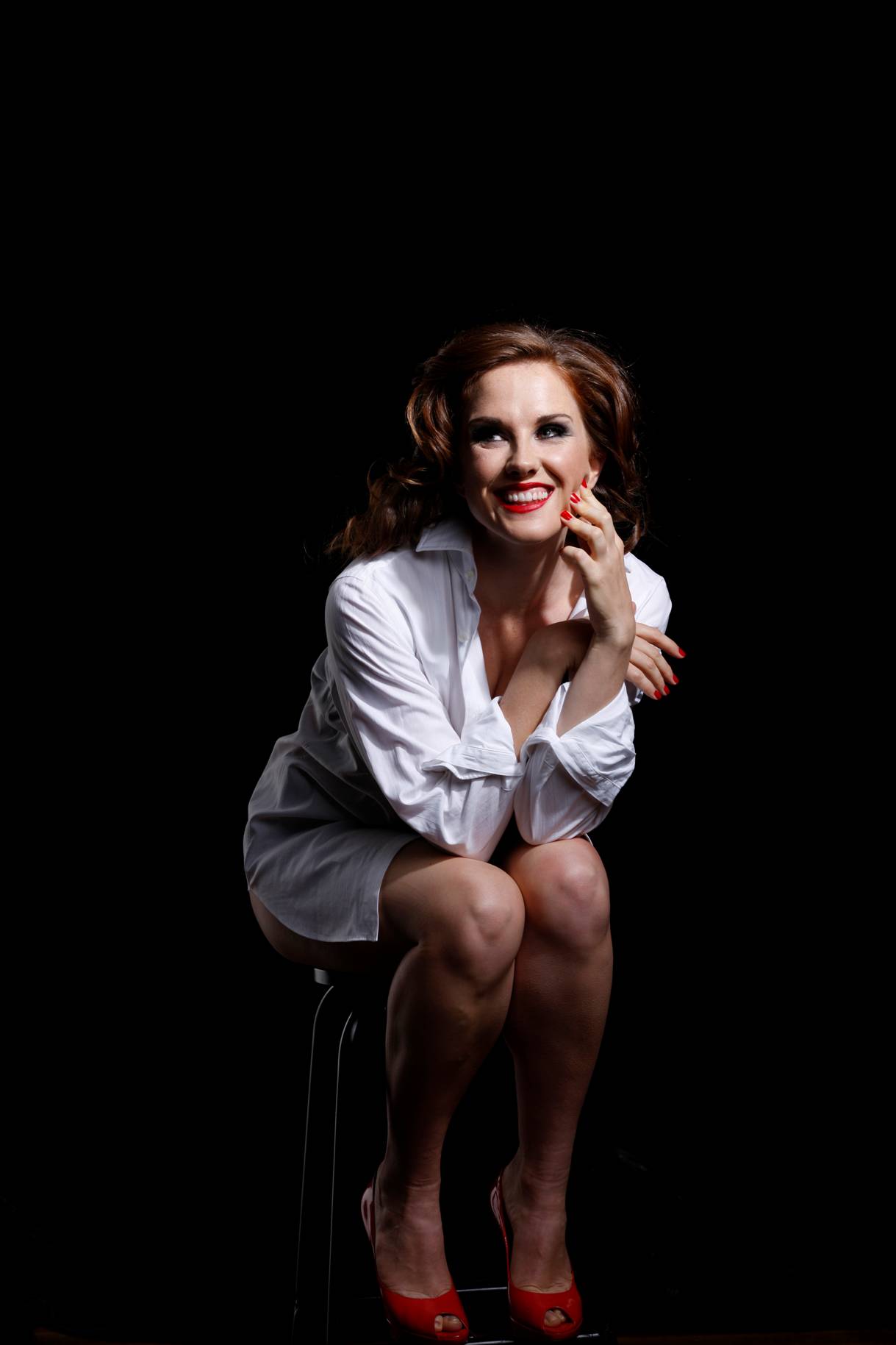
Verity Hunt-Ballard promoting Sweet Charity. Photo suplied

Verity Hunt-Ballard promoting Sweet Charity. Photo suplied

Last time Verity Hunt-Ballard performed in Sydney she flew over the heads of the audience as Mary Poppins in Cameron Mackintosh’s sumptuous, award-winning production.

Now, she is taking on another starring role – as Charity Hope Valentine in Sweet Charity – but this time in a gritty, intimate production.

The show has been chosen to launch the new Hayes Theatre Co, which is turning the former Darlinghurst Theatre in Potts Point into a home for small-scale musicals and cabaret. The exciting initiative looks set to shake up musical theatre in Sydney.

With only 115 seats and audiences sitting up close, “there will be nowhere to hide”, says Hunt-Ballard with a laugh.

“The last role I played was in 2000-seat theatres, which is a different discipline in a way, a different way of storytelling. (Sweet Charity) is really a play with music essentially, not like going to your big budget musicals – which are wonderful obviously, I’m a huge fan of them – but this is different and kind of unique. It’s really exciting to me because I haven’t done a small piece for many years.”

After Mary Poppins ended, Hunt-Ballard – whose other credits include Jersey Boys and The Rocky Horror Show – took a break from musicals to recover from the demanding two-year run.

“It was such a huge journey for me and ticked a lot of boxes, I guess,” says the softly spoken performer, who had only played supporting roles until then. “It was incredible but really hard yakka doing eight shows a week for two years. But it was a huge learning curve and I’m very, very grateful.”

For the past year – apart from appearing in a short return season of Eddie Perfect’s Shane Warne The Musical – she has been focused on raising her baby daughter with partner Scott Johnson who she met when they were performing together in Jersey Boys. However, Sweet Charity was too special an opportunity to resist.

“When (director) Dean Bryant and (producer) Lisa Campbell ring you and say ‘would you like to play Sweet Charity?’ even with an 11-month baby you say ‘yes’,” says Hunt-Ballard.

“We’re opening a theatre honouring Nancye Hayes who’s a really dear friend of mine and who has been my mentor really. She directed me at WAAPA years ago and we’ve been friends ever since. She calls herself my daughter’s fairy godmother. So all the stars aligned and I thought, ‘I’ll just have to take this job’. We’ve just moved to Melbourne but my darling Scott said, ‘OK, we’ll go back.’”

With music by Cy Coleman, lyrics by Dorothy Fields and book by Neil Simon, Sweet Charity opened on Broadway in 1966 in a production directed and choreographed by the legendary Bob Fosse with Gwen Verdon as Charity.

Other actors to have played the title role include Shirley MacLaine in the 1969 film and Nancye Hayes in the original 1967 Australian production.

It tells the story of eternal optimist Charity Hope Valentine, who dreams of being rescued from her job as a hostess in the seedy Fandango Dancehall by love and marriage.

Though she retains an element of innocence about her, Charity is polls removed from the “practically perfect” Mary Poppins.

“I feel, approaching this role, even more equipped having been through the last year emotionally and having to go to really dark places of sleep deprivation,” says Hunt-Ballard. “Not that Charity has children but she is certainly a character that has had to deal with life’s challenges. She’s tough. Full of hope but really tough (and) quite damaged in a way. She suffers rejection so many times but she just keeps going. It’s a story about the human spirit in a way.”

The Hayes Theatre Co production is directed by Dean Bryant whose many musical theatre credits include working as associate director on Priscilla, Queen of the Desert – The Musical around the world, the world premiere of An Officer and a Gentleman and A Funny Thing Happened on the Way to the Forum. He has also directed The Producers, Anything Goes and The Pirates of Penzance for The Production Company in Melbourne.

In 2006, three years after Hunt-Ballard graduated from WAAPA, he directed her in a show he co-wrote with composer Matthew Frank called Virgins, which went to the New York Musical Theatre Festival. Longtime friends, Hunt-Ballard is excited to be working with him again.

“Dean’s vision is quite gritty, quite dark and very influenced by Nights of Cabiria, the Fellini film that Sweet Charity was based on, which focuses more on the fact that Charity is a prostitute. She’s not just a dance hall hostess. She really has no skills, no support and she has to do this to survive,” says Hunt-Ballard.

“Our assistant director Valentina Gasbarrino is Italian and she was talking about the Fellini film and what it meant to Rome at that time: the oppression of the working class that he was showing. Dean is really excited that we are performing in the Cross because we really want it to feel like you are stepping into what could be any club (in the area).”

Hunt-Ballard says that the production will be “very physical” with “hip” new musical arrangements by Andrew Worboys and “hot” costumes by Academy Award-winning designer Tim Chappel.

Audiences will watch the show as if they are in the Fandango Ballroom with the characters.

“It’s quite stark,” says Hunt-Ballard. “We will be using minimal props and costume changes will happen on stage. It will take audiences on an emotional trip hopefully – sometimes uncomfortable, sometimes funny and sometimes beautiful.”

Sweet Charity, Hayes Theatre Co, Potts Point until March 9. Bookings: hayestheatre.com.au or 0498 960 586

An edited version of this story appeared in the Sunday Telegraph on February 2

Travelling North

Wharf 1, Sydney, January 18

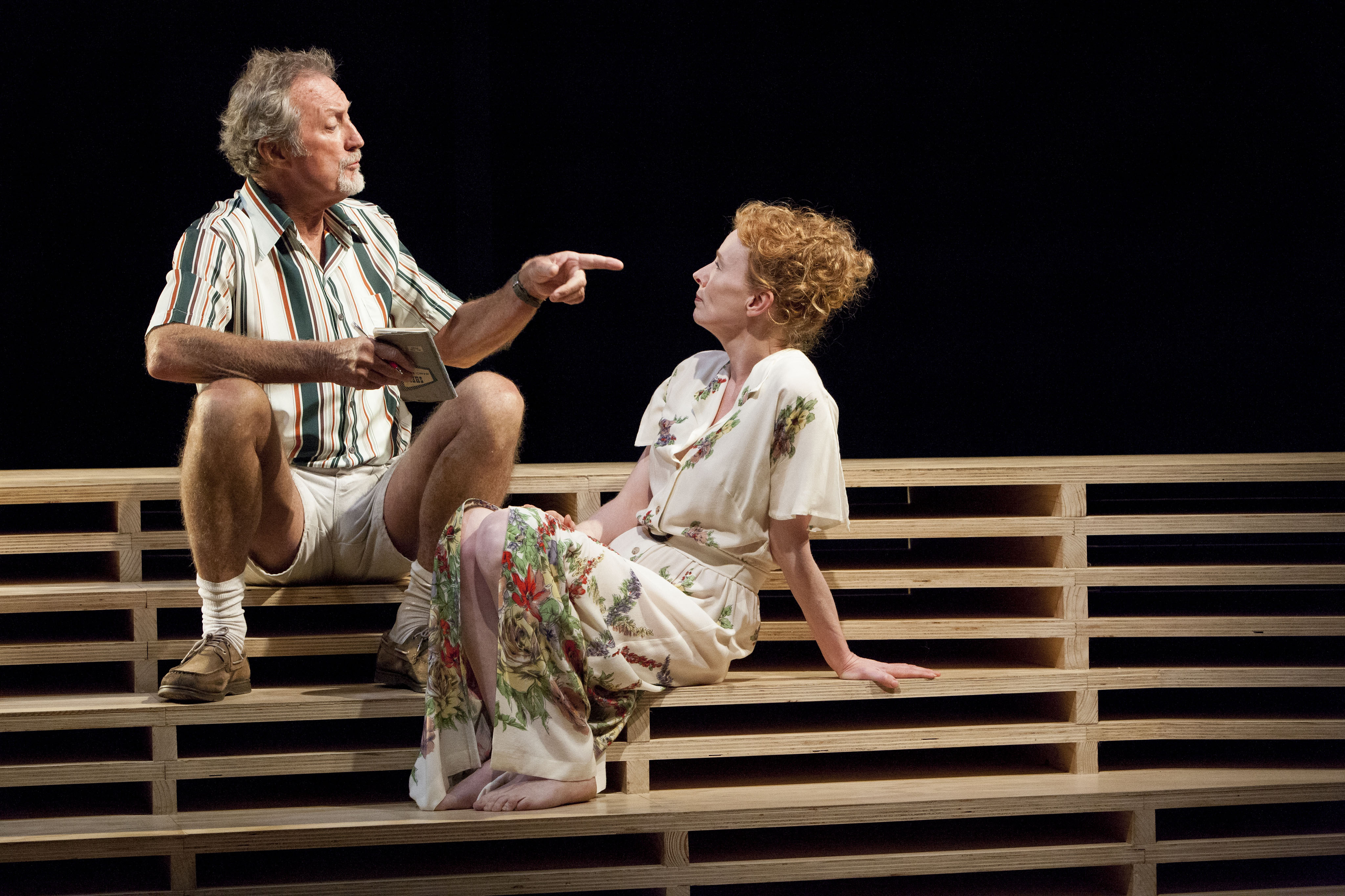
Bryan Brown and Alison Whyte. Photo: Brett Boardman

Bryan Brown and Alison Whyte. Photo: Brett Boardman

It’s a big year for David Williamson with eight of his plays to be staged in Sydney. It’s a shame then that the first of them – Sydney Theatre Company’s production of Travelling North – is a disappointment.

Written in 1979, Travelling North is a gentle, elegiac comedy about an autumnal romance between Frances (Alison Whyte, replacing the injured Greta Scacchi) and the grouchy, older Frank (Bryan Brown).

To the chagrin of Frances’s unhappily married daughters (Harriet Dyer and Sara West), she and Frank decide to head north together – but when Frank’s health fails there is trouble in paradise.

Directed by Andrew Upton, the production is hampered by David Fleischer’s stark, unattractive set. Performed on a large, slatted wooden platform backed by dark walls, with virtually no props, there is no sense of place, which the play needs. Instead, it is left to Nick Schlieper’s lighting to convey the shifts between chilly Melbourne and tropical Queensland.

It also seems odd that though the play stretches over a year or more, Whyte wears the same dress throughout while other actors have costume changes.

Brown brings little emotional depth or nuance to the role of Frank. He is at his most believable when angrily demanding information from his doctor (Russell Kiefel) but mostly looks slightly awkward as if uncomfortable on stage and captures little of Frank’s irascible charm.

Whyte is an elegant, dignified, warm-hearted Frances. Despite her late addition to the cast, hers is the most convincing performance, though Andrew Tighe gives the production an engaging shot in the arm with a very funny, sweet performance as the interfering but well-meaning neighbour in short shorts, socks and sandals.

It seemed to me that the problem is not in the writing. Williamson writes believable dialogue laced with a wry, gentle humour and canvases pertinent issues: older love, the generation divide and the way grown-up children so often demand that their parents remain at their beck and call – something we see a lot these days as more and more grandparents find themselves co-opted as child carers. We should care about the characters a whole lot more than we do here.

Instead, it feels as if none of the different elements of the production have really gelled. The emotional heart of the play is missing in this rather one-dimensional production, which doesn’t do Williamson justice.

Travelling North runs at Wharf I until March 22. Bookings: www.sydneytheatre.com.au or 02 9250 1777

An edited version of this review ran in the Sunday Telegraph on February 2

Magda turns wicked; Bonnie searches for Snow White

Magda Szubanski. Photo: supplied

Magda Szubanski. Photo: supplied

When Magda Szubanski agreed to feature in Snow White – Winter Family Musical, Bonnie Lythgoe couldn’t contain her excitement as another part of her “dream team” fell into place.

“I was waiting with bated breath to find out if she’d do it. I can’t tell you how happy I am,” says Lythgoe, who was a judge on the first three series of So You Think You Can Dance Australia.

As revealed exclusively in yesterday’s Sunday Telegraph, Szubanski will play the Wicked Queen in Lythgoe’s contemporary pantomime spectacular (co-produced with David and Lisa Campbell’s Luckiest Productions), which has a short season at Sydney’s State Theatre in July.

“I haven’t done a panto before but I’ve always thought it would be terrific fun,” says Szubanski. “I did do A Funny Thing Happened on the Way to the Forum with Geoffrey Rush. That was rather like a panto and that was tremendous fun.”

“We haven’t really done a lot of (pantos) here but the tradition they have in Britain is so popular that I thought it would be a hoot to do. I don’t think you can underestimate how joyous these things are.”

Szubanski is looking forward to playing the villain. “One of the dwarves was the role I was after – but I think I’m too short to play a dwarf,” quips the much-loved actor/comedian.

Szubanski joins a celebrity-studded cast that includes the unlikely pairing of Kyle Sandilands and Sir Cliff Richard as the two (pre-recorded) faces of the Wicked Queen’s magic mirror. Naturally Sandilands is the nasty Mirror Disgruntled while Richard is the kindly Mirror Enchanted.

Jimmy Giggle (aka James Rees) from the ABC-TV children’s show Giggle and Hoot will play Snow White’s best friend Muddles and TV host Peter Everett, recently seen on Celebrity Apprentice, is her guardian Chambers.

The huntsman is played by Josh Adamson, an Australian performer currently living in the US, who performed in Lythgoe’s panto Aladdin and his Winter’s Wish at the Pasadena Playhouse in December. The role of the Prince is still to be announced – but is likely to be another name.

However, Lythgoe is offering a complete unknown the chance to land the starring role. Later this month, she and a team of celebrity judges will embark on a nationwide search for an actress, aged 16 to 26, to play Snow White. Pant O-Z Factor: The Search for Snow White, will be filmed and covered by the media.

The auditions will take place at Westfield shopping centres around the country (see details below), where the various judging panels will include people like Sonia Kruger, David Campbell, Matt Lee and Prinnie Stevens among others.

Bonnie Lythgoe auditioning for one of her pantos in the US. Photo: supplied

Bonnie Lythgoe auditioning for one of her pantos in the US. Photo: supplied

Lythgoe has been staging pantos in the US with great success for several years now and has already produced Snow White there with Neil Patrick Harris as the Magic Mirror. The shows combine the British panto tradition (“he’s behind you!”) with contemporary pop songs.

For the Sydney production she says she is looking for a leading lady who is “a little bit more feisty” than the Disney heroine “but a lovely, warm, friendly person.

“I’m looking for raw talent. I don’t want somebody who has been working for five years,” says Lythgoe. “She needs to sing well, to believe in the character she’s playing and be real. She also needs to move well but she doesn’t need to be a fantastic dancer.”

As well as playing the Wicked Queen, Szubanski has been enlisted as a co-writer to ensure the comedy speaks to Australian audiences and promises there will be “fun jokes for all the family”.

“It’s like the stuff we did with Fast Forward where there’s the colour and movement for the kids and then slightly more sophisticated (or not!) elements for the adults, so I think it will be really fun” says Szubanski. “My Mum who is 89 is saying, ‘Oh! I’ll pop up to Sydney to see that.’”

Pant O-Z Factor: The Search for Snow White auditions will be held at:

Saturday February 22, Westfield Marion, Adelaide

Saturday March 8 at Westfield Chermside, Brisbane

Sunday March 9 at Westfield Chermside, Brisbane

Saturday March 15, Westfield Southland, Melbourne

Sunday March 16, Westfield Knox, Melbourne

Saturday March 22, Westfield Parramatta, Sydney

Sunday March 23, Westfield Hurstville, Sydney

Auditions will be held from 9am to 5pm each day. People wanting to audition should arrive at 8am on the day to register. More information about the show can be found at Bonnie Lythgoe’s website http://www.bonnielythgoe.com

Snow White – Winter Family Musical plays at the State Theatre in Sydney, July 4 – 13. Bookings: http://www.tickemaster.com.au or 1300 139 588 

The Long Way Home

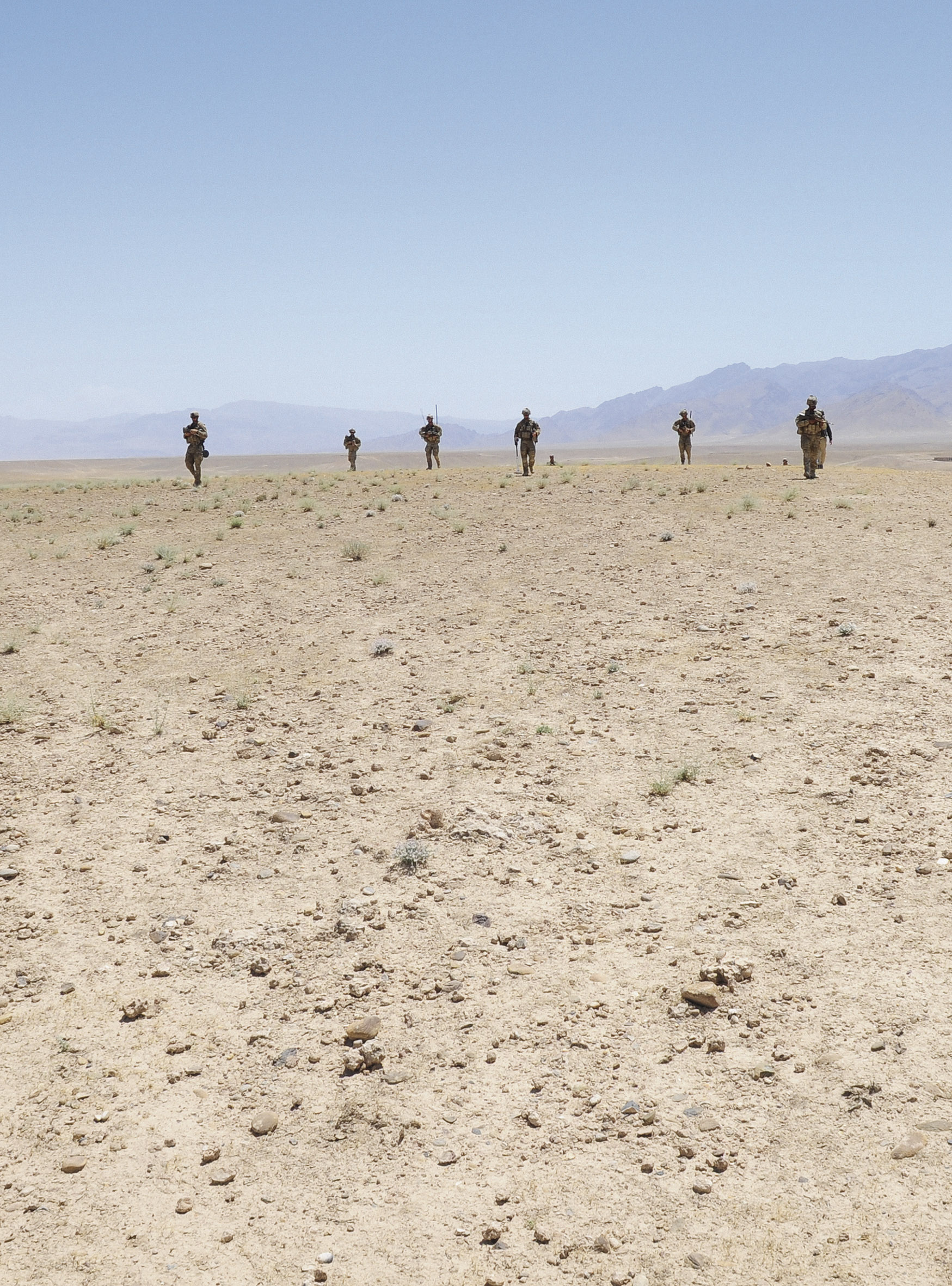
Members of Mentoring Team One, part of Mentoring Task Force - Four, move across the the 'Dasht' (desert) during a mentored patrol with members of the Afghanistan National Army in Uruzgan. Photo courtesy of the Australian Defence Force

Members of Mentoring Team One, part of Mentoring Task Force – Four, move across the the ‘Dasht’ (desert) during a mentored patrol with members of the Afghanistan National Army in Uruzgan. Photo courtesy of the Australian Defence Force

In 2009, Corporal Tim Loch was deployed in Afghanistan where his work as a combat engineer involved detecting improvised explosive devices (IEDs) that threatened the movement of Australian troops.

While a searching a road one day, their “means were defeated” as he puts it.

“I was crew commander that day. I was standing up in the little manhole in the top of the vehicle and we were crumped (blown up). ‘Crumped’ – because that’s what it sounds like,” he explains.

“My right heel was crushed, my right femur was snapped. The machine gun in front was hewn off its bolts and hit me in the face. I can remember being conscious for a few minutes and seeing my leg at a 45 degree angle and I can remember claret (blood) all over my jacket and then I passed out.”

As he floated in and out of consciousness he was taken to hospitals in Tarin Kowt and Khandahar (he thinks) and then flown to Germany where his leg was properly set. He was then brought back to Brisbane where, he says, “they put a Meccano set in my right foot – and that felt like someone had parked a truck on it.”

His weight dropped from around 90kg to 57kg and it took him two years to learn to walk without a walking stick and run again and to bulk up after his . “I still can’t pack march, there are still a few things I can’t do, but then you look at other guys and think, ‘hey, I’m still alive and I’ve still got a leg so I guess I’m lucky,’” he says.

His tone is neutral as he talks matter-of-factly about his experience, neither dramatising nor underplaying it (though he has a vivid turn of phrase), emphasising several times that everyone who has been injured in active service has “a sob story”.

Corporal Loch is one of 13 servicemen and women performing alongside four professional actors in The Long Way Home, a new play co-produced by Sydney Theatre Company and the Australian Defence Force (ADF), which opens in Sydney next month and then tours nationally.

The project was initiated by General David Hurley, Chief of the Defence Force, with the aim of aiding the recovery of the participants and giving audiences an insight into what our armed forces have to cope with both during active service and when they return. Hurley was inspired by a play he saw in London in 2012 called The Two Worlds of Charlie F, directed by British director Stephen Rayne, in which wounded British soldiers told their stories on stage. Rayne is directing the Australian production.

The Long Way Home was written by Melbourne playwright Daniel Keene after a five-week workshop during which 15 soldiers – all of whom suffered physical or psychological injury in Afghanistan, Iraq or East Timor – talked openly and honestly about their experiences.

“It’s been an extraordinary experience emotionally and artistically. ‘Intense’ is the word,” says Keene.

The soldiers opened up to him and the other theatre-makers “with various degrees of difficulty”, says Keene. “At the very beginning people didn’t know what to expect from us and we didn’t know what to expect from them so it was tentative, but ultimately everyone was very open and very honest and very direct and courageous, actually, in what they were telling us.”

Neither Rayne nor Keene wanted to produce a piece of verbatim documentary theatre, but a drama.

“The whole notion of creating something rather than (the soldiers) just repeating their experience was very important for us,” says Keene. “We wanted them to create a piece of work. They all play characters so they have a mask if you like. They re not playing themselves, they are playing someone else so in a way that’s a freedom for them.

“It’s a complex piece of work. There are five different narratives that run through the play, it’s not just one story. Everything that any character says is based on something we’ve been told, so all the stories, all the little narratives that unfold are drawn from the core material we had from the ADF members.”

Loch describes it as “a fiction based on reality. I play a character called Tom. I won’t give too much away. He’s returned from overseas and he’s having a difficult time adjusting back to life in Australia. The hoops he has to jump through are some of the things I’ve had to do and things that some of the other participants have had to deal with.”

Though the play moves between Australia and Afghanistan, Keene says that the essential focus is on the difficult transition between being deployed in a dangerous war zone, where your life depends daily on the decisions you make, and then returning to life in Australia.

“That’s a huge problem for returning soldiers,” says Keene. “That’s why it’s called The Long Way Home because it’s about the emotional and spiritual cost of that return.”

Like most of the participating soldiers, Loch knew little about theatre at the start of the project. The only show he has seen was The Pirates of Penzance with Jon English, which he was taken to see as “a wee tacker” in Rockhampton.

He has only been inside a theatre once since then – and that was to search a Townsville venue for bombs during a training exercise.

“I can tell you where the best spots are to hide things in a theatre but how to project your voice from the stage is a new territory,” he says.

Loch admits that when he was first approached about participating in The Long Way Home (“because I’ve got a little bit of a name for being a character and because I was working in Afghanistan”), he was hesitant.

“It’s nothing against the theatre, it’s just going from being a combat engineer, which is something considered very alpha male, a beef-eating type, to something in the theatre, which is not what a strong silent type does (is a big step),” says Loch who grew up “on a cattle station with the cowboy mentality of suffer in silence.”

However, once his Regiment Sergeant Major explained the project to him in depth, he decided to do it not just to explain to audiences what soldiers go through but also in the hope that it may help soldiers suffering post-traumatic stress disorder (PTSD) admit they have a problem and seek help.

“I see a lot of guys in the military who are having a hard time and they just don’t want to communicate or they feel uncomfortable about it,” he says. “They can’t stick up their hand and say, ‘I have a mental injury, I need to do something about it.’

“I personally don’t have PTSD but some of the other cast members do so I guess it’s like, ‘hey, we have this, but we are able to stand up in front of several people hopefully at a time and we are able to be open about it and there is no reason why you can’t either,’ and essentially if that’s what we can achieve that will be great. If we can get together and make an entertaining show that’s great too – but if we get the first priority done I’m happy regardless.”

Though Loch may not have PTSD he admits to having experienced some difficult times during his recovery, particularly while in hospital in Brisbane.

“I spent God knows how many months in that place. That’s when I started to get angry and that irrational it wasn’t fun,” he says. “I lost a relationship out of it. I was dumped on Facebook. That was good fun. But everyone’s got a sob story.”

Loch admits he also struggled with guilt that he was back here while his mates were still in Afghanistan – though he takes some comfort from the fact that he was the worst injured when they were crumped, praising their section commander who realised such an attack was likely and took precautions to minimise injuries in the event of it happening.

Loch is still a member of the ADF (which he joined in 2004) and currently teaches at the School of Military Engineering – at his own request.

“When I was injured in 2009, I had to learn to walk again and I wasn’t able to run and I asked my regiment, ‘can you send me to the School of Engineering’ and they said, ‘why?’” he explains. “I said, ‘well, even if I have a walking stick I can still give a PowerPoint presentation. At least I’ve got something to do’ – and I found that was a very big part of my individual recovery process.

“However, the recovery process needs to be individually structured. What works for one guy may be the worst thing you can do for another guy and that’s where it gets very tricky. If you talk to other guys about their recovery process you rarely get the same story twice.”

For all the challenges of being deployed in Afghanistan, Loch admits he’d “go back in a heartbeat. I’ll be honest, as hot as it is, as much as it sucks, as much as everything annoys you, there’s nothing I’d rather be doing.

“The main thing is everything feels real. You are getting stressed about how close you are to a rocket range, or (that) we may not have enough ammunition or we are starting to run low on radio battery and if we have no communication we are buggered. That’s what you get stressed out about. But then you come back to Australia and everyone is stressed out about them playing the same song on radio all the time or ‘I don’t like this television show’. It’s like, really? Get some real problems.”

Loch believes that it will be hard to get returned servicemen and women suffering from PTSD, most of whom would rarely, if ever, go to the theatre, to come to see The Long Way Home.

“When guys are going through depression, PTSD and alcoholism you tend to go into a shell, you lock yourself in a room and you don’t want to come out,” he says. “Everyone’s got their own favourite little hiding spots. When I was going through a tough time, mine was the backyard with an outdoor table setting and I’d sit there with a bottle of rum and a packet of cigarettes and I’d go through the whole lot. I’d run out, I’d drive to the shop, get some more and come back. That went for a couple of weeks until someone clipped me around the ears and told me to wake up to myself.

“But what I’m hoping is a lot of the family members will come and look at the show whether it be soldier’s mothers, grandmothers, fathers, grandfathers, uncles and aunties. That’s one thing. But what we’re really hoping is a lot of the people who have these symptoms, hopefully their partners will see the advertisements and say, ‘hey, maybe we should go along to this and have a look.’”

After opening in Sydney, The Long Way Home tours to Darwin, Brisbane, Wollongong, Townsville, Canberra, Melbourne, Adelaide and Perth. (Full details of the tour are available on the Sydney Theatre Company website).

“The main garrison cities if you like are Darwin and Townsville,” says Loch. “And even Wollongong, there are a lot of navy guys down there. But Townsville and Darwin are definitely going to be the biggest shows simply because that’s where a lot of us come from. That’s why I am most looking forward to the Townsville show because that’s where my old regiment was. Hopefully, I don’t embarrass them too much.”

The Long Way Home plays at Sydney Theatre, February 7 – 15, and then tours nationally. Bookings and tour information: www.sydneytheatre.com.au or 02 9250 1777 

Black Diggers

Drama Theatre, Sydney Opera House, January 19

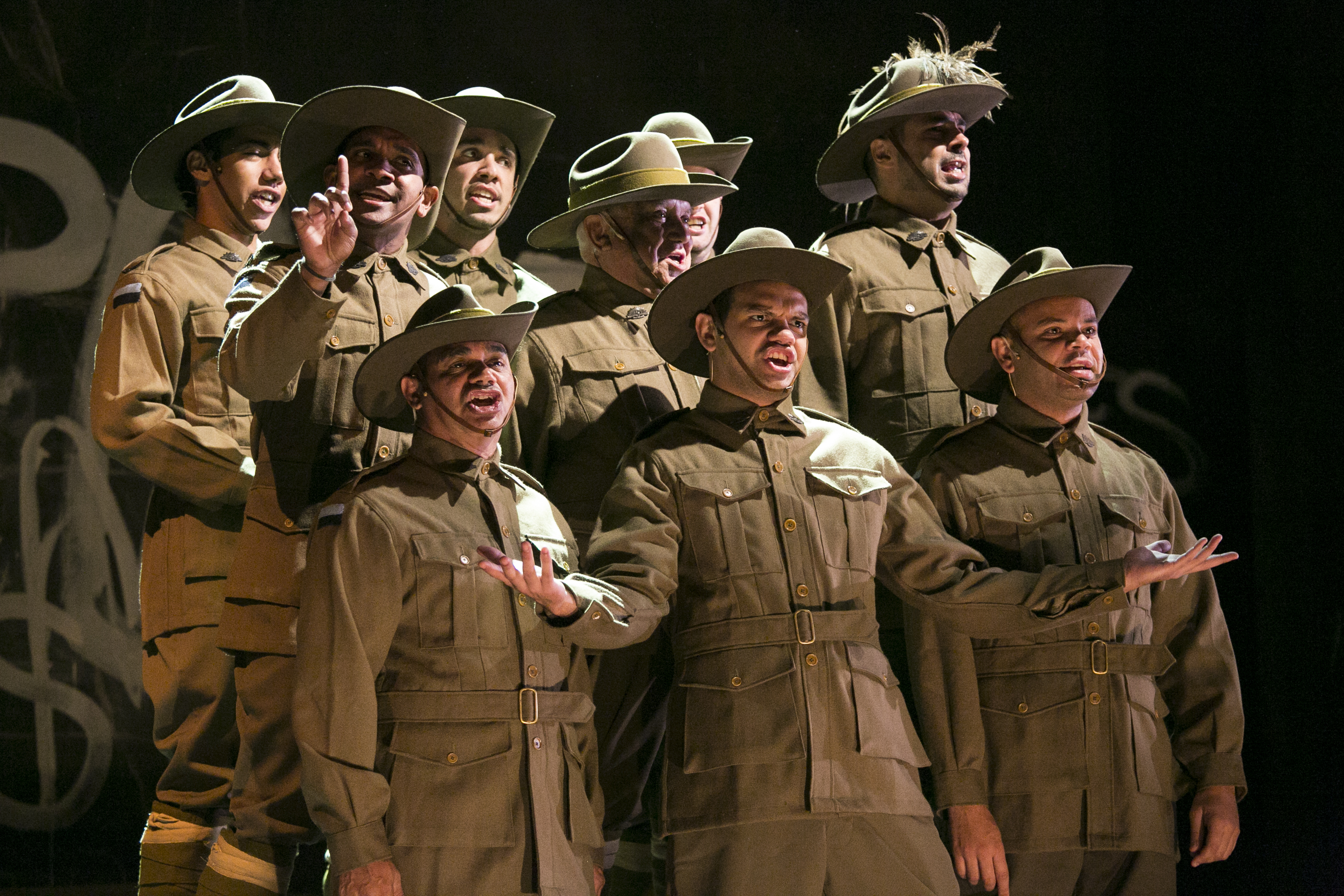
The cast of Black Diggers. Photo: Jamie Williams

The cast of Black Diggers. Photo: Jamie Williams

The words “Lest We Forget” are movingly evoked at the end of Black Diggers but, in fact, this new Australian play is more about illuminating a little known part of Australian history – the role and treatment of around 800 Aboriginal diggers during World War I.

Sydney Festival is presenting the premiere of this important Queensland Theatre Company production written by Tom Wright and directed by Wesley Enoch to coincide with the centenary of the start of the Great War.

Drawing on verbatim and other source material held by the Australian War Memorial, with research by David Williams, Wright has created a script full of short scenes and little vignettes, punctuated by song, which come together powerfully to offer a shocking and moving insight into the subject.

We see why Aboriginal men joined up to serve a King and country that didn’t even class them as citizens, the camaraderie and friendships they forged with other Australian diggers in the trenches and on the battlefields where colour became irrelevant, and their dashed expectations as they returned home having enjoyed an equality they hadn’t previously known, only to find that nothing had changed in Australia.

As one of the characters so eloquently puts it: “They painted my colour back on the day I got off that boat.”

Worse, many found that their own lands were taken away from them and given to other returned servicemen as part of the Soldier Settlement Scheme, which Indigenous soldiers were ineligible to apply to. On top of that, many were ostracised by their own communities. And, of course, many suffered post-traumatic stress disorder.

Enoch directs all this with a light touch, balancing the dark moments with a genial, knockabout humour, though never shying away from the tough themes.

The all-male Indigenous cast play a wide range of characters, black and white, and do a terrific job of delineating them all, sometimes in very brief cameos.

Featuring George Bostock, Luke Carroll, David Page, Hunter Page-Lochard, Guy Simon, Colin Smith, Eliah Watego, Tibian Wyles and Meyne Wyatt, some of the cast are more assured as performers than others but they work together as a strong ensemble and all deserve praise.

Stephen Curtis’s clever set (dramatically lit by Ben Hughes) works on both a practical and metaphorical level. Black walls frame a black stage with a raised central platform and a fire in an oil drum to one side. As the play progresses, the names and dates of soldiers and the battles they fought in are chalked on the walls until they have become covered in white – symbolic of the whitewashing of the Indigenous diggers’ role in our history. Finally, having filled in this gap in our knowledge, the cast wipe away some of the white to spell out the words “Lest We Forget”.

Running around 100-minutes without interval, Black Diggers is a compelling piece of theatre. It tells an important story but does so without hectoring or lecturing, moving us instead to laughter and tears. It deserves to be seen widely.

Black Diggers plays at the Sydney Opera House until January 26. Bookings: 9250 7777 or sydneyfestival.org.au

On the Shore of the Wide World

SBW Stables Theatre, Sydney, January 13

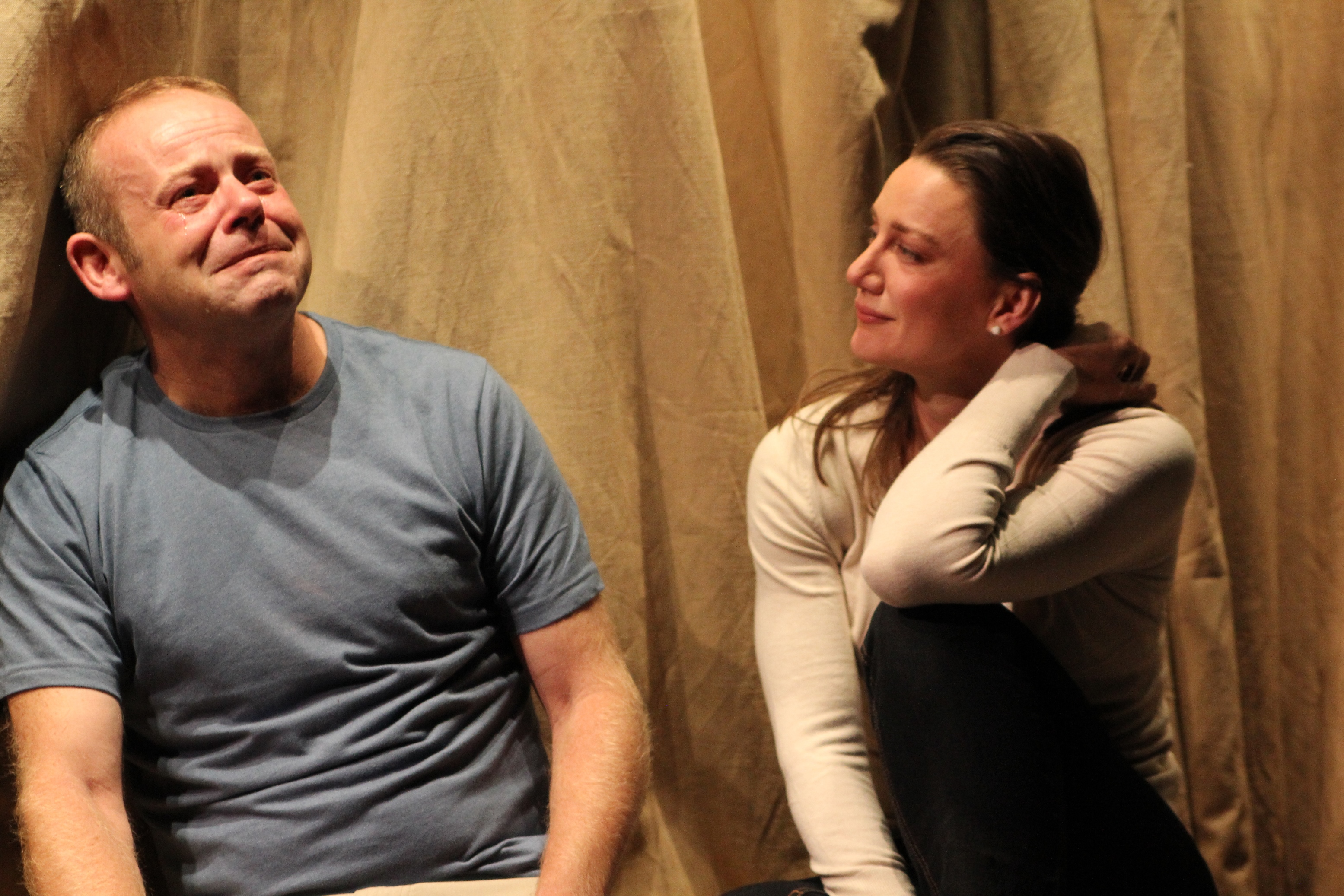
Huw Higginson and Amanda Stephens-Lee. Photo: Rebecca Martin

Huw Higginson and Amanda Stephens-Lee. Photo: Rebecca Martin

In 2012, Anthony Skuse directed pantsguys Productions’ award-winning indie production of Punk Rock, written in 2009 by UK playwright Simon Stephens.

Now, Skuse directs Stephens’ 2005 play On the Shore of the Wide World for pantsguys and Griffin Independent – and it’s another memorable production.

Set in Stephens’ native Stockport, a town in Greater Manchester, the play tells the story of three generations of the suffering Holmes family over the course of nine months.

Peter (Huw Higginson) and Alice (Amanda Stephens-Lee) are muddling along OK but are hurt and upset when their teenage son Alex (Graeme McRae) and his new girlfriend, the spunky Sarah (Lily Newbury-Freeman), want to escape to London. Meanwhile, their sweet but odd younger son Christopher (Alex Beauman) is instantly smitten with Sarah.

Living nearby are Peter’s alcoholic father Charlie (Paul Bertram), who has a close relationship with his grandsons, Christopher in particular, and Charlie’s nervous wife Ellen (Kate Fitzpatrick).

Christopher catches his grandparents unawares one day and is rocked. Then a sudden tragedy forces buried emotions, shame, secrets and regrets to the fore and the family find themselves confronting and opening up to each other as they struggle to find a way to move forward together.

Running three hours including interval, the first act is a slow burn but the second act flies as the emotion builds.

Skuse directs a quiet, beautifully measured, subtle production, in which the actors often stay on stage to watch scenes they aren’t in, the compassion in their eyes intensifying the emotion.

There are excellent performances all round from a cast that also includes Jacob Warner as Alex’s drug-dealing friend Paul, Emma Palmer as a comparatively posh, pregnant publisher who employs Peter to renovate her home and develops quite a bond with him, and Alistair Wallace as John who meets Alice as a result of the tragedy.

Higginson (well-known from ten years playing PC George Garfield in The Bill) is a stand-out though with a heartbreakingly portrayal of the loving but emotionally inarticulate Peter. An engrossing, moving drama.

On the Shore of the Wide World runs at the SBW Stables Theatre until February 1. Bookings: www.griffintheatre.com.au or 02 9361 3817

An edited version of this review ran in the Sunday Telegraph on January 19

LIMBO

Spiegeltent, Hyde Park, Sydney

January 9

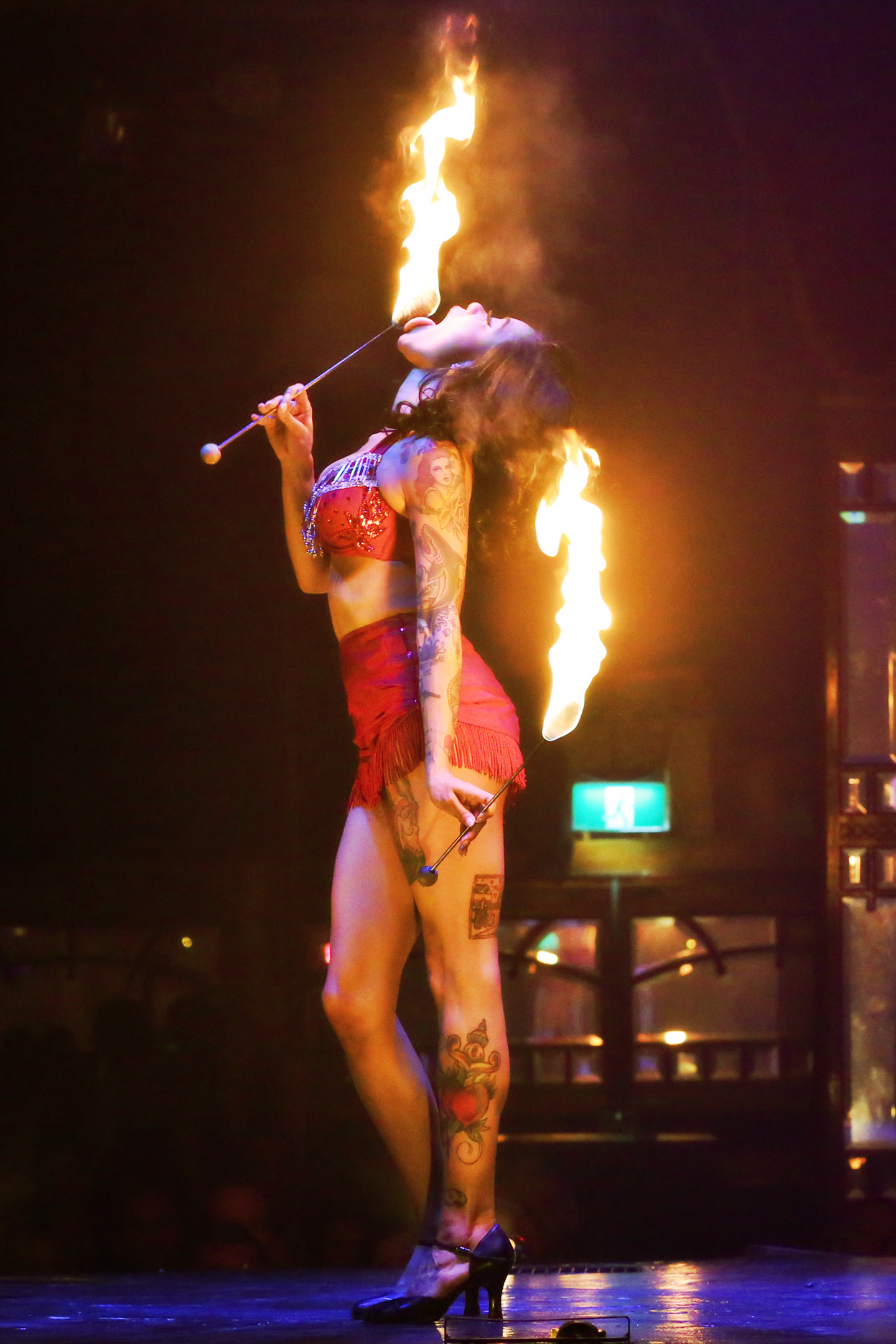
Heather Holliday in LIMBO. Photo: Prudence Upton

Heather Holliday in LIMBO. Photo: Prudence Upton

Right now, Sydney resembles a three-ring circus – in the nicest possible way – with audiences very happy to “roll up, roll up” to around a dozen shows that fall under the circus banner, all happily strutting their stuff in venues around town.

Most high profile are the sexed-up circus-cabaret-burlesque cocktails, which Sydneysiders just can’t seem to get enough of. The three biggies are Spiegelworld’s Empire, which is playing in a Spiegeltent at the Entertainment Quarter in Moore Park; La Soirée in the Studio at the Sydney Opera House; and LIMBO, the main house show in the Sydney Festival’s Spiegeltent. (The Festival is also presenting a number of smaller shows in the more intimate Circus Ronaldo Tent).

They’re all terrific in their own way but for my money LIMBO is in a class of its own.

Rather than just consisting of one different trick or act after another, LIMBO creates its own enthralling netherworld. Fierce, highly theatrical, full of joie de vivre and sexy without trying, it has a coherent aesthetic, style and sense of drama, having been created by an ensemble from the ground up.

It is produced by Strut & Fret (the Australian company behind last year’s Sydney Festival show Cantina) in association with Edinburgh’s Underbelly Productions and London’s Southbank Centre.

Directed by Australian Scott Maidment and featuring a supremely skilled, versatile, international cast, LIMBO combines staggering circus acts (given a fresh spin) with some sensational dance routines and little linking vignettes.

It’s all tightly choreographed to an eclectic score played live by a funky band led by New Yorker Sxip Shirey, with knowing winks and smiles from the physical performers.

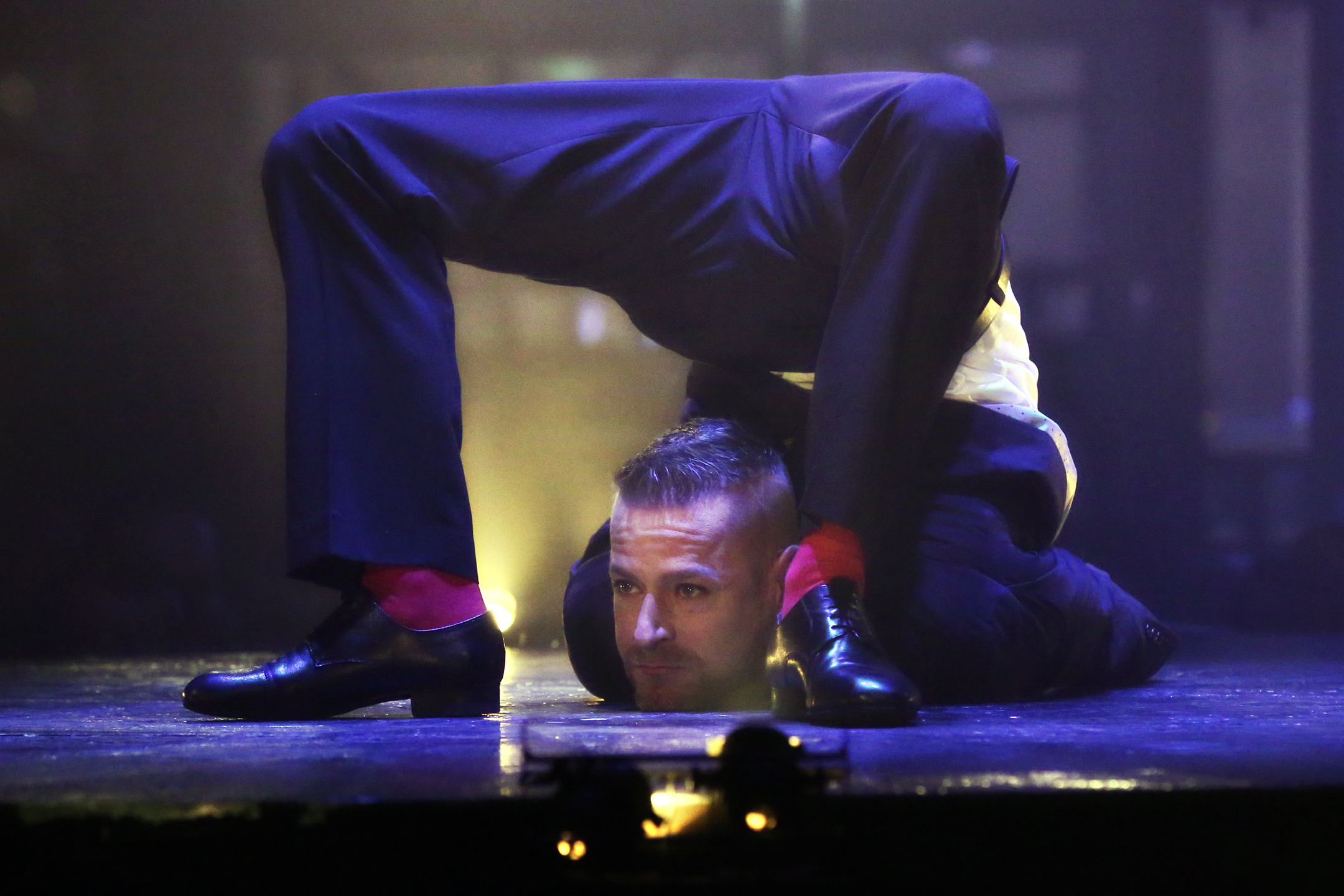
A contorted Phillip Tigris. Photo: Prudence Upton

A contorted Phillip Tigris. Photo: Prudence Upton

Acts include astonishing contortion by the suited Phillip Tigris, delicate Chinese pole by Mikael Bres complete with a floating feather, unbelievable balances by Danik Abishev, who hops on one hand along a series of poles, eye-popping sword-swallowing and fire eating by Heather Holliday, and aerial hoop by Evelyne Allard.

Dancer/choreographer Hilton Denis (So You Think You Can Dance Australia) taps up a storm and is one of a trio with Bres and Abishev in a surprisingly beautiful sway pole act over the audience’s heads that elicits gasps as they narrowly miss each other, while collecting glasses and programs from the audience as they swoop past.

Dramatically lit by Philip Gladwell with sexy Weimar-esque costumes by Zoe Rouse, LIMBO is an entrancing, exhilarating, rollercoaster ride. I laughed, I marveled, I sat opened mouthed and I thrilled to the theatricality of it all. Highly recommended.

LIMBO plays in the Spiegeltent in the Festival Village, Hyde Park until January 26. Bookings: http://www.sydneyfestival.org.au or 1300 856 876

An edited version of this review ran in the Sunday Telegraph on January 12

Amanda Palmer

The Spiegeltent, Festival Village, Hyde Park, Sydney

January 9

Amanda Palmer at the Sydney Festival. Photo: Jamie Williams

Amanda Palmer at the Sydney Festival. Photo: Jamie Williams

I have to confess that I was an Amanda Palmer virgin – in the sense of never having seen her live – until now. I’ve read about her, of course, and I’ve heard her songs but never encountered her up close, in the flesh.

My 20-something plus-one, meanwhile, knew nothing about her beyond her letter supporting Miley Cyrus’s right to twerk. We were both blown away.

The post-punk cabaret star, who was one half of pioneering cabaret duo The Dresden Dolls, has toured here regularly, most recently with her new band the Grand Theft Orchestra.This time it’s just her on keyboard and ukulele performing in the decadent timber and mirrored surrounds of The Spiegeltent – a venue that seems almost tailor made for her – for Sydney Festival.

We heard her before we saw her, as robust strumming on the ukulele from the back of the tent heralded her entrance. Singing “In My Mind” unplugged she wandered through the tent before hitting the stage.

In slinky, cream satin vintage gown with long black gloves, fishnets and those famous, arching eyebrows, Palmer has a charisma that quickly draws you into her orbit as she weaves an almost immediate, spell-binding rapport with her audience.

Her patter moves from the droll to the personal and pointed. Her gorgeous, versatile voice cajoles and seduces. She reduces you to mirth one minute and breaks your heart the next, seemingly effortlessly.

Her repertoire ranged from the comic “Vegemite (The Black Death)”, which she wrote for her author husband Neil Gaiman who unlike Palmer loves our yeasty spread, to an intense version of Ted Egan’s “The Drover’s Boy”, during which performer Sabrina D’Angelo emerged from a Drizabone and Akubra to heighten the drama of the song.

Other numbers included “Map of Tasmania”, Palmer’s joyously cheeky ode to the unclipped female bush, the Dresden Dolls’ perky “Coin-Operated Boy”, Bat for Lashes’ “Laura” sung as a beautiful duet with Brendan Maclean, also dressed in a slinky slip with a spiky blonde quiff, and a moving song about her tough last year.

She ended in upbeat fashion with “Ukulele Anthem”, her paen to the power of music and creativity even if – or especially if – it’s on a simple ukulele that anyone can learn to play.

It was a beautifully balanced song list from across her career that would have delighted fans (though there was no number from her latest album “Theatre is Evil”) as well as serving as a brilliant introduction to newbies.

After the first show Palmer tweeted: “oh my god that was surreal. so many people who didn’t know me at all. this festival is going to be actual WORK.” But work that will doubtless win her umpteen new Aussie fans.

During the show she confessed to being “obsessed” with Australia. Right back at you Miss Palmer! Come back soon.

Amanda Palmer plays in The Spiegeltent until January 19. Bookings: Sydney Festival 1300 856 876

An edited version of this review ran in the Sunday Telegraph on January 12