David Suchet interview

In 1985, David Suchet played Inspector Japp in a film of Agatha Christie’s Thirteen at Dinner with Peter Ustinov as Poirot. Fortunately he wasn’t very good. Had he been, he may never have taken on the role of Poirot himself.

Suchet, of course, played Christie’s fastidious little Belgian detective in 74 telemovies over 25 years, winning millions of fans around the world.

In between his Poirot commitments, he returned regularly to the stage though he wasn’t able to undertake a long run. However, after Poirot’s death in the final episode last year, Suchet now has the time to tour internationally in a play by Roger Crane called The Last Confession, currently in Australia. Set in the Vatican it is billed as “a thriller” set around the sudden (some think suspicious) death of Pope John Paul I in 1978.
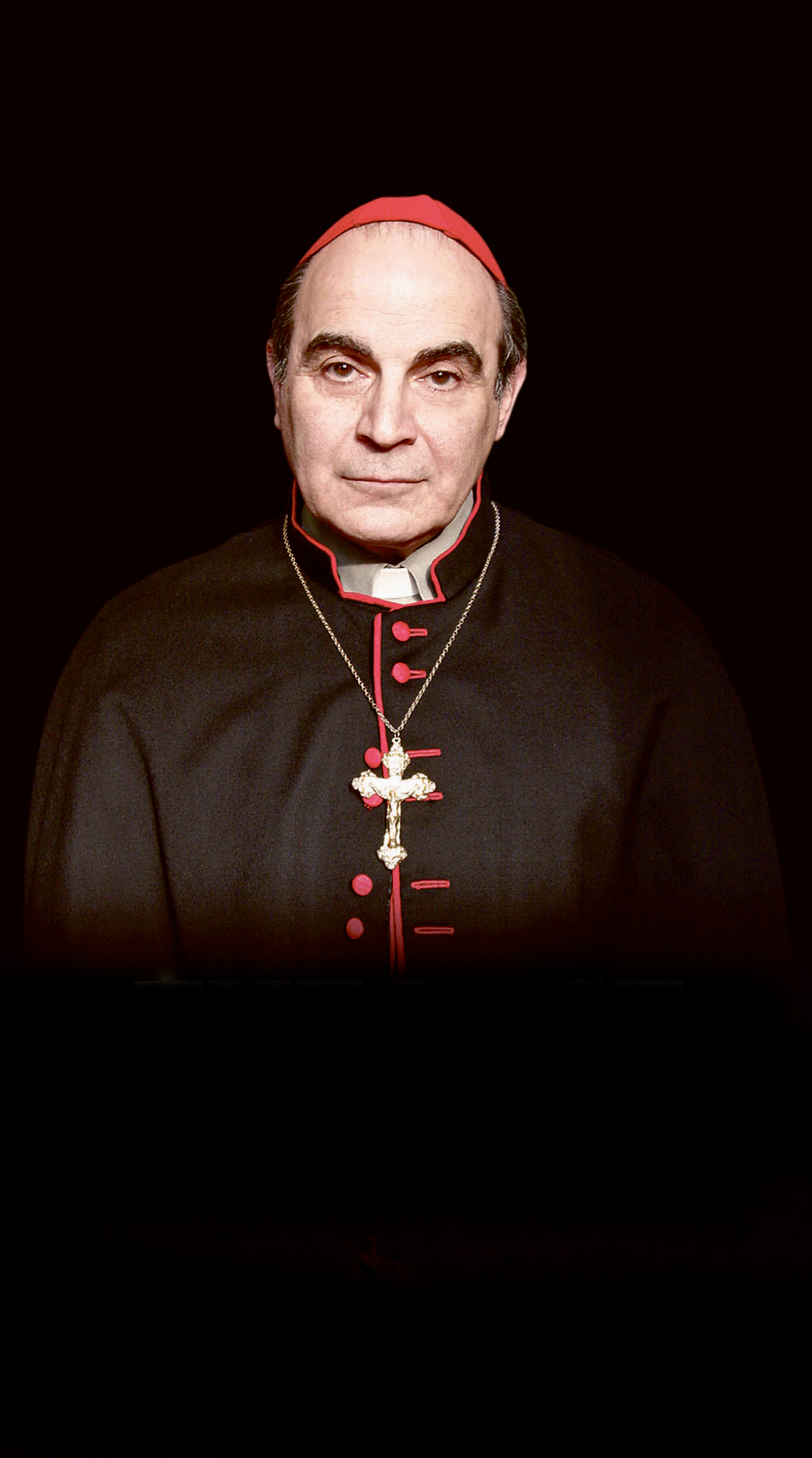
David Suchet in The Last Confession. Photo: Hugo Glendinning

David Suchet in The Last Confession. Photo: Hugo Glendinning

Next, he plays Lady Bracknell in Oscar Wilde’s “trivial comedy for serious people” The Importance of Being Earnest in London’s West End.

During a quick media stop-over in Sydney before the start of the tour in Perth, the thoroughly charming, genial British actor took time to talk about saying goodbye to Poirot, his current role in The Last Confession, his conversion to Christianity, Twitter and the chance to play Lady Bracknell.

Jo Litson: You have talked about the end of Poirot being like saying goodbye to a dear friend. Has it been very emotional?

David Suchet: It was and it is. I can’t really be allowed to let him go at the moment because I’ve just been in this play The Last Confession in Los Angeles and Canada and the last five episodes of Poirot are just being aired there now so when I was there I was doing publicity for Poirot – and that’s a year after I’d finished the series. So, in fact, I haven’t been able to put him to rest. Maybe I’m beginning to from now.

You’ll miss him a lot presumably?

I’ll miss him very much, but he’ll always be (screening) somewhere.

What would you say if they asked you to play him in a film?

I’ve always said if there was a movie to be made of one of the stories I would consider that, because it would be like revisiting one of Agatha Christie’s stories before he died so I wouldn’t mind that. And it would be in a different medium. I’d never do him again on television.

I have been asked to do him in the theatre but my theatre career has always been very distinct and separate from Hercule Poirot. Of course, I’d be tempted to do him in the theatre but I don’t feel, with the best will in the world, that it’s right for me to bring that character into my theatre repertoire. I think it may overshadow what I’ve done in 45 years. I’ve performed in these great plays – Joe Keller in All My Sons, Tyrone in A Long Day’s Journey Into Night, George in Who’s Afraid of Virginia Woolf?, Iago in Othello, Prospero in The Tempest – and then suddenly Poirot? You’d have to ask why, wouldn’t you? So it would be for the wrong reasons.

I have to let him go. There will be other Poirots sooner rather than later, I’m sure, and I must be generous and magnanimous and wish them luck and hope they have a huge success with it. But I have to let him go in exactly the same way Sean Connery had to let James Bond go. It was his decision to let go. It’s not my decision to let go but I’ve done all the stories now, there are none left to do so that’s it, I must say goodbye.

You were in an early film when Peter Ustinov played him?

Yes, I played Inspector Japp. He (Peter Ustinov) was such a lovely man. He was so generous to me when I took over and wished me all the luck, publicly as well. But I have to say that I am only grateful that when I played Inspector Japp with Peter Ustinov that I gave such a bad performance. I’ll tell you why. Peter went on to do four or five other films after that with the same cast so if I’d been good I would have been Inspector Japp in all those other films. I would never than have been asked to play Poirot.

I believe your involvement with The Last Confession goes back to before the play premiered in Chichester in 2007?

Yes, my involvement with the play goes back even further than that. It was sent to me by another director for another company in England, I would say four years before it was sent to me again. When it was first sent to me the play was not ready. I liked it very much. I was very intrigued with its plot but the script needed working on. I only was going to be given three weeks rehearsal and I knew those three weeks rehearsal were going to be rewriting the play rather than putting on a finished piece and I said to myself, ‘no, I don’t want to do that.’

About three or four years after that it was sent to me again having been reworked by the writer and it was much, much better to the extent that I was really interested in this play now and went to New York and worked with Roger Crane on my own to develop it even further. Then the producers came on board and then we got a director and he took over that job.

Because of Poirot I only had time to do six weeks in Chichester and 10 weeks in the West End. And ever since then the producers have wanted to do it again and I’ve never been available so now that Poirot has died it’s the first time that I have suddenly been free. I wanted to do it again because I wanted to re-explore the character. I hadn’t really finished in a sense.
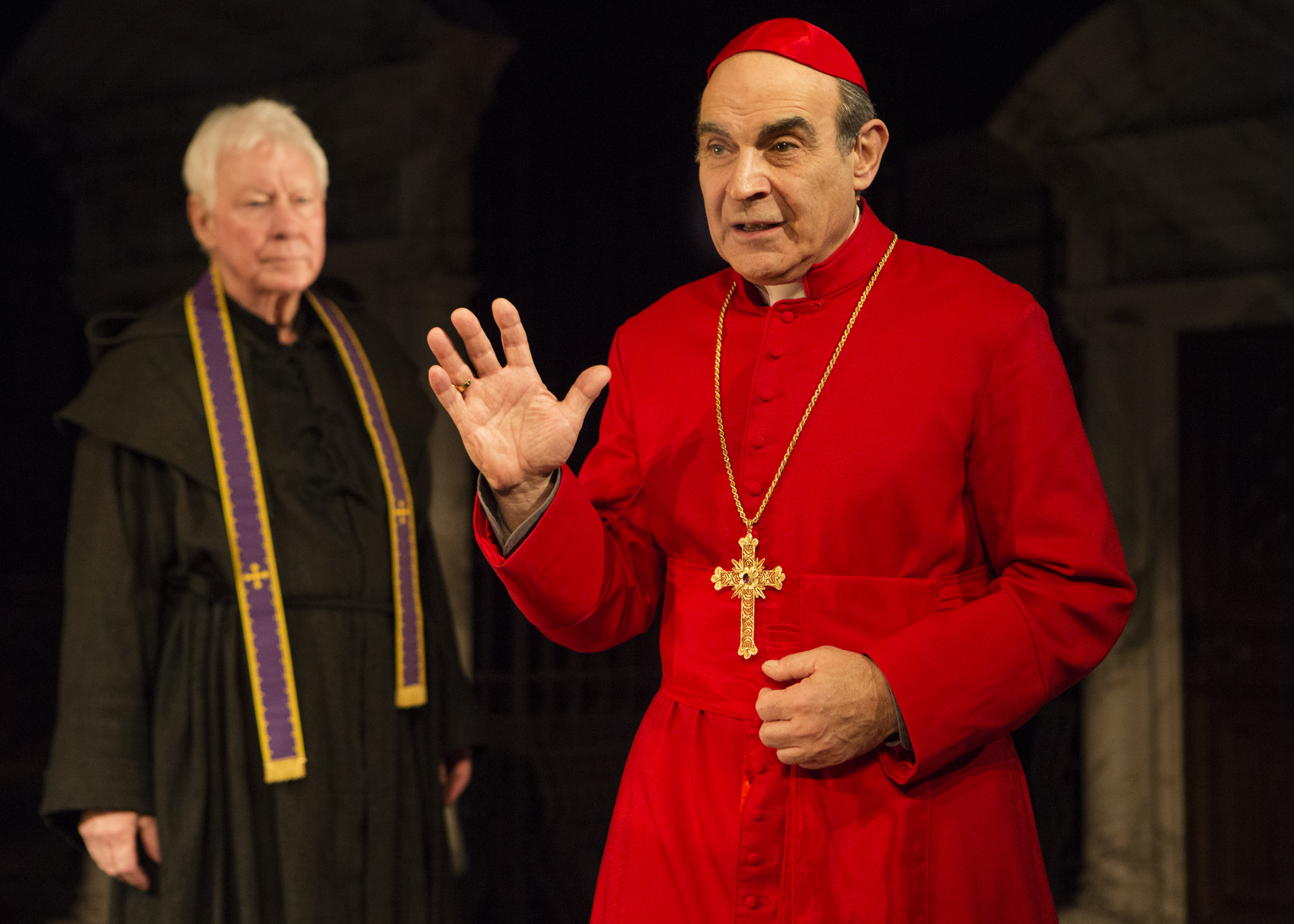
David Suchet in The Last Confession. Photo: Cylla von Tiedemann

David Suchet in The Last Confession. Photo: Cylla von Tiedemann

Apparently it’s thanks to you that the play is touring Australia?

We were always going to go to Canada and Los Angeles and I said to Paul Elliott, our producer, I’d like to go to other English speaking countries who have supported my Poirot all these years. Can we please go to Australia and South Africa? He tried both. Australia had (theatre) vacancies and wanted it. South Africa wanted it but had no vacancies at the time so this is why I’m now here. It’s all part of my desire to come and, in a way, say “thank you”. I have a huge fan base here. When Poirot is showing in Australia I always know it’s being shown because my mail bag is huge and I get messages on Twitter saying “I’m now watching you in Sydney or Brisbane…” and it’s always such a thrill for me that my program is being watched on the other side of the world. Now that I’m in Sydney I get stopped in the street and people are so charming and I’m so pleased to be here on stage doing something completely different and, in a sense, saying thank you.

Do you do you own tweets?

I do. People are always surprised. I don’t do it that often. I don’t have that many followers for a so-called star. (He has 29,000). I get on Twitter about once a week and do a few lines here and there but at least they know it’s me. I never wanted to do Twitter. It was when I was in All My Sons in the West End, the publicity department said I had to and they offered to run my Twitter page for me. I said, “well, if I’m going to do it, I know my Poirot fans are going to want to ask questions and things like that, which you wouldn’t be able to answer so I’ll do it on my own.” I don’t get into conversations but when people say nice things I get back and say thank you.

Superficially there would seem to be some similarities between Poirot and The Last Confession: a thriller with a possible murder?

That’s publicity from a long time ago. The play is not a whodunit. To a certain extent nobody will ever know who dunit if they did do it. Pope John Paul I was found dead in his bed 33 days after starting to be the most radical, reforming pope in the history of the Catholic Church. He was everybody’s idea of the parish priest, the “smiling pope”, the people’s pope, the pope that didn’t want to be carried on a throne for his coronation. Sound familiar? Yes, sounds a bit like Pope Francis doesn’t it?

My character Giovani Benelli, an archbishop originally, was a great friend of Albino Luciani who was to become Pope John Paul I and really got his friend into the papacy. He then becomes a cardinal and his friend having become Pope is found dead in his bed. My character then feels such pain and guilt that he has this great struggle of faith. So this play is as much about the struggle of this man as an investigation into the possible causes of the untimely death of this great pope. So it’s a play that will take you into the power politics of the Vatican. Yes, we may be walking around in scarlet robes all 20 of us but you could be entering parliament.
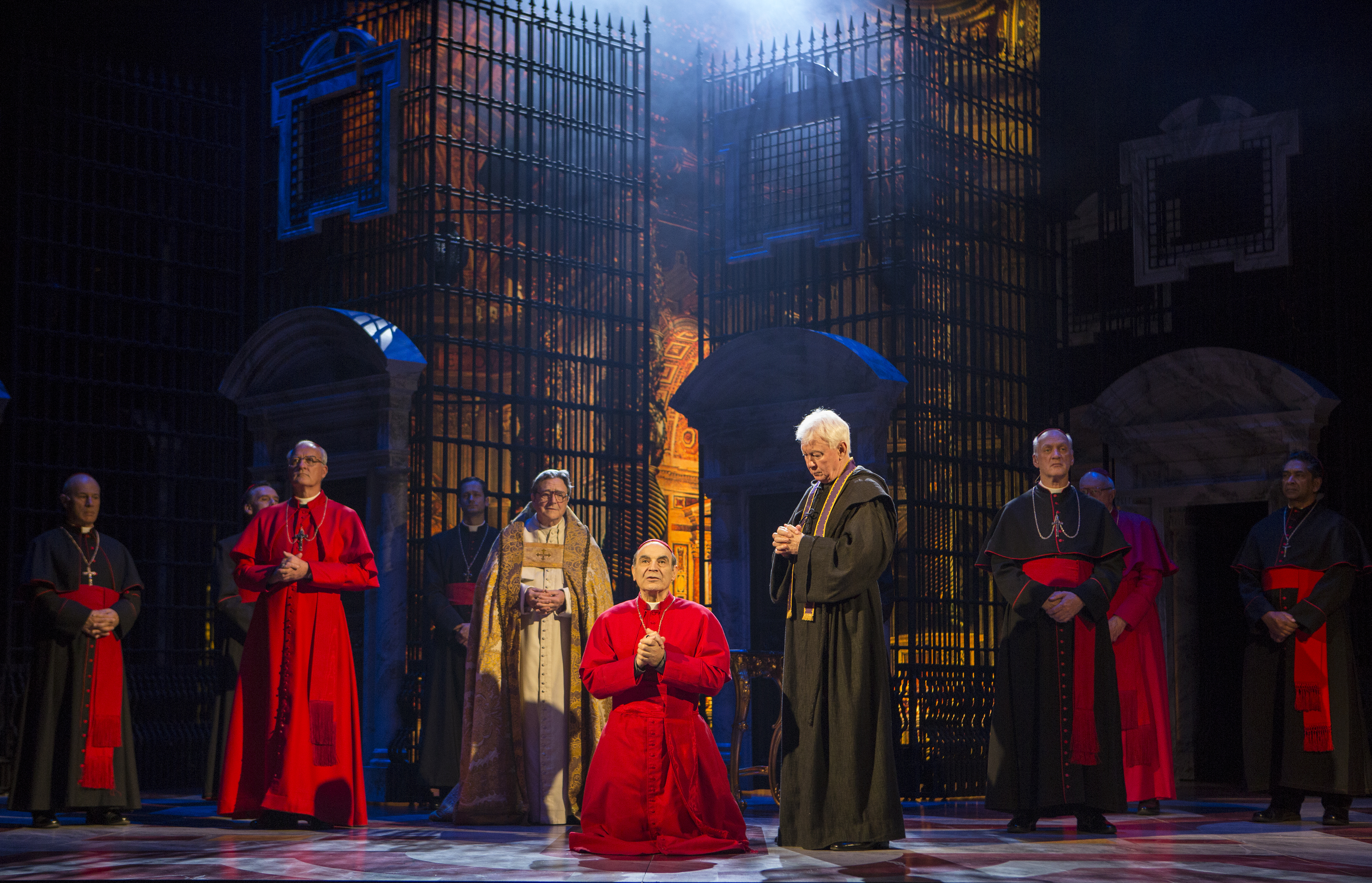
The Last Confession. Photo: Cylla von Tiedemann

The Last Confession. Photo: Cylla von Tiedemann

I believe your wife (Sheila Ferris) is in it?

Yes, she is playing the only female role in the play – a nun who takes care of Pope John Paul I. It’s a very long time since she was on stage, over 20 years. She gave up a wonderful career to look after our children, bless her, and this is an opportunity for her to come back, and she’s really enjoying it.

You have recorded an audio book of The Bible. That’s quite some undertaking?

Apart from being a Christian – and I do have a very strong faith – I’ve always found that The Bible is a library of books. We’ve got drama, we’ve got poetry, we’ve got allegory, we’ve got songs, we’ve got history, we’ve got everything in The Bible. As somebody said, it’s the greatest book in the world. For an actor to read it from beginning to end is massive, and it took me over 200 hours. I’m so pleased I’ve done it.

Is it true you converted to Christianity after reading a Gideon’s Bible in a hotel room?

No, there wasn’t a Gideon’s Bible; that was the funny thing. My conversion to Christianity from agnosticism or almost on the edge of atheism began in a hotel room in Seattle in 1986. I was beginning to think about my late grandfather and about life after death. I thought, “I don’t believe in life after death and yet I’ve always believed my late grandfather was a spiritual guide so how can I not believe in life after death?”

I looked in the drawer beside the bed for the Gideon’s Bible and it wasn’t there so the next day I managed to get the New Testament and I started to read. I thought I’d read somebody who actually existed so I read one of the letters of Paul. I’ve always been interested in Rome so I read his letters to the Romans. The first half of the letter I didn’t understand at all but then I found a way of existing in the second half of that letter in the Book of Romans that I’d been searching for all my life: how to relate to other human beings and how to be a human being. I thought this is great and suddenly I found a worldview, suddenly I was looking through a lens that made sense to me. Then I had to discover where did Paul get this from and it was from Jesus so that led me to Christianity.

What do you do next?

I’m going to be in The Importance of being Earnest. I’m going to be playing Lady Bracknell in the West End. I follow in the great shoes of Geoffrey Rush (who played Lady Bracknell for Melbourne Theatre Company in 2011). It’s not the first time this cross-gender casting has been done. A number of actors have played Lady Bracknell and roles like Viola. And actresses – though you can’t say that anymore – have played roles like Richard II. But it’s a chance for me to embody a wonderfully written comedy role. I’m really looking forward to it. So I change from playing a cardinal to a lady. What an amazing career for an actor of my age! I’m so lucky.

The Last Confession is at His Majesty’s Theatre, Adelaide, August 27 – 31; Comedy Theatre, Melbourne, September 3 – 21; and Theatre Royal, Sydney, September 24 – October 5.

This interview was conducted on behalf of the Sunday Telegraph where a story ran on August 10
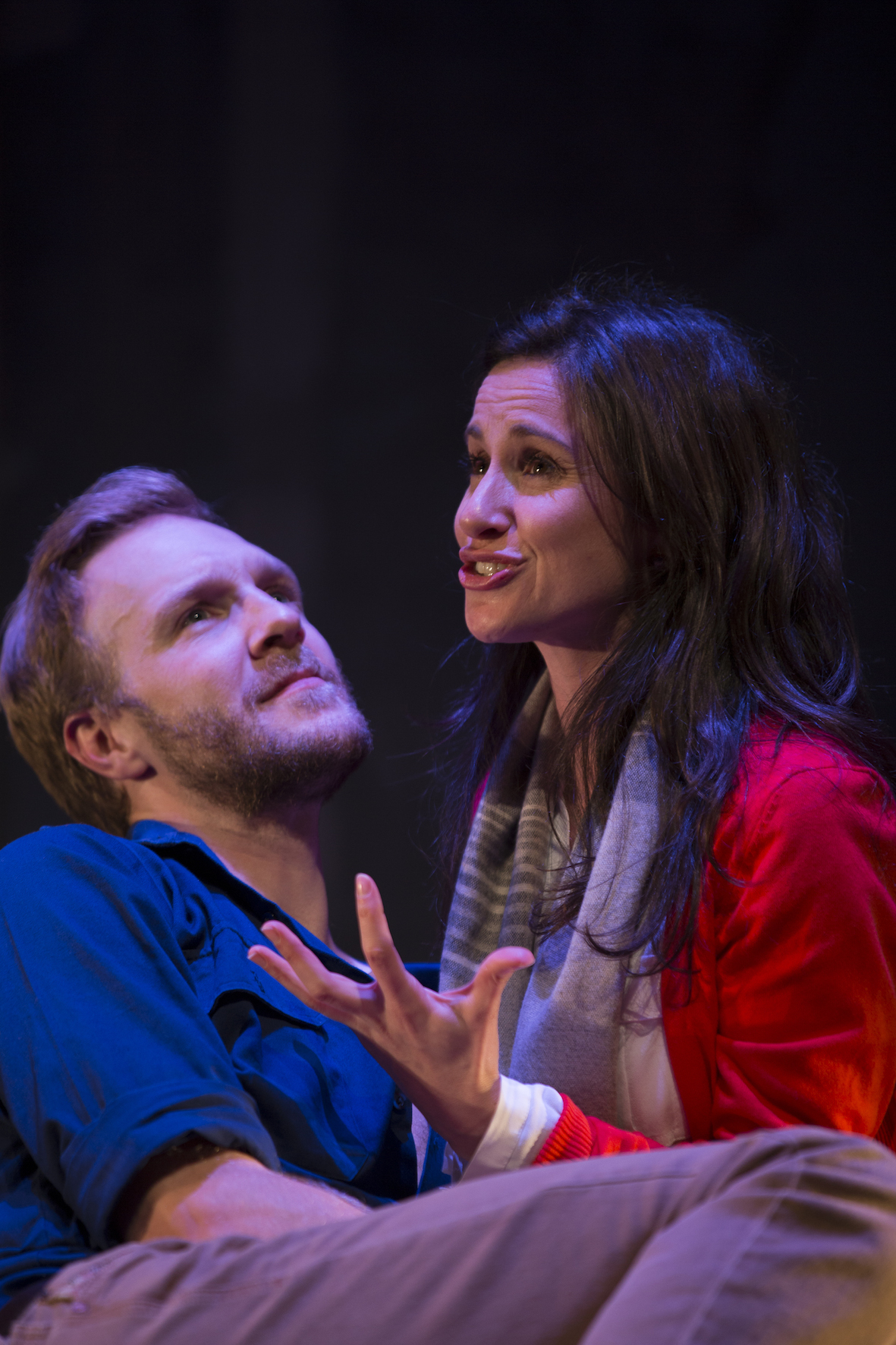
Constellations

Eternity Playhouse, August 12

Sam O'Sullivan and Emma Palmer. Photo: Gez Xavier Mansfield

Sam O’Sullivan and Emma Palmer. Photo: Gez Xavier Mansfield

Written by British playwright Nick Payne when he was just 29, Constellations was rapturously received in the UK in 2012. In January, Jake Gyllenhaal stars in a Broadway production.

Grab the chance to see it here because it really is an ingeniously constructed, beautifully written two-hander – and this Darlinghurst Theatre Company production, directed by Anthony Skuse, more than does it justice.

Marianne (Emma Palmer) is a vivacious, voluble physicist interested in the “multiverse” theory. Roland (Sam O’Sullivan) is a laid-back beekeeper. They meet at a barbecue. She goes over to chat but he snubs her, saying he’s married. End of story. Or is it? The scene is then replayed again and again, each time with a slightly different outcome.

This pattern repeats throughout the play at different points in their relationship. But no matter how different possible outcomes we experience, they all end in imminent, untimely death.

Early on, Marianne says to Roland: “In the quantum multiverse, every choice, every decision you’ve ever made, and never made, exists in an unimaginably vast ensemble of parallel universes.”

Although Payne uses the idea of parallel universes for the play’s structure, he doesn’t actually explore the philosophical and scientific ideas around this in any depth. Instead, the play riffs on the idea of “what if?” and the way our lives could go in so many different directions depending on the little choices we make, the people we meet, when we meet them, and so on. Think Sliding Doors meets Groundhog Day (happening here and now in our world – or so it seemed to me).

Staged on Gez Xavier Mansfield’s wonderfully spare set, which opens up the theatre to its bare, beautiful walls, Skuse directs with great precision but lightness of touch giving the piece room to breathe while putting the focus firmly on the human dimension.

Both actors are superb, bringing untold nuance to numerous variations of similar lines (which must make it devilish hard to learn), while creating totally consistent, convincing characters. The way the play loops back on itself also means they frequently have to turn on a dime emotionally, ending one phase in deepest melancholy before returning to perky cheeriness seconds later.

Palmer has the added challenge of portraying Marianne’s developing aphasia (which affects language), which she does in heartbreaking fashion. What’s more, they both nail the English accents – and from two different regions, no less. (Praise to the vocal and dialect coach Linda Nicholls-Gidley).

Sara Swersky’s lighting and Marty Jamieson’s subtle sound also play their part in a beautifully modulated production.

The play runs a tight 80 minutes, which is the perfect length. Any longer and it could start to wear thin. Constellations may wear its scientific conceit very lightly but Skuse’s exquisite, moving production enthralls. Recommended.

Constellations runs at the Eternity Playhouse, Darlinghurst until September 7. Bookings: www.darlinghursttheatre.com

A version of this review ran in the Sunday Telegraph on August 17

Nora

Belvoir St Theatre, August 13

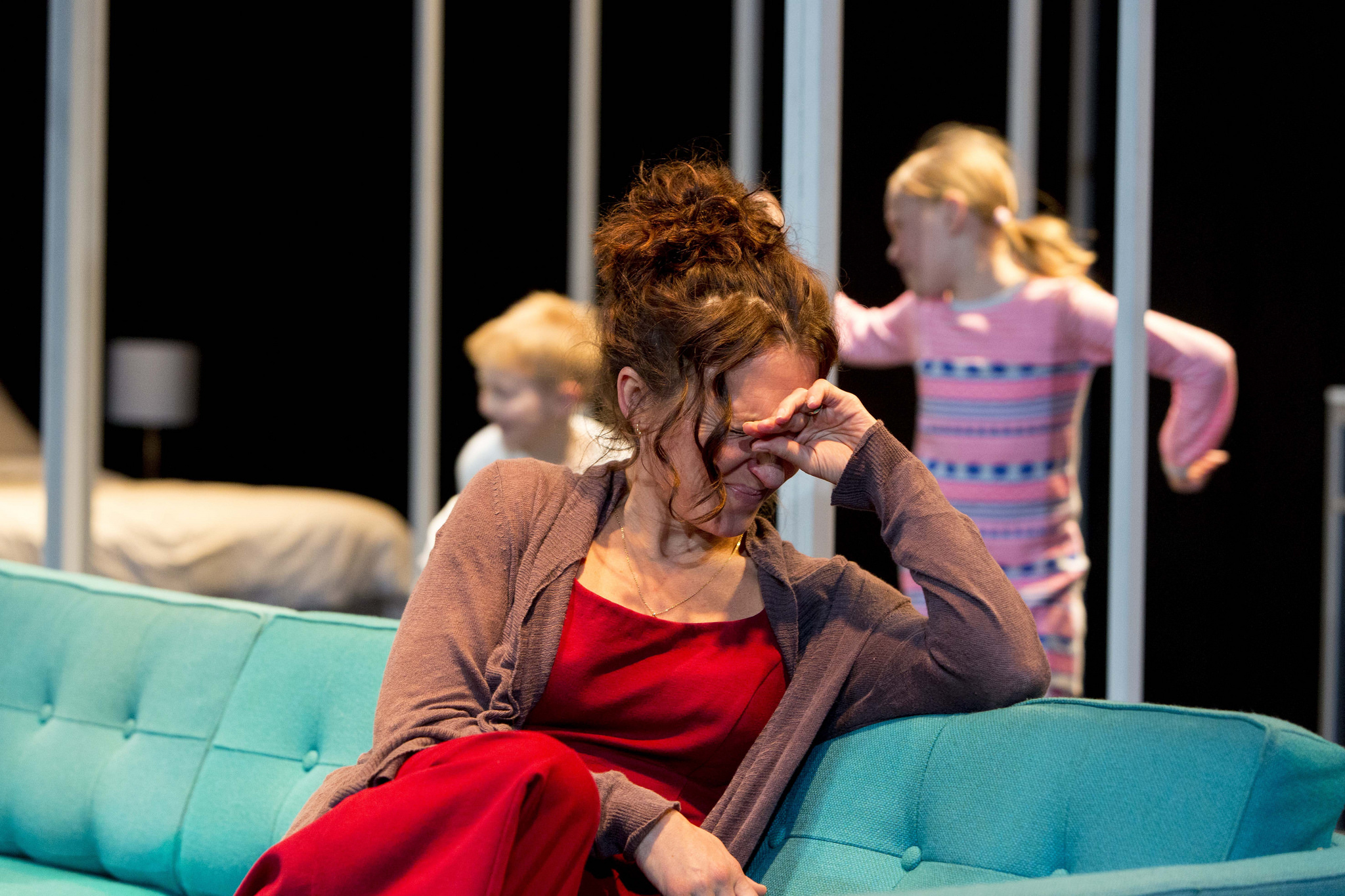
Blazey Best as Nora. Photo:  Brett Boardman

Blazey Best as Nora. Photo: Brett Boardman

When Nora slammed the door behind her at the end of Ibsen’s 1879 drama A Doll’s House, her decision to leave her husband and children was so controversial that it sent shock waves around Europe.

The actor playing her in the German premiere refused to perform the ending and Ibsen was forced to rewrite it, with Nora deciding to stay because of her responsibility to her children. Eventually, of course, the original – and far more powerful – ending was restored.

We don’t know what happens to Ibsen’s Nora but we know how hard it will be for her in a patriarchal society without money, work experience or a family to turn to. Ibsen has already shown us this through the story of her widowed friend Kristine. Nora will have the added shame of leaving her family to contend with.

In Nora, co-adaptors Kit Brookman and Anne-Louise Sarks (who also directs the Belvoir production) ask what that decision would mean for a woman in Sydney in 2014, and follow her out of the door.

Since Nora’s decision doesn’t have the same shock value in this day and age, Brookman and Sarks have put a strong focus on her willingness to leave her children – something many would still struggle to understand today.

Act I is a very loose contemporary retelling of Ibsen’s play with Nora, her husband Torvald (here a corporate financier about to be promoted) and their two children, but none of the other characters.

The play opens with Nora (Blazey Best) lying next to her young son as he goes to sleep, while her daughter lies above them in the bunk bed. It is clear they have a close relationship and all the scenes between her and the children are touching, emphasising how desperately they will miss her.

Set designer Marg Horwell has put a skeletal white metal frame of the whole house on stage so that we are able to see into all the rooms at once. Nora seems to be suffering from severe depression, periodically extricating herself from her husband (Damien Ryan) and children (Toby Challenor and Indianna Gregg on opening night) as they tear around the house to gaze blankly out of the window or cry bitterly. In one scene, she dances frenetically, her despair further highlighted by her children joining in joyfully.

Where the tension in Ibsen’s play builds inexorably as Nora waits for Torvald to discover that she borrowed money from Krogstad by forging her father’s signature, the first act of Nora is a slow burn.

In Ibsen’s play, Torvald’s appalled and appalling reaction to Krogstad’s revelation sends Nora out of the door but there is no such dramatic flash point here. Torvald discovers she has opened a secret bank account and has been “squirreling” money away but though he is upset that she wasn’t honest with him, he seems to accept what she has done.

Instead, Nora appears worn down by Torvald’s well-meaning but patronising control of all she does. Her decision to leave has clearly been brewing for some time.

Act II takes place later on the night of her leaving. Nora has gone to the home of Helen (Linda Cropper), a woman she worked with some years ago but hardly knows to ask if she can stay for a few days while she finds her feet. Helen is bemused as to why Nora has chosen to go to her, while her own personal situation means she finds it incredibly hard to comprehend how Nora could leave her children.

Horwell has created a similar-style set for Helen’s smaller home. There are sightline issues, which I noticed more in Act II, with the steel frame bisecting the face of the actors quite regularly.

If Act I was a slow (but interesting) burn, then Act II falls rather flat. Essentially Nora articulates why she left. She “feels dead”, “my children cannot be a reason for being”, “I can’t live not knowing who I am” – all of which we have already inferred.

The two women sit in silence while they wait for a kettle to burn. We watch them slowly make a sofa bed. Playing this out silently in real time does ratchet up the awkwardness of the situation but it doesn’t make for great drama. What’s more, it’s pretty clear that Nora has no intention of returning home – at this point anyway – so there is little to keep us on the edge of our seats.

Sarks draws fine performances from her cast. Best gives a powerful portrayal of a listless, unhappy woman struggling with depression – though for some reason I didn’t feel a great deal for her emotionally, which I suspect is more to do with the play than Best, who is terrific. Ryan gives a wonderful character study of a man who loves and cares for his wife but is oblivious to the way he patronises and controls her. His priggish nature is more subtle than in Ibsen’s play but still in evidence.

His children seem to love him. The way his little boy runs into his arms is lovely and he is gentle with his daughter but the fact that he pushes them to practice golf putting when they don’t want to because it could be useful to them speaks reams.

Cropper is also excellent as Helen and the children are very convincing.

Nora follows Sport for Jove’s recent, beautifully wrought, period production of A Doll’s House, which really packed a punch dramatically in a way that Nora doesn’t manage to do. Nonetheless, it’s an interesting venture and the first act works well. However, having followed Nora through the door I’d have liked to have seen how she fared weeks, months or maybe years down the track. As it is, Act II just seems to articulate, in rather deadly fashion, what we pretty much already know and leaves it at that.

Nora plays at Belvoir until September 14. Bookings: www.belvoir.com.au or 02 9699 3444

The Tap Pack

Hayes Theatre Co, August 2

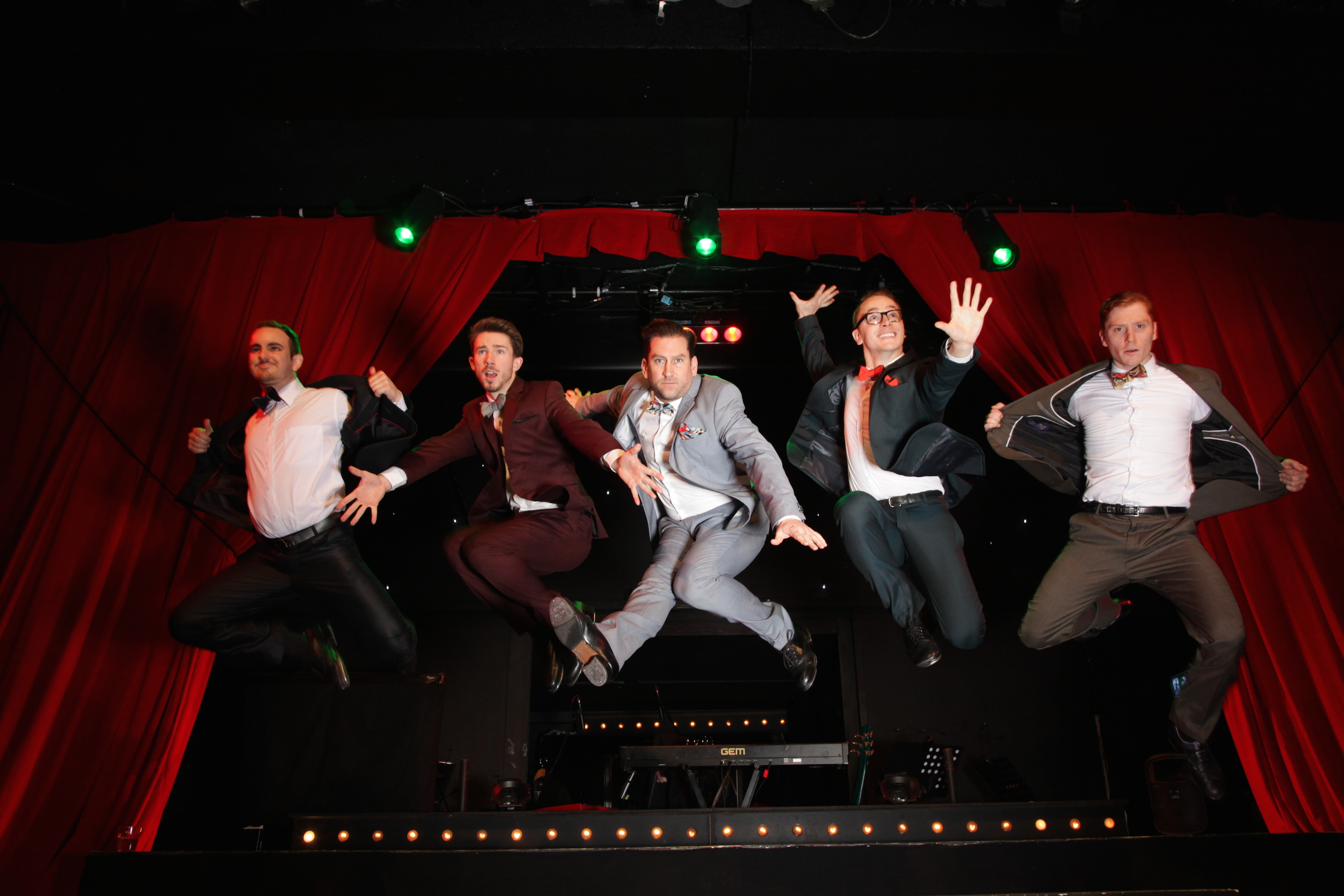
Jesse Rasmussen, Ben Brown, Christopher Horsey, Jordan Pollard and Thomas J Egan. Photo: Shan Turner-Carroll

Jesse Rasmussen, Ben Brown, Christopher Horsey, Jordan Pollard and Thomas J Egan. Photo: Shan Turner-Carroll

If you want to see some exhilarating tap dancing then look no further than The Tap Pack.

Jesse Rasmussen, Jordan Pollard and Thomas J Egan created the show as a vehicle for the tap-dancing prowess of themselves and their fellow performers Ben Brown and Christopher Horsey – and on this front it certainly delivers.

But even though the production has been in development for a while now, and had performances last year, the story they have written as a framework for the dancing still needs work.

Directed and co-created by Nigel Turner-Carroll, The Tap Pack opens with cocky Aussie busker Blue (Rasmussen) doing his thing to raise the funds to get to New York and meet his idols Fiveplay, a Rat Pack-style act he dreams of performing with. Rasmussen quickly has the audience clapping along.

In New York, Blue encounters Fiveplay, now reduced to Fourplay (yeah, we get it). Led by the hard-drinking Marty (Horsey), the sole surviving original member, the act is well past its use-by date. Blue could help them reboot their show, the other boys are excited, but Marty is resistant and, well……. you know how it turns out.

The plot is slight, the characters are fairly under-developed and the story is corny and predictable, with some silly sight gags involving a chain saw and some goggles as well as some slightly blue humour. There’s the germ of a great show here. The boys have plenty of charm and they can certainly dance, they just need a sharper, wittier script.

However, with a six-piece band led by musical director Michael Dench on keyboards, the music is hot and Brown delivers some strong vocals. But it’s the tight, terrific dancing that really kicks The Tap Pack over the line.

The show ends on a high as the boys bust out their best moves to finish with a spectacular, extended tap routine that sends the audience home happy. Fantapstic!

The Tap Pack plays at the Hayes Theatre Co until August 17. Bookings: www.hayestheatre.com.au

A version of this review appeared in the Sunday Telegraph on August 10

Tartuffe

Drama Theatre, July 30

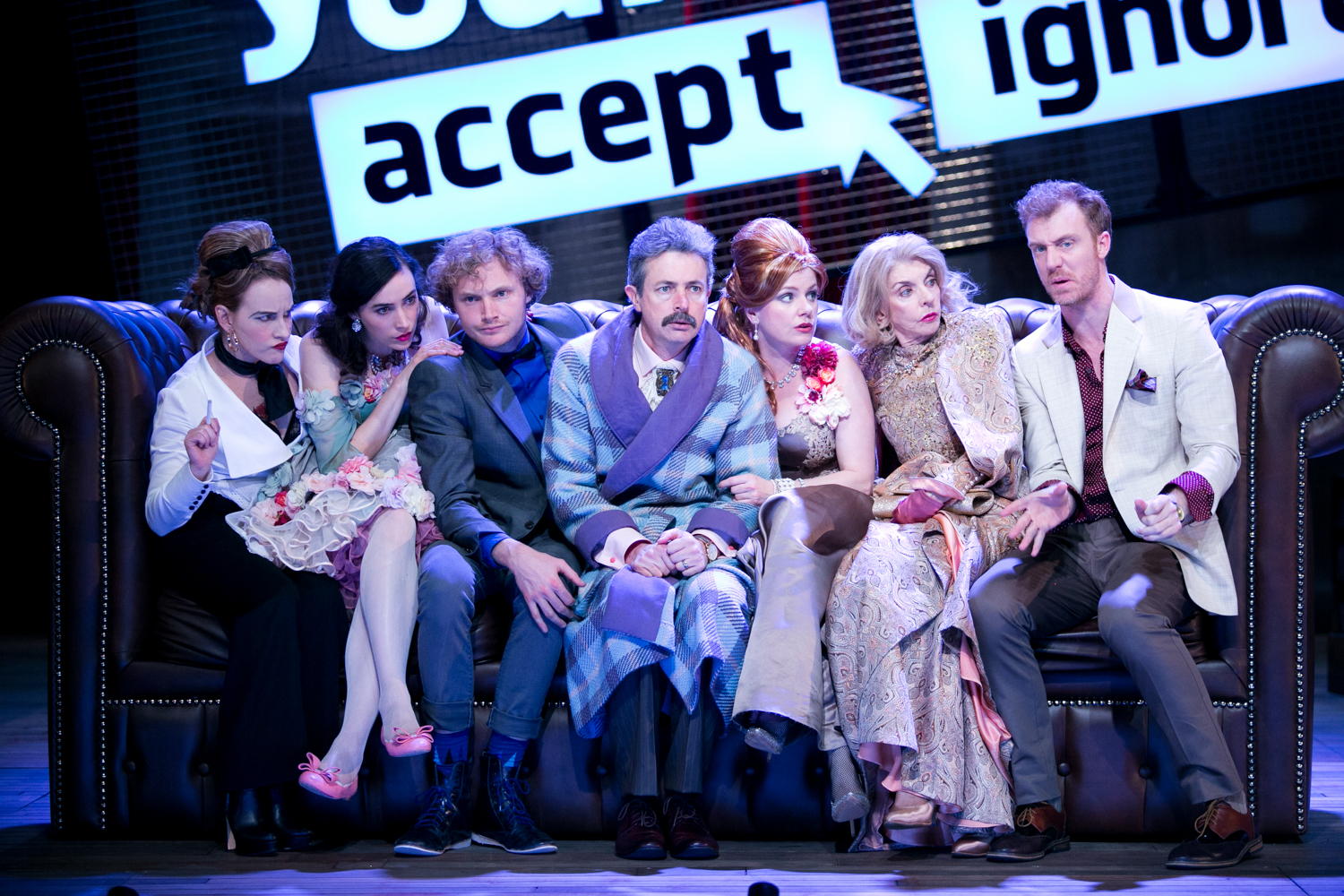
Kate Mulvany, Genevieve Hakewill, Charlie Garber, Sean O'Shea, Helen Dallimore, Jennifer Hagan and Robert Jago. Photo: Lisa Tomasetti

Kate Mulvany, Geraldine Hakewill, Charlie Garber, Sean O’Shea, Helen Dallimore, Jennifer Hagan and Robert Jago. Photo: Lisa Tomasetti

Right from the get-go, Justine Fleming’s contemporary adaptation of Molière’s Tartuffe has the audience chortling in this new Bell Shakespeare production.

As with his adaptation for Bell’s 2012 production of Molière’s The School for Wives, Fleming combines colourful, irreverent colloquialism with rhyming couplets. Phrases such as “bunch of losers”, “shut your gob” and “a piddle short of a piss” had the delighted audience in stitches.

At the same time, it’s an extremely clever adaptation that faithfully captures the spirit of Molière’s satire about religious hypocrisy and gullibility and tells the story with great élan and clarity. Locating it in the present day, the themes certainly feel as relevant as ever.

Rich, successful and married to a gorgeous, younger second wife Elmire (Helen Dallimore), Orgon (Sean O’Shea) is looking for spiritual meaning in his life. Sensing that he’s ripe for the picking, the devious, duplicitous Tartuffe (Leon Ford) schemes to take him to the cleaners. Tartuffe also has his eye on Elmire, while Orgon wants him to marry his daughter Mariane (Geraldine Hakewill). No matter that she is already promised to Valère (Tom Hobbs).

Orgon and his mother (Jennifer Hagan) may be taken in, but the rest of the family see straight through Tartuffe’s fraud and plot to trick him into revealing his true nature.

Peter Evans directs a rollicking, extremely funny production on a set by Anna Cordingley with oversized furniture that not only matches the excess of all that unfolds but also suggests the childishness of their behaviour. Besides a massive sofa, there’s an off-kilter grandfather clock and a giant closet with an ever-changing interior. In the second act a sign descends inviting you, in Facebook fashion, to “accept” or “ignore” a request to  befriend Jesus.

Cordingley’s colourful costumes are also amusing, wittily combining styles and eras, while Kelly Ryall’s jaunty, synthesised versions of baroque music work a treat.

In the original 1664 comedy, tragedy is averted at the last minute with an intervention from the King. Here, Fleming puts his own twist on the ending with Poetic Justice saving the day, while tipping a nod to Molière being the French Shakespeare.

The cast all bring an enormous vigour to the roles. Kate Mulvany is a knockout as the outspoken, sassy, exasperated maid Dorine. Tottering around on vertiginous heels, her effortless command of the language and comedy is deliciously spot-on.

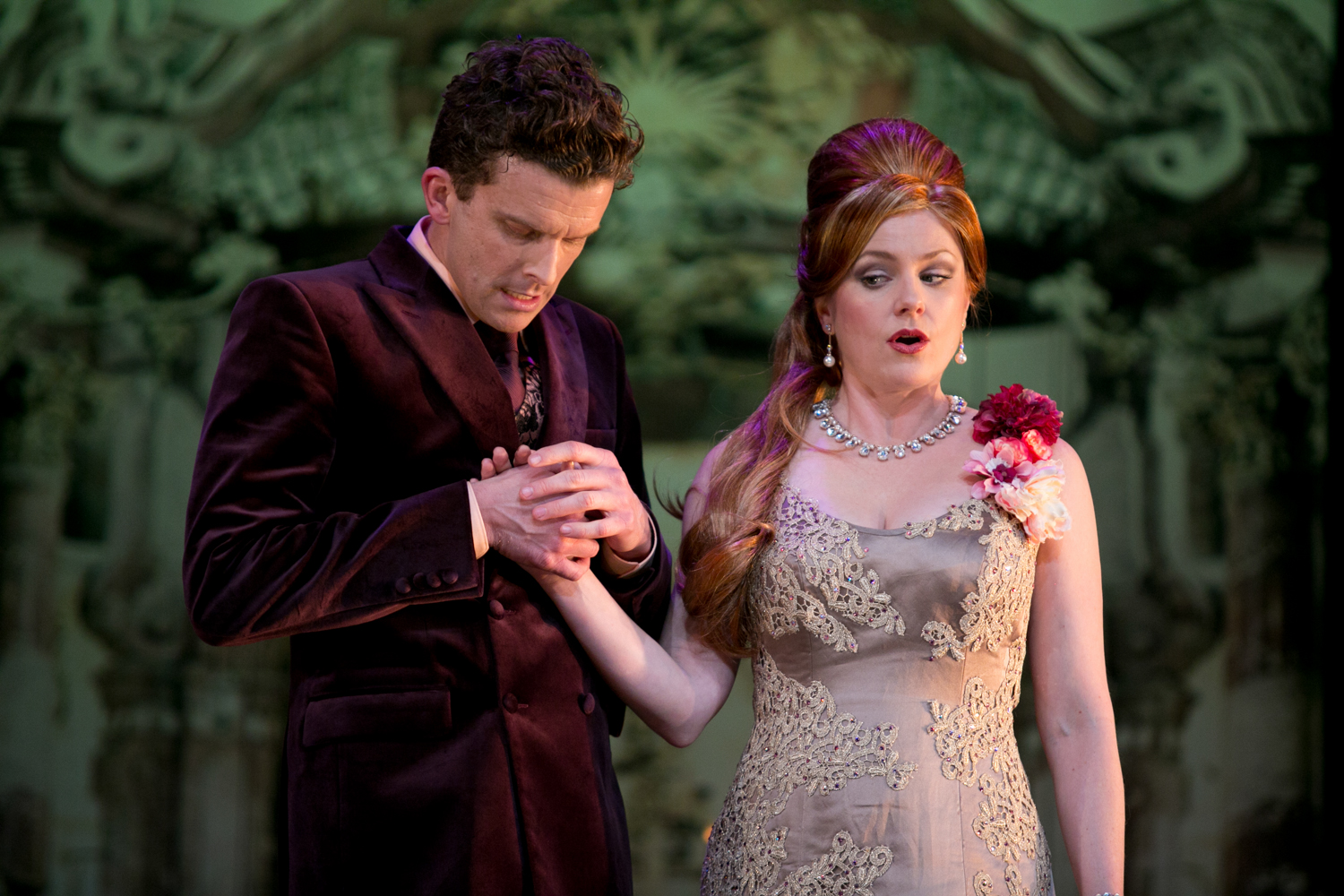
Ford is smoothly, smarmily sanctimonious as Tartuffe one minute, then breaks out with hilarious abandon when he thinks no one is watching. His pelvic thrusting move across the stage to Elmire is hilarious while his amorous advance on her, using her fishnets and high heels, is one of the funniest things I’ve seen on stage in ages.

Leon Ford and Helen Dallimore. Photo: Lisa  Tomasetti

Leon Ford and Helen Dallimore. Photo: Lisa Tomasetti

O’Shea is also very funny as the well-meaning but bullish, deluded Orgon. I’m not sure that in this day and age Mariane needed to be quite such a ditzy bimbo but Hakewill plays it to the hilt. The lovers’ tiff between her and Valère is a hoot, while Hobbs has fun and games breaking the fourth wall.

In fact, there are terrific performances all round from Charlie Garber as Orgon’s hot-headed son Damis, Robert Jago as Orgon’s level-headed, clear-sighted brother-in-law Cléante, Hagan as the haughty, disapproving Madame Pernelle, Russell Smith as Monsieur Loyal and Scott Witt as the bumbling servant (among other roles).

All in all, the production is a delight, full of inspired comic touches from the funny little bounce as various characters flop onto the sofa to Dorine stashing a half-smoked cigarette in her bra. Too much fun. Highly recommended.

Tartuffe is at the Drama Theatre until August 23. Bookings: www.sydneyoperahouse.com or 02 9250 7777

A version of this review ran in the Sunday Telegraph on August 3

Mr Kolpert

ATYP Studio 1, August 1

Garth Holcombe, Claire Lovering, Paige Gardiner and Tim Reuben. Photo: Gez Xavier Mansfield

Garth Holcombe, Claire Lovering, Paige Gardiner and Tim Reuben. Photo: Gez Xavier Mansfield

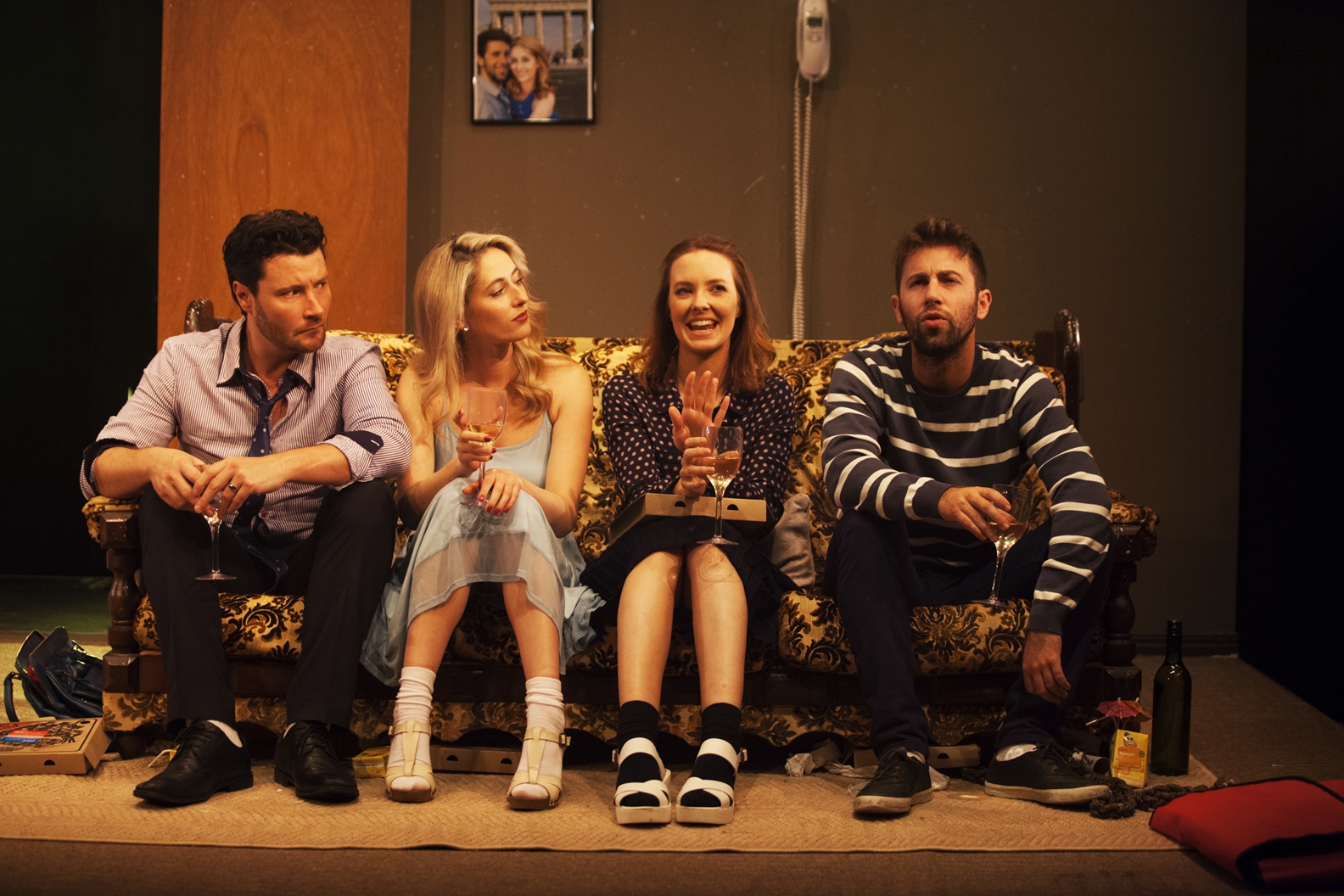
Would you like blood with your pizza? Mind games with your tiramisu?

German playwright David Gieselmann gives us both in his absurdist black comedy Mr Kolpert (translated by David Tushingham), which is at once provocative, stomach-churning and ridiculously funny.

Hip young couple Ralf (Tim Reuben) and Sarah (Claire Lovering) have invited Sarah’s work colleague Edith (Paige Gardiner) and her husband Bastian (Garth Holcombe) around for dinner to alleviate their boredom.

Hospitality isn’t high on their agenda. Sarah hasn’t even bothered catering, offering wine or fruit juice poppers and a choice of take-away. Instead, they intend to play cat and mouse with their guests.

At the start of the evening, they announce that they have murdered Sarah and Edith’s dull co-worker Mr Kolpert (Tom Christophersen) and stashed his body in the huge trunk in the room. Just joking! Or are they?

The build-up of tension as to whether they have or haven’t bumped off Mr Kolpert drives the play, which echoes with references to Edward Albee’s Who’s Afraid of Virginia Woolf?, Hitchcock’s Rope, Eugene Ionesco, Quentin Tarantino, Joe Orton and Monty Python, among others.

The play, which premiered at London’s Royal Court Theatre in 2000, has fun and games with the idea of the extreme lengths some people will go to in order to feel something, anything, in a world of existential, urban ennui; a world where an overload of graphic news reports of horrific world events, and even more graphic depictions of violence in films and video games, numbs the mind and deadens emotions. It also plugs into the anxiety of the contemporary world.

Directing the play for indie Sydney company pantsguys Productions, James Dalton draws wonderfully calibrated performances from his cast in a well-paced production that finds just the right balance between absurdist drama and dark comedy of manners.

Gardiner is exceptional as the nice, placatory Edith who discovers something altogether different beating beneath her cheery, polite demeanour. Her oscillation between hysterical laughter and terrified screams when Ralf taunts her with the ropes he supposedly tied Mr Kolpert up with is side-splittingly funny.

Holcombe is wonderfully manic as the boorish, unpredictable Bastion, an aggressive architect with anger management issues. Reuben and Lovering do a great job of keeping us guessing what Ralf (who is appropriately enough a chaos researcher) and Sarah have or haven’t done, while Edan Lacey is very funny as the hapless pizza delivery boy.

The production strikes me as funnier than I remember Benedict Andrews’ 2002 production for Sydney Theatre Company, though memory sometimes plays tricks.

The drab, beige apartment by set and costume designer Antoinette Barboutis suggests the boredom Ralf and Sarah are railing against, as well as the idea that evil can lurk in the most mundane places. Every now and then, lurid green lighting (Benjamin Brockman) as well as UV lighting, lends the space a strange, sinister feel.

Pantsguys is emerging as a reliably exciting indie company. Their previous productions include Punk Rock in 2012, which won three Sydney Theatre Awards, and On the Shore of the Wide World earlier this year, which was Griffin Independent’s top-selling production to date (both directed by Anthony Skuse). Mr Kolpert is an equally impressive production.

Running around 80 minutes without interval, the ending of the play is somewhat abrupt, a pizza-ordering scene is overdone, and Gieselmann employs some sleight-of-hand (with the knocking). It is also fairly lightweight, its theme obvious enough. But it’s a darkly entertaining, provocative piece that had the audience laughing, shrieking and squealing.

Mr Kolpert runs at the ATYP Studio I, Pier 4/5, Hickson Road until August 16. Bookings: www.atyp.com.au or 02 9270 2400

Macbeth

Sydney Theatre, July 25

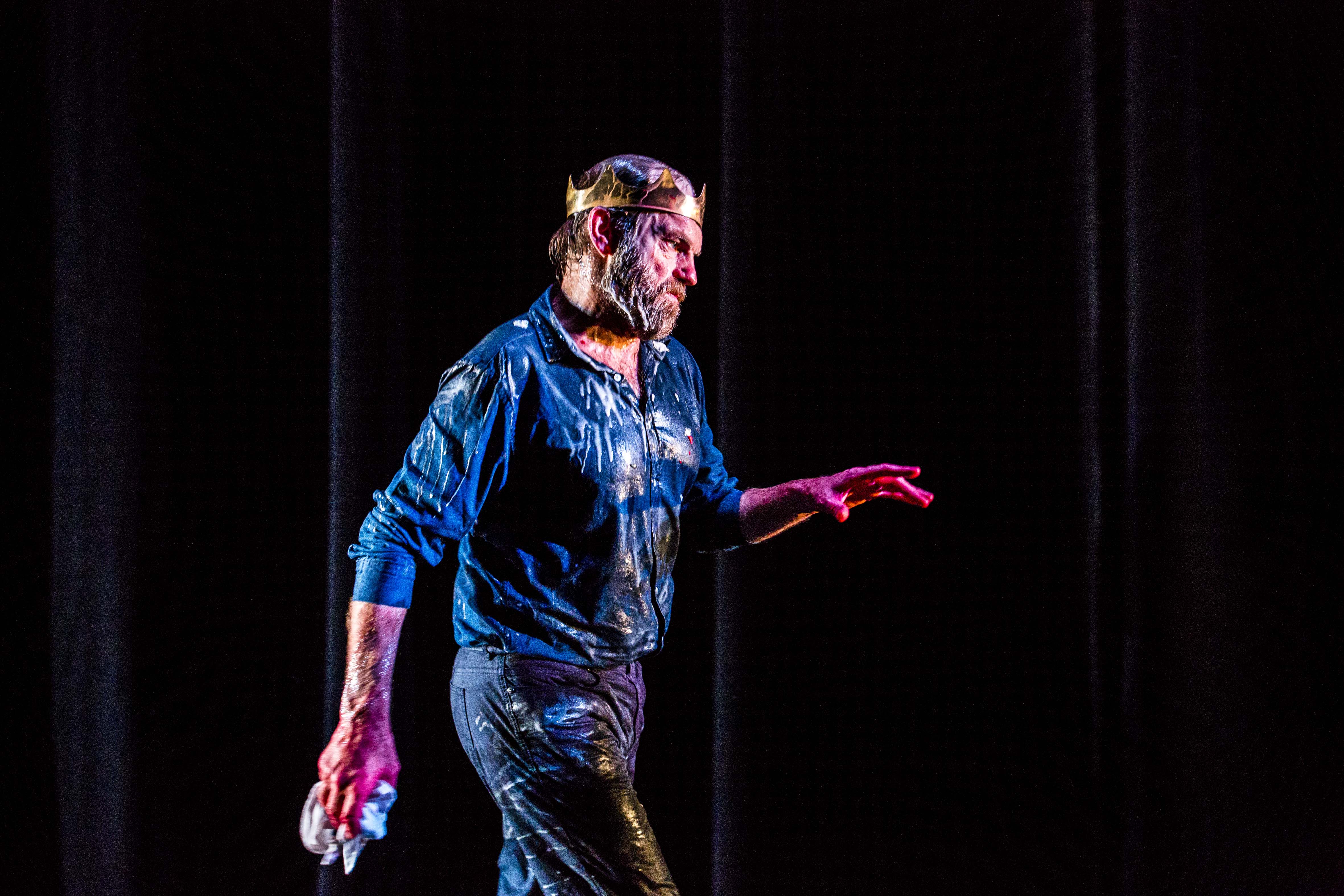
Hugo Weaving as Macbeth. Photo: Brett Boardman

Hugo Weaving as Macbeth. Photo: Brett Boardman

The casting of Hugo Weaving as Macbeth and the decision of director Kip Williams to turn the Sydney Theatre back-to-front make this Sydney Theatre Company production one of the hottest tickets of the year.

Weaving does not disappoint, giving a passionate, compelling performance, but the production itself waxes and wanes somewhat.

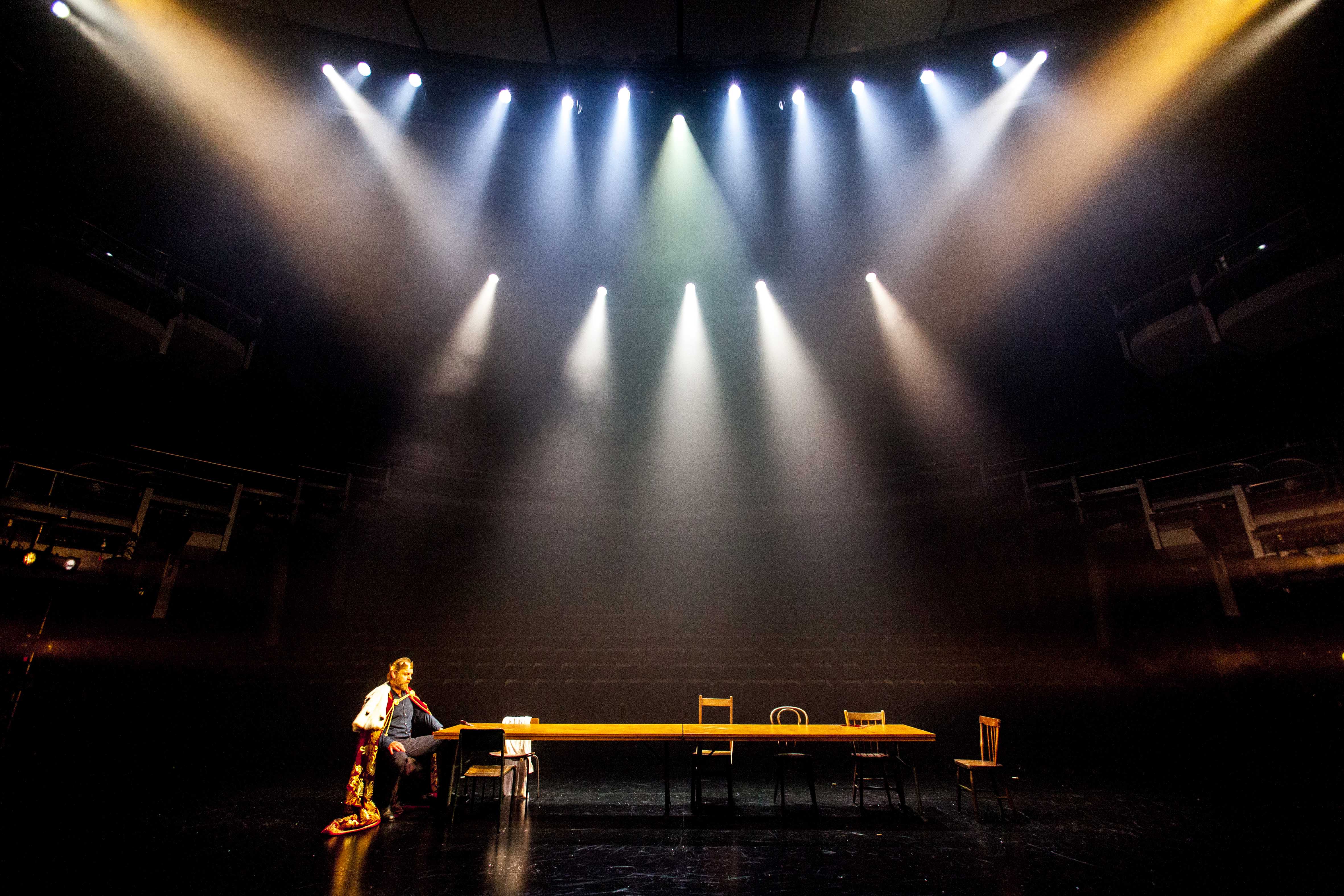
Entering the theatre, the audience is led to a seating bank on the stage for 360 people who sit facing the eerily empty 900-seat auditorium. On stage in front of you stands a long trestle table with a few props (a plastic tub of water, a ruff, a wig, a crown and on the back of one chair a red velvet gown with ermine collar).

It looks like a rehearsal room and when the actors appear casually dressed in contemporary street wear and begin performing seated at the table under a general lighting state, that’s exactly what it feels like. It’s a slow start.

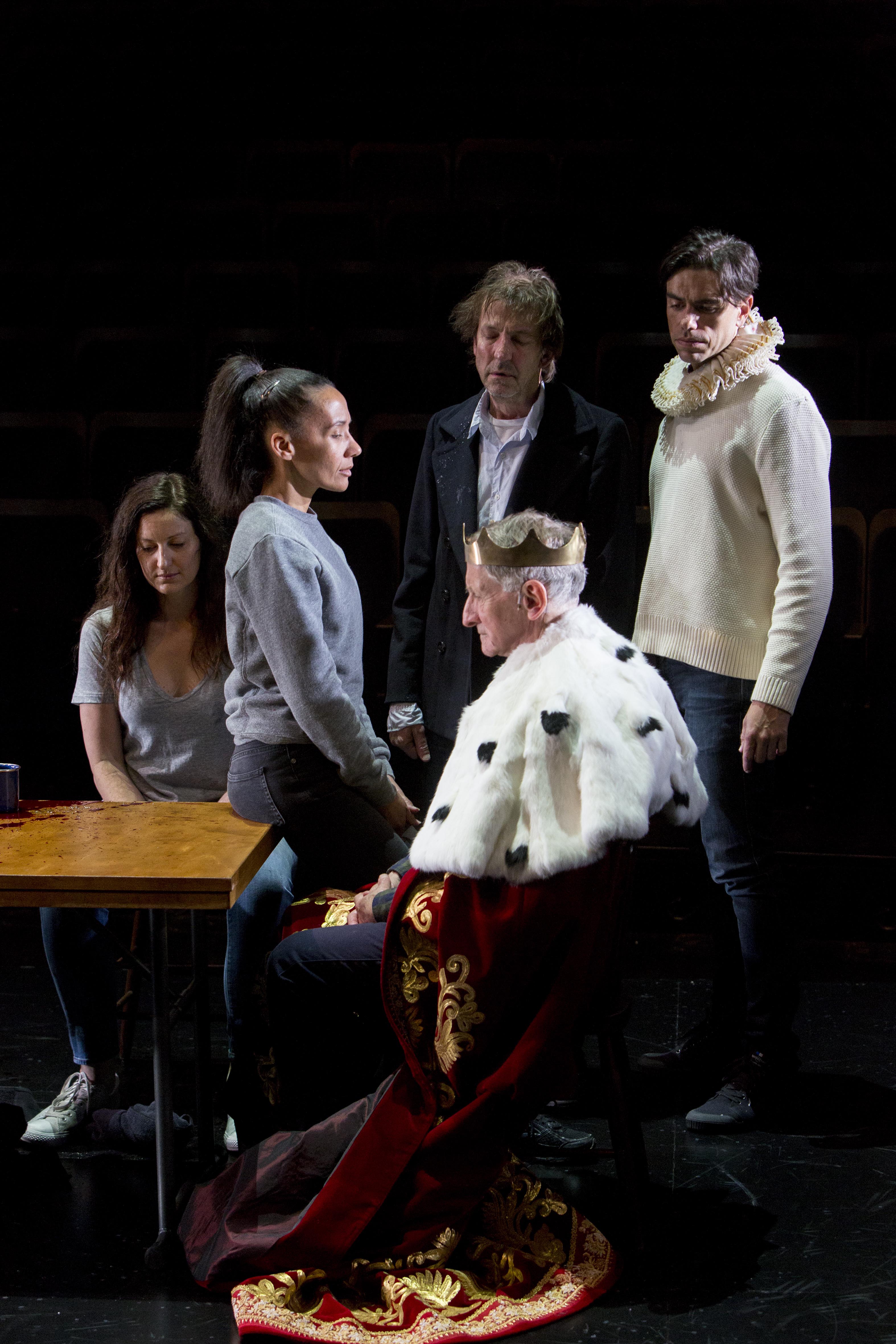
Kate Box, Paula Arundell, Robert Menzies, John Gaden and Eden Falk. Photo: Brett Boardman

Kate Box, Paula Arundell, Robert Menzies, John Gaden and Eden Falk. Photo: Brett Boardman

It’s not until after the death of Duncan (John Gaden) when fog fills the stage and sound and lighting start to transform the space that excitement levels begin to rise.

It’s a valid enough conceit to have the full theatricality only kick in once Macbeth has sealed his fate and begun his descent into a nightmarish world full of bloody horror. It’s just that the early stage business feels a bit silly. The witches (Kate Box, Ivan Donato and Robert Menzies) dunk their heads in the tub of water, blow bubbles and then recite their lines while dripping. As an image for the boiling cauldron it comes up short.

Having Melita Jurisic in a plastic rain mac, chugging on a cup of blood and then dribbling it down her front as the wounded Captain reporting from the battle also comes across as gimmicky.

But as Duncan lies dead, the production starts to hit its stride. The actors bang their hands on the table, Max Lyandvert’s visceral sound design picks up on the drumming and amplifies it tenfold, the stage fills with fog, the lighting changes and we’re off.

The stunningly staged banquet scene with candles, flowers and place settings comes as a relief. Having the murdered Banquo (Paula Arundell) sit at the table has been done before, of course, but it works exceptionally well.

There are some other wonderful effects – the sudden fall of a black curtain not far from us, isolating Macbeth from the world beyond, for example, and later Macbeth strobe-lit in battle. There is also an extended fall of shimmering “rain”, which inevitably recalls the golden shower in Benedict Andrews’s production of The War of the Roses in the same venue. But, no matter, it’s incredibly beautiful and very effective.

Hugo Weaving. Photo Brett Boardman

Hugo Weaving. Photo Brett Boardman

Under Nick Schlieper’s lighting, the auditorium does become a haunting, ghostly backdrop. Williams doesn’t stage many scenes there but those that he does work well. Banquo is chased through the auditorium and murdered in the stalls. When Macduff (Kate Box) goes to England to beg Malcolm (Eden Falk) to return to Scotland, their encounter takes place at the front of the circle while Macbeth stands silhouetted on stage.

Many liked Williams’ restraint in not using the auditorium too much; I liked what he did with it but felt he could have used it a little bit more.

The costumes by the show’s designer Alice Babidge come across as rather ad hoc without a unifying style. The street wear is uninspiring, despite odd touches like the ruff and kingly robe, and Jurisic’s Lady Macbeth dress is downright drab and unflattering. It’s a shame the costuming doesn’t develop more as the rest of the production builds theatrically. That said, when Babidge does go for a flourish with the final image of Malcolm being dressed in doublet and hose for his coronation, it sits oddly.

The play is performed by an ensemble of eight, all of whom double except for Weaving. The acting is a little uneven with a range of vocal styles.

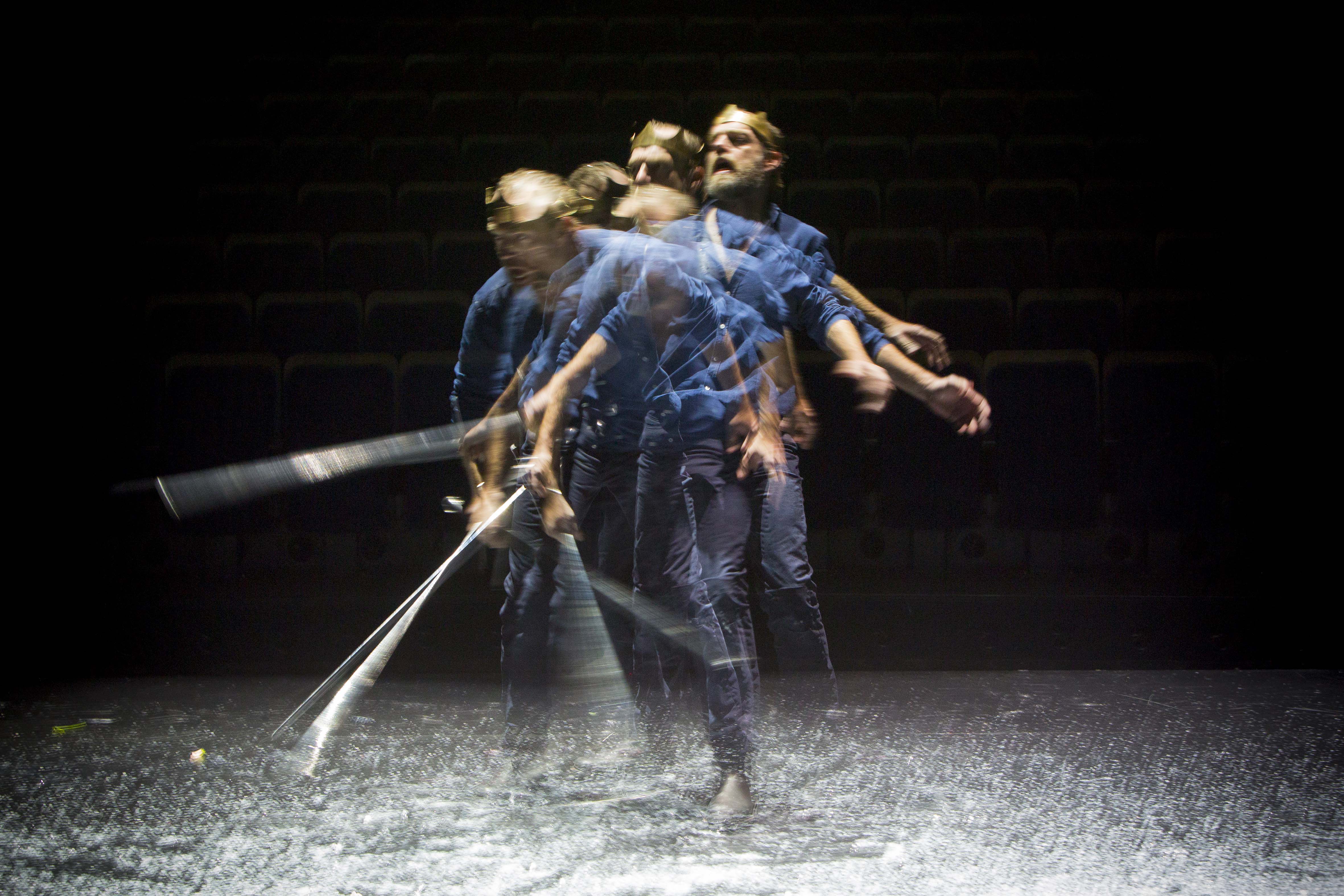
Weaving gives a magnetic performance that focuses on Macbeth’s interior torture. He spits and snarls as he gives physical and emotional expression to the conflict that rages within him between vaulting ambition, doubt, fear, ruthlessness and fleeting regret. His anguish is utterly palpable.

Hugo Weaving. Photo: Brett Boardman

Hugo Weaving. Photo: Brett Boardman

As Lady Macbeth, Jurisic is so febrile and intense from the start that she almost leaves herself nowhere to go. Like Weaving, her vocals are rich and mellifluous but in starting at such a pitch, some of her dialogue is lost by the time she plays the mad scene.

Gaden handles the language with effortless eloquence, as ever, and is very touching as Macduff’s young son in a moving scene with Arundell as Lady Macduff. Box is also impressive, bringing a quiet dignity to the role of Macduff.

In the end, however, the production – which runs a tight two hours without interval – is set around the mesmerising performance of Weaving. The back-to-front staging doesn’t make any strong comment on the play but proves to be an atmospheric backdrop and Weaving’s performance is thrilling.

Macbeth plays at Sydney Theatre until September 27. Most performances are sold out. A few tickets were released yesterday so check with the box office on 02 9250 1777. Otherwise a limited number of Suncorp $20 tickets go on sale at 9am each Tuesday for the following week either in person at the Wharf Theatre box office or on 02 9250 1929

A version of this review ran in the Sunday Telegraph on July 27

A Doll’s House

Reginald Theatre, Seymour Centre, July 26

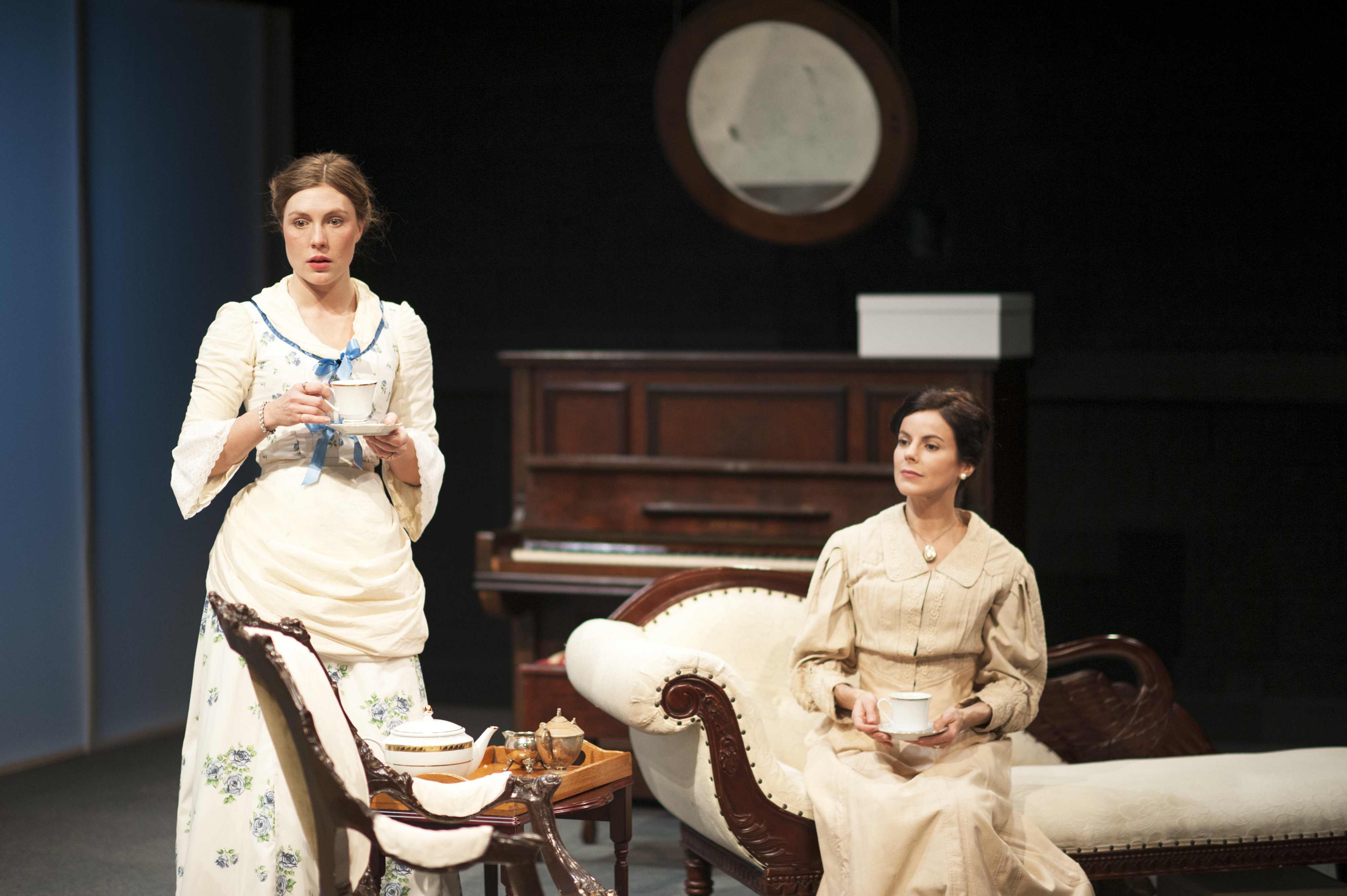
Matilda Ridgway and Francesca Savige. Photo: Seiya Taguchi

Matilda Ridgway and Francesca Savige. Photo: Seiya Taguchi

When Ibsen’s A Doll’s House premiered in 1879, the door that Nora slammed behind her at the end of the play sent out shock waves.

It’s not going to generate the controversy that it did then – not in our society anyway – but this finely tuned Sport for Jove Theatre Company production keeps you on the edge of your seat.

As for the play’s relevance, you don’t need to look further than the all-too-regular news stories about men threatening, even killing wives and children, as a result of ugly separations to know that many women still find themselves trapped by men, circumstances and lack of money.

Director Adam Cook takes a traditional approach with a period production that is faithful to Ibsen. It’s clearly been staged on a relatively tight budget but it is so beautifully paced and performed that it reverberates with a clarity and truthfulness that is utterly absorbing.

Hugh O’Connor’s simple set features a plain back wall, inset with three doors, which becomes slightly translucent under certain lighting (Gavan Swift) so that we glimpse the comings and goings of the characters. Carefully chosen pieces of furniture suggest the period, along with O’Connor’s costuming.

Matilda Ridgway’s lovely performance as Nora is at the heart and soul of the production. Initially she is giddily girlish as she plays at being the doll-like wife and little songbird her husband Torvald so frequently refers to. But as reality intervenes in way Torvald would never have thought possible, and the bars of her gilded cage seem to close ever tighter around her, a different Nora begins to emerge. Her final stance is deeply moving.

Ridgway’s face is wonderfully expressive as emotion after emotion chases across it. She behaves in a slightly different way to each of the other characters – Torvald, her old friend Kristine Linde, who has fallen on hard times and arrives out of the blue hoping to find work now that Torvald has been promoted to head of the bank, family friend Dr Rank who has long been in love with Nora and is now facing death, the housemaid Helen who has effectively brought Nora up, and her young children.

And then there’s Nils Krogstad from whom Nora borrowed money to fund a year in Italy that saved Torvald’s life. Not only does Torvald not know where the money came from but Nora forged her father’s signature on the contract. Since then she has been struggling to pay the loan back without Torvald knowing. Now Torvald has decided to sack Krogstad from the bank and give his job to Kristine.

Douglas Hansell is excellent as the morally upright, pompous Torvald, who is misogynistic and domineering without ever realising that he is being anything but the perfect husband. Some of his comments about his wife’s role in life (namely to look after him and their children) triggered gasps from the audience, but Hansell plays it without becoming a one-dimensional villain. His love seems genuine even if he has no idea who his wife really is beneath the identity he has created for her.

Francesca Savige is quietly contained as Kristine who believes Nora needs to grow up and take responsibility for what she has done, Anthony Gooley is suitably creepy as Krogstad, while gradually revealing the troubled man beneath, Barry French is warmly genial as Dr Rank and Annie Byron touching as Helen.

Thom and Bill Blake are cute, cheeky, confident and convincing as Nora’s young sons (roles they share with fellow ATYP students Massimo Di Napoli and Noah Sturzaker).

From start to finish, the production keeps you riveted. At the performance I saw, a young woman behind us, who presumably didn’t know the play, was almost hysterical with excitement at the ending, which had clearly taken her by surprise and knocked her for six. Thrilling.

A Doll’s House is at the Seymour Centre until August 2.

Every Second

Eternity Playhouse, July 1

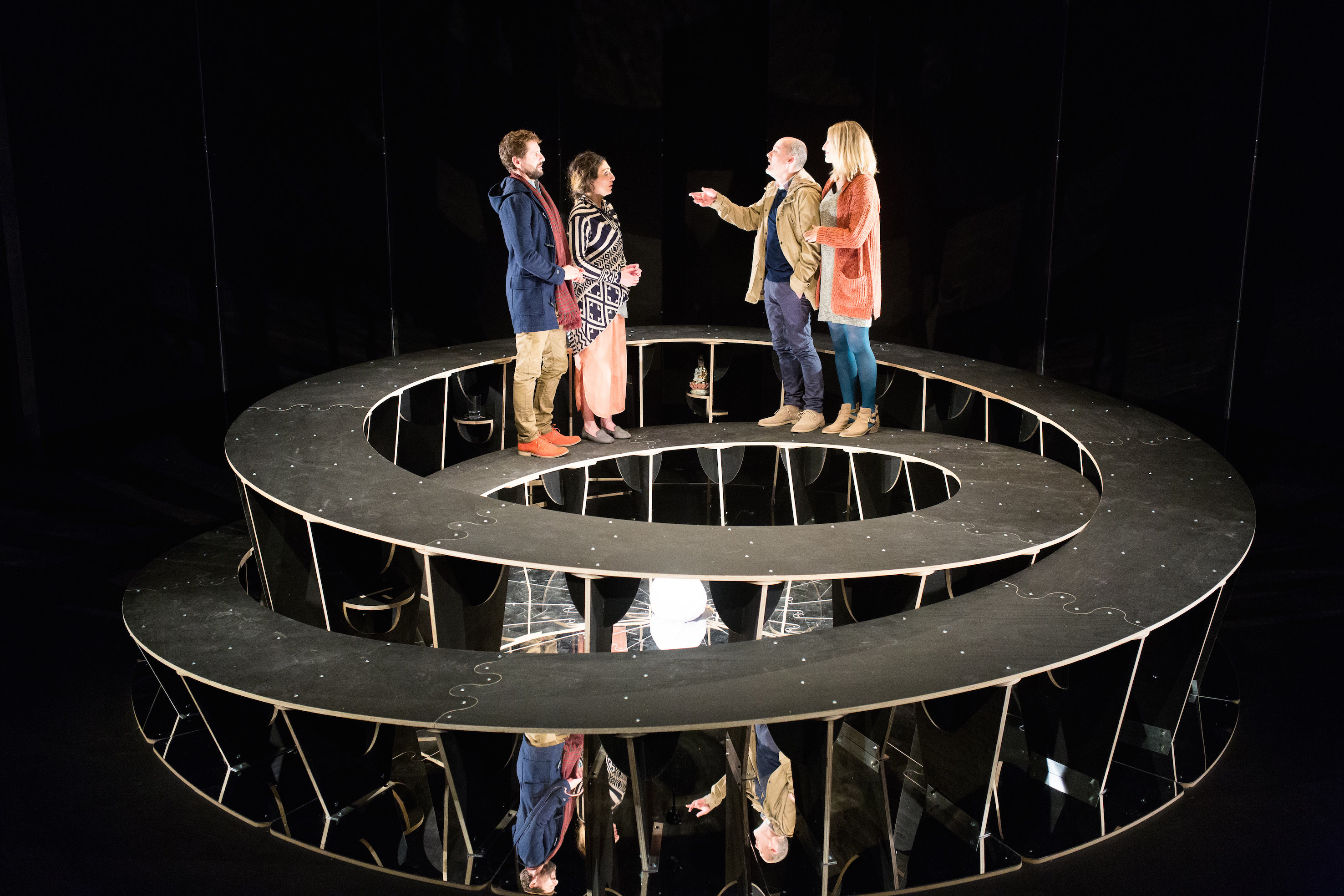
Simon Corfield, Julia Ohannessian, Glenn Hezeldine, Georgina Symes. Photo: Louis Dillon-Savage

Simon Corfield, Julia Ohannessian, Glenn Hezeldine, Georgina Symes. Photo: Louis Dillon-Savage

“How could there not be a baby? With all that love?”

So says Bill in Every Second, a new Australian play by Vanessa Bates about two couples struggling to conceive.

Bill (Glenn Hazeldine) and Jen (Georgina Symes) decide to try IVF and stay strong through the ordeal. Their younger friends Meg (Julia Ohannessian) and Tim (Simon Corfield) are finding their quest for a baby more stressful.

Meg opts for natural therapies but is becoming very anxious. Tim is heartily sick of vile-tasting herbal remedies and sex becoming a chore. (There are several candid representations of sex and fertility testing, just so you know.)

Bates’s writing is pared back, heightened and very funny at times. She creates believable characters but needs to explore their situation in greater emotional depth if we are to be moved by their plight. Desperately wanting a child and not being able to have one is emotionally devastating for many people and Bates goes some way to capturing that. But it would be interesting if she were to analyse why they want a child so desperately. Is it just the hormonal urge or something else?

Certain things in the script (a hit-and-run accident, a plea to a dead friend, an extramarital fling) feel unresolved and rather cursorily dealt with, while a sperm ballet (a nod, presumably, to the sperm scene in Woody Allen’s film Everything You Always Wanted to Know About Sex) sits oddly and isn’t that funny.

That said, Shannon Murphy directs a terrific, nifty, inventive production for Darlinghurst Theatre Company, with strong performances from all four actors. Andy McDonell’s abstract set – a spiral ramp around a womb-like core – works extremely well.

One in 33 Australian babies are conceived via IVF so Bates has tuned into a common experience. For the drama to resonant more broadly, she could usefully expand her story and deepen its emotional layers.

Every Second plays at the Eternity Playhouse in Darlinghurst until July 27. Bookings: www.darlinghursttheatre.com

A version of this review appeared in the Sunday Telegraph on July 13

Snow White – Winter Family Musical

State Theatre, July 4

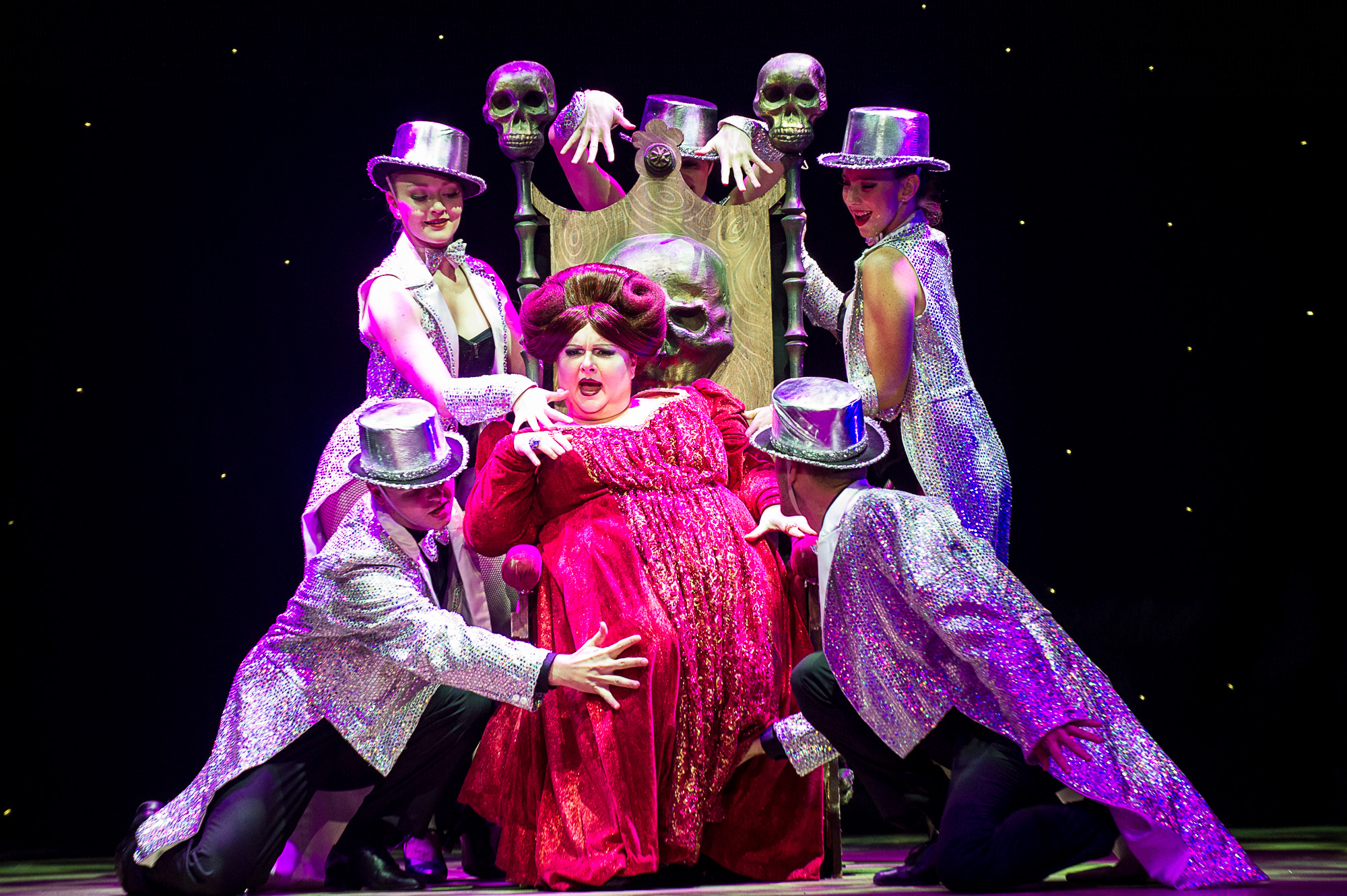
Magda Szubanski and ensemble. Photo: Kurt Sneddon, Blueprint Studios

Magda Szubanski and ensemble. Photo: Kurt Sneddon, Blueprint Studios

The Christmas pantomime is a popular British tradition. After success in the US, Bonnie Lythgoe hopes to introduce an annual panto here. If her first production, Snow White – Winter Family Musical, is anything to go by, she could be onto a winner.

Snow White takes the time-honoured panto formula and gives it a contemporary shake, adding pop songs by the likes of One Direction and Michael Jackson, and lacing the script with just enough local references and topical jokes for both adults and children.

The costumes and old-school painted backdrops hark back to classic panto, giving the show a nostalgic charm, and look great.

On opening night, the performers quickly involved the audience who entered into the spirit of it with gusto, booing the Wicked Queen, shouting to warn Snow White not to eat the apple, and shrieking during the famous ghost gag.

Lythgoe, who produces and directs, has cast the show cleverly with celebrities and actors who understand the performance style. Magda Szubanski, in particular, is fabulous as the wicked Queen Grismalda, interacting with the audience with quick-smart ease.

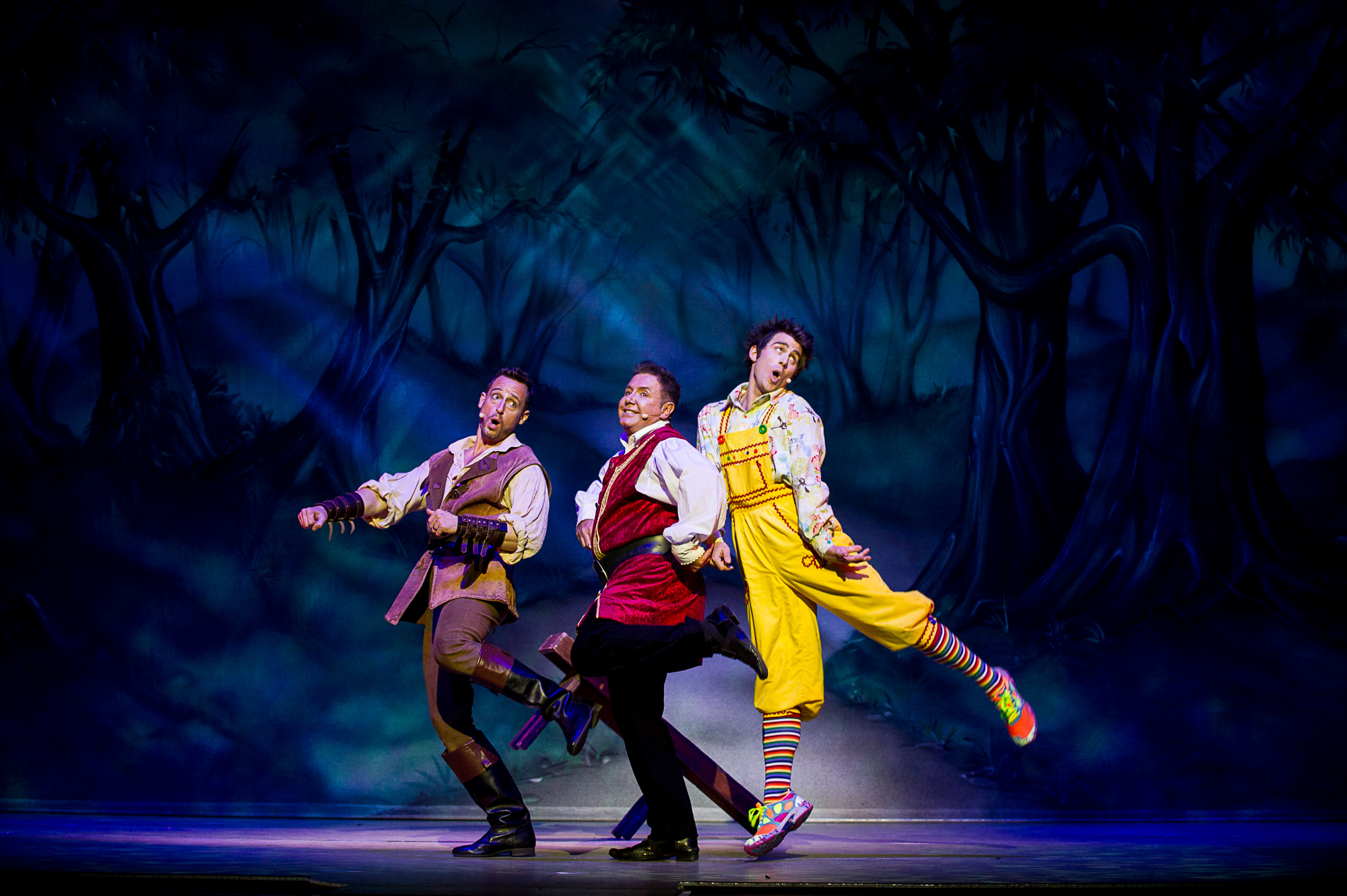
Josh Adamson, Peter Everett and Jimmy Rees. Photo: Kurt Sneddon, Blueprint Studios

Josh Adamson, Peter Everett and Jimmy Rees. Photo: Kurt Sneddon, Blueprint Studios

Jimmy Rees (aka Jimmy Giggle from the ABC TV show Giggle & Hoot) also nails it as the hapless jester Muddles, who is hopelessly devoted to Snow White. Both of them pitch their performances perfectly, mining every ounce of comedy without overdoing it.

Newcomer Erin Clare (who was discovered during a national search for an unknown performer to play the role) shines as Snow White, embodying just the kind of fairytale heroine that little children imagine. Peter Everett is endearing as Chambers, loyal courtier and friend to Snow White, Andrew Cutcliffe is suitably dashing as Prince Handsome, and Josh Adamson has the right swagger as Herman the Huntsman. Sir Cliff Richard and Kyle Sandilands lend strong support as the Queen’s (pre-recorded) two-faced mirror.

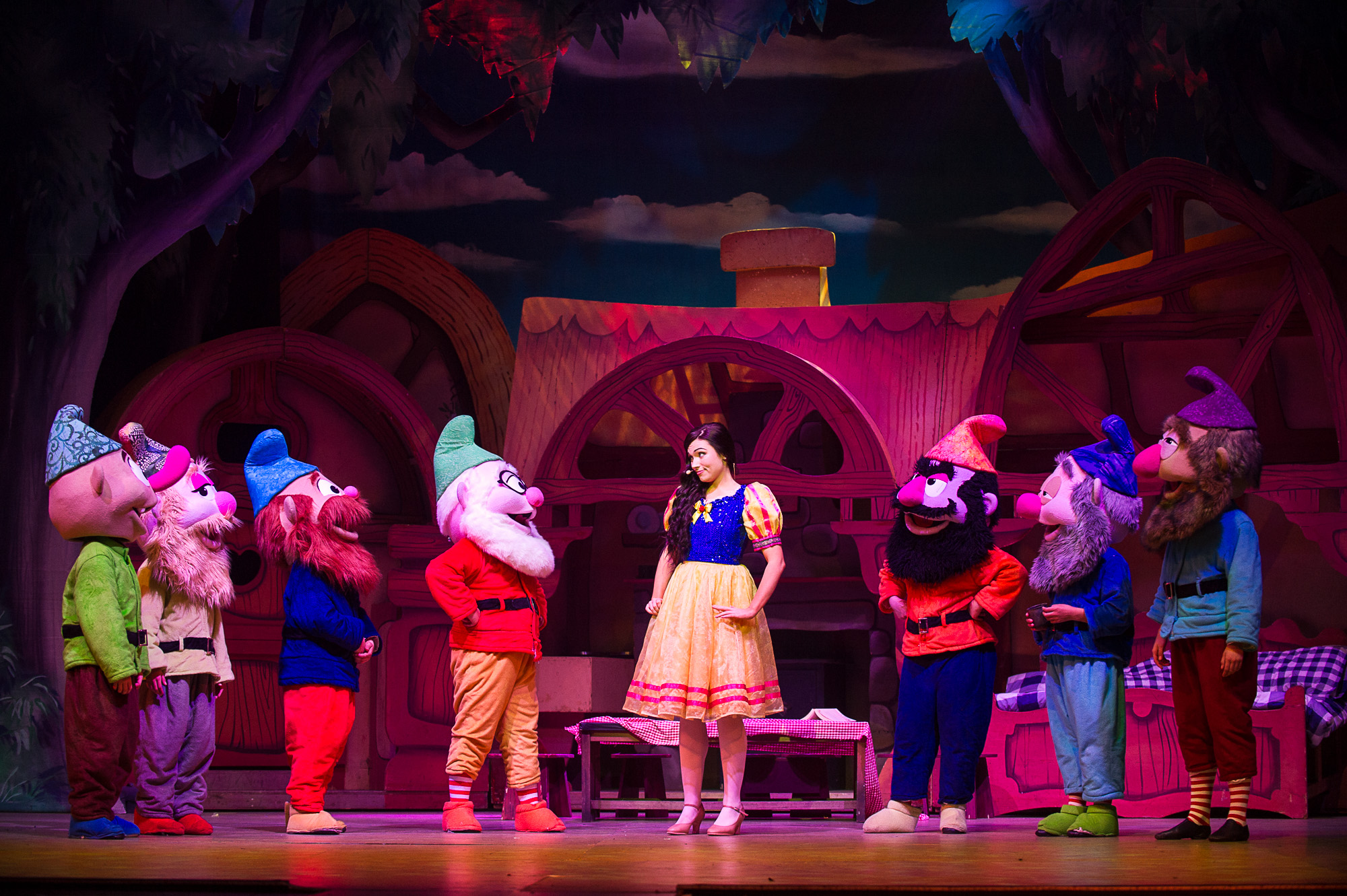
The seven dwarves are played by children in cartoony heads, straight out of a picture book or animated film, which works surprisingly well.

Erin Clare with the seven dwarves. Photo: Kurt Sneddon, Blueprint Studios

Erin Clare with the seven dwarves. Photo: Kurt Sneddon, Blueprint Studios

Running just over two hours including interval, Snow White does feel a little long at times, particularly the extended ghost gag. The odd nip and tuck wouldn’t hurt. However, the three little girls in front of us, who ranged in age from around three to six, clearly had a wonderful time and hardly a restless moment.

In Lythgoe’s care, Snow White is good old-fashioned entertainment and great fun for all the family. “Oh no it isn’t! Oh YES it is!”

Snow White – Winter Family Musical plays at Sydney’s State Theatre until July 13. Bookings: www.ticketmaster.com.au or 136 100

A version of this review ran in the Sunday Telegraph on July 6