A Christmas Carol

Belvoir St Theatre, November 12
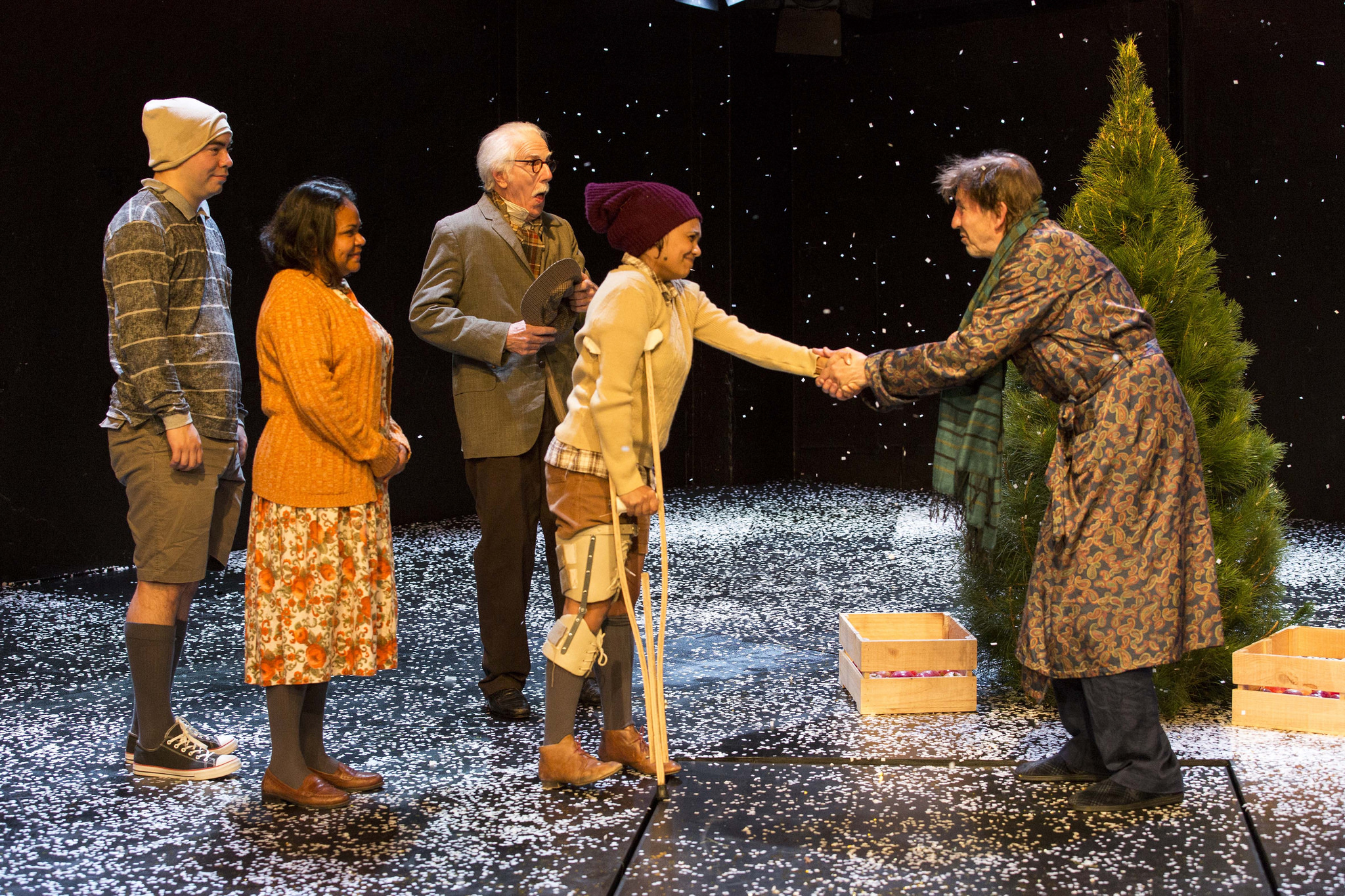
Ivan Donato, Ursula Yovich, Peter Carroll, Miranda Tapsell and Robert Menzies. Photo: Brett Boardman

Ivan Donato, Ursula Yovich, Peter Carroll, Miranda Tapsell and Robert Menzies. Photo: Brett Boardman

The magic begins as soon as you enter the theatre to find the seats dusted with (paper) snow. All over the theatre young and old excitedly lark around with it, dumping it on each other’s heads and tossing snowballs.

It’s the perfect start to Belvoir’s A Christmas Carol: a production so delightful and touching it would melt the hardest heart.

The costuming is contemporary (Mel Page) but the adaptation by director Anne-Louise Sarks and Benedict Hardie is a faithful telling of Charles Dickens’ timeless tale.

In this materialistic society of ours, the story of the miserly Scrooge resonates as powerfully as ever. Visited on Christmas Eve by the ghost of his former business partner Jacob Marley, followed by the Ghosts of Christmas Past, Present and Yet To Come, Scrooge learns to open his heart (and wallet).

The messages that although you can’t change your past, it’s never too late to change your ways, and that it’s more rewarding to give than to receive, are as beautiful and timely as ever.

The Belvoir stage has rarely looked larger than it does with Michael Hankin’s steeply raked black set. It’s a deceptively simple design with trap doors and a platform that rises and falls, brought to vivid life by Benjamin Cisterne’s dynamic lighting.

Steve Rodgers. Photo: Brett Boardman

Steve Rodgers. Photo: Brett Boardman

Sarks’ production doesn’t avoid the dark corners of the story but her production twinkles with joy and playfulness along with showers of snow and glitter, a human Christmas tree, and carol singers in wonderfully naff, knitted Christmas jumpers (think Mark Darcy in Bridget Jones’s Diary).

Robert Menzies is perfect as the mean-spirited, grouchy Scrooge, who starts the evening growling “Bah, humbug!” to any mention of Christmas and gradually thaws until he is gamboling in the snow making angel wings.

The other seven actors take on a number of roles each and work together as a tight ensemble. Steve Rodgers brings a beatific smile and deep humanity to the role of Bob Cratchitt, matched by Ursula Yovich as his kind-hearted but tougher, spirited wife. Together they are incredibly touching.

Miranda Tapsell. Photo: Brett Boardman

Miranda Tapsell. Photo: Brett Boardman

Miranda Tapsell’s radiantly glowing face could light the darkest night as Tiny Tim. Wearing a gorgeous confection-of-a-costume made from gold tinsel, Kate Box brings a deliciously mischievous exuberance to the Ghost of Christmas Present. Ivan Donato is a more solemn presence as the Ghost of Christmas Past in a shiny suit, Peter Carroll is hilariously, maniacally unhinged as Jacob Marley, while Eden Falk is decency and kindness personified as Scrooge’s nephew.
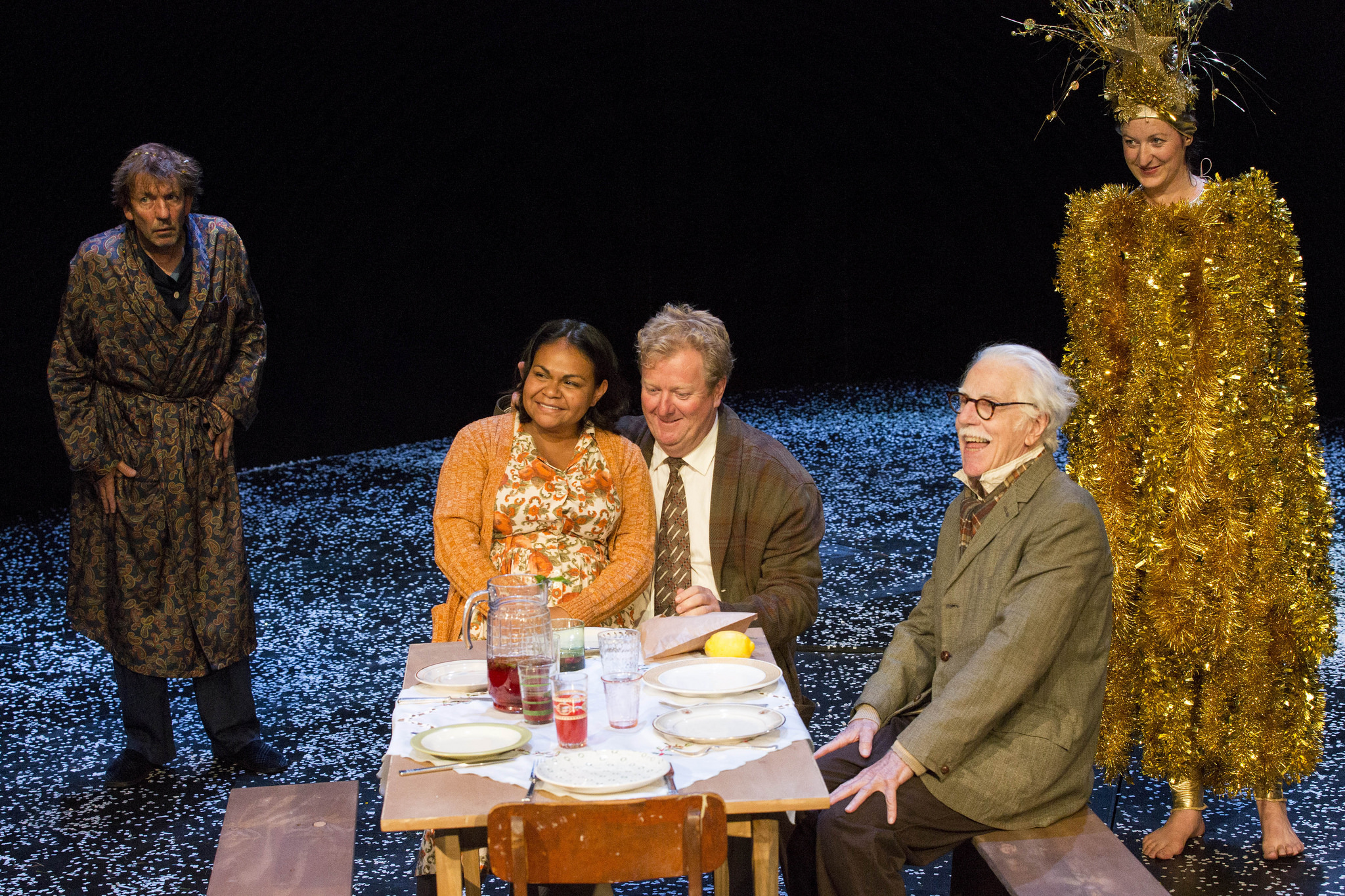
Robert Menzies, Ursula Yovich, Steve Rodgers, Peter Carroll, Kate Box. Photo: Brett Boardman

Robert Menzies, Ursula Yovich, Steve Rodgers, Peter Carroll, Kate Box. Photo: Brett Boardman

With music by Stefan Gregory and movement by Scott Witt, the heartwarming, family-friendly production (which runs 75 minutes) moves you to laughter and tears, sending you home filled with the spirit of Christmas.

In fact, I felt so uplifted that the next morning I booked tickets to take my family to see it just before Christmas. A real gift of a show.

A Christmas Carol is at Belvoir St Theatre until December 24. Bookings: www.belvoir.com.au or 9699 3444

A version of this review ran in the Sunday Telegraph on November 23
The Way Things Work

Bondi Pavilion, November 11

Ashley Lyons and nicholas Papademetriou. Photo: Zak Kaczmarek

Ashley Lyons and nicholas Papademetriou. Photo: Zak Kaczmarek

For his final production as artistic director of Rock Surfers Theatre Company, Leland Kean is directing a new Australian play by Aidan Fennessy called The Way Things Work, which won the inaugural Rock Surfers/Cordell Jigsaw Zapruder (CJZ) Playwriting Commission.

A dark satire about corruption in NSW, from the highest level down to the criminal underbelly, Fennessy won’t have needed to look far for inspiration with the newspapers full of corruption allegations on both sides of NSW politics and elsewhere in the private sector.

Investigative journalist Kate McClymont was a guest on opening night and in a short speech afterwards confirmed that the fiction on stage wasn’t that far removed from reality.

The Way Things Work unfolds in three sections with two actors playing three sets of characters.

The play opens with Minister Barlow (Nicholas Papademetriou) feeling the heat. The Minister (who surname has lent itself to umpteen scathing headlines) has overseen the construction of a multi-million dollar East-West road tunnel, funded by a public-private partnership. He has brought it in on time and on budget. The trouble is, it’s already beginning to crumble because it was built using ordinary concrete not the required “special concrete” and will eventually cost taxpayers vastly more to repair than it did to build.

The project is now the subject of a Royal Commission and the Minister is keen that certain behind-the-scenes deals are not revealed. He calls his departmental secretary (Ashley Lyons), a senior public servant, in for a meeting and puts pressure on him to “forget” a certain name.

In the second section, we meet the two Greek-Australian brothers whose company supplied the concrete and who are engaged in a power struggle of their own as their company is about to be bought out by a major media conglomerate.

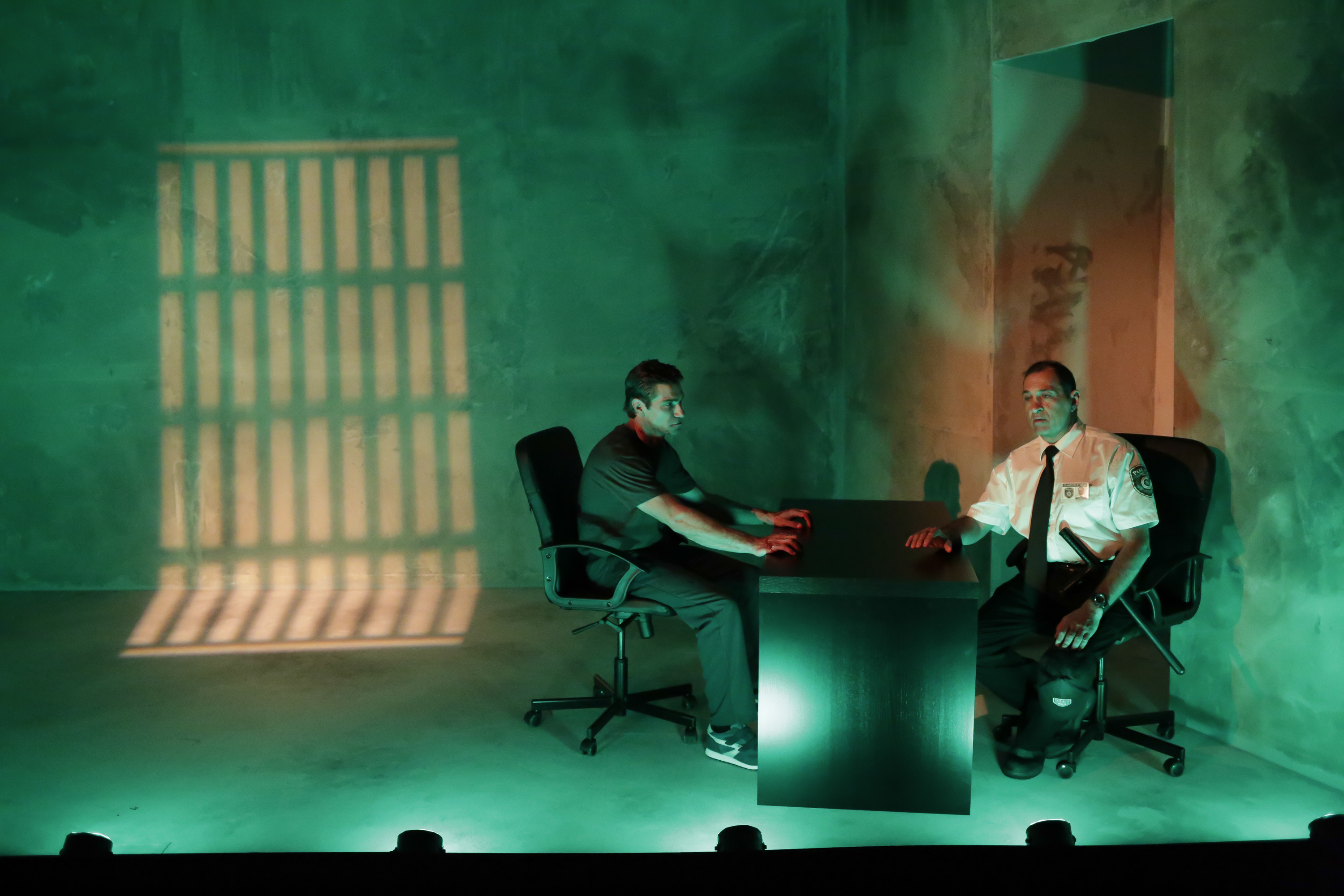
The third section features a prison warden (Papademetriou) and a prisoner (Lyons) who have forged a close relationship over many years. The warden has just enlisted the prisoner as a hit man to prevent another of the inmates testifying at the commission, but there is more bubbling away beneath the surface.

Kean, who designed the set as well as directing, stages the play in a concrete box, which changes under Luiz Pampolha’s noir-ish lighting but which lends the piece a consistently tangible feeling of brutality, ruthlessness and claustrophobia, heightened by Jed Silver’s sound.

On opening night Papademetriou rather overplayed the Minister so that the character verged on the cartoonish, undercutting any genuine sense of reality. Some of the dialogue he was given also stretched credibility a little.

But Papademetriou settled down in the next two scenes with two far more potent, believable characterisations and as the play progressed the tension built nicely.

Lyons gives a chameleon-like performance, morphing convincingly from the anxious public servant determined not to compromise his integrity, to the cocky, blinged-up brother, to the prisoner whose sense of betrayal is surprisingly touching.

Running a tight 100-minutes, Kean keeps the action taut, driven by a macho energy. After a somewhat shaky start, The Way Things Work becomes a darkly funny, entertaining play that will certainly resonate with Sydneysiders.

The Way Things Work plays at Bondi Pavilion until November 29. Bookings: www.rocksurfers.org or 1300 241 167

Switzerland

Drama Theatre, Sydney Opera House, November 7

Sarah Peirse and Eamon Farren. Photo: Brett Boardman

Sarah Peirse and Eamon Farren. Photo: Brett Boardman

Joanna Murray-Smith’s new play Switzerland is a gripping psychological thriller about renowned crime writer Patricia Highsmith that creeps up on you slowly and then has you on the edge of your seat.

Highsmith’s novels include The Talented Mr Ripley, one of several she wrote about the psychopathic, sexually ambiguous Tom Ripley, and Strangers on a Train, which Alfred Hitchcock adapted for the screen.

Born in Texas, but bitter about her lack of serious recognition in her homeland as opposed to Europe where she was feted for her literary skill and psychological insight, she lived her last years in Switzerland, land of neutrality, secret bank accounts, picturesque mountain chalets and cuckoo clocks.

Widely regarded as a tough cookie, the eccentric, tight-fisted, hard-drinking, chain-smoking Highsmith (who was bisexual but more drawn to women) was considered misogynistic and cruel, even by her friends. She loved guns and cats and had a strange thing about snails. But Murray-Smith seamlessly weaves into the dialogue pretty much all that you need to know about her.

Murray-Smith’s play was commissioned by Los Angeles’ Geffen Playhouse – but fortuitously for Sydney audiences they agreed to Sydney Theatre Company staging the world premiere.

Set in the early 1990s, the cleverly constructed, tense drama finds Highsmith (Sarah Peirse) living with cancer towards the end of her life in Switzerland.

A young man called Edward Ridgeway (Eamon Farren) arrives from her New York publisher bearing jars of peanut butter (the wrong brand) and cans of soup.

Slightly nerdy and understandably nervous given the incident with the knife that befell the publisher’s previous emissary, Edward’s mission is to try to convince her to sign a deal to write one final Ripley novel.

Highsmith lacerates him with withering, caustic wit, delivered by Peirse with savagely funny brutality. But Edward – who is passionate about Highsmith’s oeuvre – holds his own (even if he can’t pronounce oeuvre) and things start to shift into a game of cat and mouse where it’s not clear who’s the cat.

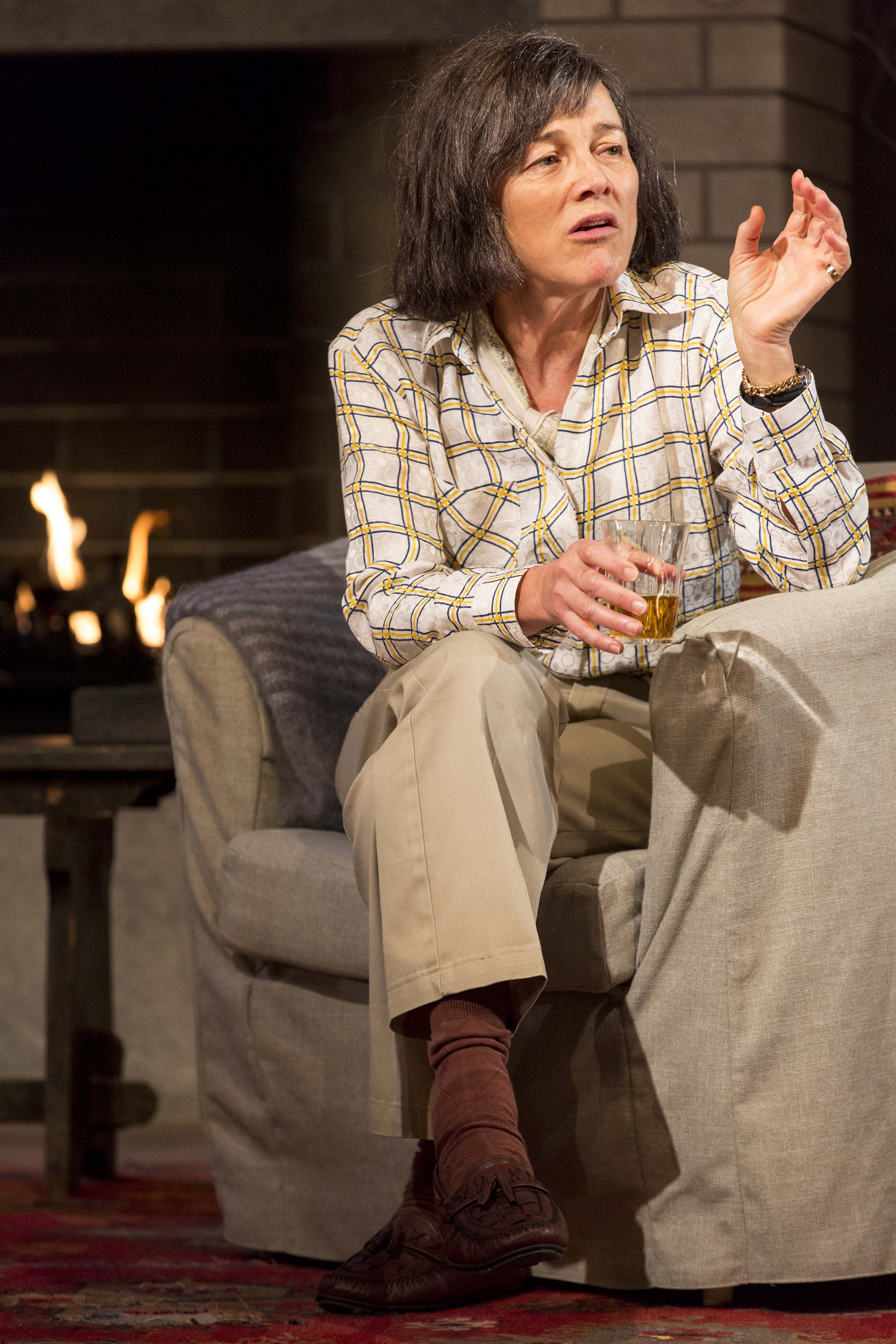
Michael Scott-Mitchell’s detailed, realistic set (based apparently on Highsmith’s final Swiss home) – with large fireplace, leather chairs, desk with typewriter, framed weaponry, a portrait of Highsmith, thick windows and spiral staircase leading upstairs – makes a virtue of the awkward, wide stage and works superbly in a way you wouldn’t expect for an intimate two-hander.

Nick Schlieper lights it so that it becomes a place of shifting light and shadows, and Steve Francis’s slightly creepy music heightens the growing tension.

Scott-Mitchell’s costuming is also excellent with loose-fitting jeans and mannish socks and shoes for Peirse, and gradually changing outfits for Farren that reflect his character’s evolution.

Sarah Goodes directs an immaculately paced production, drawing superb performances from the two actors, who take you with them through every tiny emotional twist and turn.

Sarah Pierse. Photo: Brett Boardman

Sarah Pierse. Photo: Brett Boardman

The way Peirse reveals sudden flashes of vulnerability, pleasure or admiration beneath the Teflon-tough, gruff exterior is done with a flawless subtlety. She totally inhabits the role. Edward’s transformation is brilliantly judged in an equally subtle performance by Farren.

Murray-Smith celebrates and emulates Highsmith’s writing, while giving us an insight into her fascination with violence and the dark side of human nature. At the same time, she explores a range of ideas including Highsmith’s relationship with her imagination and characters all the while playing intriguing mind games with us. The play is often laugh-out-loud funny too.

As for how the song Happy Talk from the musical South Pacific fits into all this – well, you’ll just have to go and see, but it’s an inspired theatrical moment.

Running 100 minutes without interval, Switzerland is a thrilling piece of writing given a superb production by STC. In some of Murray-Smith’s previous plays you feel her putting words into the mouths of the characters to serve the debate and themes she is discussing. Here the dialogue feels utterly truthful, emerging organically from the mouths of the characters. I don’t think it’s a stretch to say it’s her very best play to date. Highly recommended.

Switzerland plays at the Drama Theatre, Sydney Opera House until December 20. Bookings: www.sydneytheatre.com.au or 9250 1777

A version of this review ran in the Sunday Telegraph on November 16

Daylight Saving

Eternity Playhouse, November 4

Rachel Gordon and Ian Stenlake. Photo: Helen White

Rachel Gordon and Ian Stenlake. Photo: Helen White

When Nick Enright wrote his 1989 rom-com Daylight Saving, it was a last-ditch effort. Had it not been a success, he had threatened to turn his back on playwriting.

But the play, which premiered at the Ensemble Theatre, was a big hit. Enright went on to a stellar career (cut sadly short when he died from melanoma in 2003) with writing credits including Cloudstreet, The Boy From Oz and the film Lorenzo’s Oil. He also wrote the book and lyrics for the musical Miracle City, currently enjoying a brilliant revival at the Hayes Theatre Co.

Darlinghurst Theatre Company is now staging Daylight Saving (with support form the Enright Family). It’s been lovingly directed by Adam Cook, who has chosen to keep it in its original 1980s time period, but the play itself feels rather dated and lightweight. The humour doesn’t zing in quite the same way that it did back in 1989 (the biggest laugh of the night is a sight gag: a huge, brick-like mobile phone) and its themes of loneliness in marriage, the passing of time and seizing the day don’t have quite the same traction – perhaps because we’ve heard them discussed so often.

Well constructed and elegantly written, the play is stylistically not dissimilar to Alan Ayckbourn or David Williamson. There are some deft, very funny one-liners that the cast deliver with consummate timing,  but the laughs are slow to build and rather sporadic.

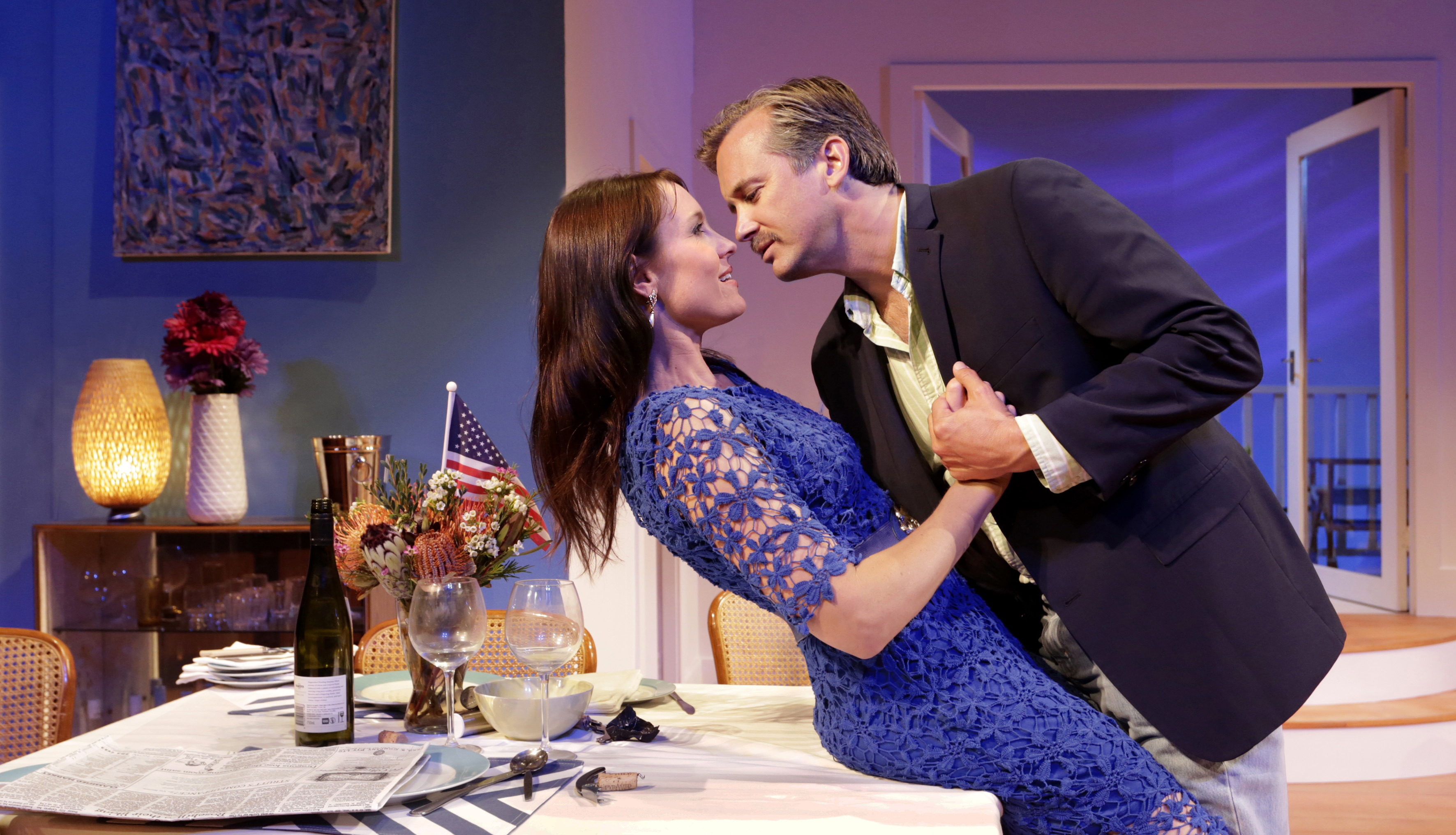
Felicity (Rachel Gordon) is a successful restaurateur on Sydney’s northern beaches. She lives in a gorgeous house overlooking Pittwater and would seem to have it all. However, her husband Tom (Christopher Stollery), who manages a top-ranking but temperamental young tennis player Jason Strutt (Jacob Warner), devotes so much time to work that she is feeling increasingly lonely and under-valued.

This time, Tom has forgotten their wedding anniversary as he heads off overseas yet again. So when her old flame Joshua Makepeace (Ian Stenlake), to whom she lost her virginity in America as a student, appears out of the blue Felicity contemplates a romantic night. Somehow the fact that it’s the night that the clocks go back, gifting them an extra hour together, makes it seem even more special.

But plans for a candlelit lobster dinner go awry with a procession of visitors interrupting the evening.

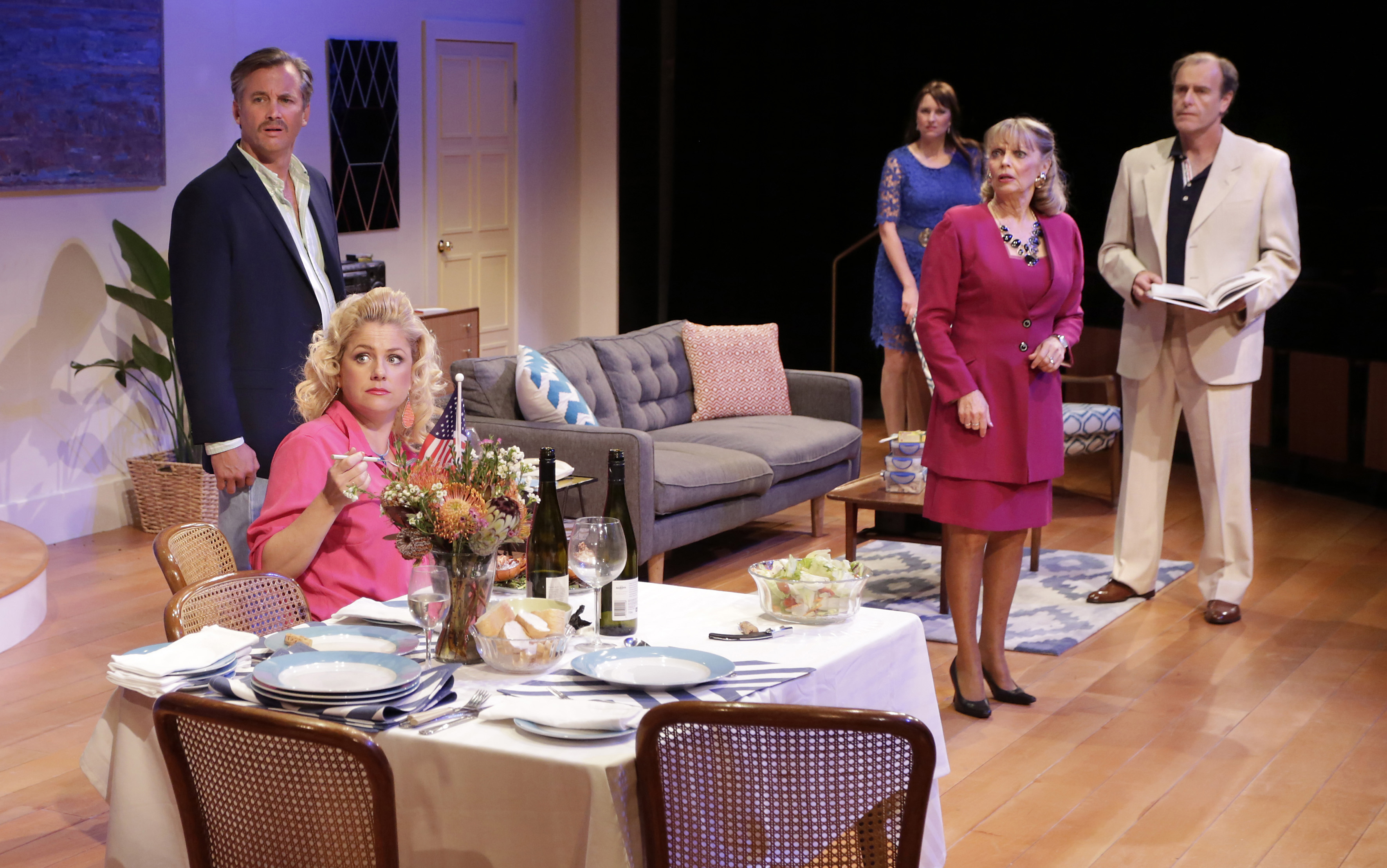
Hugh O’Connor has designed a bright, gleaming set that captures the feel of a comfortable, advantageously positioned waterside home, beautifully lit by Gavan Swift, and his costumes have 80s elements without feeling like a parody.

Helen Dallimore, Ian Stenlake, Belinda Giblin, Rachel Gordon and Christopher Stollery. Photo: Helen White

Helen Dallimore, Ian Stenlake, Belinda Giblin, Rachel Gordon and Christopher Stollery. Photo: Helen White

Cook has gathered a strong cast, with the women in particularly fine form. As Felicity, Gordon gives a performance that feels effortlessly natural and real, her disappointment lying just beneath the surface. Belinda Giblin is absolutely on the money as Felicity’s well-meaning but interfering mother: a North Shore widow with fake tan who arrives like a whirlwind, dispensing advice, inedible cookies and deliciously dry witticisms, delivered to perfection.

Helen Dallimore is also extremely funny as Felicity’s rather boorish next-door neighbour Stephanie, whose boyfriend has given her up for Lent and who is so wrapped up in her own indignation she is oblivious to what’s going on around her.

Stenlake offers the kind of winning charm that Stollery’s grouchy Tom lacks, while Warner plays Jason’s bratishness to the hilt.

Cook has found as much humanity in it as he can, but at the end of the day it all feels rather slight: a play that hasn’t quite stood the test of time but one that is still gently amusing.

Daylight Saving runs at the Eternity Playhouse until November 30. Bookings: www.darlinghursttheatre.com or 02 8356 9987

Rachel Gordon interview

Rachel Gordon is about to star in Nick Enright’s 1989 rom-com Daylight Saving for Darlinghurst Theatre Company. She talks about the play and the many diverse credits in her bio.

Rachel Gordon. Photo: Helen White

Rachel Gordon. Photo: Helen White

Logie Award nominee Rachel Gordon has some pretty interesting things in her bio besides her many acting credits.

In 2007, she was personally trained by Al Gore and The Australian Conservation Foundation as a presenter for The Climate Change Project.

The following year she spent a month walking the Great Wall of China with various celebrities to raise money for Olivia Newton-John’s Cancer and Wellness Centre.

“Joan Rivers was on it. She turned up and said, ‘When you said the Great Wall I thought you said the Great Mall. What am I doing here?’ She was on the Great Wall of China walking along in her high heels. She was hilarious.

“I’m very lucky to have had a lot of incredible experiences like that,” says Gordon.

And don’t be surprised if Gordon one day adds “politician” to her c.v.

Her great grandfather was Prime Minister Joseph Lyons, while his wife, Dame Enid Lyons, was the first woman in the Australian parliament.

“That’s really cool for a feminist, isn’t it?” says Gordon.

“They died before I was born but I’d like to get into politics and I know my brother is very keen as well so it might be in the blood.

“I have a lot of things I would like to change. I really love that Ghandi quote: ‘Be the change you wish to see in the world.’ There’s no point sitting back and pointing the finger at politicians. I should probably get up and do something, so who knows?”

For the time being, however, Gordon continues to be in demand as an actor.

She is about to star in a production of Nick Enright’s 1989 hit rom-com Daylight Saving directed by Adam Cook for Darlinghurst Theatre Company with a cast including Helen Dallimore, Belinda Giblin and Ian Stenlake.

“Ian Stenlake and I actually went to NIDA together and lived together for a while – not as a couple but in a share house with lots of other students. We’ve never worked together professionally so that’s really nice,” she says.

Gordon is best known for her television work in shows such as The Moodys, Blue Heelers and Home and Away. She has just finished filming a new Channel Seven series called The Killing Field with Rebecca Gibney and Peter O’Brien in which she plays Gibney’s character’s sister.

She has also done plenty of theatre over the years.

“When I first came out of NIDA that’s all I did,” she says. “It took a long time to get much TV work and then that was what I did for a period of time. But over the last couple of years I’ve been doing quite a lot of theatre again and I absolutely adore it. There’s nothing like having an audience in the room with you.”

Enright (The Boy From Oz, Cloudstreet, Lorenzo’s Oil) wrote Daylight Saving for his close friend, actor Sandy Gore. At the time, he was dispirited by his lack of playwriting success and he considered the play a last ditch effort. Fortunately it proved to be a hit, leading to a stellar career. Sadly, he died in 2003 from melanoma, aged 52.

“It’s such an honour to play this role especially because Nick Enright was so dearly loved by pretty much everybody in the theatre community that met him,” says Gordon.

“But I was terrified when I actually got the role because Sandy is such a dear friend and I so want to do the play and her justice. So I called her and told her and she’s been very supportive.”

Gordon plays a successful Sydney restaurateur who contemplates having a fling with an old flame (Stenlake) while her husband is overseas on one of his many business trips. But their candle-lit dinner is constantly interrupted.

“There’s this beautiful feeling in the play, which I think Nick fostered in a lot of his work of really seizing the moment – as he did in his own life. He filled it with so much and affected so many people on so many levels through his generosity of spirit, his largesse, his intellect and his humour. He gave us these wonderful plays and he taught thousands of students.

“There is a real sense of urgency in the play. Felicity, my character, has one night to perhaps live out her dream of being with this ex-flame. We all have these moments in our lives where you think ‘what would have happened if I had taken a different turn?’

“It’s a very charming romantic comedy and I think it will make people laugh and feel happy and hold their dear ones close,” says Gordon.

Gordon’s own dear ones include her two children with actor Jon Sivewright, who she met on Home and Away.

“I’ve got a three-year old and a ten-month old. He’s with the babies at the moment being a very good father,” she says. “They probably feel like they’re on holiday getting everything they want!”

Daylight Saving runs at the Eternity Playhouse until November 30. Bookings: darlinghursttheatre.com or 8356 9987

A version of this story ran in the Sunday Telegraph on October 26

Blue/Orange

Ensemble Theatre, October 29

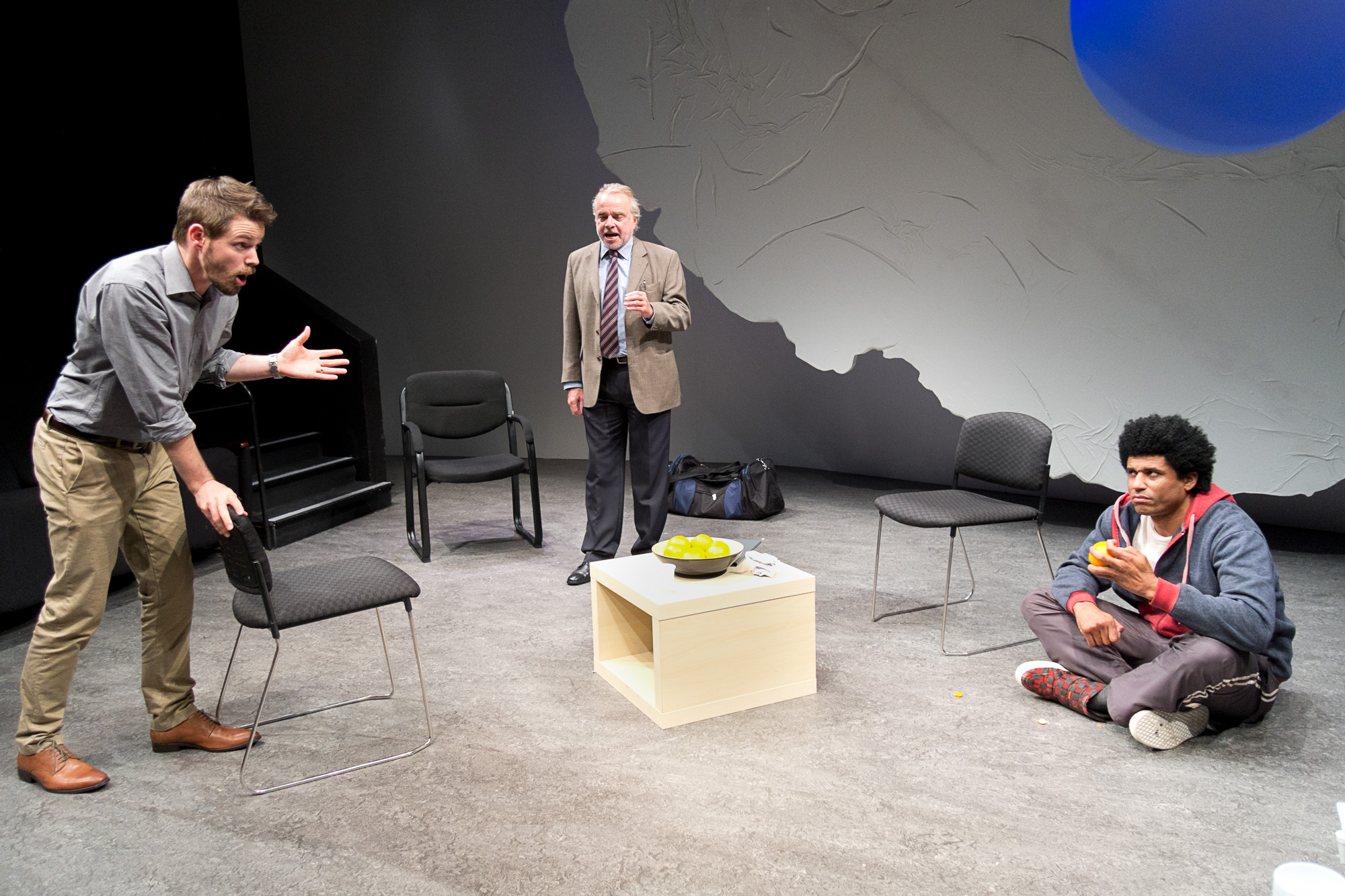
Ian Meadows, Sean Taylor and Dorian Nkono. Photo: Clare Hawley

Ian Meadows, Sean Taylor and Dorian Nkono. Photo: Clare Hawley

Written by British playwright Joe Penhall (who grew up in Australia), Blue/Orange is a fierce comedy bursting with conflicting ideas about mental illness, its diagnosis and its treatment. Premiered by London’s National Theatre in 2000, it is given three exemplary performances in this impressive Ensemble Theatre production.

Christopher (Dorian Nkono), a young black Londoner, is 24 hours away from being released from a psychiatric hospital. The police sectioned him after an “incident” at a market but legally he can only be held for 28 days and he can’t wait to get out. In fact, he is climbing the walls – even without the coffee and coke he craves.

Christopher has been diagnosed as having a borderline personality disorder but Bruce (Ian Meadows), a young trainee psychiatrist who has been treating him, suspects that he is actually a paranoid schizophrenic and wants to keep him at the hospital to do more tests.

He asks his mentor Robert (Sean Taylor), a senior doctor, to sit in on one of their sessions. But instead of supporting Bruce, Robert is dismissive. He is writing a book about “black psychosis” in which he argues that ethnic and cultural factors play more of a role in mental illness that is recognised and argues that growing up black and poor in Britain could go a long way to explaining Christopher’s problem. Besides, he needs the bed for other patients.

Soon the two doctors are at loggerheads. Robert insists Christopher be allowed to go home – even though it becomes clear that he has no home or family to go to. Bruce fights tooth and nail to change Robert’s mind, fearful that Christopher is a danger to himself and others.

As for Christopher, he thinks his father is Ugandan dictator Idi Amin and that the oranges in the room are blue.

Blue/Orange is passionately written. The arguments swing back and forth and Penhall keeps us wondering about the true state of Christopher’s mental health. At times though it feels overwritten, with dialogue turning into big, weighty speeches that feel imposed on the drama.

A couple of the twists don’t ring totally true and it’s hard to believe that the two doctors would argue so vehemently about Christopher in front of him, as they do at times. Robert also feels a tad too overtly Machiavellian. But then the play is also very much about power and ego, with the two doctors shown to be more interested in their own careers than Christopher.

Running two hours and twenty minutes (including interval) Blue/Orange would be sharpened by an edit. But the writing is so robust, and laced with so much humour, that it keeps you thoroughly engaged – especially when performed as well as it is here.

Anna Crawford directs a brisk, well-paced production on a set by Tobhiyah Stone Feller that contrasts a bland room with a large sculptural backdrop at the heart of which is a round void (somewhat reminiscent of an Anish Kapoor void) onto which coloured light is projected (a visual metaphor for Christopher’s confused perceptions).

Taylor is perfectly cast as Robert, capturing his patrician, easy swagger and enunciating each word with crisp precision in his seductively rumbling voice. But his charm becomes almost sinister as he is revealed to be patronising, bitter and manipulative.

Meadows is equally persuasive as the decent, passionate but inexperienced Bruce who speaks his mind with injudicious frankness, and Nkono is wonderful as Christopher, hyper-active one minute, forlorn and touchingly vulnerable the next. Remaining somewhat enigmatic throughout, Nkono’s Christopher certainly defies easy diagnosis, showing how hard it can be to recognise and treat mental illness – particularly when there are other agendas at play.

It’s a fascinating play that would probably be even stronger with an edit but nonetheless it still packs a considerable punch.

Blue/Orange is at the Ensemble Theatre until November 29. Bookings: www.ensemble.com.au or 02 9929 0644

Henry V

Playhouse Theatre, Sydney Opera House, October 23

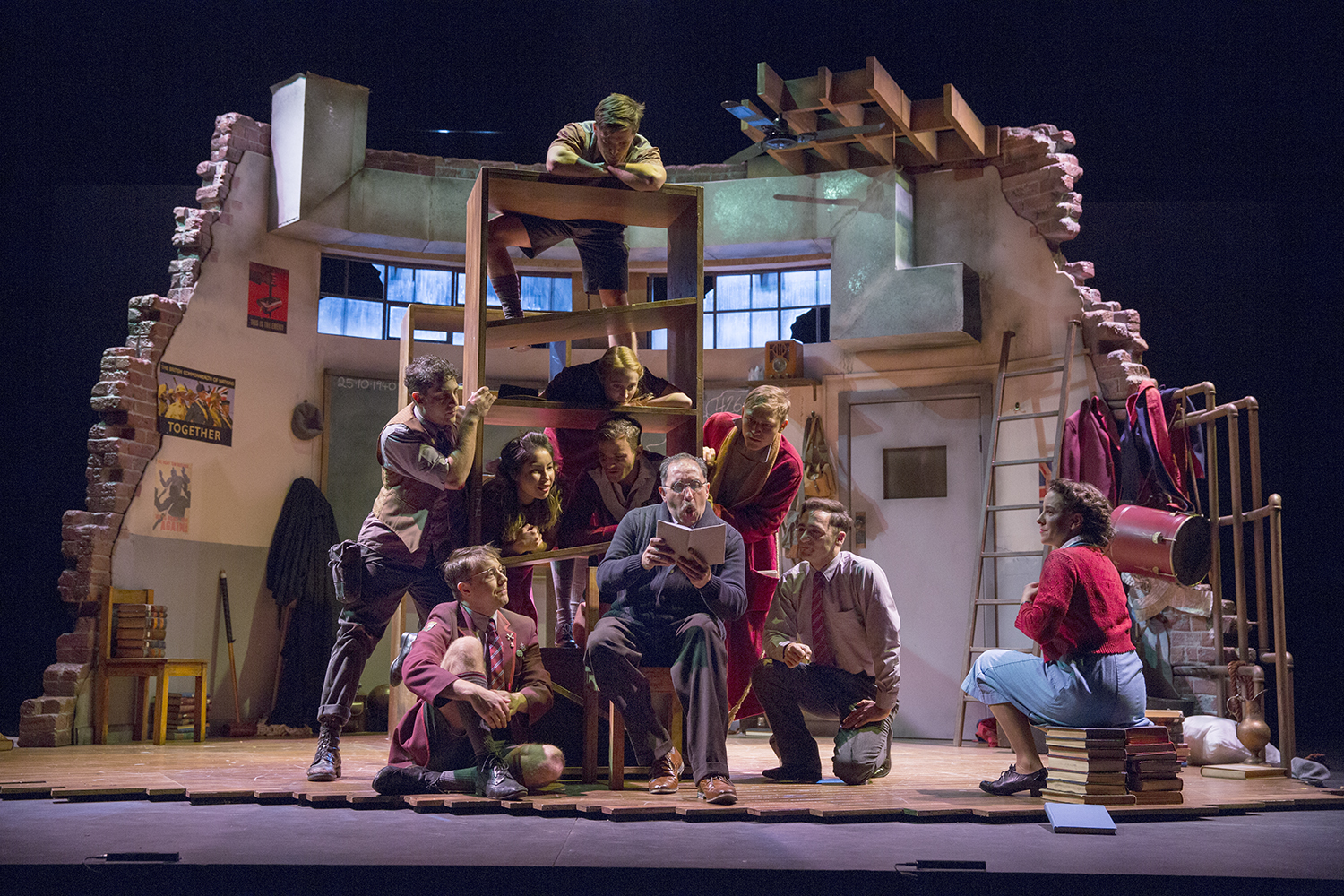
The cast of Henry V. Photo: Michele Mossop

The cast of Henry V. Photo: Michele Mossop

It is 1940. The date is clearly written on the blackboard in a basement room of a London school where a cardigan-wearing teacher (Keith Agius), some of his pupils and the school nurse (Danielle King) take shelter as German bombs rain down outside.

To distract the students from the air raid, the teacher hands out play scripts and an improvised performance takes place. Brief scenes from Richard II and Henry IV Parts 1 and 2 act as a prologue and then we are into Henry V, a play about war.

It’s an inspired device by director Damien Ryan, which doesn’t just frame Shakespeare’s play but runs parallel throughout the multi-layered production. We never forget that this is Henry V as performed by terrified young people during wartime.

Now and again the stories intersect in moments of enormous power – one of them deeply shocking, another incredibly poignant.

Directing for Bell Shakespeare, Ryan proves yet again what an exciting director of Shakespeare he is. Henry V is a dense play yet he brings a customary clarity, energy and modern edge to it.

Ryan was inspired by real life accounts he read of a Boy’s Club, which put on plays and cabarets to raise the spirits of people in London air raid shelters during the Blitz.

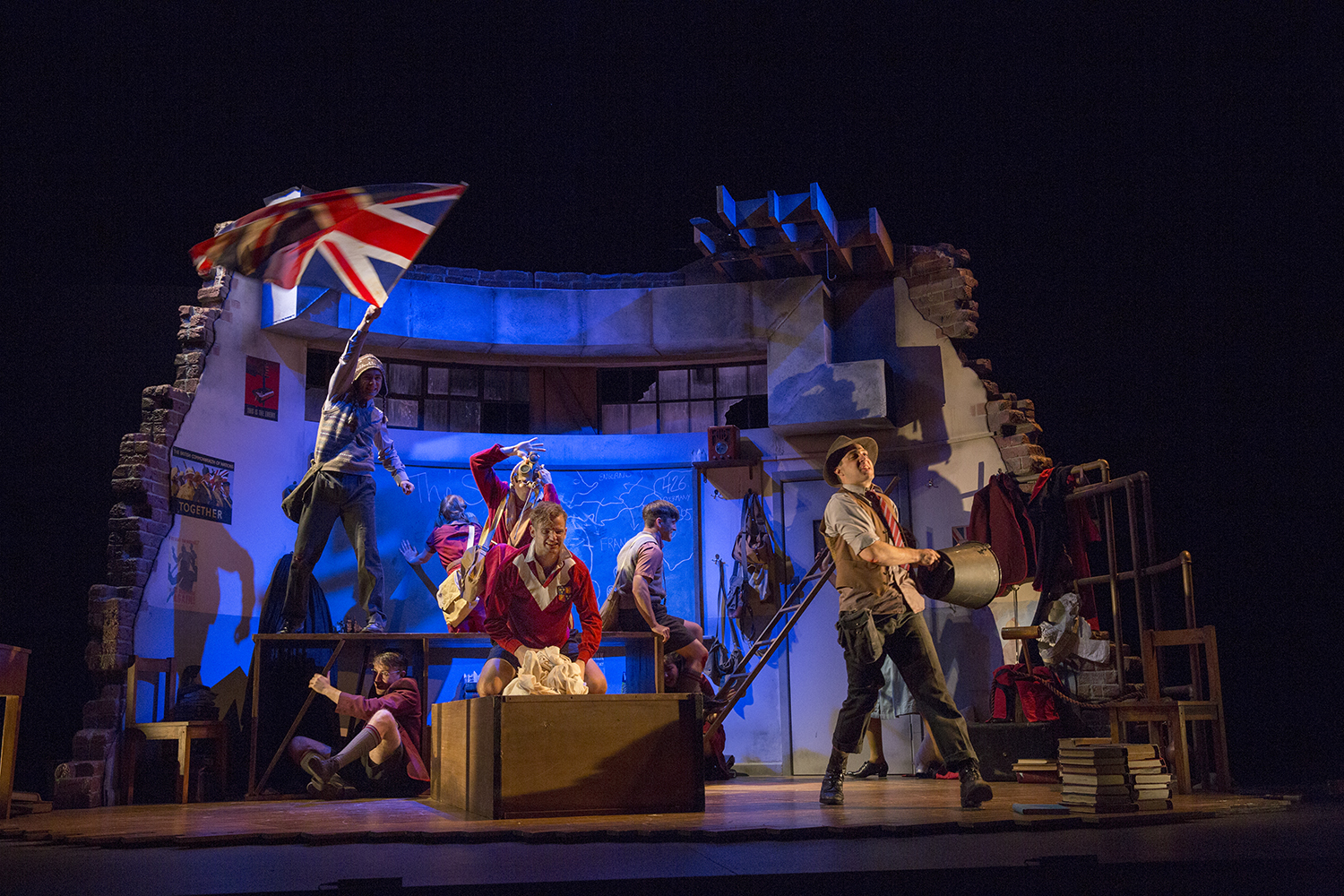
The terrific set by Anna Gardiner gives the cast bookcases, books, blankets, a bucket, newspaper crowns and armour, among various other props, which they use with thrilling invention.

The cast of Henry V. Photo: Michele Mossop

The cast of Henry V. Photo: Michele Mossop

In a play in which Shakespeare calls for the audience to use their imagination on an empty stage, Ryan gets us to do the same but with a plethora of props. Full of surprises, the staging is quite brilliant. It looks improvised, with the actors moving the furniture around at breakneck speed for different scenes, but it’s highly detailed and precisely choreographed. Full credit to movement director Scott Witt who worked with Ryan.

Ryan has gathered a superb ensemble of 10 actors: Keith Agius, Danielle King, Michael Sheasby, Matthew Backer, Drew Livingston, Damien Strouthos, Gabriel Fancourt, Eloise Winestock, Darcy Brown and Ildiko Susany.

Sheasby plays Henry V with the charisma of the captain of the school rugby team. Everyone else plays multiple roles and yet it is always clear who is who and what is happening. Agius makes a wonderful Falstaff (with cushion up his cardigan) and also plays the Chorus, and Winestock is very funny as the feisty, French Princess Katherine, but each and every one of the actors plays their numerous parts with élan.

Eloise Winestock and Michael Sheasby. Photo: Michele Mossop

Eloise Winestock and Michael Sheasby. Photo: Michele Mossop

The sound by Steve Francis, moving vocal compositions by actor Drew Livingston and lighting by Sian James-Holland all contribute magnificently.

Ryan balances the valour and heroism of Henry – who has matured from the callow, irresponsible youth in Henry IV, who hung out in taverns with the reprobate Falstaff, to inspiring leader of his underdog “band of brothers” – with a powerful portrayal of the rank brutality, ugliness and futility of war.

This is one of the most exciting, moving pieces of theatre I’ve seen in Sydney this year. Don’t miss it.

Henry V runs at the Playhouse, Sydney Opera House until November 16. Bookings: www.sydneyoperahouse.com or 02 9250 7777

A version of this review ran in the Sunday Telegraph on October 26


Calpurnia Descending

Wharf 2, October 11

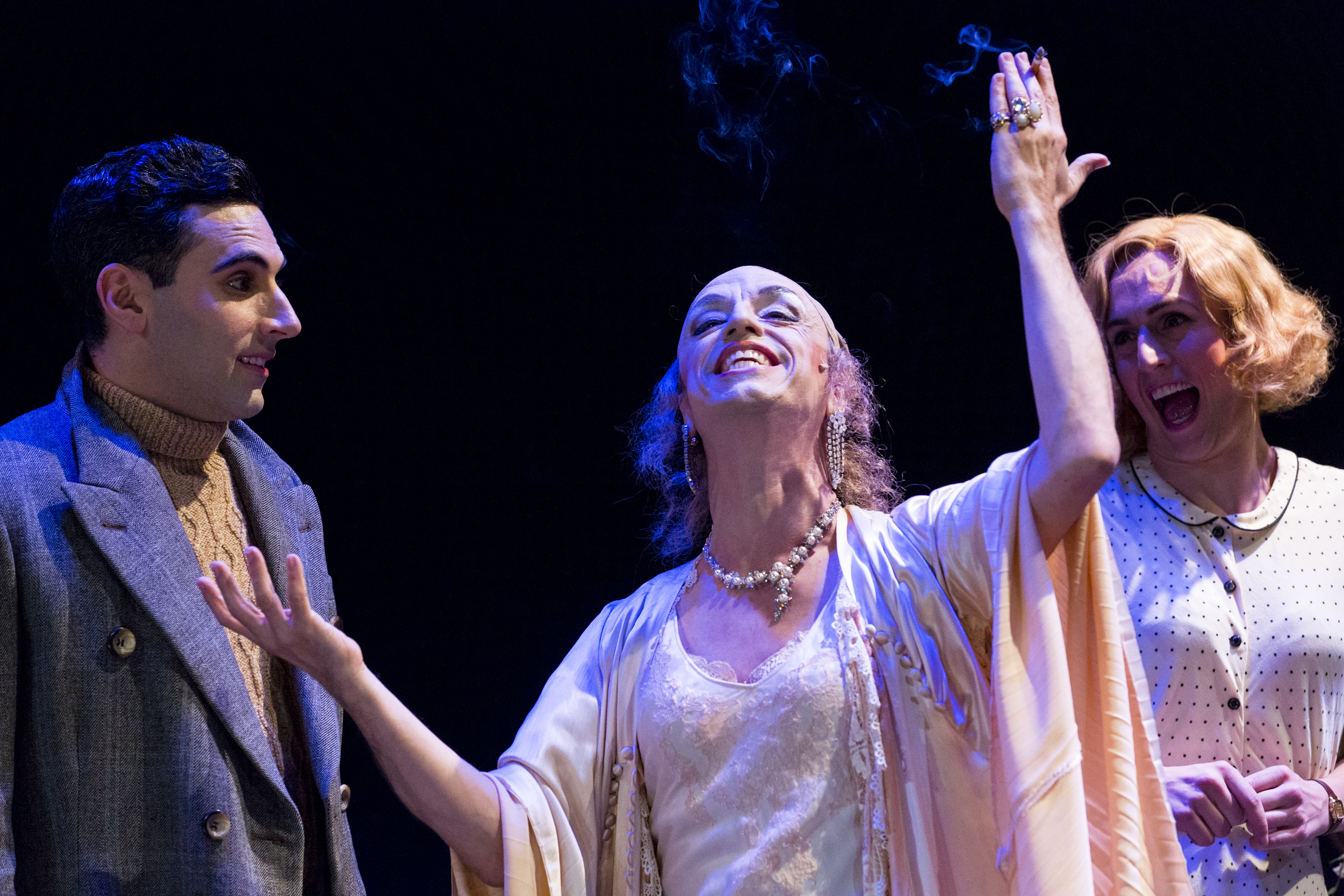
Peter Paltos, Paul Capsis and Ash Flanders. Photo: Brett Boardman

Peter Paltos, Paul Capsis and Ash Flanders. Photo: Brett Boardman

Melbourne’s self-styled “gay DIY drag-theatre” group Sisters Grimm (Ash Flanders and Declan Greene) has made a name for itself subverting classic film genres to create hilarious, high camp stage comedies.

Last year, Sydney Theatre Company had a hit when it presented Little Mercy, which played with the tropes of the “evil child” horror film.

Now comes Calpurnia Descending, a Sisters Grimm production commissioned by STC and Melbourne’s Malthouse Theatre, in which Flanders and Paul Capsis play rival divas. It sounds like a match made in heaven but Calpurnia Descending ends up feeling rather less than the sum of its parts.

It’s 1939. Aging, faded, Broadway legend Beverly Dumont (Capsis) is living as a recluse in a New York apartment with her sinister butler Tootles (Sandy Gore). But when a small-town, wannabe starlet called Violet St Clair (Flanders) comes across her by accident, Dumont agrees to make a dramatic return to the Broadway stage.

Dumont will star as Caesar’s third wife Calpurnia in a tragedy written by her late husband, while St Clair will play Cleopatra.

But will Beverly tolerate Violet when the director (Peter Paltos) is so obviously infatuated with her? And will the not-so-sweet ingénue be content in Beverly’s shadow?

Calpurnia Descending begins in familiar territory with echoes of iconic films like All About Eve, Sunset Boulevard and Whatever Happened to Baby Jane? Then a screen covering the entire stage descends and the production turns filmic. Black and white footage shot live (and badly out of sync) transform the narrative – the rehearsal period – into an old movie. This then morphs into a manic, dizzily colourful, pre-recorded animation in which Beverly appears trapped in a nightmarish video clip or web page.

Where Norma Desmond was undone by the transition from silent films to the talkies, Miss Dumont will struggle to survive in the Internet era where pop stars are the new divas.

Beverly is a gift of a role for Capsis who made his name “channeling” divas as a cabaret performer, and he makes the most of it, playing her spotlight-craving, hard-drinking monstrousness to the hilt while still making her tragic. It’s a fine performance.

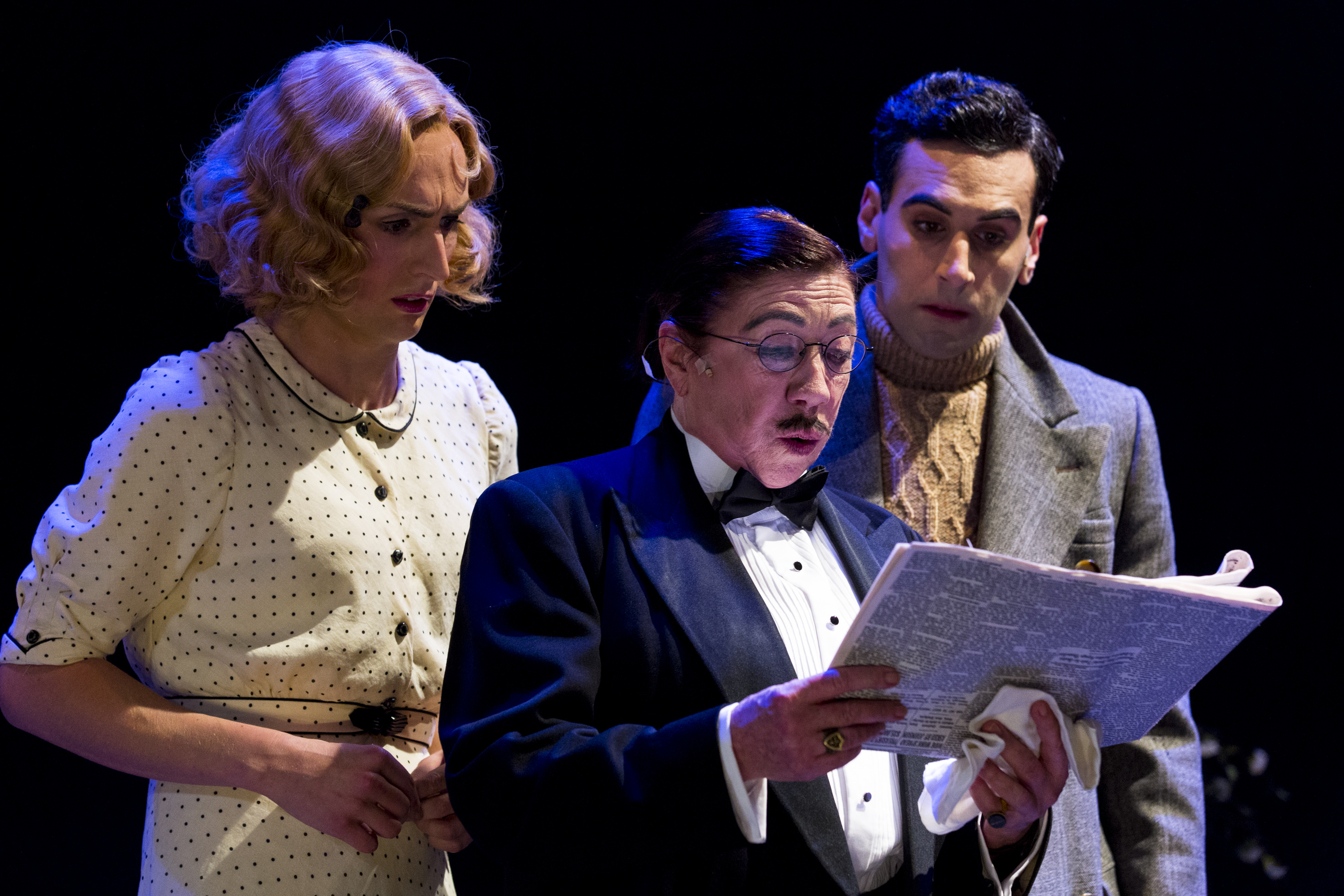
Ash Flanders,  Sandy Gore and Peter Paltos. Photo: Brett Boardman

Ash Flanders, Sandy Gore and Peter Paltos. Photo: Brett Boardman

Flanders conveys the ruthlessness beneath the sweet façade beautifully. The cross-gender casting also features Gore in nicely observed, amusing performances as Tootles and Broadway producer Max Silvestri who desperately needs a hit, while Paltos hits just the right note as the dashing, young, diva-struck director.

Calpurnia Descending is technically ambitious and cleverly designed (set and costumes by David Fleischer, AV by Matthew Gingold, animation by Matthew Greenwood, lighting by Katie Sfetkidis, sound by Jed Palmer). It’s also fun but the filmic element feels over-long and the plot twists become confusing.

Directed by Greene, the production goes beyond mere homage or parody but in the end what it’s trying to say isn’t clear. Some have read it as an exploration of the commercialisation of queer culture and appropriation of gay icons (think Katy Perry) but I’m not at all convinced that comes across.

Calpurnia Descending is at Wharf 2 until November 8

A version of this review ran in the Sunday Telegraph on October 19

Howie the Rookie

Old Fitzroy Theatre, October 2

Andrew Henry and Sean Hawkins. Photo: Kathy Luu

Andrew Henry and Sean Hawkins. Photo: Kathy Luu

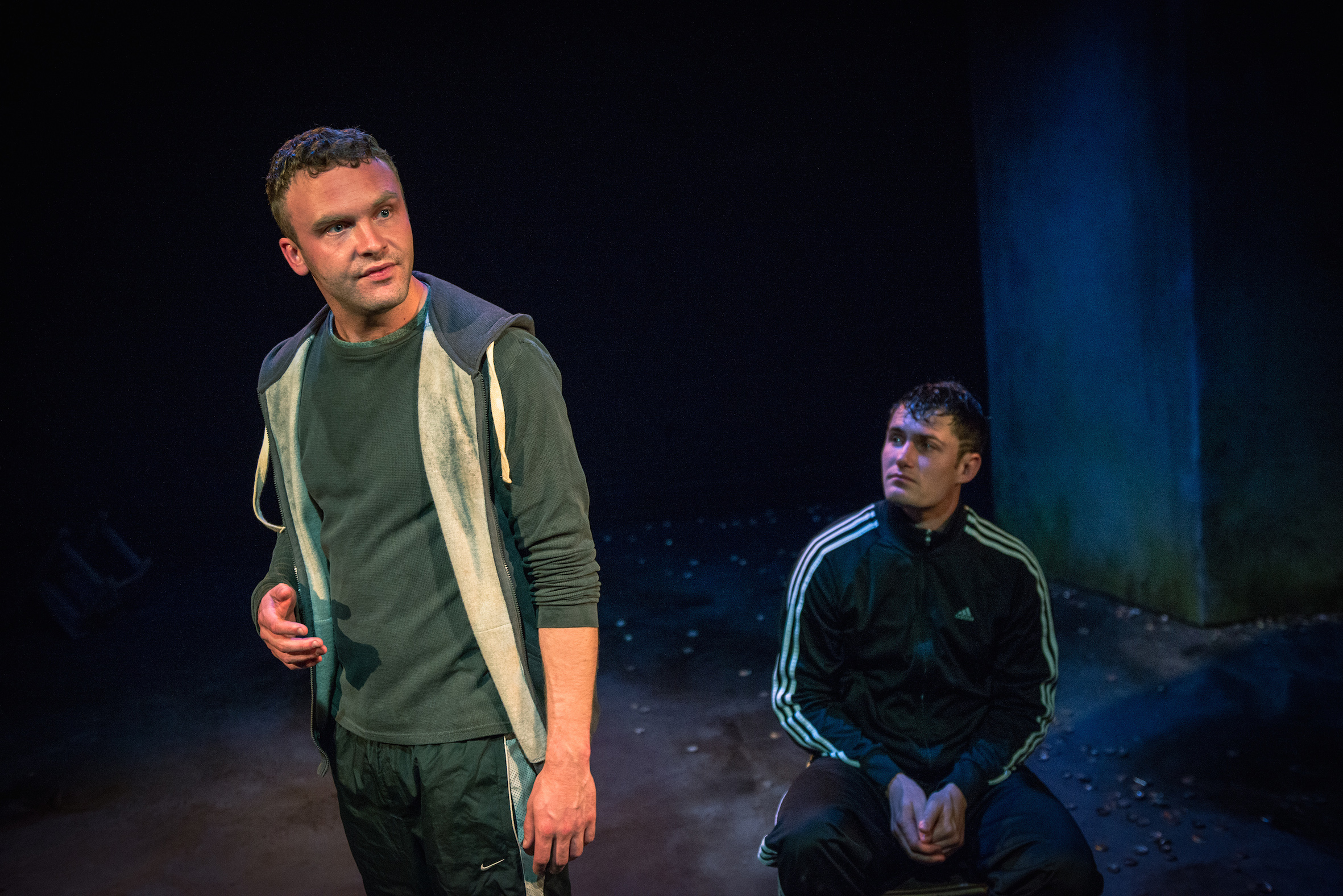
Irish writer Mark O’Rowe spins a gripping, blood-and-brawl yarn in the two intersecting 40-minute monologues that make up his 1999 play Howie the Rookie, which feels slightly fantastical and yet profoundly, horribly human.

Brought to brilliant life by Andrew Henry and Sean Hawkins, the production directed by Toby Schmitz packs a knockout punch.

Set in a tough, working-class suburb of Dublin in the late 1990s, the Howie Lee (Henry) begins the tale. He is, he tells us, out to bash up the Rookie Lee (same surname, but no relation) for infecting a mate’s mattress, where he sometimes sleeps, with scabies. So when his mum asks him to babysit his five-year old brother the Mouse Lee, he tells her in no uncertain terms where to get off.

When the Rookie (Hawkins) takes up the story, he reveals that he is in considerably more trouble than a bashing at the hands of the Howie and his mates. He has inadvertently killed the Siamese fighting fish belonging to the Ladyboy, a brutal gangster, and has to raise a substantial amount of cash if he wants to keep his kneecaps in tact, as a result of which an unlikely alliance forms between the Howie and the Rookie.

O’ Rowe’s use of language is exhilarating. Writing in a vibrant, robust, vital style that sings with a kind of blistering, slangy poetry (words like “slappercopper” for police woman, for example), he creates such vivid, visceral images you feel you are there.

The story is peopled with eccentric characters. The Howie is a bit of a dag and useless when it comes to chatting up girls, unlike the good-looking Rookie.

Then there’s the Avalanche, a mountainous vision in white ski pants who lusts after the Howie (who has bedded her once) and now keeps appearing at inopportune times like when he’s taking a leak.

The Howie’s friends include Flan Dingle, who has dreadful BO, Ginger Boy with blazing red hair and the Avalanche’s towering brother (“six feet tall, built like a human white puddin’), who may not be quite the full quid. As for the Ladyboy, he is rumored to have three rows of teeth like a shark.

A dark, ugly comedy full of booze, piss, blood, biff and violence, it’s very funny – until it suddenly gets all too real.

Schmitz – who is currently based in South Africa where he is playing a featured role in the pirate TV series Black Sails – returned to Australia briefly to direct Howie the Rookie.

Lisa Mimmocchi has designed him the perfect, minimal set: a black box space with nothing in it except two chairs for the storytellers, a tiny up-ended chair in the corner (the meaning of which is explained in the course of the tale) and a pile of beer bottle tops. The tracksuits she chooses for the two storytellers are also spot-on, while the shaved pattern in Hawkins’ hair is an inspired touch.

Schmitz, who performed at the Old Fitz several times early in his career, uses the space exceptionally well. His decision to have both men there throughout the two monologues is a canny one, for starters. They sit, sipping on a beer, while the other talks, occasionally reacting and making eye contact, but mostly just present. But it somehow makes it feel more real to see the other key person in the story.

Schmitz also uses the bottle tops, just twice, to send a jolt through the audience. Alexander Berlage’s lighting and Jeremy Silver’s sound complete the picture perfectly.

Henry and Hawkins are both excellent; Henry capturing the insecurity beneath the loutish Howie’s almost pathetic bravado, Hawkins also conveying the vulnerability beneath the Rookie’s far cooler façade. By the end of the piece we have come to care about both of them and the denouement is surprisingly moving.

The two actors do a pretty good job with the Oirish accent too (dialect coach, Gabrielle Rogers).

Howie the Rookie is a tough little gem, which sits perfectly in the tiny, 50-seat pub theatre at the Old Fitz. Recommended.

Howie the Rooks runs at the Old Fitzroy Theatre until October 25. Bookings: www.sitco.net.au or 1300 307 264

The Last Confession

Theatre Royal, September 24

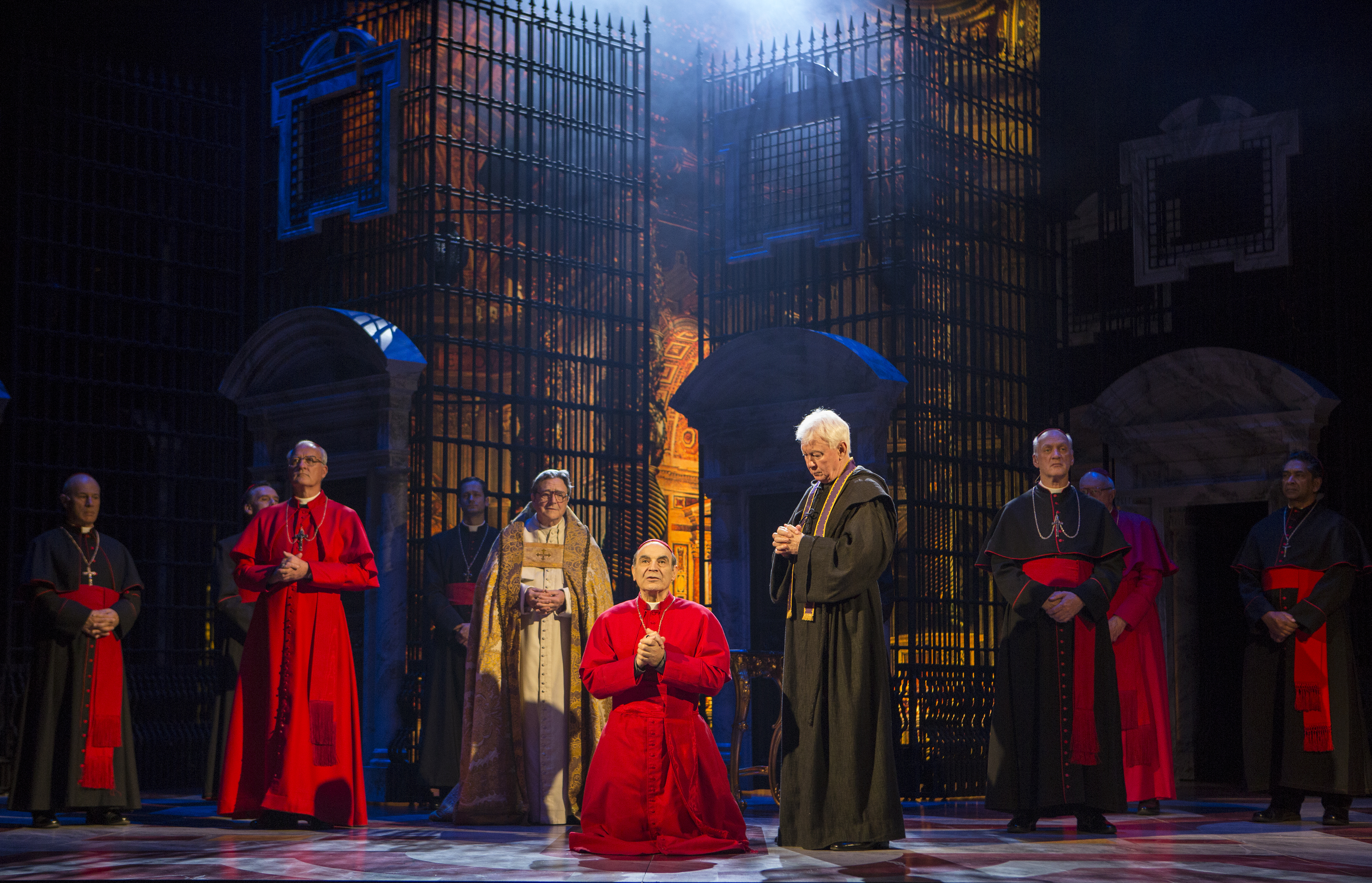
David Suchet and the cast of The Last Confession. Photo: Cylla von Tiedemann

David Suchet and the cast of The Last Confession. Photo: Cylla von Tiedemann

In 1978, Pope John Paul I died just 33 days into his papacy. When it emerged that on the eve of his death, he had told several cardinals hostile to his planned reforms that he was removing them from Rome, there were suspicions of foul play.

The mystery has all the makings of a fascinating drama but The Last Confession by Roger Crane, an American lawyer and first-time playwright, is a rather stolid, old-fashioned play, which only fires intermittently.

The main draw-card is that it stars David Suchet (of Poirot fame) – and he doesn’t disappoint.

Suchet plays Cardinal Giovanni Benelli, who engineers the election of his friend Cardinal Albino Luciani to the papacy and then suffers a crisis of faith after his death.

Directed by Jonathan Church on William Dudley’s grandiose set, the play starts slowly, with a long stretch of un-dramatic dialogue taking an age to set things up. It only comes to life when Luciani becomes Pope and locks horns with intransigent, conservative members of the Roman Curia.

Benelli’s investigation into the Pope’s death in Act II is also lively. But the play frequently gets bogged down in long, wordy debates.

Fortunately the international cast of 20 are all extremely good. Suchet is a charismatic presence and uses his rich, velvety voice to great effect in a powerful, if slightly mannered, performance.

Richard O’Callaghan is also a standout as the gentle, humble, morally upright yet determined “people’s Pop” John Paul I who wants to bring the Catholic Church into the 20th century.

The Last Confession offers a peek into the machinations of the Catholic Church and the corrupt power of the Vatican bank. With a shorter, sharper script it could be intriguing.

The Last Confession runs at Sydney’s Theatre Royal until October 12. Bookings: www.ticketmaster.com.au or 136 100

A version of this review ran in the Sunday Telegraph on September 28