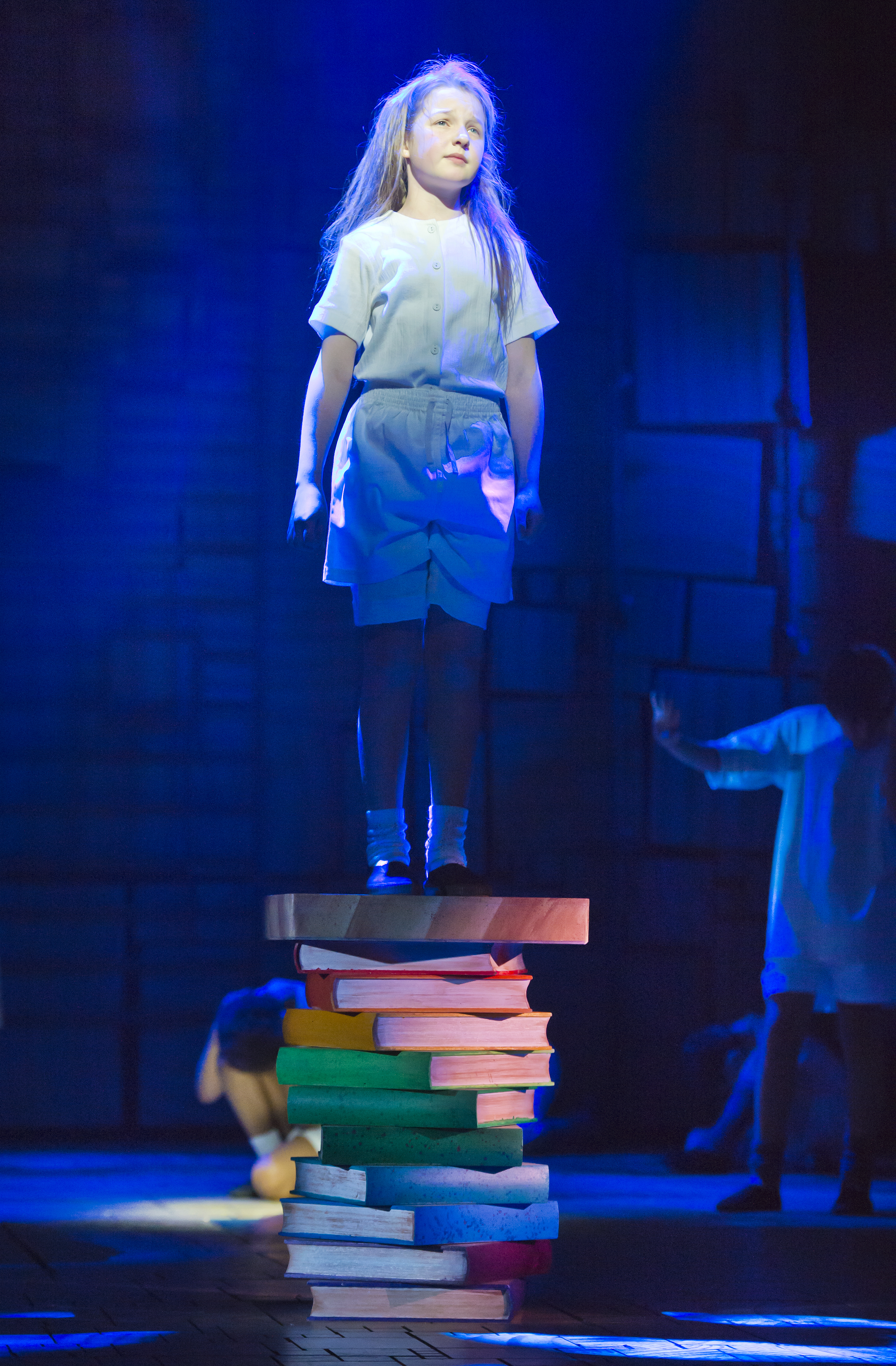
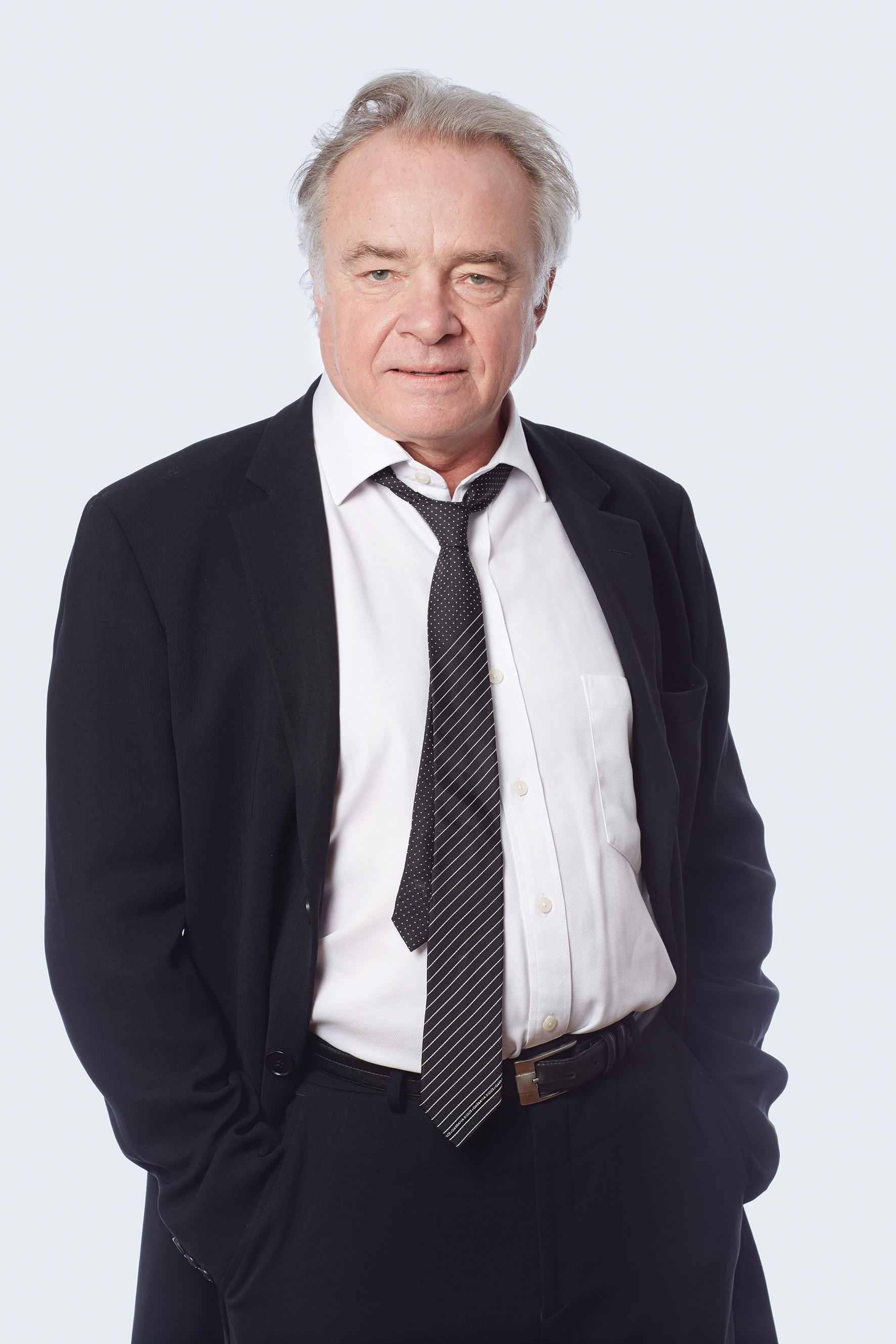
Sean Taylor in My Zinc Bed

Sean Taylor plays a charismatic millionaire in David Hare's My Zinc Bed

Sean Taylor plays a charismatic millionaire in David Hare’s My Zinc Bed

While rehearsing at the Ensemble Theatre for its current production of David Hare’s My Zinc Bed, Sean Taylor also managed to fit in a couple of day’s filming on Secret City, a new political drama for Foxtel being shot in Canberra.

“It’s the first time I’ve ever worked with an Oscar nominee so it was daunting,” he quips.

The Academy Award nominee in question is his wife Jacki Weaver. They’ve acted opposite each other many times. In fact, they met when they played lovers in David Williamson’s Soulmates for Sydney Theatre Company in 2002, marrying the following year.

“But this is the first time post-nomination, well, twice nominated,” he says.

“But, no, it’s been a lot of fun. Jacki plays the Attorney General and I play the Head of ASIO so she’s my boss and there’s one scene where she fires me. She’s been working very hard and from the little I’ve seen I think it’s going to be a good series.”

It was just coincidence that filming on Secret City coincided with rehearsals for My Zinc Bed but it has given them a chance to spend some time together and for Weaver to be at the opening night this Thursday.

Born in South Africa, Taylor emigrated to Australia in 2000 to be near his two daughters who moved here with their mother after they divorced.

“I try to go back to Africa at least once a year and see friends and family but I suppose I’m spending most of my time these days in Los Angeles (due to Weaver’s career),” he says.

Blessed with a beautiful, deep, sonorous voice, Taylor is a commanding stage actor recently seen at the Ensemble in productions of Hare’s Skylight and Joe Penhall’s Blue/Orange. 

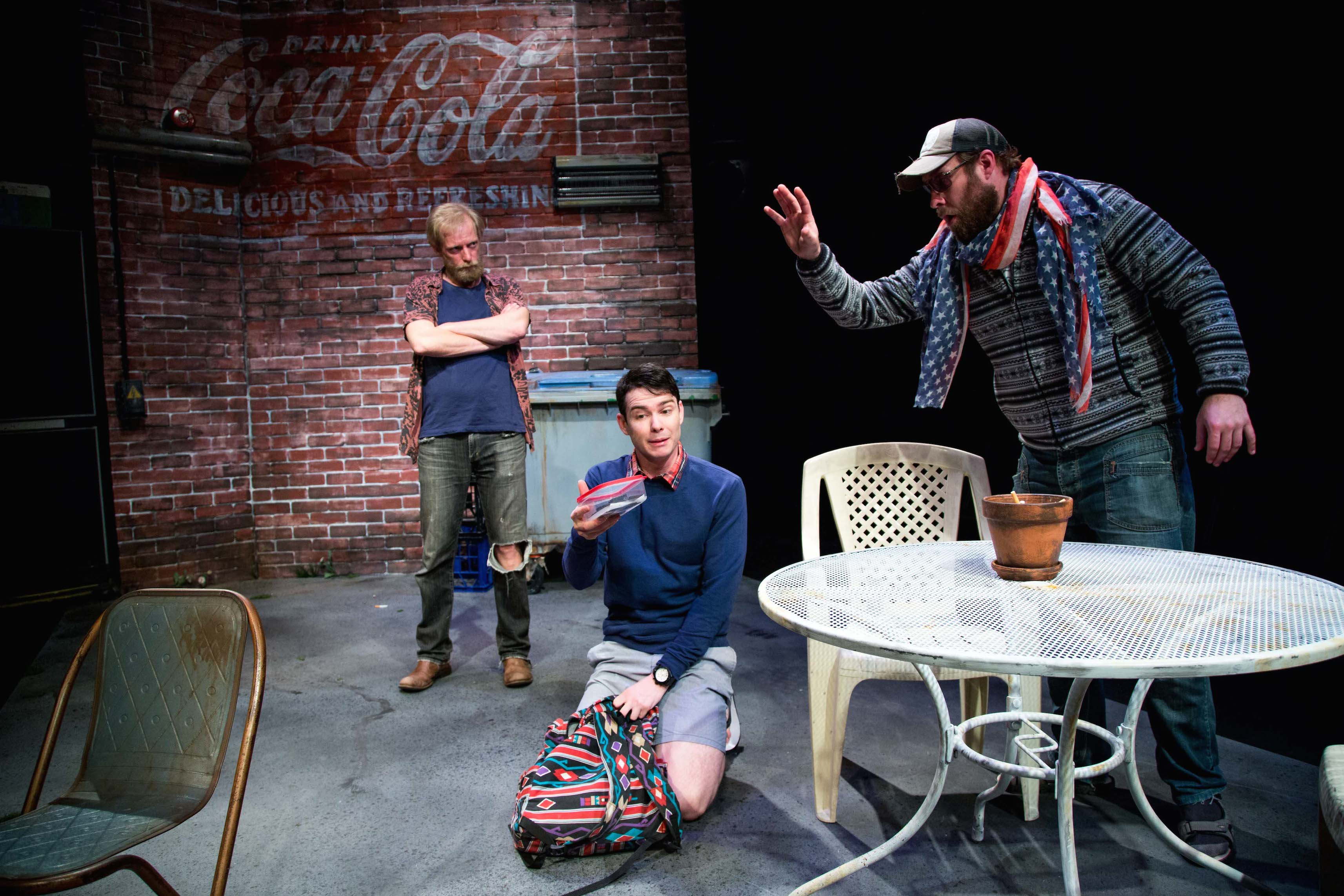
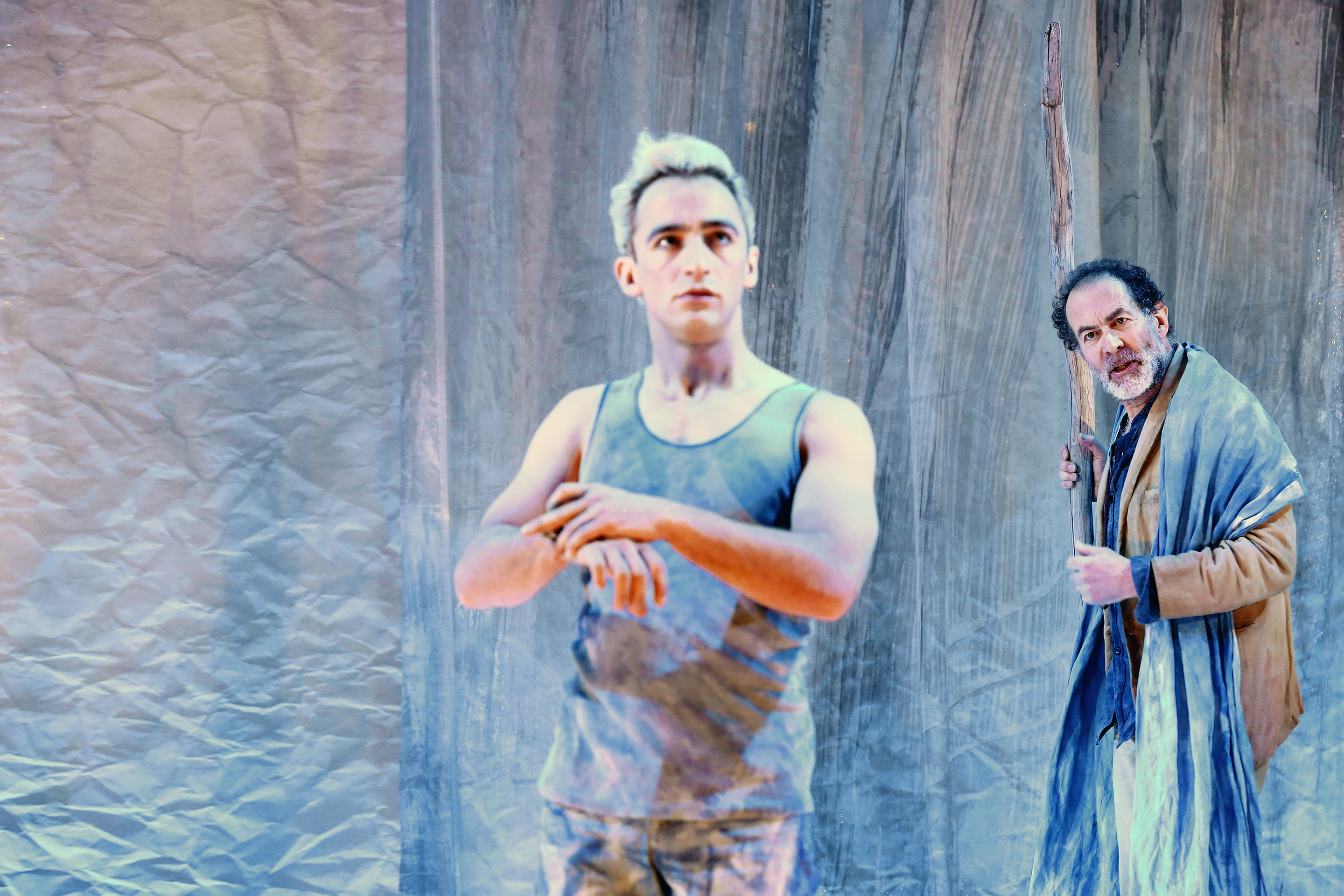
In Hare’s intriguing play My Zinc Bed, which explores themes of addiction, he plays Victor Quinn, a charismatic millionaire. Directed by Mark Kilmurry, the Ensemble is staging a new 90-minute version.

Taylor bought the script and learned the whole play while in LA prior to rehearsals without knowing that they were using a different version.

“I’m of an age now (60) where I can’t learn something in 10 days, it takes longer,” he admits candidly.

“I got here and suddenly there was this other tighter version of the play and I thought that Hare had cut some very nice stuff out so I persuaded Mark to bring some of the other stuff back in and it’s working very well I think.”

When a hard-up poet and reformed alcoholic called Paul Peplow is sent to interview Victor for a newspaper profile, he finds himself enticed into a thrilling but dangerous world. As Paul spars verbally with Victor and flirts with his younger wife Elsa, his hard-won sobriety is threatened. But is Victor just using Paul to amuse his wife and reinvigorate their stale marriage?
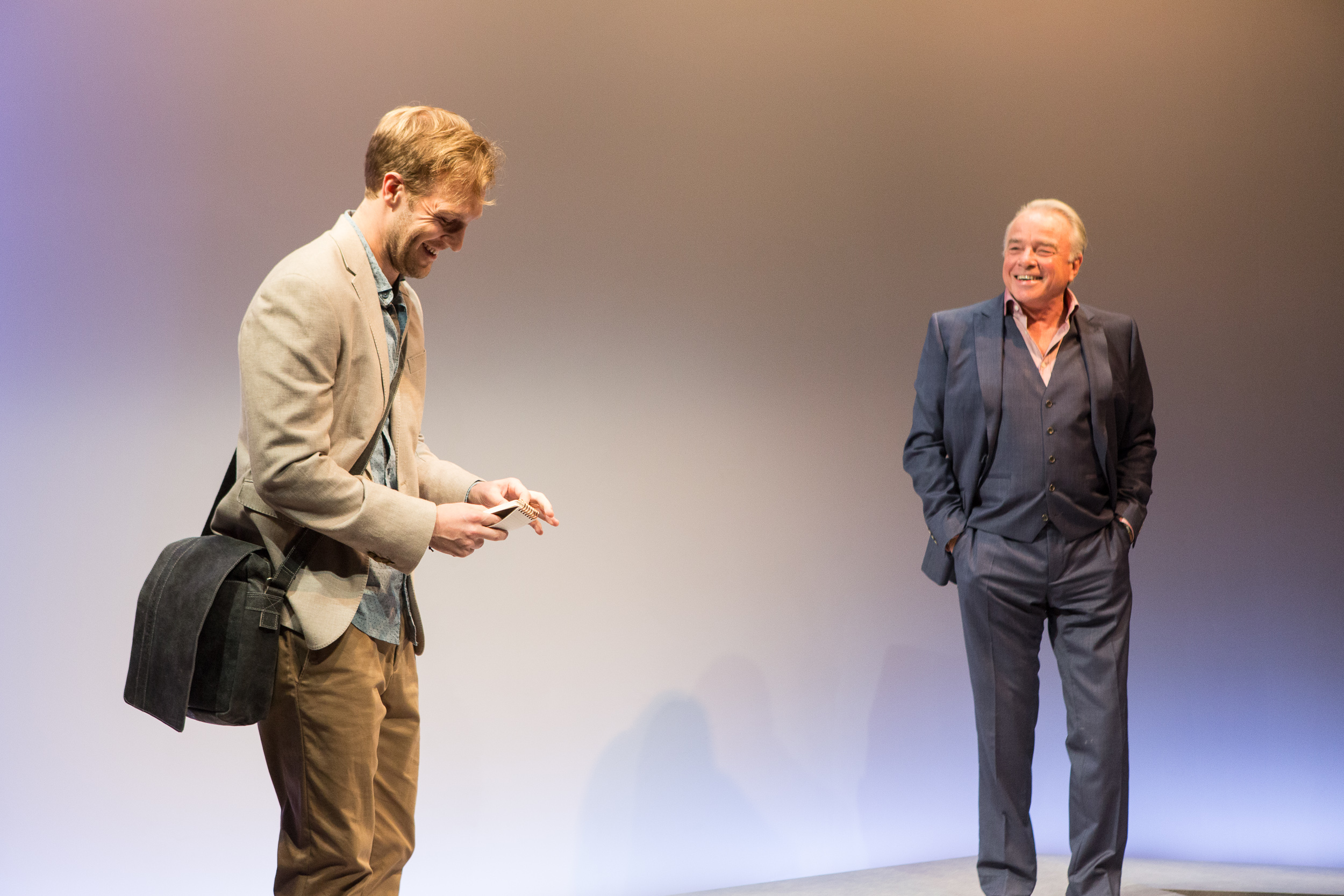
Sam O'Sullivan and Sean Taylor in My Zinc Bed. Photo: Clare Hawley

Sam O’Sullivan and Sean Taylor in My Zinc Bed. Photo: Clare Hawley

“There’s a lot of game-playing and manipulation in the way Victor sets things up,” says Taylor.

“In the last couple of runs I’ve been playing against that a bit just to see how it goes but Mark prefers it that I lay it on a bit. I’m trying to make him not quite so obvious. But Paul, who is played by Sam O’Sullivan, actually says: ‘Am I Faust? Is he Mephistopheles? Am I making a pact with the devil?’

“It’s about addiction to many things, I think, besides drink and drugs. I think there’s a certain addiction to chaos. Some people thrive on it. When their life is running smoothly they veer off. I think the other two characters especially seek that because it makes them feel alive but they also realise that if they do follow those instincts then they can spiral into a very bad situation,” says Taylor.

“Hare always deals with politics even if he doesn’t overtly state it,” he adds. “My character used to be a communist and now he’s this capitalist – which is kind of a similar journey to what Hare’s been on, I think. He was a big leftie when he was younger. I remember readings his plays like Fanshen, which was about the Chinese revolution. Now he’s an older man and very successful. The younger character is maybe a bit like Hare in that he’s a writer.”

Taylor also plays Harold Holt in a new short film called The Defector directed by Scott Mannion, with Oscar winner Russell Boyd (Master and Commander) as Director of Photography, which he describes as “a quirky film”.

“What really got me interested when I was approached about it was that Russell Boyd was the cameraman on it. And Russell Boyd has actually written a thing online about this young director saying he believed in him so I thought that’s a project I’d like to be involved in.”

Taylor admits that life has changed since Weaver’s breakout film role in Animal Kingdom.

“Five or six years ago, I never dreamed we’d be living in Los Angeles,” he says. “It’s an interesting city but it’s not a city I would choose to live. Hollywood was never on my radar. So I don’t know that I love Los Angeles, but Jacki really loves it. She’s really enjoying it, and so she should. She’s been in this game a long time. I said to her, ‘you’ve got to take this ball and run with it. You never know when it will implode. It might never implode but it might, so just enjoy it,’” he says.

“I’m still working on trying to get a visa so it get a bit boring when you’re not working. I’ve been for a couple of screen tests and had very good responses. But the people in my age bracket have been working there for 40 years and they’re established.

“I was up against Nick Nolte for a role and you go: ‘well I ‘m farting against thunder here aren’t I?’ But still it’s good to go and meet these people. The role is out there somewhere. It might never land in my lap but if I’m fortunate to be in the right place at the right time that will be great. If it happens I’ll embrace it.”

My Zinc Bed plays at the Ensemble Theatre until November 22. Bookings: 9929 0644
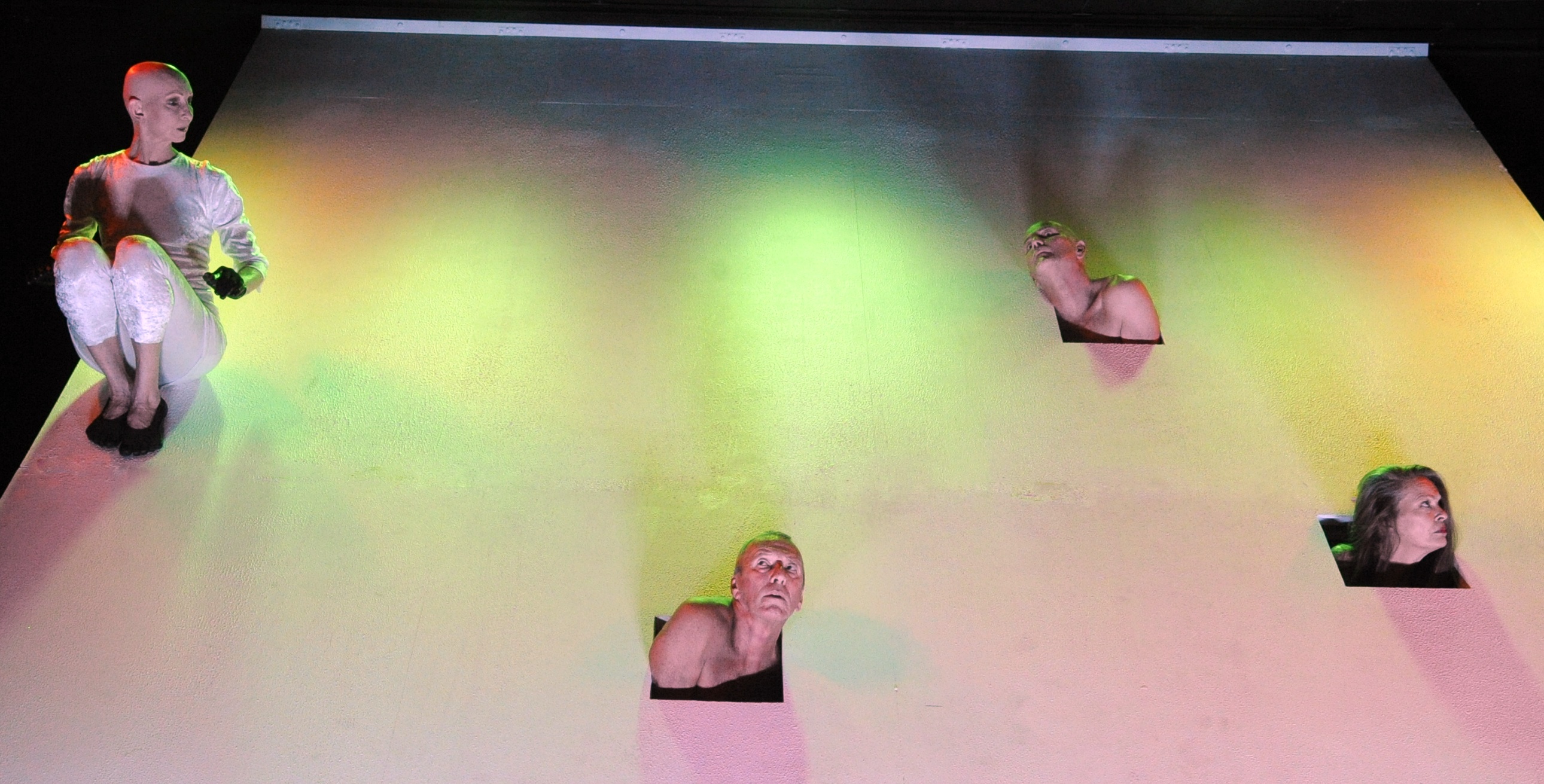
Departures

Ken Unsworth Studio, Alexandria, October 4

Anca Frankenhaeuser, Patrick Harding-Irmer, Ross Philip and Susan Barling. Photo: Regis Lansac

Anca Frankenhaeuser, Patrick Harding-Irmer, Ross Philip and Susan Barling. Photo: Regis Lansac

Since 2000, eminent sculptor and artist Ken Unsworth has collaborated with Australian Dance Artists (ADA) on a series of productions, which have now become a highly anticipated annual event for the lucky invited audience.

Part-performance and part-installation, frequently with live music, their work is unlike anything else we are seeing on Sydney’s dance scene.

ADA is made up of four senior/veteran dance artists who have had long, prestigious careers in contemporary dance: Anca Frankenhaeuser and Patrick Harding-Irmer who performed with London Contemporary Dance Theatre, and Susan Barling and Ross Philip, who performed with Sydney Dance Company. Norman Hall, who was ADA’s Founding Director, continues to work with them as a choreographic collaborator.

Susan Barling and Ross Philip. Photo: Regis Lansac

Susan Barling and Ross Philip. Photo: Regis Lansac

Their latest production, Departures, is currently weaving its inspired, crazy magic at Unsworth’s studio in Alexandria where he has built a stage and a small auditorium with three rows of church pews for around 50 people.

Unsworth, who basically finances the productions personally, has commissioned a new score from Jonathan Cooper for Departures, and it’s a beauty. It is performed live by members of the Australian Piano Quartet, Rebecca Chan, Glenn Christensen, James Wannan and Thomas Rann, augmented by Benjamin Kopp on piano, Genevieve Lang on harp and Katherine Lukey on violin.

As always, the production is full of extraordinary, surreal imagery with the choreography created in response to the music and the strange and wonderful sculptural creations that Unsworth has built.

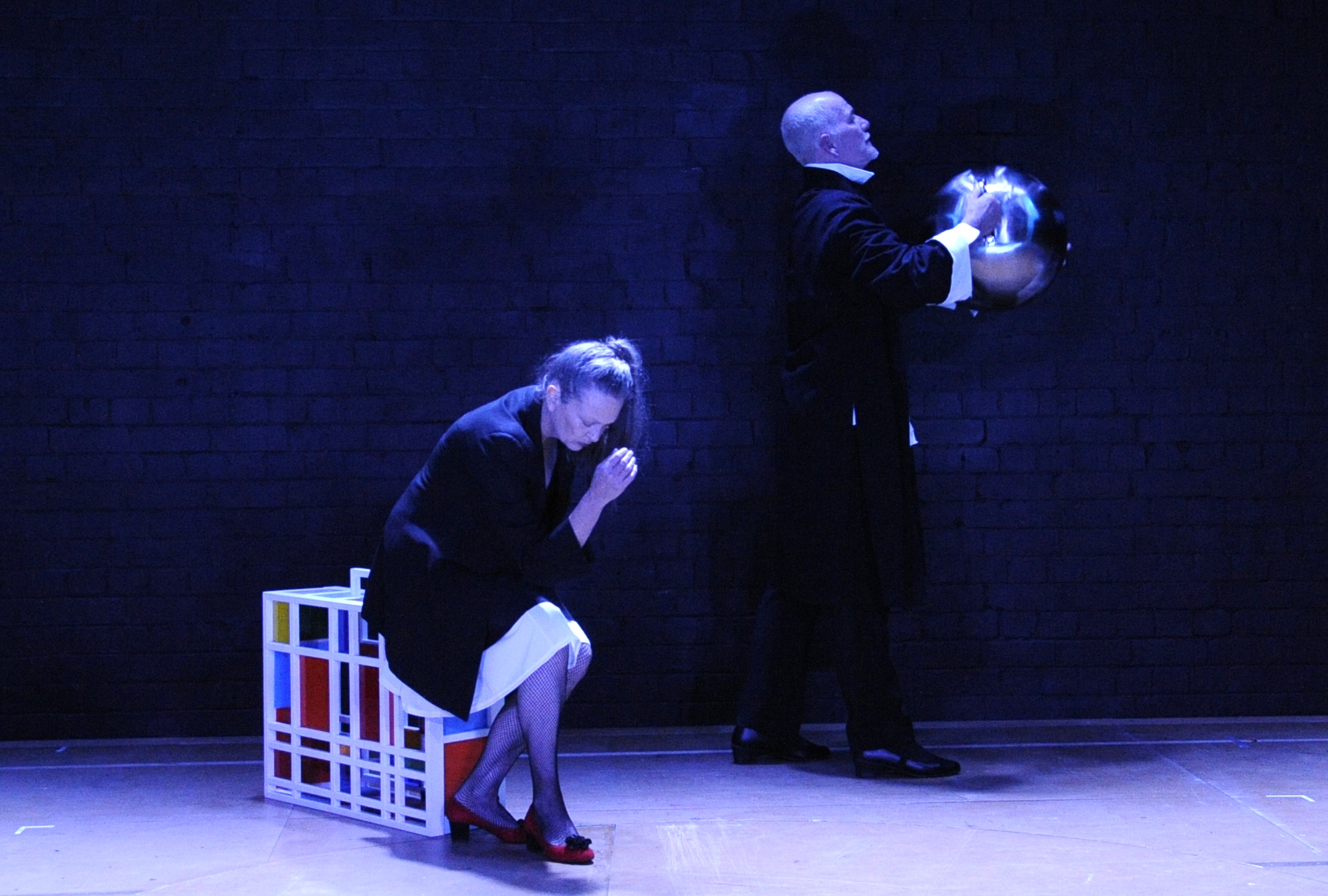
The production begins with a huge ball, mirrored by a smaller one, swinging back and forth in hypnotic fashion, while a glowing orb rises and sets like the sun.

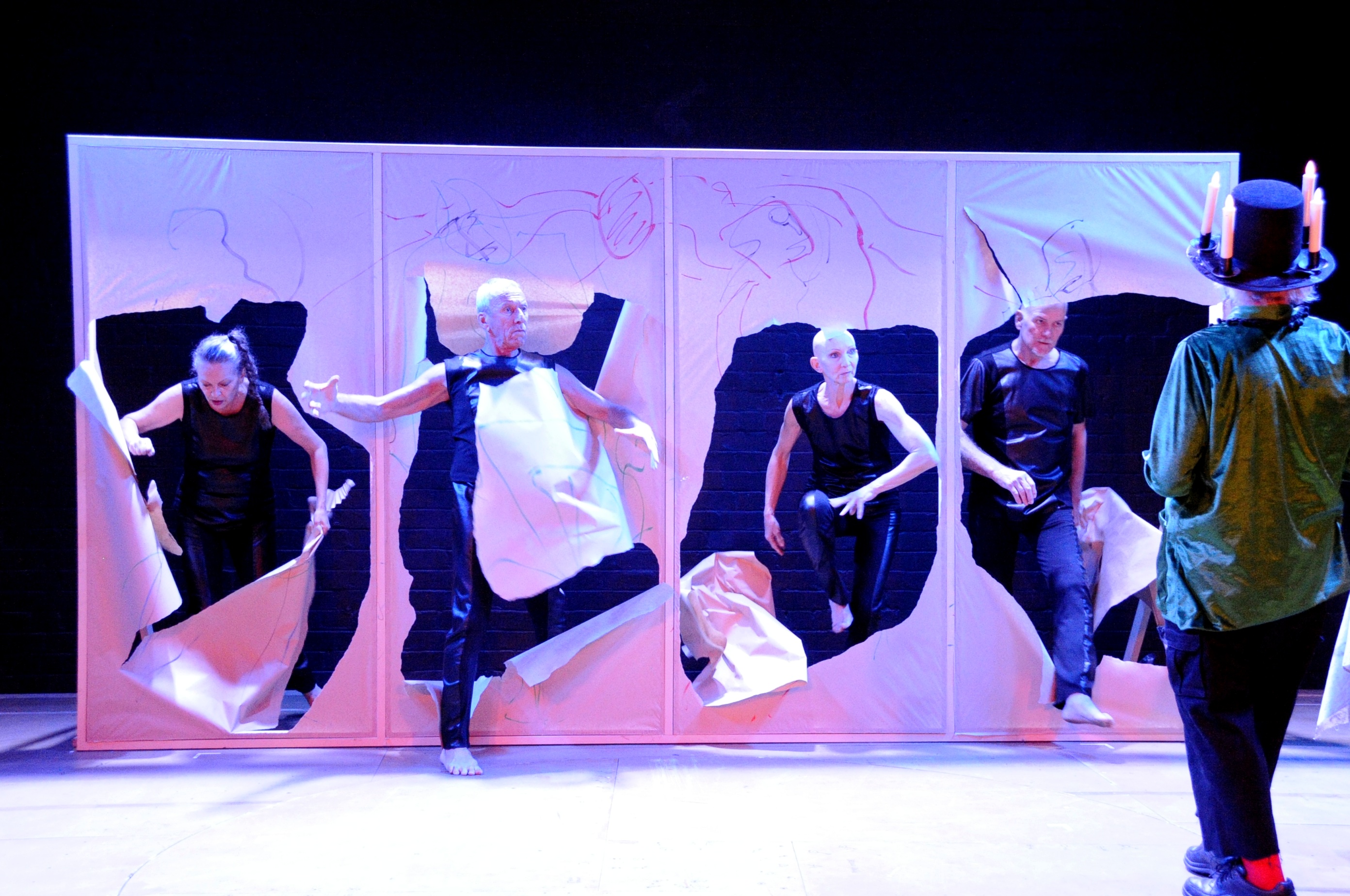
Susan Barling, Ross Philip, Anca Frankenhaeuser and Patrick Harding-Irmer. Photo: Regis Lansac

Susan Barling, Patrick Harding-Irmer, Anca Frankenhaeuser and Ross Philip with Ken Unsworth. Photo: Regis Lansac

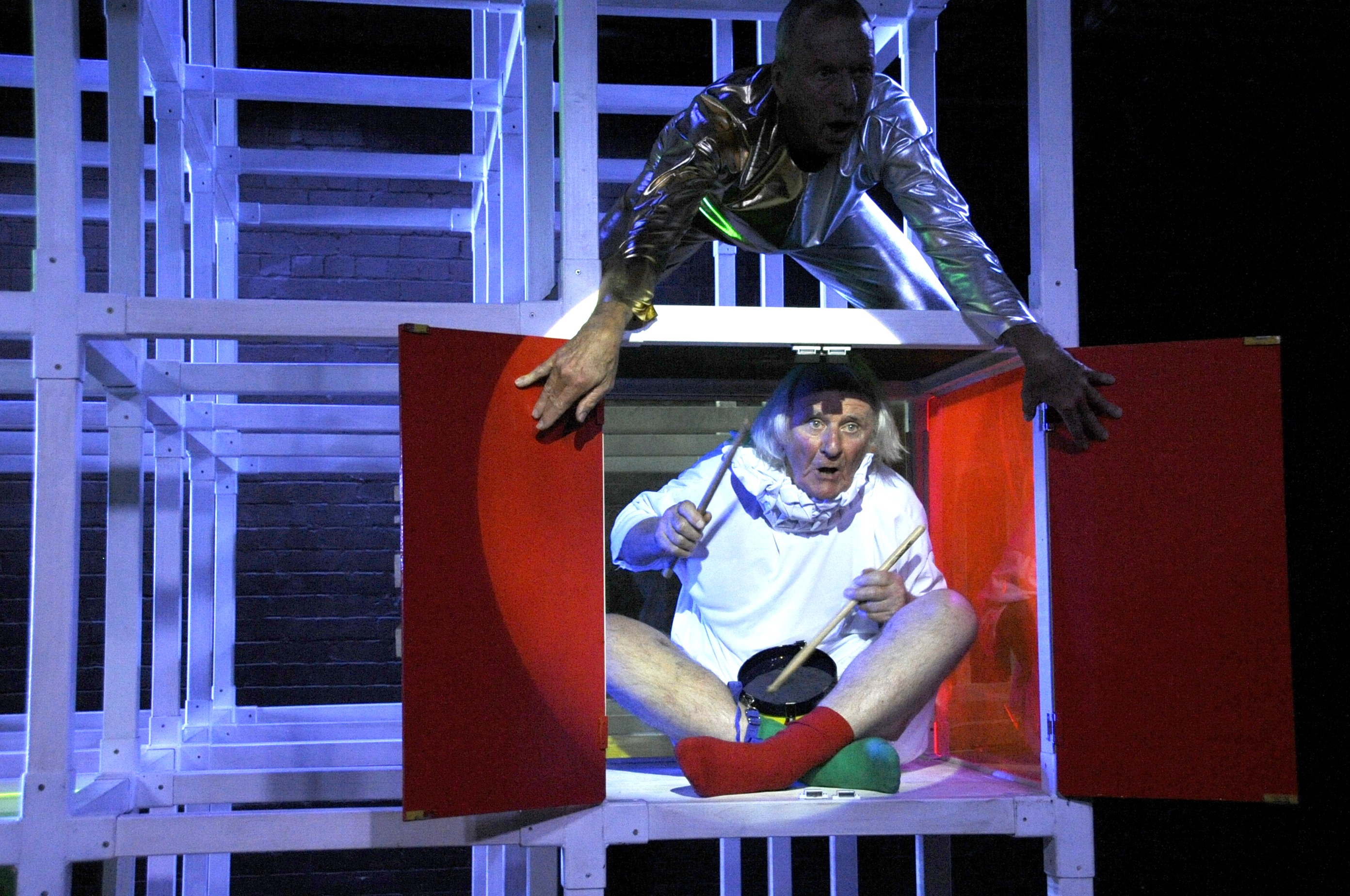
Appearing in a top hat with candles, shirt, pants and jauntily mis-matched, colourful socks, Unsworth begins painting figures on paper panels only to be manhandled and summarily dismissed as the dancers make their dramatic appearance.

From there, the production unfolds through a series of powerful images that explore themes of art, love, life and death.

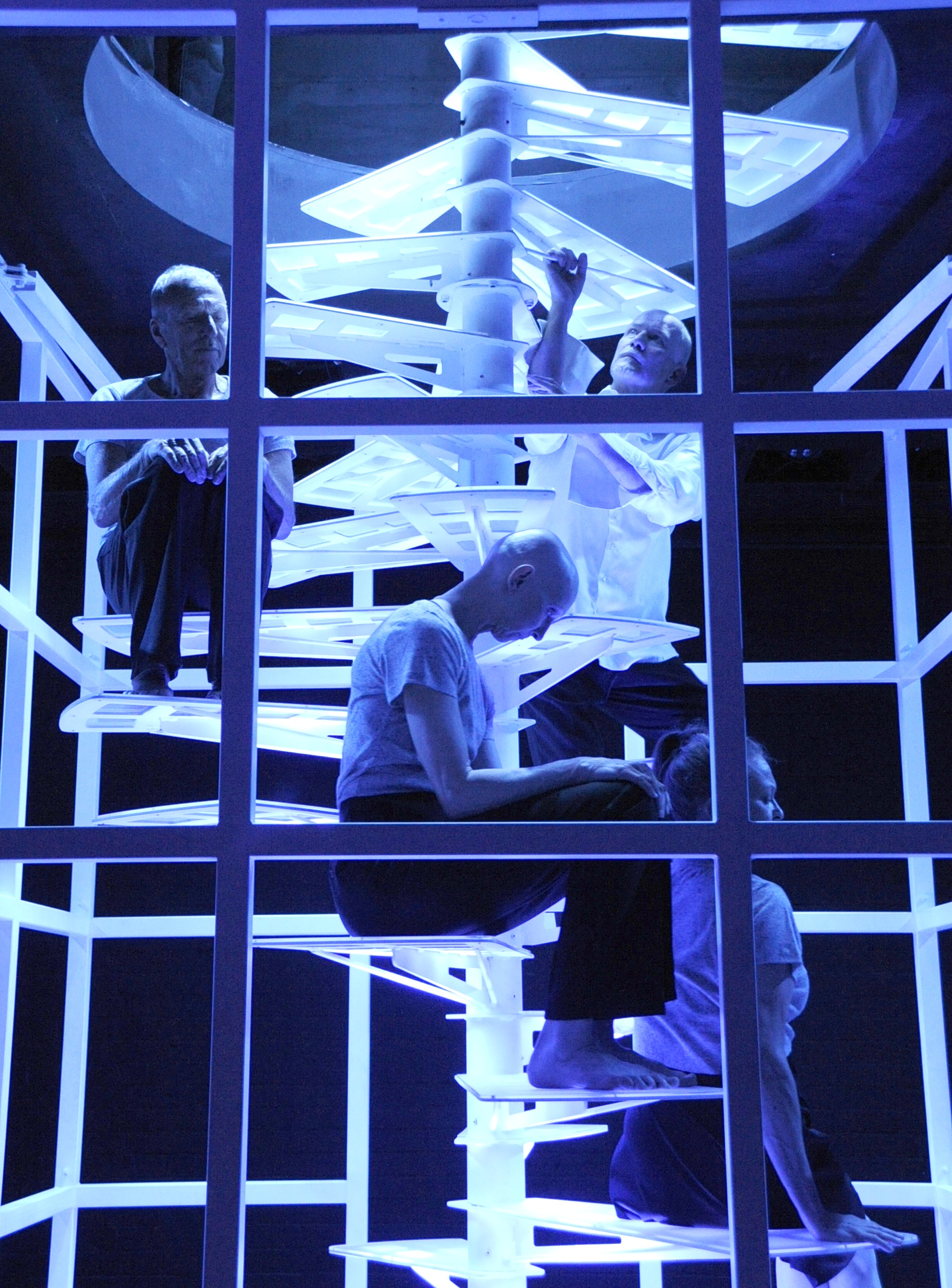
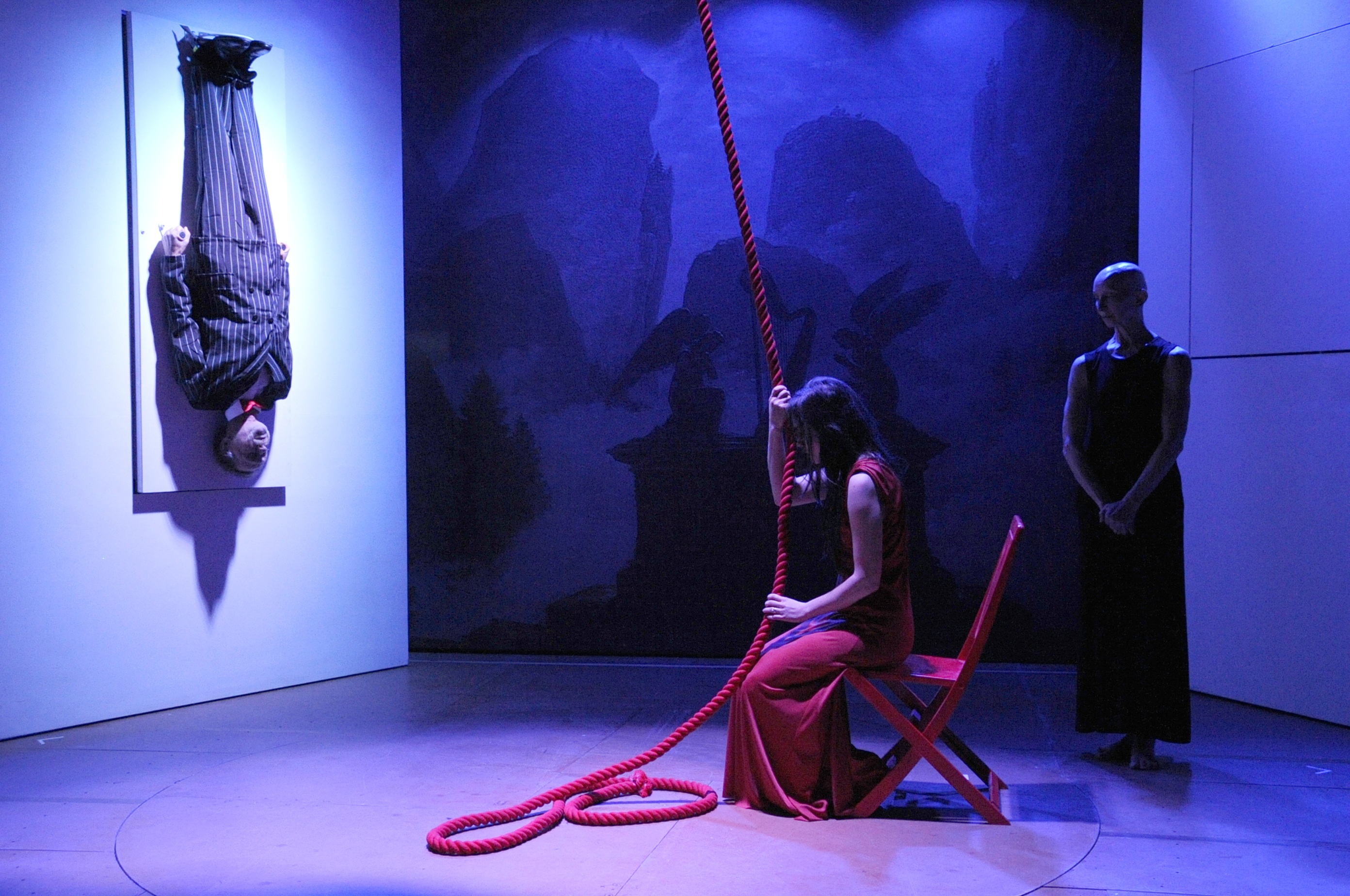
Unsworth has built several large sculptural pieces: a steep slope which Frankenhaeuser traverses with exquisite, elegant poise while interacting with the heads that appear, almost Beckett-like, through trapdoors; a large, square metal frame with hidden secrets behind doors in various compartments; and a spinning double helix spiral staircase which disappears into the roof, which the dancers ascend and descend simultaneously.

There are also two walls – one which has an anguished Barling appearing and disappearing on a spinning shelf, and another with a door to which singer Clive Birch is strapped while singing upright and then upside down.

Patrick Harding-Irmer, Anca Frankenhaeuser. Photo: Regis Lansac

Patrick Harding-Irmer, Anca Frankenhaeuser Ross Philip and Susan Barling. Photo: Regis Lansac

As well as commissioning the score, Unsworth has written the lyrics to a song, Never Ever, performed by Birch and young soprano Rioghnach Wegrecka who walks across the back of the stage from one brightly coloured chair to another.

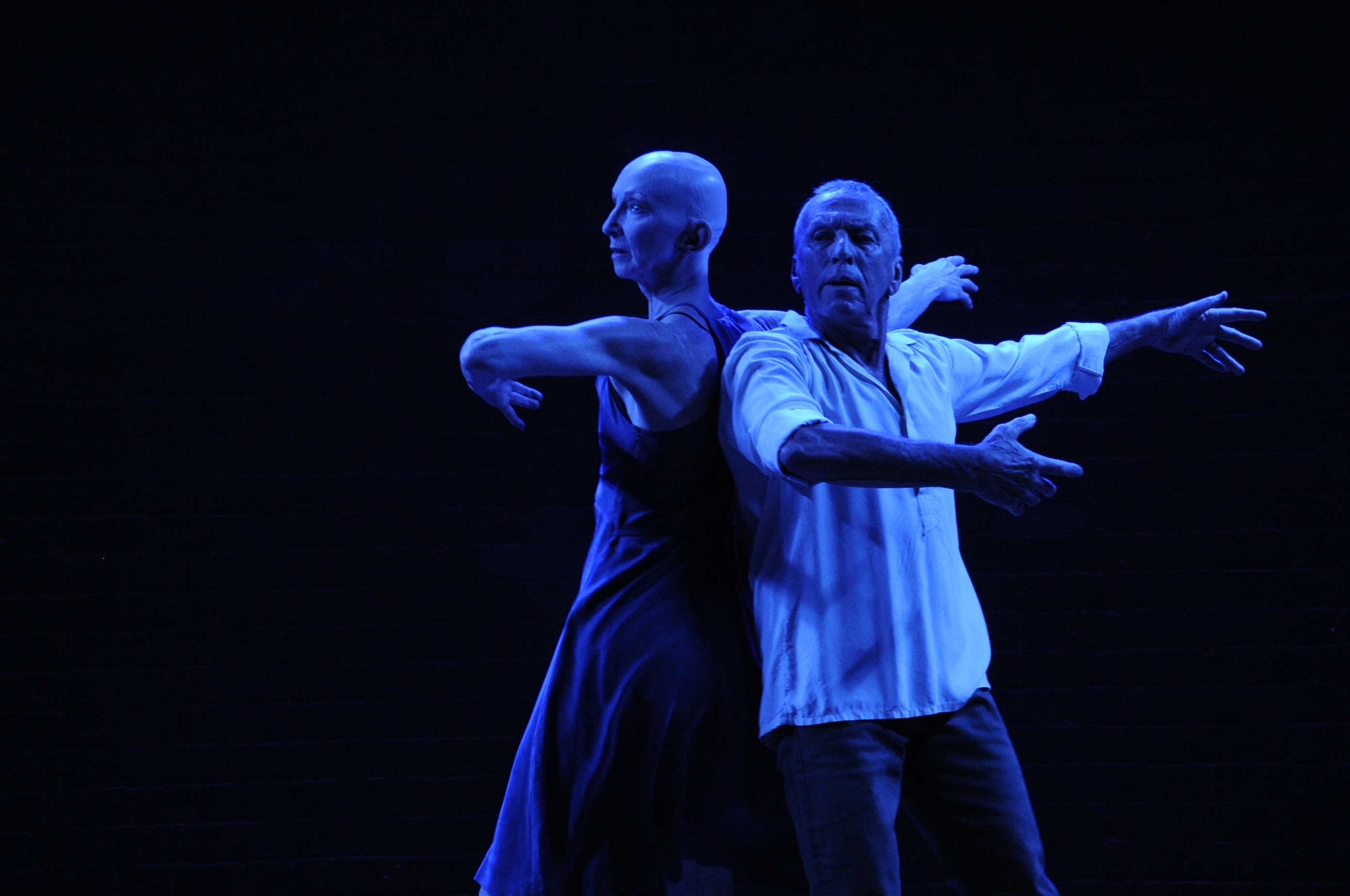
There’s also a very beautiful, moving duet by Frankenhaeuser and Harding-Irmer, which subverts and distorts the movement to match the music, as well as numerous other striking images including Harding-Irmer in suit jacket and high heel shoes. As always, the movement is underpinned by a depth of emotion from the mature but still toned and eloquent dancers.

Duet between Patrick Harding-Irmer and Anca Frankenhaeuser. Photo: Regis Lansac

Duet between Patrick Harding-Irmer and Anca Frankenhaeuser. Photo: Regis Lansac

With lighting by Roderick van Gelder, costumes by Pamela McGraw and soundscapes by Nate Edmondson, Departures is another feather (candle) in the cap for a unique and inspiring company. Their work really should be more widely seen.

Ken Unsworth makes an appearance in one of his extraordinary sculptures. Photo: Regis Lansac

Ken Unsworth makes an appearance in one of his extraordinary sculptures. Photo: Regis Lansac

Clive Birch and Rioghnach Wegrecka. Photo: Regis Lansac

Singers Clive Birch and Rioghnach Wegrecka. Photo: Regis Lansac

High Society

Hayes Theatre Co, September 7

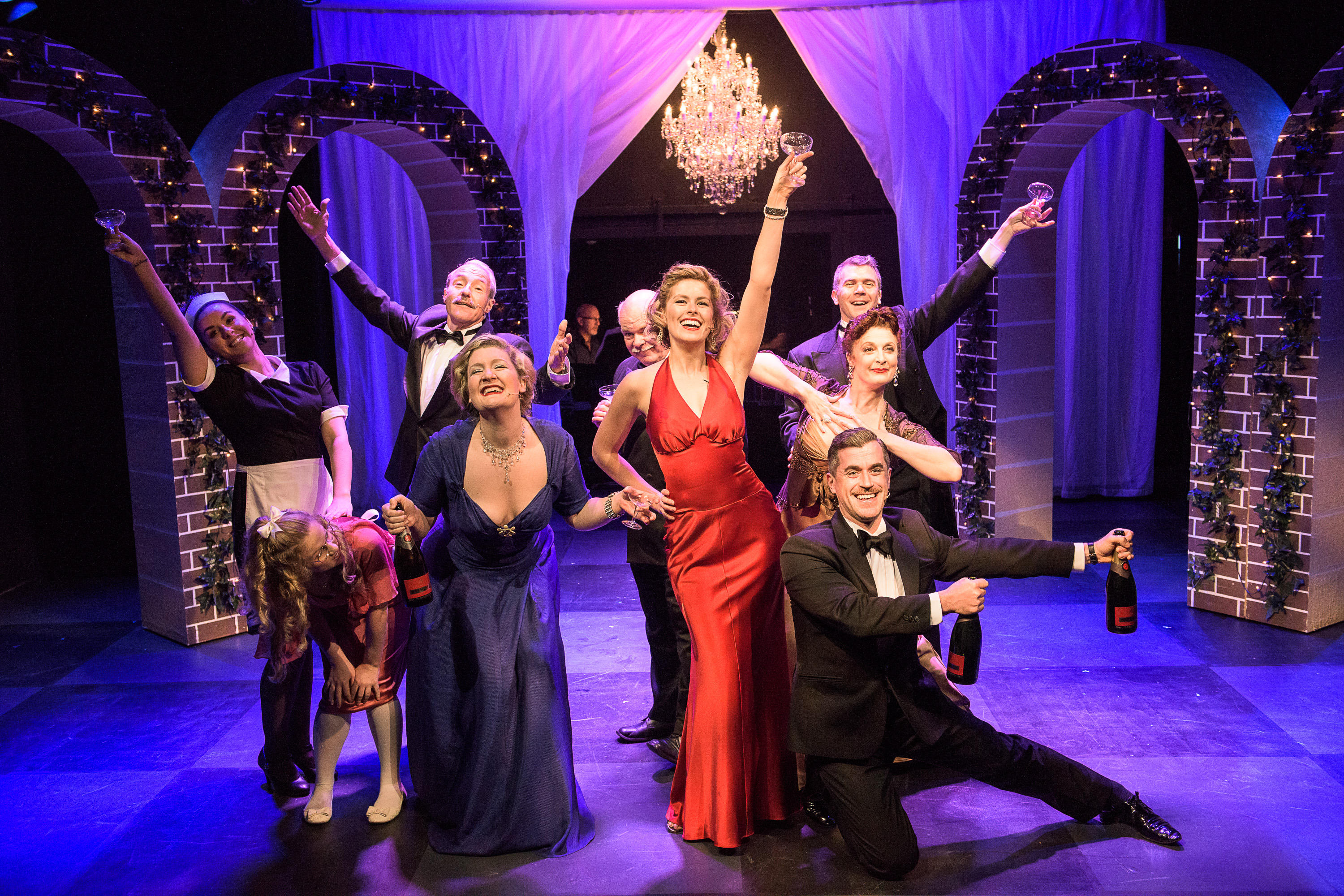
Amy Lehpamer and the cast of High Society. Photo: Kurt Sneddon

Amy Lehpamer, sizzling in red, and the cast of High Society. Photo: Kurt Sneddon

High Society is set in the palatial home of rich socialites complete with swimming pool: quite a challenge in a 111-seat theatre.

But, true to form, the Hayes Theatre Co production solves it ingeniously. Set designer Lauren Peters has come up with four elegant, moveable arches and a clever reveal for the party scene. Lucetta Stapleton’s 1930s costuming, a few props and some sound effects (Jeremy Silver) are enough to complete the picture, along with Gavan Swift’s lighting.

The 1998 stage musical is based on the 1956 film High Society starring Grace Kelly, Bing Crosby and Frank Sinatra and Philip Barry’s 1939 play The Philadelphia Story. It has a very funny script by Arthur Kopit and songs by Cole Porter, some of which were in the movie, such as Who Wants to Be a Millionaire?, Well, Did you Evah! and True Love, along with others of his that weren’t. Not all the lyrics relate as well as they might to the situation but overall it works a treat.

It’s the eve of Tracy Lord’s wedding to the rather pompous, dull George Kittredge. However, her younger sister Dinah is determined that Tracy remarry her first husband CK Dexter Haven, who turns up unexpectedly with a pair of reporters from Spy Magazine, Mike Connor and Liz Imbrie.

Helen Dallimore directs with a sure, light touch, telling the story with great clarity, while Cameron Mitchell’s choreography suits the period. In another ingenious touch, Dallimore uses a quartet led by musical director Daryl Wallis whose jazzy arrangements of the score work brilliantly.

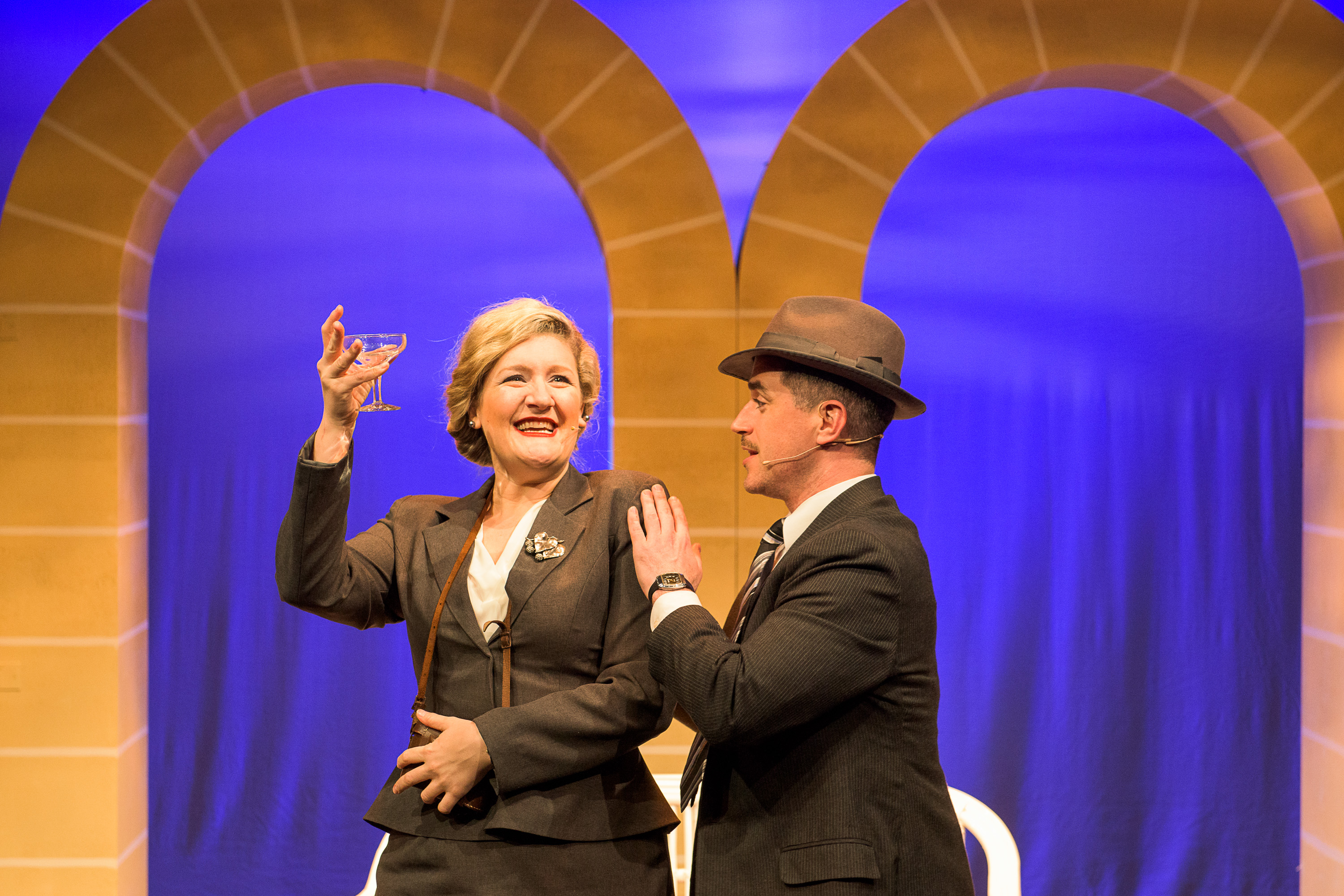
Virginia Gay and Bobby Fox. Photo: Kurt Sneddon

Virginia Gay and Bobby Fox. Photo: Kurt Sneddon

Amy Lehpamer positively glows as Tracy: glamorous, tough and very funny when drunk, her singing, acting and dancing all perfectly pitched. Virginia Gay is sensational as Liz, who is quietly in love with Mike. Her comic timing is impeccable, her performance is full of delicious, surprising little details (the way she hesitates to articulate the word ‘you’ when singing “All I want is you” in Who Wants to Be a Millionaire? just one of many) and she knows exactly how to deliver the songs.

Bobby Fox convincingly conveys Mike’s gradual softening as he falls for Tracy in a charismatic performance, while Bert LaBonté is an understated, rather melancholic Dexter whose charm grows on you.

Along the rest of the exceptionally strong cast, there are well judged comic performance from Scott Irwin as George, Jessica Whitfield as Dinah and Laurence Coy as the lecherous uncle Willy, while Delia Hannah is lovely as Tracy’s mother. All in all, divine.

High Society plays at the Hayes Theatre Co until October 3. Bookings: www.hayestheatre.com.au or 02 8065 7337

 A version of this review ran in the Sunday Telegraph on September 13

The Aliens

Old Fitz Theatre, August 28

Jeremy Waters, James Bell and Ben Wood. Photo: Rupert Reid

Jeremy Waters, James Bell and Ben Wood. Photo: Rupert Reid

Annie Baker is an award-winning 34-year old American playwright with a growing reputation. Her gentle three-hander The Aliens, which premiered off-Broadway in 2010, shows why.

It’s set in small-town Vermont, where a couple of fringe-dwelling slackers in their 30s – Jasper (Jeremy Waters) and KJ (Ben Wood) – pass the days in the grungy backyard of a café.

Passionate about the poetry of Charles Bukowski and smarting from having been dropped by his girlfriend, Jasper smokes broodily and is writing a novel. KJ, meanwhile, nurses a deep well of sadness beneath the bravado and isn’t doing much beyond whiling away the hours with his best mate.

The backyard is off-limits to customers but when Evan (James Bell), a shy high school student who works at the café, tentatively asks them to leave, it’s clear they’re going nowhere. Instead they decide to take him under their wing and a touching relationship between the three begins to form.

The Aliens is a deceptively simple play, which creeps up on you. Not a great deal actually happens, but there is plenty bubbling away beneath the surface as Baker deals with love, death, art and the ties that bind.

She never spells things out but subtly reveals more and more about the characters through their sporadic conversations. The silences, the things left unsaid and things mentioned in passing but not elucidated upon all gradually build to offer an incredibly moving insight into three social misfits.

Directing for Outhouse Theatre, Craig Baldwin helms a wonderfully sensitive production. Hugh O’Connor’s set perfectly captures the feel of the grungy backyard right down to the weeds poking through the concrete, while the actors inhabit the characters so truthfully it hardly feels like acting at all.

The Aliens plays at the Old Fitz Theatre, Woolloomooloo until September 19. Bookings: www.oldfitztheatre.com

A version of this review ran in the Sunday Telegraph on September 6

Bull

Old Fitz Theatre, September 5

Philippe Klaus, George Kemp and Romy Bartz. Photo: Geoff Sirmai

Philippe Klaus, George Kemp and Romy Bartz. Photo: Geoff Sirmai

Bull, by British playwright Mike Bartlett, is considered a companion piece to his much-admired play Cock about a love triangle between two men and a woman, which also had a production at the Old Fitz earlier this year (see review on the blog).

Bull is a less subtle play. Running a tight 55-minutes, it is a savage black comedy about bullying, going straight for the jugular from the opening moments.

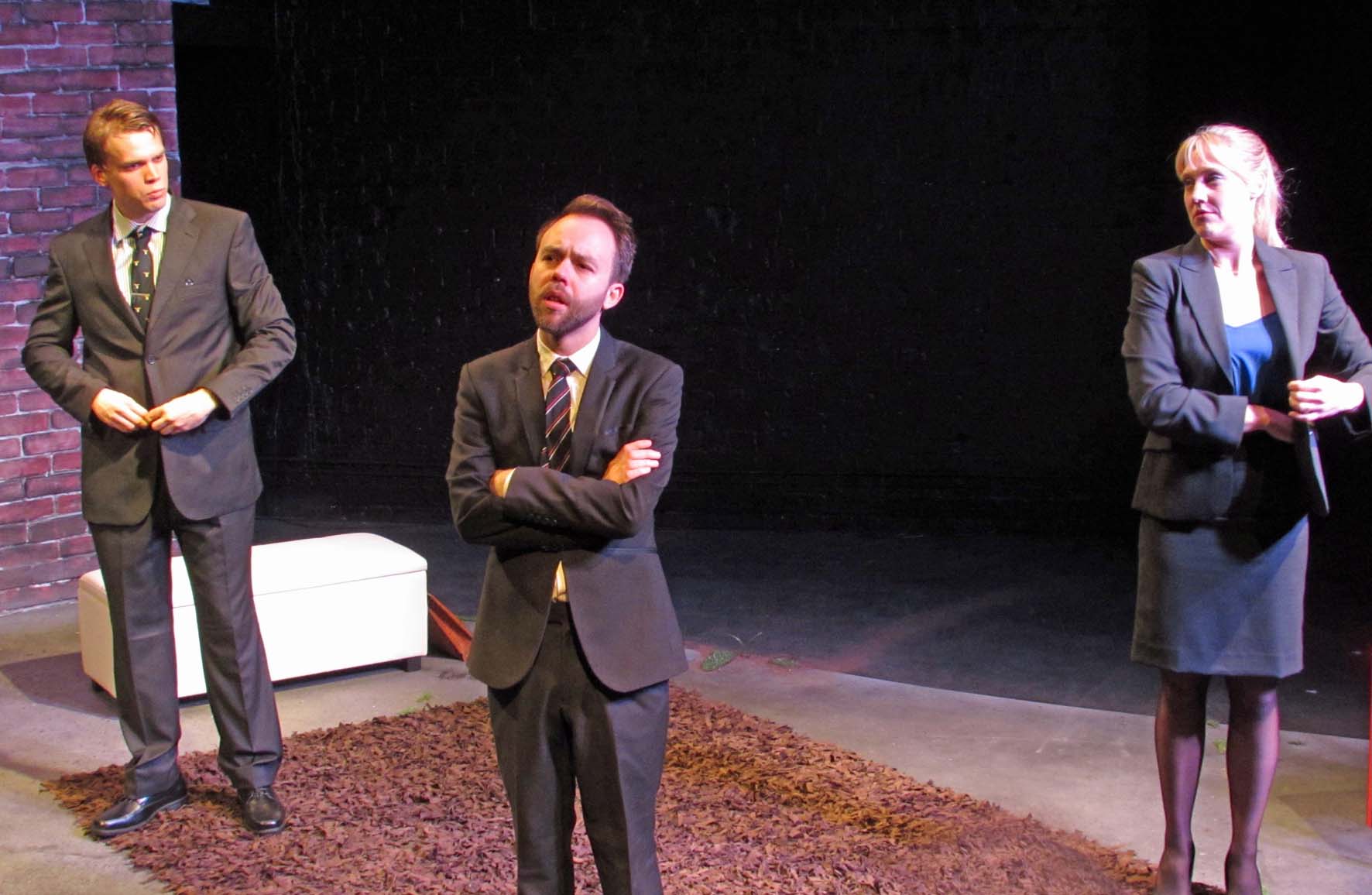
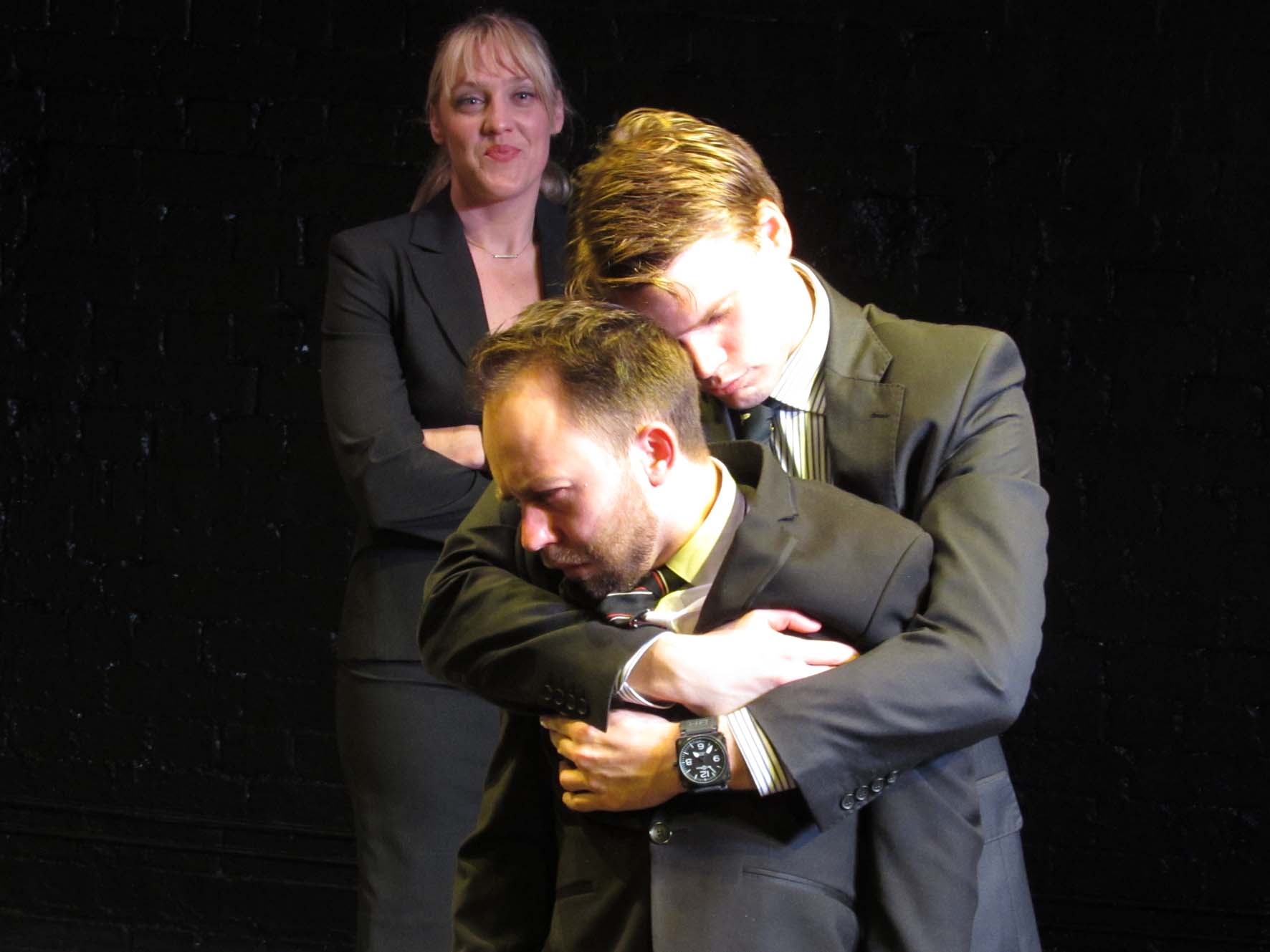
Set in a London office, three young employees – Isobel (Romy Bartz), Tony (Philippe Klaus) and Thomas (George Kemp) – are waiting for an interview with their boss (Craig Ashley), knowing that one of them is to lose their job due to cost cutting.

The steely, power-dressed Isobel and more laid-back but equally manipulative Tony are determined that it won’t be them, working together to ritually humiliate and undermine Thomas. It’s the law of the jungle and though Thomas tries to fight back, he’s no match for them. He’s one of life’s loner-losers no matter how much he tries not to be.

The verbal viciousness is breath-taking at times, the outcome mercilessly inevitable.

Directing the play for Ronaissance Production in association with Red Line Productions, Rowan Greaves has the actors go full-bore from the start. The play might perhaps have built tension had they played cat-and-mouse a little more initially, pretending some semblance of nicety before they go in for the kill. Instead, the play feels like a full-on assault.

George Kemp, Philippe Klaus and Romy Bartz. Photo: Geoff Sirmai

George Kemp, Philippe Klaus and Romy Bartz. Photo: Geoff Sirmai

The actors are all terrific. Bartz is chillingly cold and utterly remorseless as the main aggressor Isobel, staring at Thomas with withering condescension. As the private school educated Tony, Klaus is the good cop to her bad cop, less obviously aggressive but just as ruthlessly nasty in a slightly more insidious way, performing with an arrogant insouciance.

Kemp is also excellent as the hapless, floundering Thomas, his body language reflecting his growing desperation, as he is gradually undone.

In London, the play was performed in a boxing ring. Here, given that it’s a late-night production, it is staged on the set of The Aliens – but really very little is needed in the way of props or staging with the focus on the verbal cut-and-thrust.

Bull is a short, sharp, brutal play and though it isn’t as fascinating or thought-provoking a drama as Cock it’s still packs a punch.

One of Britain’s leading contemporary playwrights, Bartlett won the 2015 Olivier Award for Best New Play for his epic drama King Charles III, which comes to Sydney next year as part of the Sydney Theatre Company’s 2016 season. And it’s the original Almeida Theatre production from London that we’ll see, arriving here direct from Broadway. In the interim, it’s worth catching Bull as a little taster of Bartlett’s considerable way with words.

Bull plays at the Old Fitz Theatre, Woolloomooloo until September 12. Bookings: http://www.oldfitz.com/bull

The Tempest

Playhouse, Sydney Opera House, August 21

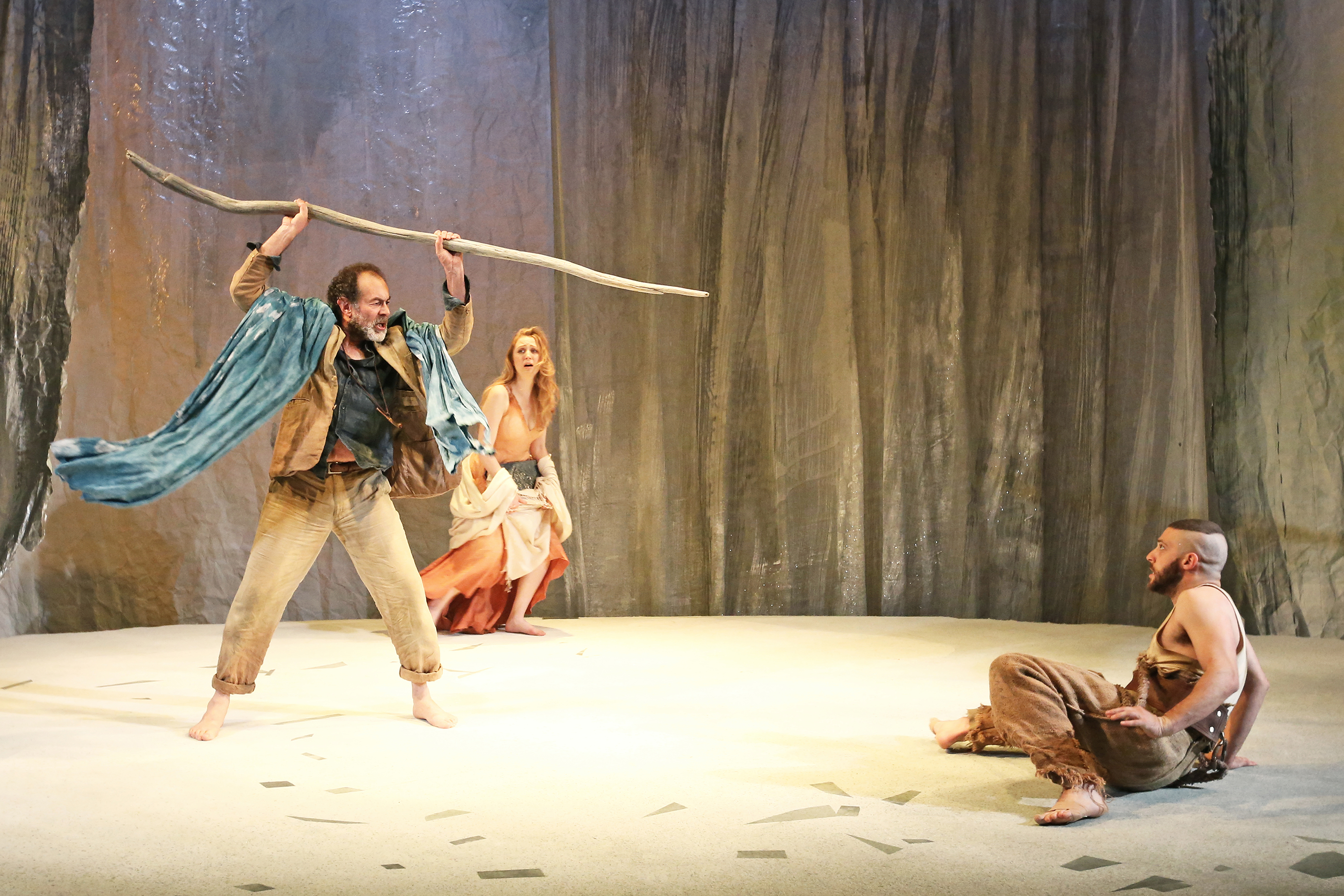
Brian Lipson, Eloise Winestock and Damien Strouthos. Photo: Prudence Upton

Brian Lipson, Eloise Winestock and Damien Strouthos. Photo: Prudence Upton

The symbolism may have been unconscious as John Bell insists, but he couldn’t have chosen a more apt play than The Tempest as his final production for Bell Shakespeare, the company he founded 25 years ago.

Thought to be Shakespeare’s last full-length play, Prospero’s final renunciation of his “rough magic” has been seen as the Bard’s farewell to the stage. This enchanting production is a perfect farewell for Bell too.

Bell doesn’t overlay any political interpretation but directs the romantic tale of forgiveness and reconciliation with an eloquent simplicity and a deft lightness, helming a production in which all the elements cohere in delightful fashion.

The opening storm conjured by Prospero to bring his former foes to the magical isle, where he has been living for the past 12 years with his daughter Miranda, is dramatically staged with wind machines, billowing drapes, operatic music and strobe lighting as the actors cling to a thick rope to represent the lurching ship.

As the winds abate, Julie Lynch’s minimal set (a disc-like platform backed by silvery-grey drapes) together with her costumes create the perfect setting for Bell’s lyrical vision, enhanced by Damien Cooper’s lighting, Alan John’s music and Nate Edmondson’s sound.

Brian Lipson’s Prospero is discovered sitting cross-legged on the stage meditating as we enter the theatre. His portrayal is less an avenging, autocratic sorcerer and more a world-weary, slightly absent-minded, emotional man with a wry manner, a fierce love for his daughter and a great deal of humanity.

Eloise Winestock plays Miranda with a touch of untamed animal about her, as well as wide-eyed delight when she sees other people for the first time, while Felix Gentle is a sweet-natured Ferdinand.

Matthew Backer and Brian Lipson. Photo: Prudence Upton

Matthew Backer and Brian Lipson. Photo: Prudence Upton

Matthew Backer’s spellbinding portrayal of Ariel makes the spirit’s desperate longing for freedom palpable. His tippy-toe physicality gives him an otherworldly quality and the way his movement echoes the mortals when he leads them with his magic is a lovely touch. In fact, movement director Scott Witt has done a superb job throughout. Backer’s clear-voiced singing also helps evoke the magic in the air.

Damien Strouthos’s Caliban is less brutish than often portrayed, making his famous speech about the noises of the isle all the more believable. Arky Michael and Hazem Shammas are genuinely funny as the comic servants Trinculo and Stephano, while also doubling effectively as Antonio and Sebastian. Robert Alexander as the kindly, dignified Gonzalo and Maeliosa Stafford as King Alonso complete the fine cast.

“Let you indulgence set me free,” says Prospero to the audience in the epilogue.

The words resonated beyond the play on opening night as the audience stood and turned to face John Bell sitting in the audience, offering him applause not just for the production but for his great achievements at Bell Shakespeare.

The Tempest plays at the Sydney Opera House Playhouse until September 18. Bookings: www.sydneyoperahouse.com or 02 9250 7777

 A version of this review ran in the Sunday Telegraph on August 30

The Book Club; Mothers and Sons

The Ensemble Theatre currently has two plays running in repertory: Roger Hall’s The Book Club and Terrence McNally’s Mothers and Sons.

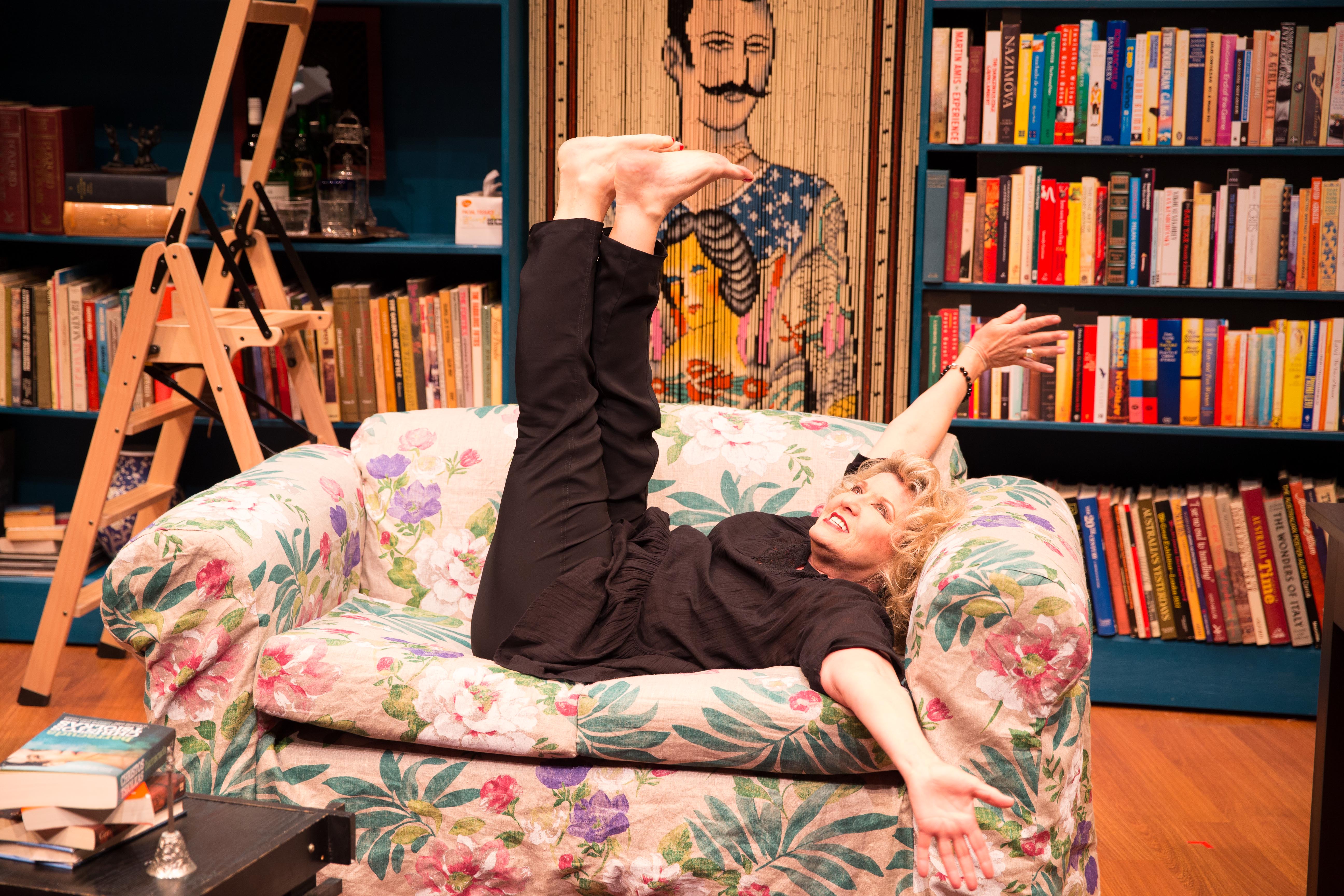
Amanda Muggleton in The Book Club. Photo: Thomas Blunt

Amanda Muggleton in The Book Club. Photo: Thomas Blunt

Amanda Muggleton is in her element in The Book Club, giving a big, warm, generous, comic performance that has the audiences in the palm of her hand and frequently in stitches.

The 1999 one-woman play by British-born New Zealand playwright Roger Hall was first adapted by Rodney Fisher for Muggleton in 2008. Fisher has updated it again for this season with more recent references to books including Christos Tsiolkas’s Barracuda and Geraldine Brooks’s March. He has also cut the script back so that it now runs 100 minutes without interval.

Muggleton plays Deborah, an upper-middle-class Sydney housewife with too much time on her hands. Her daughters have left home and she has little in common with her sports-obsessed lawyer husband Wally, currently training for a marathon.

Realising she’s bored, a friend invites her to join a book group. When it’s her turn to host, Deb invites local author Michael (quite how she manages it is never explained, but no matter) who spices her life up in a way she had previously only fantasised about with Martin Amis.

Narrating the show directly to the audience, Muggleton plays Deborah and all the women in the book club – kindly Welshwoman Millie, snobbish Eastern suburbs socialite Meredith, sweet pregnant Caroline, Swiss PR executive Steffi who never reads more than the first chapter, and so on. She also plays Wally and Michael, morphing easily between all the different characters and accents.

Muggleton gives an exuberant, joyous, energetic performance that has her literally bouncing around the stage at times. Her warm interactions with the audience are quick smart, picking up on any reaction. On opening night, an elderly gent fell asleep in the front row, which she seized on for some gentle ribbing.

Directed by Fisher, who also designed the set, The Book Club is a lightweight entertainment but given such a consummate, gorgeous performance by Muggleton it’s a complete delight. The opening audience loved her and leapt to their feet – an unusual accolade at the Ensemble.

Mothers and Sons

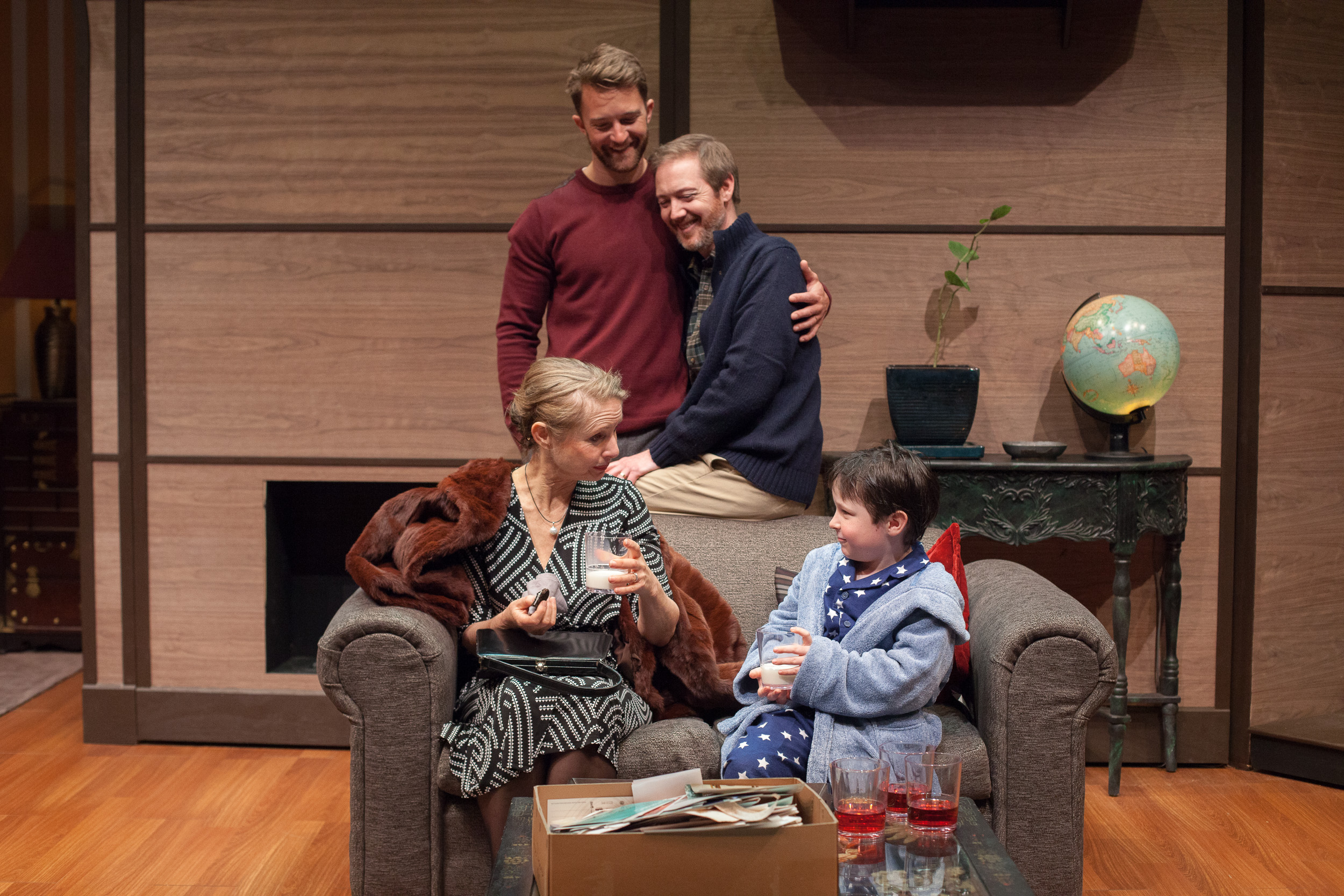
Anne Tenney, Tim Draxl, Jason Langley and Thomas Fisher in Mothers and Sons. Photo: Clare Hawley

Anne Tenney, Tim Draxl, Jason Langley and Thomas Fisher in Mothers and Sons. Photo: Clare Hawley

Terrence McNally’s 2014 Broadway play Mothers and Sons canvasses the losses and gains for America’s gay community since the AIDS epidemic including same-sex marriage and gay parenting.

The play begins with two people gazing rather awkwardly out of the window of a smart New York apartment: Cal (Jason Langley) and Katharine (Anne Tenney) who, it transpires is the mother of Andre, a promising actor and Cal’s former lover who died 19 years ago of AIDS.

Quite why Katharine has decided to make an appearance now is not clear, but she is one embittered woman. Having barely seen Andre after he came out, she has never been able to deal with his death and is still in denial about his sexuality informing Cal that: “Andre wasn’t gay when he came to New York. He came to New York to be an actor.”

Cal meanwhile has moved on. He is now married to the younger Will (Tim Draxl) who he met eight years after Andre died and they have a six-year old son Bud (Thomas Fisher/Connor Burke).

Mothers and Sons is one of those plays that feels a little too overtly like a staged debate, written so that the playwright can air issues close to his heart and needing discussion. Though beautifully played by Langley, Cal is too nice a character in some ways (it’s hard to believe he is a ruthless money-maker as he supposedly is, working in some vaguely defined financial role) so he never really lets rip but remains reasonable and polite in the face of Katharine’s homophobic remarks. As a result, the emotional stakes don’t feel high enough and there is little dramatic tension. This is compounded by the gentle pace of Sandra Bates’s production, much of which unfolds at the same level.

The device of having Will and Cal alternatively go off-stage to oversee Bud’s (very long) bath, also feels rather clunky.

Still, it’s a bold choice for the Ensemble and certainly tunes into issues that are very much in the zeitgeist at the moment, putting a human face to debates such as same-sex marriage.

Running 90-minutes, Mothers and Sons is well staged and well performed. It’s an enjoyable night of theatre, though it doesn’t have quite the emotional and dramatic impact that it might.

Mothers and Sons runs until September 27 and The Book Club runs until October 3, with performances at various times. Bookings: www.ensemble.com.au or 02 9929 0644

Seventeen

Belvoir St Theatre, August 5

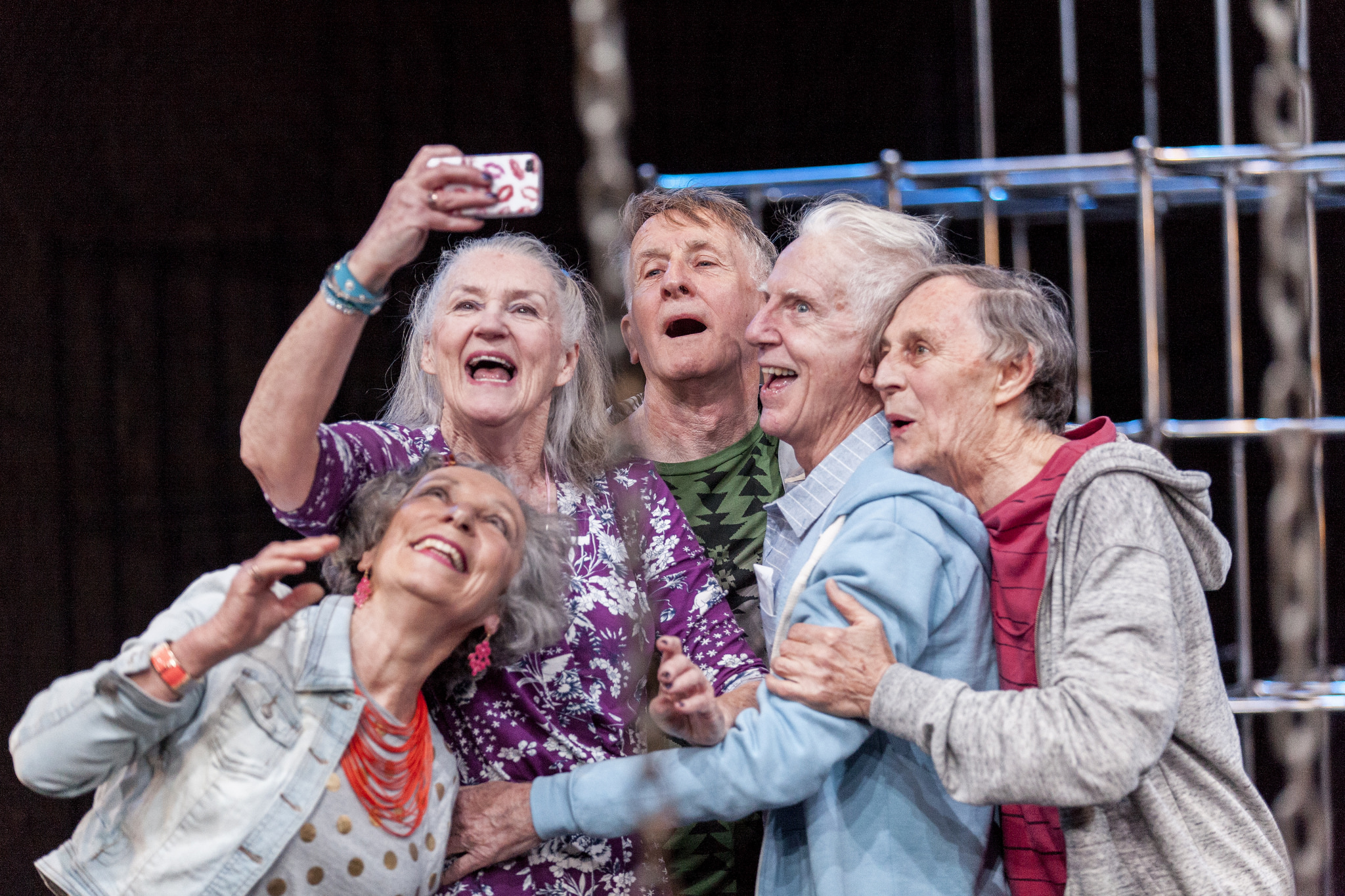
Anna Volska, Maggie Dence, John Gaden, Peter Carroll and Barry Otto. Photo: Brett Boardman

Anna Volska, Maggie Dence, John Gaden, Peter Carroll and Barry Otto. Photo: Brett Boardman

Sure, it could easily have been another song in the event but it’s quite a moment when the veteran cast of Seventeen dances to Taylor Swift’s Shake It Off. Famously, it nearly didn’t happen. When rights to the song were denied at the last minute, director Anne-Louise Sarks took to Twitter. The campaign went viral with Swift tweeting her permission, gifting the production invaluable publicity.

Written by Matthew Whittet, Seventeen is a very sweet play. On the last day of high school, a small group of friends gather in the park to party the night away before they all go their separate ways and life changes forever. As they drink too much, dance and play truth and dare, anxieties, fears and secrets bubble to the surface.

It could be performed by young people but Whittet wrote it for 70-year olds, adding another level of poignancy to his examination of those uncertain years on the cusp of adulthood when you ponder who you are and what you hope to become.

And so we have a cast of esteemed older actors in the roles. There’s the loud, pushy ringleader Mike (John Gaden), his quieter, more sensitive best mate Tom (Peter Carroll) who is heading interstate to Melbourne University, Mike’s pretty, popular girlfriend Sue (Maggie Dence) and Sue’s brainy friend Edwina (Anna Volska) who rarely lets her hair down.

Joining them are the uninvited Ronny (Barry Otto), the weird, misfit kid that no-one likes, and Mike’s 14-year old sister Lizzy (played by the younger Genevieve Lemon) who won’t go home no matter how much they tell her to piss off.

The company spent time during rehearsals with some 17-year olds to get back in touch with a teenager’s energy, physicality and way of talking – and they all do a great job. Carroll and Gaden, in particular, climb the playground equipment and get their groove on with the ease and exuberance of people decades younger (movement by Scott Witt).

There are a few clunky moments as Whittet sends characters off stage to allow others to remain alone, which feel a bit engineered, but overall Sarks’ production is nicely staged on Robert Cousins’ playground set, with very clever costuming by Mel Page.

The performances are exceptional. After initial laughter at seeing septuagenarians larking around, saying “fucktard” and dancing to contemporary pop songs, we accept the convention as the actors draw us into the character’s emotional dilemmas.

There are lovely moments for all the characters, while Otto’s portrayal of the sad, alienated Ronny is heartbreaking.

The characters can’t believe how quickly their high school years have flown. Young people will doubtless relate to that, but Seventeen will probably speak loudest to people whose teenage years are long in the past and for whom the passing of time and sense of nostalgia will strike even more of a chord.

Whittet writes with love, tenderness and a gentle optimism. He doesn’t tell us what happens to the characters – which would arguably make for an even stronger play – but he leaves us hoping against hope that things will turn out well for all of them.

Seventeen runs until September 13. Bookings: www.belvoir.com.au or 02 9699 3444

 A version of this review ran in the Sunday Telegraph on August 9

The Present

Roslyn Packer Theatre, August 8

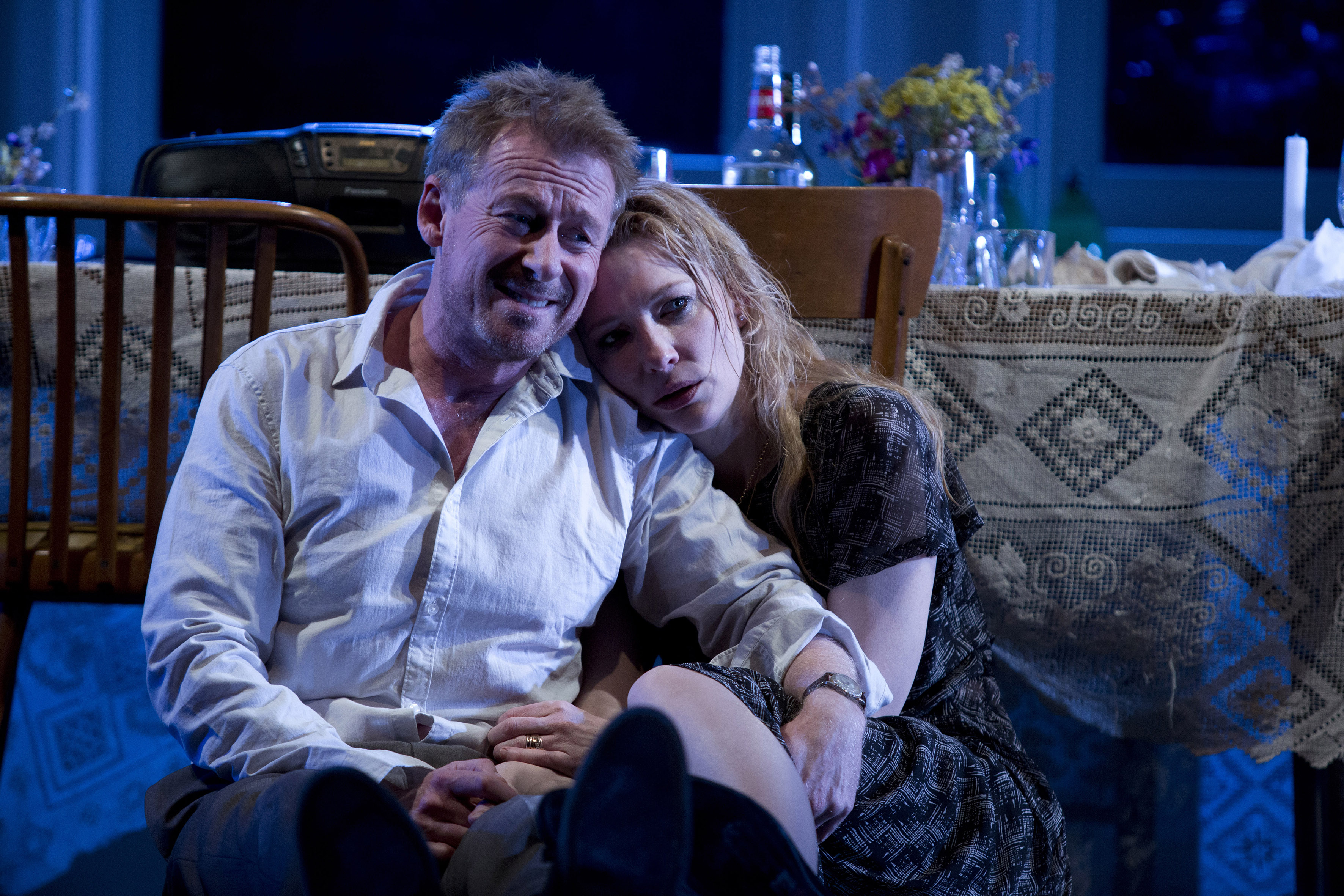
Richard Roxburgh and Cate Blanchett in The Present. Photo: Lisa Tomasetti

Richard Roxburgh and Cate Blanchett in The Present. Photo: Lisa Tomasetti

Chekhov famously said that if there’s a gun on stage, then eventually it must be used. In his latest Chekhov adaptation, The Present, Andrew Upton wastes no time, starting the tragicomedy with a bang.

In fact, Upton has the characters pull the trigger several times before the play’s dramatic conclusion – just some of the fireworks, emotional and literal, that punctuate and power this blisteringly brilliant Sydney Theatre Company production.

Upton has adapted a number of classic Russian plays with considerable success – Chekhov’s Uncle Vanya and The Cherry Orchard, Maxim Gorky’s Philistines and Children of the Sun, and Mikhail Bulgakov’s The White Guard – but The Present is arguably his best yet.

Written around 1878, Chekhov’s sprawling, untitled first play – often called Platonov after its central character – would run around five hours in its original form but Upton has condensed it to a gripping three hours including interval.

He has updated the action from pre-revolutionary Russia to the mid-1990s, post-Perestroika, another period of great change and disillusionment. Instead of the main protagonists being 20-something as Chekhov had them, they are in their 40s, intensifying their feelings of yearning, regret and frustration.

The play is set in the country house of Anna Petrovna (Cate Blanchett), the widow of an older, powerful General, where a group of friends and acquaintances gather to celebrate her 40th birthday. Among them are local doctor Nikolai (Toby Schmitz), Anna’s stepson, the slightly nerdy, awkward Sergei (Chris Ryan) and his brittle new wife Sophia (Jacqueline McKenzie), a doctor who has recently returned from working overseas.

Anna has also invited two powerful landowners (David Downer and Martin Jacobs) hoping one of them might marry her, securing her land and fortune.

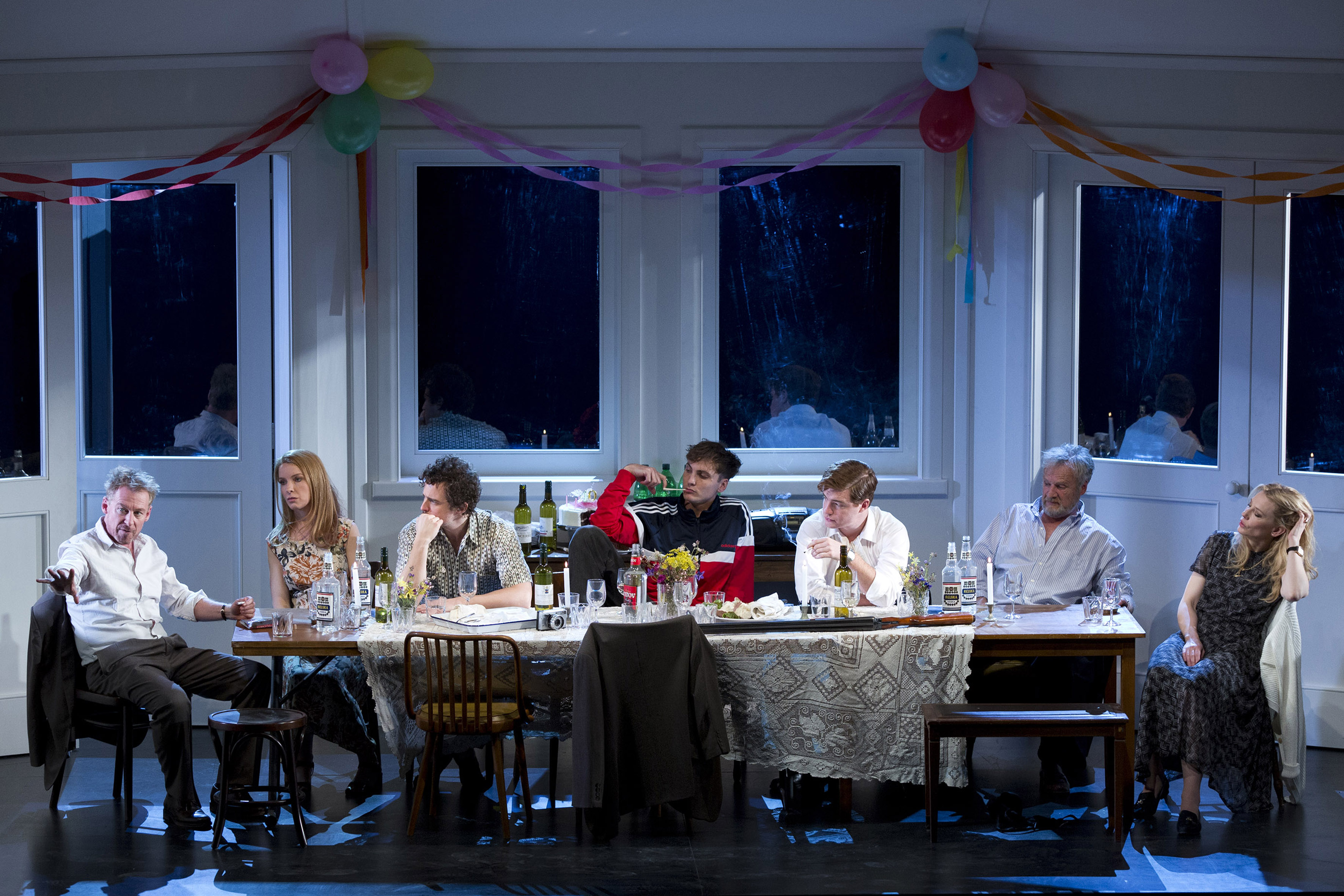
Richard Roxburgh, Jacqueline McKenzie, Chris Ryan, Eamon Farren, Brandon McClelland, Martin Jacobs and Cate Blanchett. Photo: Lisa Tomasetti

Richard Roxburgh, Jacqueline McKenzie, Chris Ryan, Eamon Farren, Brandon McClelland, Martin Jacobs and Cate Blanchett. Photo: Lisa Tomasetti

At the heart of the play is Mikhail Platonov (Richard Roxburgh), who has not fulfilled his brilliant promise as a young intellectual and is now a womanising schoolteacher.

Mikhail brings his sweet but gauche wife (Susan Prior) and baby son. However, his roving eye soon alights on Sophia, a former flame, and Nikolai’s gorgeous girlfriend Maria (Anna Bamford) – though it’s clear his heart belongs to Anna.

Irish director John Crowley helms a superbly paced production on Alice Babidge’s impressive, almost-naturalistic set, which moves from a verandah outside the dacha to a small balloon-festooned summerhouse to a night scene in swirling mist, and back to the dacha for the morning after, this time inside. It’s brilliantly lit by Nick Schlieper with a powerful sound design by Stefan Gregory who uses music by The Clash and Joy Division’s Love Will Tear Us Apart to punctuate scenes.

Together Upton, Crowley and the magnificent cast nail the Chekhovian balance between laughter and tears as the characters struggle to deal with life in the here-and-now.

The first of the four acts is a slow burn as the guests arrive. Tensions and animosities simmer beneath the desultory chat, with conversations cutting across each other, all of which is performed with a convincingly spontaneous feel. Then, in the aftermath of lunch, the play suddenly explodes into shattering life.

Roxburgh gives one of the performances of his career as Mikhail, capturing his wit and charisma but also his world-weary vulnerability and self-loathing. Blanchett is equally virtuosic as Anna, moving from bored containment to drunken abandon. Both draw on deep, uninhibited emotional reserves and the chemistry between them is electric.

But it’s a genuine ensemble piece with superb performances from the entire 13-strong cast (which also includes Eamon Farren, Brandon McClelland and Andrew Buchanan). As Upton prepares to leave STC at the end of the year, The Present is a thrilling parting gift.

The Present plays at the Roslyn Packer Theatre until September 19. It is sold out but $20 Suncorp tickets are released at 9am each Tuesday for performances during the following week. They are available online at http://www.sydneytheatre.com.au in person or by calling 02 9250 1929.

A version of this review ran in the Sunday Telegraph on August 16

Matilda The Musical

Lyric Theatre, August 20

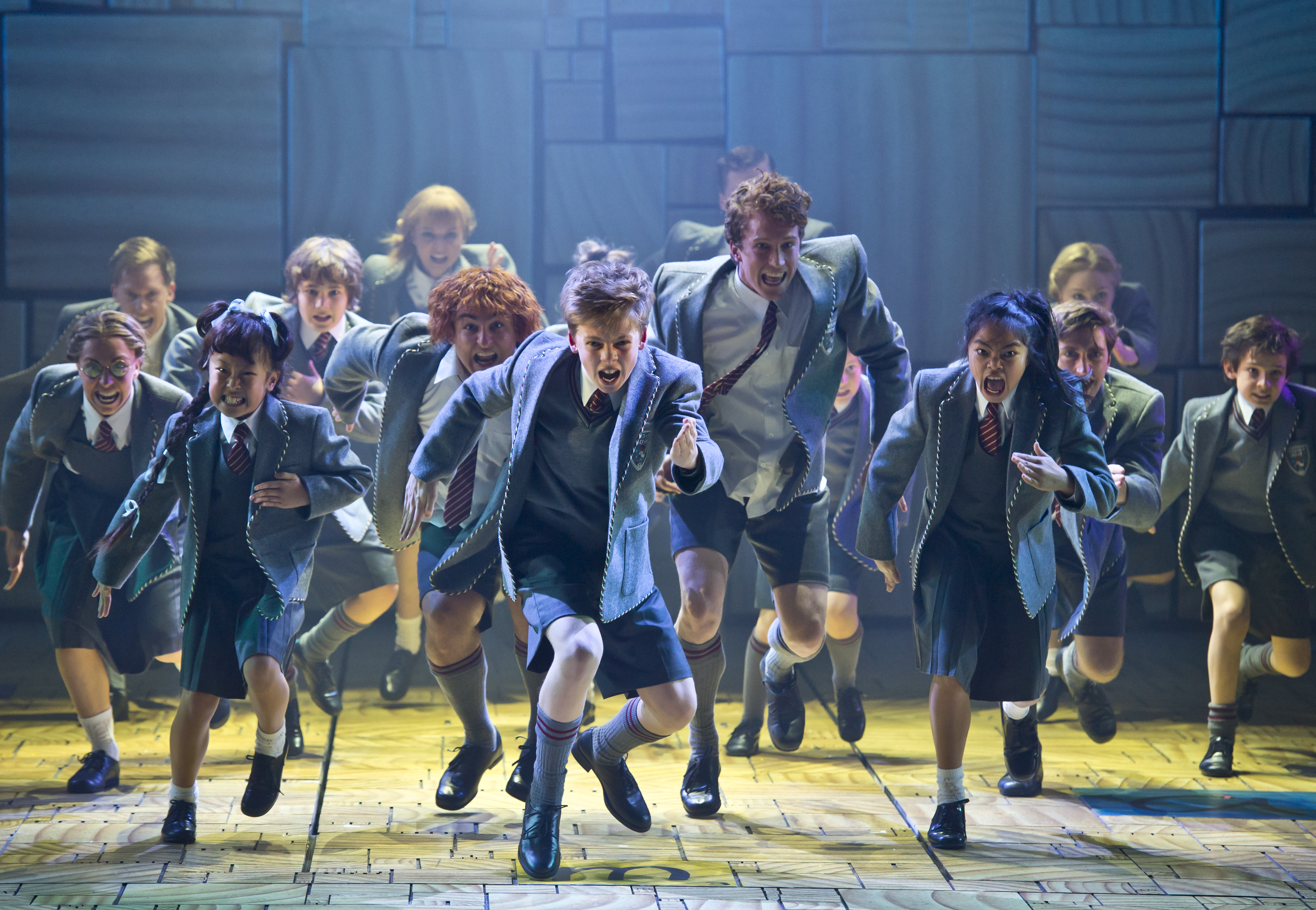
Matilda's "revolting children". Photo: James Morgan

Matilda’s “revolting children”. Photo: James Morgan

Her philistine parents consider her “a jumped-up little germ” and “a good case for population control”. To her monstrous headmistress Miss Trunchbull she’s “a maggot” like all children.

But a brave, book-loving, five-year old genius called Matilda Wormwood has been winning the hearts and minds of musical theatre audiences in London, New York and beyond, not to mention rave reviews and umpteen awards.

Based on Roald Dahl’s book, the hotly anticipated Royal Shakespeare Company production of Matilda The Musical, which premiered in 2010, has finally arrived in Sydney, triumphantly weaving such a powerful spell it has us rejoicing with its “revolting children”.

Written by Dennis Kelly (book) and Tim Minchin (music and lyrics), Matilda is one of the most thrilling new musicals of recent years: a show that isn’t afraid to be dark, sophisticated or smart, while at the same time pulsing with a gloriously funny streak of child-like, anarchic naughtiness.

There is a perfect synthesis between Kelly’s book and Minchin’s lyrics, both brilliant, which share a similar cheeky irreverence and wickedly clever wit but which also touch the heart without becoming sentimental.

The opening number, Miracle, instantly illustrates how wonderfully well Kelly and Minchin have been able to work together, setting the show up perfectly. Not only do we have Dahl’s tart observation about how most parents think their own children are little angels but a flashback to Matilda’s birth and a quick summation of her less than rosy situation. Interwoven through one song, it’s a very clever opening.

Celebrating the joy and solace of books as well as the power of words and the imagination, Kelly has added a new narrative strand to the show in which Matilda tells a story about an escapologist and an acrobat.

This beautifully staged tale (which uses dolls and shadow puppetry as well as actors) proves magically prophetic, filling out Miss Honey’s story and revealing Matilda’s yearning for loving parents without spelling it out.

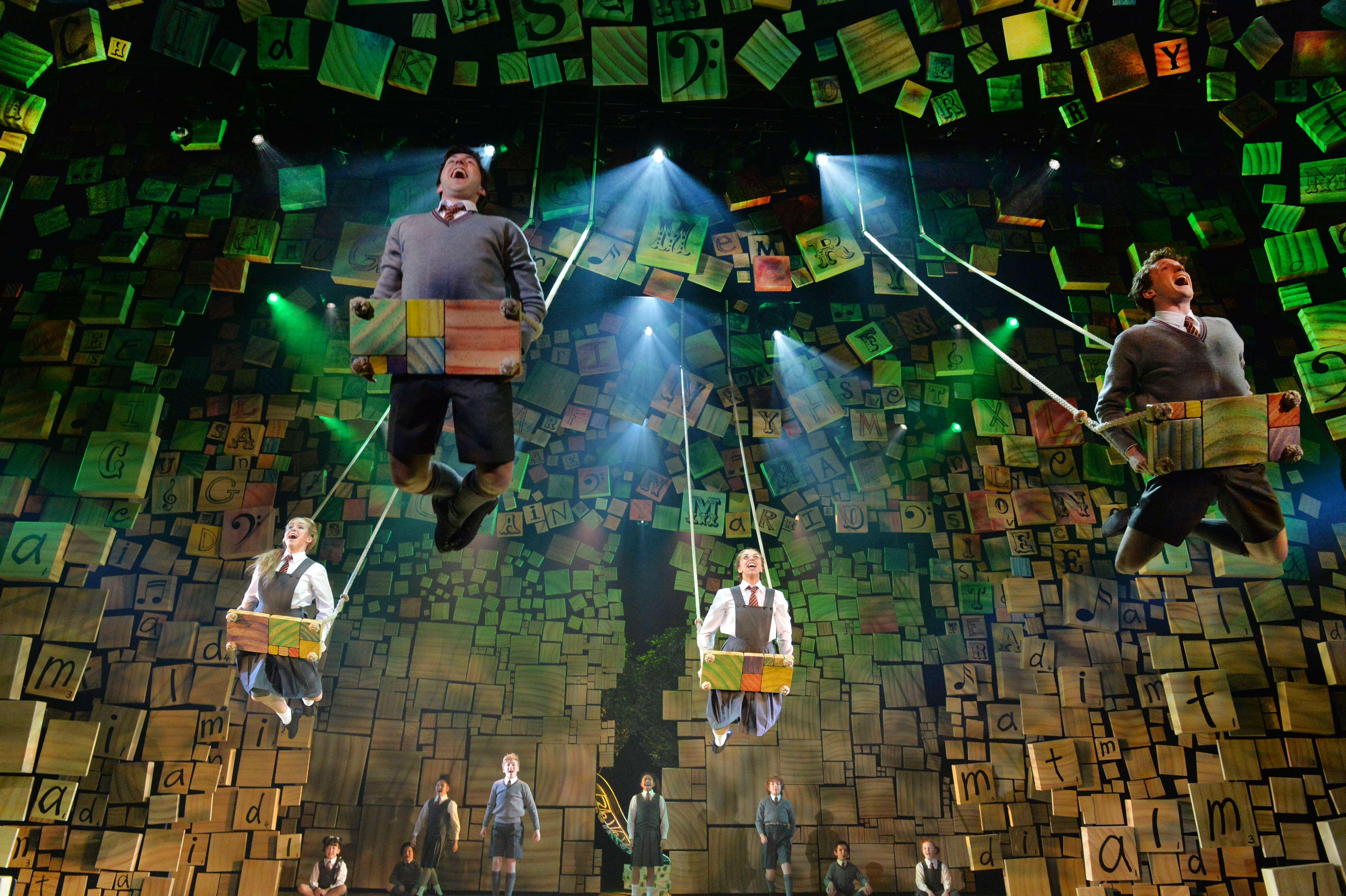
Minchin’s charmingly offbeat, catchy songs are refreshingly different to so many of the pop scores we hear in contemporary musical theatre. Highlights include the bittersweet “When I Grow” in which the children sail out over the audience on swings, the uplifting, bolshie “Revolting Children” and the moving ballad “My House”, exquisitely sung by Elise McCann.

"When I Grow Up". Photo: James Morgan

“When I Grow Up”. Photo: James Morgan

Matthew Warchus’s superlative production (staged here by associate director Nik Ashton) is a total delight. Rob Howell’s ingenious design integrates alphabet tiles and building blocks throughout the set. He has a wonderful way with colour, contrasting the garishly bright home and costumes of the Wormwoods with the forbidding grey of the school, while the drag costume he gives Miss Trunchbull with hunched shoulders and pendulous bosom is both terrifying and a hoot.

Peter Darling’s energetic choreography, which draws on kickboxing and karate, has the spot-on feel of kids stomping in the playground. His routine for School Song – in which two school boys (played here by adults) leap around in fleet-footed fashion up and down the school gate as alphabet blocks are pushed into place through the metal grille – is breathtaking. The kids powering downstage during “Revolting Children” is exhilarating.

The show makes huge demands on its child actors, particularly the young girl playing Matilda. Bella Thomas (aged 11) who starred on opening night (in a role she shares with Molly Barwick, Sasha Rose and Georgia Taplin) is extraordinary, giving Matilda a touchingly solemn yet feisty, determined demeanour. Her singing voice, meanwhile, is strong, true and clear.

Bella Thomas as Matilda singing "Quiet". Photo: James Morgan

Bella Thomas as Matilda singing “Quiet”. Photo: James Morgan

But all the children are great, as are the adult cast. James Millar is sensational as the dreaded Miss Trunchbull, deploying an alarming bosom and killer comic timing to perfection. He marries an almost psychopathic stillness with sudden, throwaway jauntiness in a way that is both hilarious and frightening.

Elisa McCann is radiant as Matilda’s kind, put-upon teacher Miss Honey, Daniel Frederiksen and Marika Aubrey are very funny as Matilda’s appalling parents and Cle Morgan exudes oodles of exuberant warmth as the librarian Mrs Phelps.

Appealing to both adults and children, Matilda is a gem of a show with a wonderful heart and message about standing up to bullies and fighting for what is right. It’s also a love letter to joy of words. Pure magic.

Matilda The Musical is now playing at Sydney’s Lyric Theatre. Bookings: www.ticketmaster.com.au

A version of this review ran in the Sunday Telegraph on August 23